Assassin’s Creed Valhalla

The announcement came out yesterday.  The setting isn’t surprising, nor is the timing of the launch.


I am perhaps getting too old for this sort of stuff. Cinematic trailers for near yearly IP releases do not cause any rise.  Having played Origins and Odyssey, I have a darn good idea what the game will look like visually.  Horses, boats, large battles, sneaking, eagle view points.  More or less a reskin.

Where this breaks is in the actual location – Britain.  Origins was in Egypt, so there wasn’t much boat work, aside from rafts.  Odyssey was an archipelago, the large ship was a key piece of the content.  Now when you think Vikings, you think shore raids.  Boats are certainly part of it, but not in the ship to ship combat, simply as a means of transportation.  I’m curious as to how this model, and the projected base building, gets implemented.

I’ve always found the AC games focused on the nomad/explorer type.  You never stick around anywhere for long, what with all the assassinations you’re doing.  You’re a small part of a hidden faction in a larger setting.  AC3 broke that a bit, but the revenge was from inside the larger setting.  Here, it appears that you’re the invading forces which is a new twist.  You’re not set up against a bad Viking, you’re a Viking going against the king of Britain.

One of the cool bits from the last 2 AC games was the supernatural aspects. Both Egypt and Greece have mystic lore coming out of every pore. Britain in the 10-12th century didn’t really have this.  Druids maybe?  Haunted castles?  Sea creatures (Loch Ness is northern Scotland… not sure that’s in scope).  Maybe it will just be epic 1v1 battles against beefed up Brits.  Most likely it will be the Norse gods, there’s ample material there.

The last few AC games have been quite good, so I’m cautiously optimistic that this one will continue that trend.  Plus, it would be neat to dual wield shields.


Frostpunk

I picked up this game a while ago based on Syncaine’s recommendation / praise.  I played about 2 hours, couldn’t make heads or tails of the systems, and moved to something else.  I knew that it was a mash of crisis simulator / city builder, and what better time to play that than now!?

Premise is simple – its the 1800’s, the world is frozen over, and you’re leading a small group on rebuilding a single city.  Steampunk + extreme cold = wordplay.  The actual gameplay is a spreadsheet manager, where your pivot table keeps messing up.  But it looks pretty.

Where normal city builders have you starting small, and the only real chance at failure is a lack of funds, Frostpunk has you in a continual downward spiral of not having enough resources.   While doing A, B suffers and vice versa.  You end up doing a bit of A, moving to B before it gets critical, then back to A before that gets critical.  When you think you have a handle on it, the game throws in something to mix it up.  Either it gets so cold no one can work, a bunch of injured people show up, the population demands resources, or a long list of other items.

Resources are managed through an underlying source of heat.  The generator in the middle of the map provides heat for those nearby, and humans can’t work if it’s too cold.  There are many ways to improve this – either more heaters, hubs, insulation, overdrives.  They all consume coal, which you need to harvest.  Building / research material is a combination of wood and steel, also things to harvest.  Food you need to hunt (and a TON of it), then cook it.  You need people to do all of this, and you rarely have enough of them.

One add-on here is automatons. These robots can replace humans gathers, work 24/7, and don’t need heat.  Making them requires a core, which is a very rare resource.  If you get enough of them, and the right buildings, you can basically huddle down the humans permanently.

These things are painful, yes, but they are not game breaking.  If 90% of your population died, that wouldn’t be game over.  Instead there are two larger metrics – Hope and Discontent.  The former is how people feel about their chances of success, and there are a ton of variable to make it move.  Discontent is how upset people are with the current state – too cold, not enough food, bad laws, criminals and the like.  If Hope reaches 0 or Discontent reaches max, you lose.

Every in-game 18 hours, you can pass a new law.  Either these are Adaptation laws (thin the food, make children work, bury the dead) which have very long term consequences, or they are Faith / Order laws which primarily govern Hope / Discontent.  This part gets neat, and quickly.  You may think you are a good leader, and would try to help everyone.  But when you don’t have enoguh food for half the population and a group of 30 show up at your door… do you have everyone starve to death?  Do you make people work a 24 hour shift so that there’s heat for everyone through the night?  Do you triage the sick, so that only those with a strong chance survive and the rest pass?

Or maybe discontent is so high that you need to pass laws on protestors, and publicly execute someone.  Maybe you become a prophet for the city and simply avoid discontent altogether, as anyone who doesn’t follow you is exiled.  Are there bad choices when it comes to survival?

So that’s the real goal of the game – letting you try your hand at managing a non-stop crisis.
ss_28db92509d505c855b07d480d749119fc147c84c.1920x1080

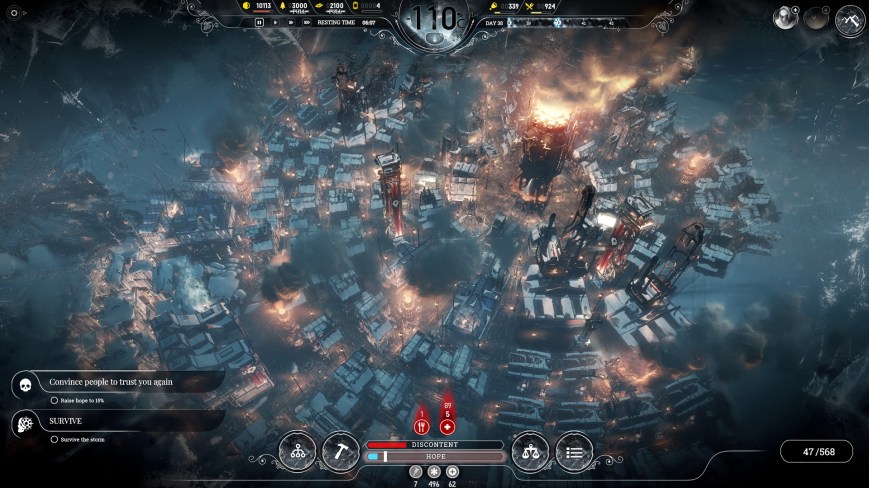
The gameplay itself is generally solid.  The graphics represent the activities going on, people picking up wood, or heading out to hunt.  You get heat and religion overlays.  You get to see where people are working.  You’re presented with generally enough data to show what’s going on at any given point.  What you don’t see are the things that are about to happen.  If you’re in the day, maybe that part of the city is warm enough, but at night it will freeze the bones of someone.  Maybe half the people in a building are sick, dropping productivity.  And when people get sick, that has a cascade effect on others… production slows, other people get sick, and then woosh.

The game does a decent job at explaining what a Law will do, in the immediate sense, but doesn’t really go into the long term effects.  Child daycare may seem a great idea, but then you realize they eat all your food, live in the least insulated buildings, and don’t produce anything – ever.  Like a near permanent hole in the dam.

The game also doesn’t do a very good job explaining what the buildings do, or how it impacts the long term city viability.  Hunting huts never require heat, but you’d never know until you turned heat off for them.  Cooking huts require TONS of heat.  Mines can be rotated before building to make them much more accessible.  Roads… holy crap it took me forever to realize how to build them.  What’s the difference between a Coal Mine and a Coal Thumper?  Is a Wall Drill better than a Sawmill?  How does exploration work?

It is hard to articulate how important these items matter.  If you’re going into this cold (heh), you can’t make educated decisions.  You will fail, multiple times.  The initial 3 days have cascading effects for the rest of the game.  Passing laws before you need them has by far the largest of all consequences.  Ignoring research + related buildings focuses your resources on much better things.  Building “permanent” hot zones for residents, and working “hot zones” for gathers has a major impact on coal management.

From a gameplay perspective, it is incredibly frustrating not to have that balance ahead of time, or the information at hand.  From a simulation perspective, it makes total sense.  People managing a crisis rarely have all the facts at hand.  You can only prepare so much for a crisis, and once it hits, you realize how everything is so interconnected.   You’re going to have protestors who are thinking about themselves rather than the city.  You’re going to see really hard decisions made, based on the goals of the person making those decisions.

My first successful playthrough (I failed a half dozen times before) had over 600 citizens, 1 death, laws focused on hope (extended shifts, child shelters, amputation, soup), and a faith-based hope system, without New Faith (where hope is replaced with devotion).  I won’t lie, the mechanics and planning required to get to this point where substantial.  At the end of the scenario (~12 hours), you get a video of your city building over time.  When it was over, I felt relief and some measure of pride.  I did it, the way I wanted to.

FF12 – Post Game

I guess it’s a Final Fantasy tradition that there are post game activities to complete.  Well, not in the sense that you complete them after the last boss, but more in that the last boss is considered easy mode to the post game stuff.

The Hunting system (it’s much more than a mini-game), adds challenges at every level from the first real battle on well past the final boss.  At nearly every occasion, if you can take down a hunt when its offered to you, that means the “regular story” combat is going to be very easy.

FF12’s final boss is targeted for the mid 50s.  You can do it earlier with a bit more planning (and items), or you can do it later and destroy the bugger in a few hits.  Levels make a very big difference in FF12, damage scales tremendously well.  In truth, I think this is FF’s easiest final boss.  You’re just dealing with damage, which is easy enough to mitigate.  Status effects… those are the things of nightmares.

FF12 adds status effects to increase difficulty.  The optional bosses all make liberal use of these to make life painful.  In order of most painful to least:

  • KO/Death
  • Inverse (swap HP with MP)
  • Disease (can’t heal)
  • Reverse (damage heals, and heals damage)
  • Reflect (enemies cast on you to heal themselves)
  • Stop (can’t move)
  • Confuse (hit others, likely killing them)
  • Sleep (wake up on damage, but healers dont normally get damaged)
  •  Silence (can’t heal)
  • Drain (removes all MP)
  •  Sap/Poison/Stone/Doom/Blind

FF staple the Marlboro has a habit of casting many of these in a single attack – as a regular enemy.  Thankfully they have low HP and with a (buffed) Remedy you can clear most of it in a single turn.  Bosses… that’s different.  Let’s start with Zodiark, the “final” esper.

Zodiark

Just getting to him in the Henne Mines means you’re in the mid 60s, as it’s the highest level zone in the game.  Zodiark uses Darkja, which deals a ton of dark damage (can 1 shot) and has a good chance to instant KO.  Losing all 3 team members in a shot should be expected.  If the entire team has dark absorbing gear, then he casts Darkja twice as often.  He also comes buffed with Reflect/Haste/Shell/Protect, which if you dispel he casts a damage immunity spell.  He avoids evasion (ignoring shields).  He casts AE (Scathe) at multiple targets for very high damage.  Gravija to drop team HP to 25%.

He’s a high group damage boss, with the ability to randomly KO the entire team.

Shadowseer

The penultimate hunt requires you to clear the bottom of Pharos.  Clearing that out is an exercise in frustration, as there are multiple enemies that can cast different status effects.  And it’s more than probable that even at max level, you’re going to have a squad wiped out if they can be inflicted by Stop/Disease/Silence.  That’s a good prep for the actual boss.

The actual boss takes all of that and dials it up to 11.  He summons previous 4 previous marks, all leveled up for the fight.  He himself goes immune to everything for 2 minutes.  And he’ll keep wailing on you (combos up to 11!) during the fight.

He has high damage group attacks, he dispels, he slows you, he prevents you from moving, he inflicts disease, he removes all your mana, and he casts invert.  The math on those last 2 are the worst.  He’ll remove all the mana from your entire squad, then invert 1 character’s HP/MP.  So you end up with 2 people with no mana, and one with no hit points – and primed to die due to a fart in the wind.  Doesn’t matter what level you are – you are going to die.

Hell Wyrm

A hidden boss that you need to clear for getting the Yiazmat hunt.  He’s the first boss you fight with multiple HP bars, since he has nearly 9m HP.  Shadowseer by comparison has 300k.

He’s more of a battle of attrition due to pure damage output and liberal use of Stop. Near the end, he uses Invert and the -ga spell series to do a really good job of wiping out your HP.  If your “tank” dies, there are pretty good odds that everyone else is going to die in 1-2 melee hits.

Yiazmat / Omega Mark XII

In the original release, due to damage cap (9,999) it took about 4 hours to kill Yiazmat due to his insane HP pool, and his random KO attack.  Omega Mark XII is just pure damage – killing a maxed out level 99 character in 2 hits.

The former requires significant planning in the damage dealing departments (TZA has no damage cap thankfully, so it’s only about 2 hours now), ideally  high combo character with a darkblade (his weakness), haste, and beserk.

The latter requires a sacrificial lamb + healer + someone who can chain cast Wither – a hard to find ability that reduces enemy attack power.  You need to get those attacks to under 1,000 damage total to have a chance to get through it.

Trial Mode

FF12 comes with a trial mode, where you’re in a gauntlet of battles against tougher foes, saving every 10 levels.  Stages 51-60 are in line with the regular game difficulty.  61-80 are tough hunts.  81-90 is the difficulty of Hell Wyrm.  91-100 includes (with no pauses between):

  • Magic Pot
  • Shadowseer
  • lvl99 Red Chochobo
  • Gilgamesh
  • Ultima
  • Abysteel
  • Zodiark
  • Yiazmat
  • Omega Mark XII
  • 5 level 99 judges (this is pretty much the equivalent of the Moroes fight of Karazan in WoW/TBC, where you need to take out a crazy group of enemies with deadly AI)

That was long

I didn’t expect this to be such a long post. It does go to show that FF12 put in some big efforts to have content outside the main story line to challenge players.  Without the Gambit system, each of these battles would have been insanely tedious start/stop to get the right actions going.  The game does a really kick butt job of throwing the kitchen sink at you AND giving you the tools to deal with it.  This game scratched a heck of an itch.


FF12 – Closing In

FF6 pushed a lot of exposition in their cutscenes.  With no voice overs, you were reading text and listening to MIDI tracks.  Still, if you’ve played that game, guaranteed you remember the Opera scene.  I’m of the strong opinion that SquareEnix (SE) has been chasing that specific moment since then.  The plates falling in Midgar in FF7.  The Black Mages falling from the sky in FF9.  The water scene with Tidus & Yuna in FF10.  They are not moments of story expedition – because there’s no text or words.

I’m nearing the end of FF12 and realizing that the nature of the game doesn’t really allow for this, outside of the overall bookmarks (intro and outro).  There are plenty of in-game engine scenes, trying to follow Ashe’s quest to follow a ghost prince (man, that sounds so FF when written out).  There are cinematic cutscenes, which generally provide an area context shot (like a really big skyship), since those models didn’t exist in the game engine. But to say there’s a defining moment, I can’t really say I’ve found one.

That’s not say there aren’t impressive moments in the game, cause there certainly are.  The skyship that blows up is neat.  The scenes before the last dungeon are wild.  The vignettes for the first time you entre each zone are solid.  Even the tougher hunts have some cool backstory (Gilgamesh is great).  I guess I’ve come to realize that FF12’s defining mark is that there are smaller peaks and troughs.

FFX was a 5 minute custscene, then 30 minutes of RNG battles, then a boss, then repeat.  It was like watching a movie, then grinding for a boss fight.  FF12 changed that because enemies were on-screen.  It wasn’t an exercise in frustration getting from A to B.  And by putting in the AI portion (gambits), it made the “regular” battles that occur seem like minor speed bumps.

And the bosses in FFX were gimmicky, which made sense given it was turn based combat.  If you had infinite time to think, then yeah, make good choices.  The Yunalesca battle is a damn good example. With a more active battle system, you have much less time to think, and the fights become more about being prepared at the start, then reacting accordingly in the fight.  Did SE get this right?  Hell no.  The initial release had a very early “exploit” that worked for 90% of the game.  Put on a specific belt, throw a specific item, and nearly every boss got neutered with every status ailment possible.  It also made skills available really early in the game, making you effectively gods by the 1/2 way mark. The TZA release made that belt unavailable for most of the game, that item require skill investment to use, and split up all skills across classes and the game.  Very well balanced, and the combat requires a whole lot more thinking.

The last bit here is the horizontal gameplay.  Most FF games keep their sidequests for the end, with the exception of a mini-game that’s introduced at the start (e.g. blitzball, tetra master).  The mini-game here is a set of hunts for difficult targets.  These targets require specific scenarios to even get them to spawn, then a good build & gear, and finally some quick thinking to get through the fight.  You usually end up with some decent gear by the end, a new subzone to explore, or a new summon.  It is an amazing system, providing a great challenge/reward system throughout, and reason to go back and explore zones.  The Bazaar is a weird system where you sell specific items to get access to other gear.  Hell, even figuring out how to find something like Gemsteel is a major pain. This one I really don’t like since you need a wiki to really use it properly, because you can’t tell what items give what rewards.  FF13 used a similar system, but it was more transparent about it. (More props to FF13 for the stagger system.)

I’m at the last dungeon now and this game is playing better than my memory recalls. The game manages to be continually engaging, both from a system and story perspective.  Rare that time is kind to a game that’s nearly 15 years old.

FF12 – Building a Tank

FF12’s license system brought a whole lot of flexibility to character creation while leveling.  The downside was that at max level, everyone had access to everything (similar to FFX), making it a mush of character development.  Zodiac Age instead limits every character to 2 jobs, creating meaningful choices.  A White Mage / Knight is great at close damage and healing, while a White Mage / Archer can pluck away from a distance.  There aren’t any bad jobs, just less optimal ones.  A high combo character is better suited to the Bushi class (ninja) since it comes with high combo weapons.

For 80% of the game, you can run pretty much any group combo you want as long as someone has access to Cure/Cura/Curaga.  10% is bosses, and with few exceptions, all are better served with a tank to take physical hits.  The last 10% are the hunts & espers, which after rank V absolutely require a tank.

FF12 has one of my favorite versions of a tank, the evasive tank (something I think Rift did best in the MMO world, though the WoW Monk is pretty close).  The concept is not so much in padding them with extra hit points as much as it’s about increasing their ability to simply avoid damage altogether.  A few hits will get through, but sparesely enoguh so that you can heal through them.

The Shikari job works best for this since it has access to the Main Gauche, a relatively low damage weapon with +34 to Evade.  There isn’t any other weapon remotely close to this.  The best shield you can buy only has +30.  There’s a +75 evasion shield through hunts later, as well as a +90 (though that comes with poison, sap, and slow).  So a clean evasive tank would max out around 83% physical evasion.

And yeah, there’s magic evasion too!  Considering that some of the largest attacks in the game are magical, this is super useful.  It maxes around 65%.  But you can only get the tank for that, and most magical attacks are group-wide.

So the tank is stat-ready.  Next is getting them spell ready.

FF12 has Lure, which is essentially a taunt spell that sticks to a character.  It also has Bubble, which doubles a characters hit points.  The duration of Lure isn’t all that long, and during the re-cast time the enemy can certainly swap targets.  So it’s not foolproof.

The evasive tank only starts being viable once you’ve unlocked all characters.  Then it shines like crazy for the rest of the game, and turns supernova against the toughest hunts.  Gilgamesh in particular.

The general idea is – get the tank ready and a 2nd character that has access to Curaga, Decoy and Bubble (see jobs from above).  The 3rd character is a high combo character with maxed damage.  You then purposefully put them into Beserk mode (they can only attack, but with higher damage) and just let the chainsaw effect go through.  This is pretty much the model every group-based RPG works under, but it’s the only FF where the tools are presented to players in such a clear fashion.

The best part of all this is that it’s entirely optional.  You can kill the last boss without ever having a tank.  It’s less optimal, but certainly feasible – my first run proved that! If you want to play the hard-mode stuff at later levels, then you need it.  That’s some good design balance.

Final Fantasies

By this point I’ve played all of them. Only 8 & 15 I have not completed, which gives you an idea where I rank them in the overall scheme.  I see the series more like generations of games, where the break in generations is a baby-meets-bathwater event.  And often, the first and last games per generation really do something special.

I see 1 through 6 as the early wave.  7 through 10 as the 3d wave.  And 12 through 15 as the AI wave.

Early Wave

The early wave was all about building a game with very limited resources.  Most people wouldn’t be able to play FF1 as it originally launched.  Hard to navigate, limited sprites, few saves, low forgiveness, and the annoying fact that you missed attacks if the enemy was dead.  It was remastered later on to add a lot of the more modern conveniences (like inventory management) as well as some extra content.  Solid.

FF6 took all those ideas and practically perfected them.  A massive roster of distinct characters with their own side quests.  Chocobos, summons, airships.  A musical score that still gets me going, and a storyline that was epic.

Each additional game in the early wave tried some different bits.  Group sizes, jobs (!), ATB vs turns, methods of leveling, and side quests.  They all had sprites.  Chocobos showed up.  The final battles were excruciatingly long.  Cid.  And each has been remastered/remade in the years since. You can play all of them on a cell phone.

3D Wave

I still remember popping in FF7 in a rented Playstation.  The intro cinematic just blew everything I knew of console games out of the water.  I’ve replayed it a dozen times at least, and each time it still feels like the first.  Sure, the character art required imagination and the translation was horrible, but the sheer scope of the game… wow.

8 brought in minigames.  9 was a throwback to 1-6 (and is one of my all-time favs), and 10 decided to bring in voice acting and a crazy stupid long end-game.  I am sure across the years I’ve broken the 1k hrs mark on FFX play time.  I can lightning dodge blindfolded.

AI Wave

Where the 3d wave changed how we saw the game, the AI wave changed how we played the game.  Gone was the concept of turns, and instead battle was active.  Computer power was good enough to always show enemies, so no more random battles.  Other player characters could be customized to act on their own, with a rudimentary (at first) AI system on behavior.  This optimization of gameplay meant that the difficulty spike went way up.  Enemy behavior became much more complex.

FF12 took the familiar steakpunk fantasy approach that worked wonders in previous settings.  The shift from FFX to FF12 was massive, and it’s only after years that people have come to appreciate what it did to the genre.  FF13 looked amazing, but its overall lack of complexity until the way end of the game makes it a rough one to recommend.  FF15 took the Ubisoft gameplay of open world minimap icons to another level, and a much more action oriented gameplay – kind of like Kingdom Hearts.  The story removed almost all fantasy elements, and was so poorly received that extra content was cancelled.

The MMOs

FF11 is pure eastern MMO, in line with Everquest’s need for group based combat and a super punishing death mechanic.  FF14 came back from a catastrophic launch to become the gold standard in western MMOs.  Nearly every issue that exists in WoW has been resolved in FF14.  I am of the opinion that the game is so refined, that it’s not possible for the genre to “grow” outside of it.

Overall Ranking

I said earlier that everyone has their personal ranking, and I’m no different.  And rather than rank on games at release, I’d rather rank on what you can get today.  Cause frankly, getting the original FF games is not going to happen.  So, from “worst”, to “best”.  No sequels.

  • FF8 – Both story and combat never clicked for me.
  • FF15 – Driving to pad time, and minimap quests were too much.
  • FF2 – Solid story, but the leveling mechanics were insane (had to use a skill to improve it)
  • FF5 – This one is hard to play since it feels like a beta for FF6.
  • FF13 – The “Press A” mechanic lasted WAY longer than it needed to.  The game is great once it opens up, but that’s after 8 hours of corridors.
  • FF3 – The job system and the Warrior of Light & Dark are in full force here.
  • FF4 – The story does it here and is the model for a lot of other games.  Cecil & Golbez make this work.  Trip to the moon too!
  • FF1 – The remake greatly polishes some rough ideas.
  • FF7 – When you leave Midgar and realize it’s effectively only a large dungeon…that’s when you realize what FF7 did to the genre.
  • FF9 – If you took the best parts of FF1 through 8 and put them in a single game.  It doesn’t innovate – it polishes.
  • FF6 – Kefka.  Ultros.  Shadow.  True character development and a polished system underneath.  The remake’s graphical adjustments are meh.
  • FF10 – The voice acting is really bad, and the story bittersweet.  Sphere grid and Blitzball are the standard which others are measured.
  • FF12 Zodiac Age – the bug fixes and job system dramatically improve an already amazing game.  Retrospective, the gambit system is an amazing development.

Boomtown and Batman

WB has a good problem on their hands.  They have the best action melee combat system on market.  Spider-man comes close, but it’s movement based rather than physical.

If you’ve ever played a Batman game, you know what I mean.  Rarely are fights ever 1:1, instead it’s Batman vs 5-10 different goons, with different abilities.  At easier difficulty levels, you can just use your fists and generally get through.  Harder difficulties really do turn you into a walking swiss army knife of combat options.  You’re shooting batarangs, rope pulls, stuns, air attacks, flash bombs and a slew of other options.  While there’s an ideal path for each enemy type, odds are you surrounded by multiple and just creating your own dance of death.

Even goons with guns can be taken down with the right tools.  The last game in the series went a bit overboard on that, as you can’t really take out an entire squad of armed foes with your hands.  Still, the model works and it’s extremely fulfilling.

Shadow of Mordor takes this up another notch, what with the possession skill.  Most fights are against 20+ enemies, and it’s really not possible to take them all down without turning the odds in your favor.  You end up just dodging all over the place, like you’re high on sugar pops.  Still taking down an army, effectively solo, is a heck of a feeling.  Throw in a boss (or 3) and it’s a great endorphin rush.

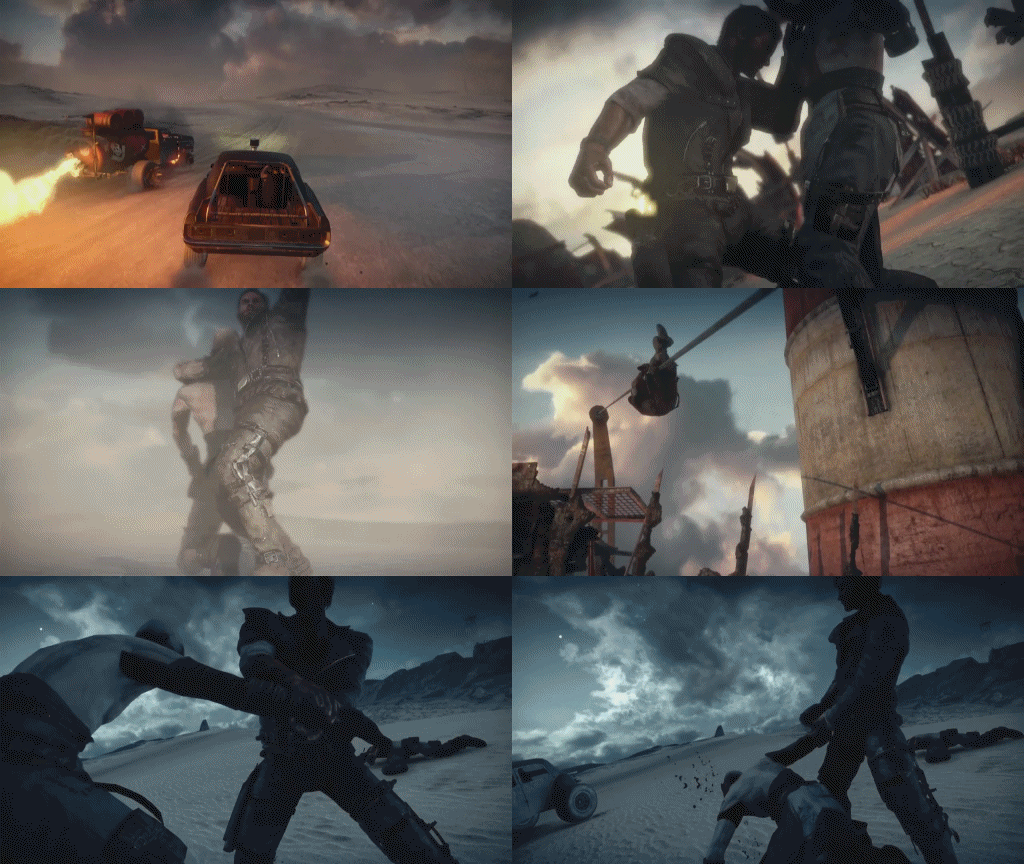
Which brings me to Mad Max.  Early fights start off with 3-5 goons.  Then you get people who run at you.  Then some with shields.  Then some with weapons.  Then PILES of enemies at once.  There’s a gradual increase of difficulty as you go through, and in nearly all cases, it is predicated on your use of the Parry and Dodge buttons.  Parry yellow, Dodge red.  You can “move cancel” almost everything but a killer blow (ironically), so that makes for some stream of combat.  But there’s really no movement involved here – you just wait for people to attack, and hope they are near a wall for what is the only “invincible” takedown that doesn’t require a consumable.

You don’t really get more tools (shiv, shotgun), but you do get some interesting skills to help offset the enemies.  You can reverse parry an attack, using the enemy’s weapon against them.  You can break shields.  You can quickly execute.  Almost all of them require you to play defensively.

It’s an interesting twist, and one that has some merit.  The Dark Souls model of opportunistic attacks is certainly sound.  Mad Max uses a different toolkit to push that concept, and for the most part, it works.


Mad Max

This one has been on my wishlist for a while now.  I heard some great things about it but I’d had enough open world games to play at the time.  I’m getting emails every day now about some game on sale, so I figured I’d get a deal and give it a go.

I am a fan of the film series.  That helps tremendously here, because the game makes next to no effort to explain the setting.  Not that we generally play these games for their story settings.  I’m not quite far in, but the bits and pieces that have been presented so far fit in really well with the world-as-seen-on-film.  Considering it came out around the time of the 4th film (which is frikkin’ amazing), the tie-in is obvious and probably in the top-3 I’ve ever played.

Open-world games walk a very tight line.  You want tons of things to do, but you want them to be meaningful.  Ubisoft put in character levels to help justify the crazy padding in the Assassin’s Creed series.  Mad Max has a lot of events, but it does a decent job in making them both varied and useful.  The base camps you’re clearing are all unique, peppered with some bosses.  There are secrets to find in each as well.  There are sniper nests / totems to take down, but they are mostly drive-bys and easy enough to manage.  The “discovery the world” points are hot air ballons, and rather than just push a button, you need to go through some minor (different) steps to get the balloon in the air.

The rough spots deal with scrap collection, which may or may not contain a piece of a useful recipe.  Means you only need to do a handful per mini-zone.  The absolute worst part is the minesweeping portion, which requires you to use a specific car and travel to the world without getting into any combat.

Given the setting, there’s a LOT of driving.  Thankfully it plays wonderfully.  Each vehicle plays differently, and your main ride has enough gizmos to make combat entertaining. There are some Death Races as well, which unlock different vehicles.  It’s ok to start, but really shines when you upgrade the ammo for your Shotgun and can take out enemies with ease.  The hunting of convoys is especially fun, as you need to take down 4-8 vehicles to get a hood ornament from the leader.  You end up doing a ton of laps around an area, using every advantage you can to survive.  Tons of fun.  It’s a really good travel system, making the world feel big without it feeling like it’s just big to impress.

Hand to hand combat is pretty much the Batman games, minus the crazy acrobatics.  So yeah, gold standard there.

giphy

All the various activities help restore a local stronghold which provides boosts to your gameplay.  Either free healing, ammo, scrap (money) collection, or similar.  They also reduce the area’s threat, which unlocks upgrades for your car.  And raising your Legend status (character level) unless character upgrades.  So there’s some value in completing them, as much there is in doing the actual activity.

The downsides here are all nitpicky.  The minesweeping portion is horrible as you can only use 1 car, which has no upgrades, and you need to manually find the minefields.  Dodge and jump are realistic, meaning they don’t really move you that much.  It’s jarring and takes a fair amount of adjustment.  Collecting scrap I tedious (hold A to collect) and takes a stronghold upgrade to collect from destroyed vehicles.  But I am nitpicking here (except minesweeping, ugh).

I’ve unlocked the 2nd area (I think there are 4), I guess that makes it about 20% or so saying “complete”.  So more thoughts as I dig deeper.  What I’ve seen so far, yeah, I can see why this game was on many top 10 lists in 2015.  Probably would be in top 10 lists in 2020 too.

Control – Foundation DLC

If you haven’t played Control yet, you should.  It’s a GotY caliber experience.  The first playthrough is a sensory experience, as the House is weird as all hell.  Figuring out how all the pieces fit together is awesome, and throwing stuff with telekenitic powers does not get old.  Clearing it all, I was really hoping for some DLC to expand on it all.

The Jukebox runs came out near the holidays.  Timed arena combat with some OK loot.  It was OK, but since loot isn’t exactly a driver in Control, there wasn’t a whole lot to replay through.  Foundation is a true DLC, expanding on the lore, the enemies, and the skill sets.

You need to have completed the main game to get into this content.  As much for the fact the story won’t make any sense if you don’t, as for the fact that the new enemies are quite difficult.  I died way more in this DLC than the main game.  Enemies have more HP, deal more damage, and are much more evasive.  More challenge is good, and it doesn’t feel cheap.

Two new skills, though they don’t have huge impacts on combat.  You can create stone, which is mostly for reaching new areas.  It can be used to create spikes, but the enemies have to be lured to the location.  You can also destroy stone, used to access new areas and crafting mats.  Used in combat, this can destroy floors, plummeting people to their death.  Which is a neat way to kill the final boss in 2 shots.

There are some additional levels to skills, just stat boosts.  Some new mods that tweak gameplay – I added a +hp when hitting with Launch.  That seems almost mandatory given the new combat difficulty.  Compared to the base game, you’re going to be using different weapon types more often.  The sniper and launcher modes are very useful now.  The SMG and shotgun are still useless.

control-the-foundation-review-1

It’s all 1 big zone, with 2 main environments to explore.  It’s more linear than the base game, and most of it is within tunnels.  They play with light/dark themes to add some stress to the game.  The TV sidequest in particular is done in pure darkness with a minor source of portable light.  The Film Camera sidequest is similar to the Ashtray maze, but due to the more precise platforming requirements, its a tad less fun than novel.

I won’t spoil the story.  The Board has issues, you get to read about how the House started, and some of the political bits.  I do wish there was more here though – Ash is a fascinating character.  It leaves enough breadcrumbs to sow some doubt as to how benevolent the Board is, which always struck me as odd in the base game.

The DLC as whole probably takes 4 hours to run though, side quests and all.  There’s 1 secret quest to collect some cat statues, and let me tell you that is one of the most obtuse puzzles I have ever seen.  One step is done in the complete dark – and I likely never would have found it without a reddit post.

The Foundation is a good DLC.  It’s more of Control, with a few minor tweaks.  It’s not an expansion.  I’d rather see a sequel than an expansion.  There are many veins that are present here.  For what it is, it works very well.  Highly recommended.

Darksiders Genesis

I’ve now played all the games in the Darksiders series, and I have to say it’s one of the more interesting ones out there.  The plot line deals with the 4 horsemen maintaining the balance between the forces of good and evil, with humans stuck somewhere in the middle.  Each game in the series emulates a particular genre, and focuses on a particular horseman.  For the most part, this works, but emulation is not replication.

The first game dealt with War and was in line with the Zelda series in terms of open world, unlocking skills, and world traversal.  It was the most puzzle focused of the series, and had the cleanest of plot lines.  Ironically, in terms of timelines, its the last one – setting the stage for all 4 horsemen to come out and play.

The second game dealt with Death and was a mashup of God of War’s combat with Diablo’s itemization.  Worked well enough, and the plot line really expanded on the world.

The third dealt with Fury and tried to be more like Dark Souls, but instead focused on parry attacks.  The world building was ok, Samael in particular was top notch, and the end scenario was unexpected given the character growth.  Looks amazing, but the gameplay got dry pretty quick.

Finally, the 4th game deals with Strife and is more in like with a twin-stick shooter (since Strife has guns).  Well, the game is actually a duo-game, since you can freely swap to War (melee focus) or play local coop.  There’s some exploring and puzzle work, and some backtracking if you want to unlock everything.  Even an arena mode to test your combat skills.

The only downside I have with this game is the locked in camera angle.  If you’ve played Diablo, you know that there are somethings that you simply cannot see due to the world geometry.  Which, fine in a 2D world (Diablo has no vertical portions).  Darksiders has a lot of vertical aspects, and some portions are really hard to figure out without trial and error.  Main game, no real issues.  Exploring the world, painful.  There’s one set of puzzles in the Void (SW portion) that requires accurate platform jumping and is so poorly executed that I’ve rarely been that frustrated.  We’re talking Tidus’ Chocobo Race in FFX levels of frustrating.  Thankfully, it only provides an achievement – entirely skippable.

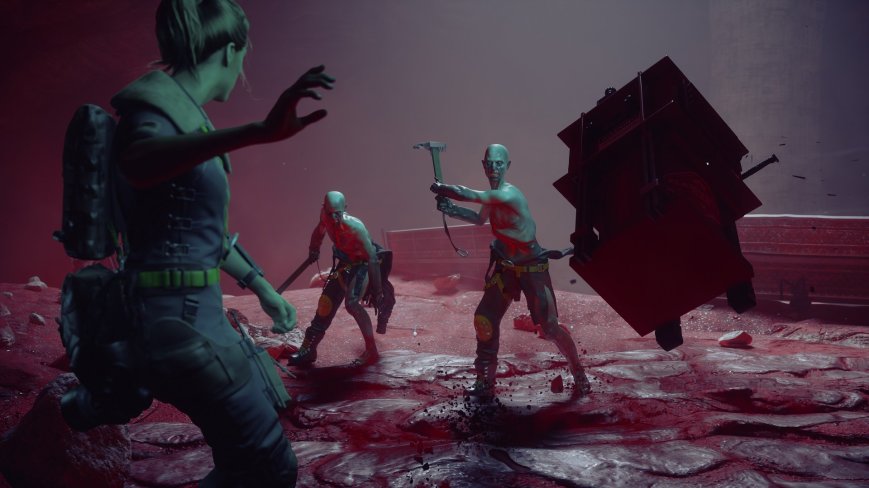
The story line isn’t very good – you’re basically chasing Lucifer and aided by Samael along the way,  but never get to see behind the curtain as to why.  Meh.  The combat makes up for it, as it can be a ton of fun to take out wide piles of various enemies with your skills.  A fully upgrade Strife is a walking death dealer – and the arena really shows that off.  The bosses all have some interesting mechanics, though often pad the length with spawns of trash to clear.  Knowing when to dodge/parry is key to survive.

dsg9

The really interesting bit here is the skill orb system.  Enemies have a chance of dropping a skill orb, and the more orbs you get, the higher their level (up to 3).  There are ok skills and amazing skills.  +3% to special attacks is meh, but having chain explosions upon death of an enemy is like setting fireworks.  There’s a slotting mechanism too, where you only get the level bonus of the orb based on the slot.  So a level 3 orb in a level 1 slot only gets level 1 bonus.  Further, slots have a type (attack/wrath/health) which when matched with the right orb provides a % bonus to that stat.  That makes an insane difference.

By the end of the game I had a few decent skills, then I decided to clear out the arena levels (20 + 1 infinite).  Clearing that ended up maxing out most of my orbs so that by the time I was at the infinite stage, I felt like a god.  I really enjoyed the min/maxing portion – it didn’t feel tedious.  It would be something entirely for Diablo 4 to emulate this system – with some further refinement it would bridge the gap between Path of Exile’s massive tree and D3’s simplistic slotting.

The Darksiders series has never been a AAA series, and I am just fine with that.  Genesis does a solid job and providing non-stop fun, and that’s all that matters in the end.