Pillars of Eternity 2 – pre Avowed

Avowed comes out in a week. The setting is shared with the Pillars of Eternity games, and I played the heck out of the first one. I enjoyed every aspect of that game, warts and all. There were small issues to solve and a very large and complicated lore setting that was gradually revealed. And honestly, the twist at the end really put the rest of the game into perspective.

Not really spoiling here, but the concept of fantasy games having active gods isn’t new. What was interesting was that these gods were not actually gods, but members of a precursor race that elevated themselves to godhood due to the lack of gods. There’s a good primer on this that was launched a few days ago.

PoE2 takes next steps from there, allowing you to import your decisions from the first game. And there are a lot of them, with meaningful impacts to the game. The story has a simple driver, a god takes physical form (a giant statue), steals part of your soul, and you need to chase them to reclaim it. Where there’s difference is in the factional warfare that you’re living with, which adds a more political / ethical structure to the game, with a ton of grey area between.

Mechanically, real-time combat with pause was a big change, where speed had a massive impact on outcomes of combat – turn-based was added later, which made some skills useless as a result. Classes were tweaked, with optional subclasses that had pros/cons attached – a min/maxer’s dream. Your home base is a ship that travels between islands, with crew, morale, food/water, equipment, and pirate battles as interesting content. The story, companions, skill checks, quests and so on are extensions from what was in the first game, and those work well.

I never completed PoE2 when it launched, but it’s been in my list of things for a long time. So I’m giving it a go now, and in the mindset to absorb more of the lore rather than the mechanical pieces. I’m honestly enjoying it more than prior attempts, the characters are more interesting and closer in terms of integration that was seen in Baldur’s Gate 2. From a practical perspective, it means there’s often a reason to backtrack to a previous area as more is available to discover, instead of simply moving from town hub to town hub.

It is, by nearly all measures, a great game. I honestly feel bad I didn’t give it a stronger go in the past.

I doubt very much I’ll be done my playthrough in time for Avowed, at least not in the way that I tend to play these games. I do however plan to buy Avowed on release, as that financial decision will have long-term impacts for Obsidian, a company that has an amazing track record in scratching my interminable itch. If they can maintain brain trust and not have layoffs, I think everyone wins.

Dragon Age Veilguard

I like Dragon Age. Clarifying statement… I like the Dragon Age setting. Dark fantasy is rather uncommon in the gaming space, and wasn’t really present outside of The Dark Crystal until Game of Thrones took off. I get that D&D had this locked down before, but I am specifically talking about dark fantasy at large. Where there are no real good guys.

Dragon Age as a gaming platform I have not enjoyed, excepting Origins. That game had a new story twist atop older mechanics which provided compensation for the misses. DA2 I tried for about an hour, and moved on – mechanically it was not for me and felt like a step back. DA:I had all the failures of an MMO framework, without the people. It had a few interesting characters, but still very frustrating to get through the mud in order to touch diamonds. I won’t bother talking about the tangent games…they were more like precursors to the main line versions.

Dragon Age Veilguard came at an interesting time. Bioware had lot the majority of its brain trust due to multiple missteps, including Anthem. Before Anthem, I would have bought the game without much though. After, I am not a fanboy to justify that and wanted to see where the cards lay. Reviews were ok and then it went on sale in the first month, both less than positive signs. To be clear again, this isn’t bad news it’s just not glowing.

EA CEO Andrew Wilson was kind enough to pipe in. DA:V ‘sold’ 1.5m copies, half of the target of 3m. Given the investment in promoting DA:V (I saw it everywhere), I can see how this would not have a terribly good ROI. DA:I may have sold like 12m copies. I would think than anything coming out of EA that took years to build would be seen as a failure when those numbers are shared.

Sidebar: Kingdom Come 2 sold 1m copies in a day. Manor Lords sold 2m copies in 3 weeks.

To point, Mr. Wilson mentioned that the core audience was in fact a success, but that the broader audience was not (akin to the magic 4 quadrants in movie media). To hit that other group of gamers, they should have applied live service components, which is where EA makes 75% of their money. I can’t see how a lockbox / gambling approach would have helped here, but I guess maybe cosmetics? Should DA have been a multiplayer game, which is functionally the only way live service games can work? I don’t see how the hero’s journey aspect of DA would have translated to that model.

And now that EA has fired (note: a minority have been moved) everyone who had any DA knowledge, the brand is all bud dead outside of fanfic. So I guess this is it. Hats off to those who did their best, unfortunately not enough for the $$$ overlords.

Which gets me into the next piece – Mass Effect 5. I honestly had to think about 4 for a while, then remembered Andromeda. BioWare is all hands on deck for the next instance, and it begs the question as to what goals they are trying to achieve here. If EA only wants live service games… well that’s certainly possible in the ME ecosystem. You could argue that pretty much every battle royale or competitive shooter could be reskinned to Mass Effect pretty easily. There are plenty of battles in those games… and bio powers are cool I guess. If they want to make an actual RPG, then I am not quite sure how you monetize that long-term. I’d guess that BioWare isn’t quite sure how to square that round peg either.

So here we are at the end of a long journey. Such a strange road. Far from the end of epic RPGs (BG3 is clear evidence, among others), but a cautionary tale of knowing what your clients want, as well as your bosses.

The Wait Is On

One of my (and I would gather many of your) coping mechanisms with *waves arms at everything around us* is gaming. For me, it’s a distraction that allows me to focus on something tangible, with relatively controlled outcomes. I can trace my actions to consequences, and my enjoyment is therefore mostly in my hands. Probably why factory automation games are so much fun, as you need to build up tons of small actions to get world-changing results…

I wouldn’t go so far to say I’m in a gaming drought, I still have a backlog to hit through (Lorelei is waiting for me). I’m popping through them methodically, and giving them each a chance to hook me. State of mind is a big deal, so not everything will work at any given time. I’ve still not been able to move beyond chapter 2 in Baldur’s Gate 3, and that feels like a slight on my gamer cred.

Of the upcoming games, the following have my interest:

  • Avowed. I have played every Obsidian game, rough edges at all. They know my soft spot I guess.
  • Monster Hunter Wilds. I’ve played a LOT of this series. For sure going to repeat here.
  • Ghost of Yotei. Ghost of Tsushima has an exceptional place in my psyche due to real world events, this one feels required as a result.
  • Outer Worlds 2. I’ve played this game to completion about 4 times. Another Obsidian game. The anti-capitalist bend here is like brain candy.
  • Fable. This one I’m curious as I played the xbox versions before. Curious as to how this will play out.
  • AC: Shadows. I have played nearly all the mainline games since the first one, and did enjoy the simplicity of Mirage. Given this one game is likely to make/break Ubisoft, feels like getting tickets to a backstage show.

That isn’t a terribly long list, but you’ll notice that none of them are games that are 10hrs or less in content. Further, these are the ones with tons of marketing behind them, and generally seen as AAA. Truthfully, I tend to keep an eye elsewhere for the indy gems that pop up with barely a squeak or a couple week’s notice. They tend to fill in all the gaps.

And right at this very instance, there’s a gap. Avowed is 2 weeks out. And Obsidian being Obsidian, there’s likely some kitchen sink / stabilization patches that will be needed too. MH: Wilds is end of month, and that one is likely to suck up time just as Factorio: Space Age did in the fall. Capcom has figured out the magic of patch cadence with this series, my expectation is content releases on a regular basis.

There’s some smaller studio stuff coming out too. Citizen Sleeper 2 is likely a go-to. I’m sure there are a dozen metroidvanias along the path. Maybe a few more open world survivals. Heck, deck builders are due too. I’m sure the majority will keep in the rogue-lite/-like structure as those allow content to be reused, therefore bringing down dev costs.

I got a hankering for something to distract me. Let’s see what ends up clicking.

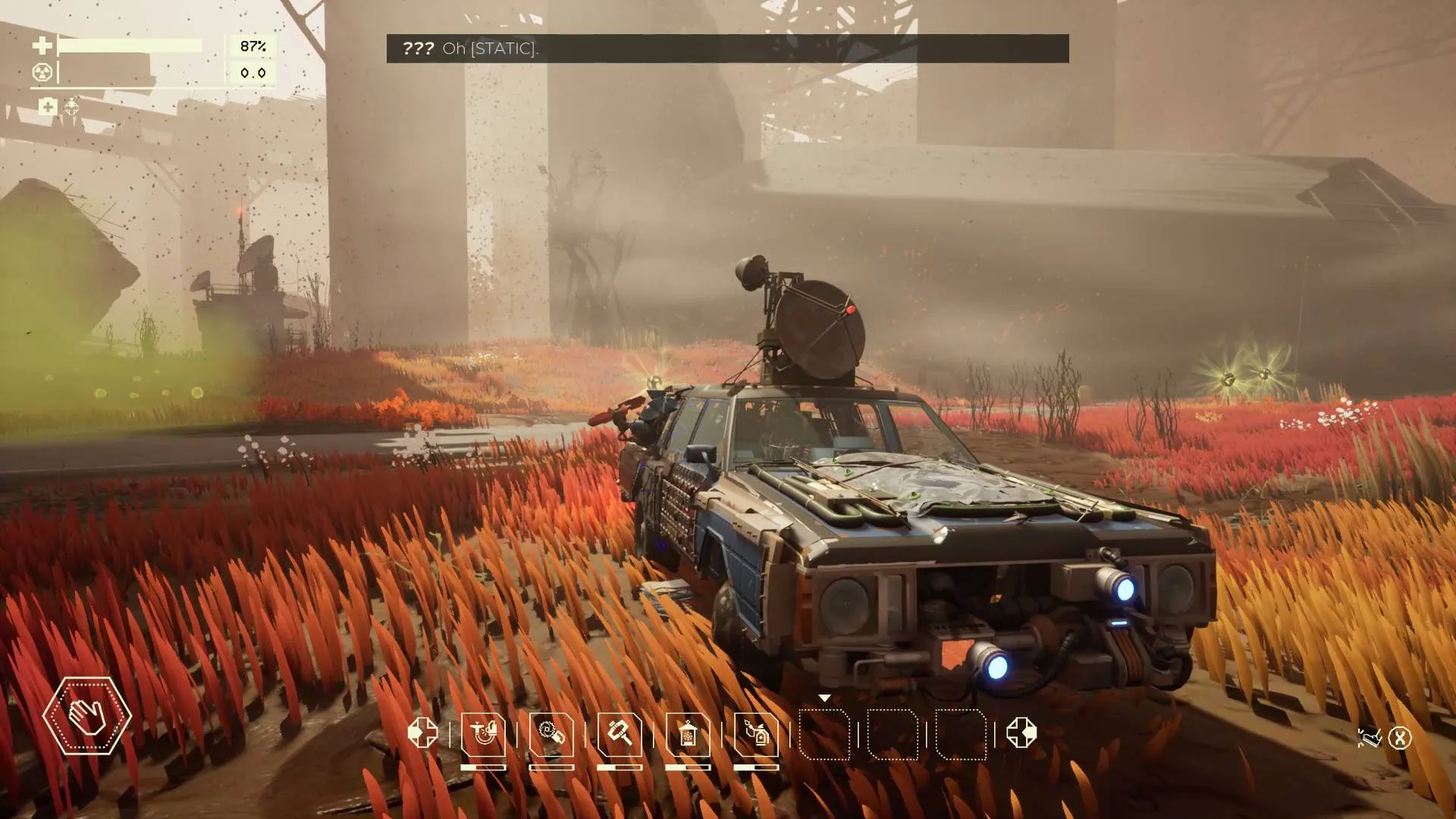
Pacific Drive – Redux

I bought Pacific Drive on release and put in about 12 hours before I had enough. Conceptually, it was really good. A great setting (sci-fi anomalies), solid art, exploration, rogue-like, and a good story. There were issues with the details. You couldn’t functionally save mid-run, and runs took upwards of 45 minutes. Death was a complete wipe of that time. Even a successful run had you spending nearly half your resources repairing and preparing for the next run. I put it on the shelf with a promise to return when it got the QoL patches I needed.

Well the good news is that the game got a ton of patches, most of them a while ago. There are now multiple difficulty multipliers, from effectively a tourist mode to iron man. You can toggle a ton of options along the way.

I opted for two changes, and that was for full repairs when returning to base and lower crafting requirements. It still required a lot of repairs in the field, and barely getting through a few runs. Saves happen between zones, meaning I only lost 10 minutes of progress, much more acceptable. The crafting material one seems simple, but you still need two dedicated runs to get the material needed for some items (coral is great example). All told, it still took about 25 hours to get through it all, so not like this was a full cake walk. Quite the opposite, plenty of times where I just simply died due to some random effect. Which reminds me…

In the base game, you could (and certainly would) acquire quirks through regular gameplay. A quirk is some random effect that can have a random cause. The simple stuff is like turning left and the wipers turn on. The bad stuff is more like you move forward and the car shuts down. Resolving a quirk was a guessing game, where you needed trial and error and a specific machine back in your garage to resolve. In my original playthrough, I tried this mini-game and didn’t find it enjoyable. The full repair setting means no more quirks (well, you’ll get them temporarily still), which means much cleaner runs.

I will say that having completed the game, and looking back, I realize that only 1 item is actually required to reach end game, and it’s an item given to you as part of the storyline. If you simply complete every task offered, you can pretty much speed run to the end. It will require some rather impressive driving skills and more in-mission repairs than I’d like, but 100% doable. For those looking for a rather ‘hard to kill me rig’ that doesn’t require end-zone farming:

  • 4 off-road tires (cheap to make, works on everything)
  • Armored doors, panels, bumper (dirt cheap and super effective)
  • Rear bumper will be the quest item above, which should be active 100% of the time (blocks nearly all environmental effects, but drains battery)
  • Roof rack + roof fuel tank (massive increase in overall fuel and integrated, so no need to fuel mid-mission)
  • 2x side rack wind turbine battery chargers (cheap to make, works while driving, easily offsets battery drain item from above)
  • Optional: roof rack resource scanner if you do plan on farming end-game materials. It is stupidly effective.

The end result is still an engrossing experience that is quite a bit different that what other games have on offer. With all those patches, you have even more flexibility as to what portions fit your specific gaming preferences as well. I think we were somewhat blessed in 2024 with smaller dev studios able to find space to showcase games like these. Well worth the pickup.

Indiana Jones & The Great Circle

I’m of multiple opinions on this game, nearly all positive for the game proper but also questioning the industry as a whole as a result.

IP games are notoriously difficult to manage, moreso when they are cross-media. Raiders of the Lost Ark came out in 1981 – over 40 years ago. It’s had a slew of films, a TV series, as well as numerous games. It’s the clear inspiration for multiple other IPs, such as the National Treasure series and obviously, Uncharted. Suffice it to say, it has a damn high bar to hit.

And it pretty much clears it with ease.

This is a game that manages to get it right. You get rewarded for exploration, and get nothing for combat. You get to explore dark catacombs, ancient crypts, discover long lost secrets, and thwart Nazis along the way. This is the closest you’ll get to playing the movie (the first 3 films that is) without an actual VR helmet.

The real beauty here is the mix between organic and led discovery. Walk around to find new things to do and discover, one of the more interesting ways to gain experience and new areas + disguises. Pay attention to what people are saying, or read the proper letter, to find a way through a tough spot or crack that safe. You’re also lead through the main storyline, with what feels like a few dozen puzzles along the way, none that are truly taxing. Well, at least none as confusing as some of the safe combos!

It ends up being an interesting tale, with just the right amount of smug villains and massive set pieces to keep you wanting to push forward. Honestly, it’s a GotY contender for me.

Industry

The sad part about this, or perhaps the reflective part, is what this shows to the industry at large. This game comes from the team that build Wolfenstein, and you can see that thumbprint everywhere. While this may be a game with a minimal use of guns, everything else fits into their M.O. This is a studios that took a step sideways and leaned into their strengths to deliver an amazing game.

Looking at the recent slew of AAA games released, how many can truly say that? I’m certain The Great Circle was not an easy game to develop, but it’s evident it was developed with a clear vision and strength. Maybe, just maybe, there’s some hope for AAA games in the future if companies can stop chasing the live service garbage that none of them can actually deliver.

So if you want to vote with your wallet, here’s a game to do it with!

Anthem – A Precursor

I wrote a lot about Anthem. There are many reasons for that, mostly due to the pedigree and seeming simplicity of the genre. BioWare had some jank in their games, but they still knew how to put pieces together and actually think things through. If you’ve ever played D&D with a friend who loved to ‘think outside the box’, the DM who navigated that is the exact same type of person Bioware used to hire. (They probably work at Larian now…)

Anthem was promised to be many things, but at the core was a 3D looter shooter, which is an advanced version of an ARPG – most of us think of Diablo in that vein. There was some story promised, but frankly that mattered little in the moment to moment gameplay portions. Boiled down to the basics, it was slot machine with pretty graphics. It’s the slot machine part that really threw Bioware out of sorts.

I also wrote a whole lot on Diablo 3, including guides on making real world money back when it launched. I’m time travelling back 10+ friggin’ years here, but there was a time when you played Diablo not by killing monsters, but by sorting tables in an auction house. I did it as an experiment, and the $ per hour was honestly much higher than expected. The main reason the auction house worked there was because the actual game didn’t actually optimize the slot machine part. The game was overturned in difficulty, and undertuned in terms of rewards. It took much less time/effort to farm gold in-game and to buy the gear than it ever would to actually get a decent drop in-game. The incentives were broken.

Anthem launched in a buggy state in 2019. Today, we would call that Early Access. It also launched on the EA game service, and nearly everyone I know purchased it that way as it was ~$20 instead of full price. Bugs aside (one locked you out of all content and took 2 weeks to patch), the gameplay itself had challenges.

Combat had 2 parts, one was focused on exploration and emergent gameplay. Unfortunately this mode was in a massive map with no indicator of your teammates, and a max of 4 people on a map that could fit 50. The second part was mission based, and while mechanically fun at the start, it became obvious quickly that core shooter mechanics were missing, notably how cover/line of sight seemed to not really work. The balance between classes also wasn’t working, were tanks were the be all/end all with other classes being relegated to glass cannon status.

The loot portion came out even worse. Loot was 100% random, with nearly 10 rolls per item. Sure, rarity is always there, but the real issue was the items themselves. You could roll any item, even if you couldn’t use it (which was 75% of all items). If you did get an item you could use, the stat rolls on that item could be for any class, so you could get a gun you could use that boosted skills/stats you didn’t have. And if by chance you did get an item you could use, with stats you could use, the range of stats was absolutely massive. More to the point, you could easily get a legendary item that was much worse than a regular version.

It took a few months and stat weights came into being, as well as quite a few quality patches. Next to no one returned to the game, and the idea of Anthem 2.0 was born. The ideas in that pitch were really good, with a very strong focus on what makes those games successful. Unfortunately, it was a skeleton crew of ideas and EA made the choice to cut their losses.

I won’t even get into their cash stop. Good news, it was cosmetics based! Bad news, no one used it.

I bring up Anthem for a few reasons. First is that the looter shooter genre appears to be well past expiry now. Destiny 2 is arguably content rich and it’s still not enough to keep people coming back for a 0.1% stat increase. It’s the only successful one left – I’m still kind of ticked that Outriders couldn’t find a footing… that game is incredible. Second is that Bioware made a game really outside their wheelhouse, using an engine that wasn’t made for multiplayer. They bet the farm on something they had never done, and lost big. They managed to alienate a die-hard user base that would have bought anything, effectively impacting their long-term stability. Third, there was a general lack of awareness of the market needs and listening to player feedback.

Looking back at 2024, does that not seem to ring a bell? Kill the Justice League, Concord, Skull and Bones are all very high profile games that have suffered tremendously due to all three of those pieces. Star Wars Outlaws is almost exclusively in the third point (somehow, BG3 sold more copies in 2024 than Outlaws did, what?!) The challenge for larger companies is that the details don’t matter, everything gets summarized by the time it hits the decision makers. The genres are defined by the games, not the other way around. We use the genre terms to explain similarities, but the games themselves are so complex and integrated we never do them justice.

Would Anthem have been successful it it was more than a looter shooter? If it moved from the abstract and really nailed down the core systems? We’ll never know. But perhaps, just perhaps, there’s a chance that the next big wig looking to make a buck actually thinks about what it means to make a successful product being more than just a label.

Factorio – Infinite Resources

This is a weird concept as the base game had you mining patches that eventually dried up, forcing you to move. Space Age adds more weirdness as resources become infinite if you know where to look. I won’t cover legendary materials here, only the normal ones. You will never need legendary materials to beat the game.

Space

  • Iron, Copper, Ice, Calcite, Carbon, Sulfur are all free in space. You can make Coal too from Carbon. At decent volumes. You’ll likely want a ship that does this above Aquilo.
This thing generates a LOT of items for free. Belt management is key to prevent backups and dump excess.

Nauvis

  • Water is infinite.
  • Uranium is sort of infinite with the Kovarex process.

Vulcanus

  • Iron & Copper are infinite here from Foundries as lava is infinite. At crazy rates too.
  • Stone is infinite here if you create copper plates, dump them into lava, and collect the stone by product.

Fulgora

  • Heavy Oil is infinite.

Gleba

  • Rocket Fuel, Plastic, Bioflux, Nutrients, Iron, and Copper are all infinite here.

Aquilo

  • Ammonia is infinite.

For the material that is NOT infinite, there are a few ways to get more of them and reduce the impacts downstream. I assume legendary modules here, but the benefits are still amazing with normal quality. Know that Speed modules decrease Quality, and that Efficiency modules are all but required until you unlock Plasma Energy.

  • Pumpjacks are interesting. Odds are you want speed to get enough throughput to feed other machines. Productivity (at best) gives -30% speed for 50% bonus. Speed gives 250% boost at max. Your best bet here is to put productivity in the pump and then a beacon with speed.
  • Any minable material should have a Big Miner with productivity modules. Research mining as well, as each is a 10% increase in output for the same amount mined.
  • Recyclers cannot use productivity, but do have research for 10% boost to scrap results. This really only applies to Holmium Ore, which should have a productivity boost on the next step in the production chain making it somewhat irrelevant.
  • In general, you want to use Cryogenic Plants, Electromagnetic Plants, and Foundries instead of their alternatives. The latter two have 4 modules + a 50% boost (which means 150%), and the Cryo Plants allow 8 modules (or 200% boost).
  • A quick note on beacons as the math can get complicated. If more than 1 beacon affects a building, then it has diminishing returns. Assuming a building is hit by only 1 beacon, the effects are 1.5x to 2.5x the value of the module (depending on quality). Use beacons + efficiency to start (buildings cap at -80% power consumption). Late game, legendary beacons + legendary speed modules = 625% speed boost. That level of speed is very likely to generate issues with belts.

The net result here is that Vulcanus has the most amount of infinite base material by a long shot. Infinite material = no need to ship between planets = improved logistics. Add a space platform to farm the missing materials, and it’s even more bonkers.

Factorio – Fulgora Touchdown

Welcome to the planet of near infinite materials! And the planet that’s borderline gacha with randomness everywhere. The environment itself is hostile, with lightning storms every night that can destroy a ton of resources if you don’t have lightning rods around. And the world is built with islands, some small and medium with scrap ore, and larger ones with not much on them. The oceans are pure heavy oil.

The main goal of our first foray in Fulgora is the science, but the secondary goal is learn about upscaling. Everything here focuses on the Recycler as a result.

Power

The way Fulgora should work for power is to collect lightning strikes and store them in accumulators. You will need a LOT of them. Quality accumulators are massive improvements.

Nuclear power is an entirely viable option here, shipping in some basic materials, setting up a kovarex plant, and melting ice for the needed water. It is tight space, a thing you won’t really be able to avoid until much, much later.

Recycler

Simple in concept, complicated in reality. You put stuff in, and the Recycler breaks it down to it’s basic components at a 75% loss. Put in 100 Iron Gears, and get 50 Iron Plates (since it takes 2 to make 1 gear). Put in Scrap Ore, and there’s 12 items that can come out, at different %. Learn to love the scrap, because it’s the only way to get water + plastic on this planet.

Also important to note that quality modules on Miners impacts the quality of the scrap, and that Recyclers with quality modules improves the quality of the outputs. So those 12 items are actually 36 (normal, uncommon, rare).

Managing Outputs

A recycler will generate a TON of random material, so you need to sort that material out. You can use splitters with filters to extract material for storage (based on quality). Anything that isn’t stored needs to route back to the recyclers for reprocessing. You will need a LOT of recyclers to process fully saturated green belts.

You’ll also find some secondary outputs, things that come out and you didn’t realize at first. Plastic, Green Circuits, Iron Plates, and Copper Plates are notable. Size wise, you’re going to need a filtering belt that’s as large as your recycler belt.

Once you have the outputs filtered into storage, you’ll have near infinite basic materials on hand.

Holmium Refinement

This is the unique planetary ore, and it’s only available as a byproduct from scrap ore. Importantly, the quality here doesn’t matter as it gets turned into liquid that has no quality. Well, quality DOES matter because you can only insert like-for-like items. Since it takes 2 items per input, you must insert the same quality items. End result, you need 1 Chemical Plant dedicated to a given quality of ore.

Using Foundries will create a TON of Holmium plates. One Foundry is more than enough to fully saturate, and it gets crazier when you add productivity modules.

Holmium is also used to create Electrolyte, a liquid used for most end-products on Fulgora. Nothing too complicated here, as it only requires Heavy Oil. These will give access to Superconductors + Supercapacitors, which give you access to this planet’s science. The wide majority of this processing is done as you would with other oil processing, taking up a relatively minor amount of space.

Quality Matters

The science here gives you Mk3 Quality Modules and most personal defense items, like Mech Armor, Mk2 Personal Roboports +Mk3 Batteries. The question is, does quality matter? It only matters when you are restricted in build space. If you have an infinite field, then adding 50% more things to it is simple. If you are limited, then you want the things on that field to be 50% more efficient. In that context, personal equipment is absolutely worth upgrading. For crafting buildings, this gets complicated as it can mess up production chains. Specifically on Fulgora, higher quality capacitors (to store energy) are amazingly effective. Normal store 5MW, uncommon 10MW (100% improvement!), and rare 15MW.

(Important note: the game has an atrocious interface when it comes to managing quality products. I can handle the quality limitations, but the ability to upgrade/downgrade/sort by quality just isn’t there. Find a mod or an upgrade blueprint, there’s plenty on Reddit.)

Upscaling

There are two ways to generate a high quality item.

  1. Use quality modules and pray to RNGsus, managing the random outputs.
  2. Use quality ingredients to create a same quality item.

Upscaling is the act of applying both methods. Use randomness to hopefully create better products, recycle the items that were not upgraded, and then re-use those quality items to directly create quality products. Sounds complicated, and it kinda is.

A practical example is Quality Modules themselves. You’ll start Fulgora with Mk2 modules, giving a 2% chance of improvement. You’ll leave with rare Mk3 modules, which give 4%, a 100% improvement.

The regular process of making modules starts with Mk1, then Mk2, then Mk3. Using belts, you can set up a production chain to create normal versions with normal material. If you insert quality modules at each step, you have chances of increases rarity. The trick then is to extract the uncommon / rare modules from the production chain. That’s the 1st part of the process, and entirely possible to generate a Mk3 rare module (at 8% quality, that’s 8% at uncommon, and 0.8% as rare).

The next step is to create with quality materials, which will be very slow as the materials will be hard to come by – especially circuits. One station will create uncommon modules with uncommon materials. Again with quality modules. Another station will create rare modules with rare materials. This is the 2nd part of the process.

You will want to use the quality modules on every Recycler and every Big Miner, eventually having them all rare Mk3. You could recycle excess modules, which I would only recommend if you have more than 500 of any given one in stock. Eventually you’ll need them when getting to epic/legendary levels.

Mech Armor

This thing rocks. It automatically flies over everything, including water and trains. You absolutely want to have it equipped. Quality matters here:

  • Normal: +50 inventory, 10×12 equipment grid
  • Rare: +80 inventory (60% more), 12×14 grid (30% more)

Exoskeleton goes from 30% to 48%. Mk2 Roboports recharges 6 bots instead of 4 and use 40 robots instead of 25. Mk2 shields go from 150 to 240hp. All of these are awesome investments.

I do not recommend method #1 to create these as the material costs are quite high. Create rare versions of the base material and the final step can then be guaranteed. It will be multiple steps, but I found it absolutely worth it.

Next Steps

If you don’t care about quality, then Fulgora is the quickest and simplest of all the extra planets. Once the recycler production chain is up and running, science is a quick hop away and you’re done. A Tesla gun + ammo is useful on Gleba, and you will want to extract a few Electromagnetic Plants + Tesla Turrets as well. The really good news here is that the recycler gives you Blue Circuits, Low Density Structures. Rocket Fuel is free since Heavy Oil is free. You won’t ever need to import them.

I would not create any production chains to create circuits yet. You may have all the ingredients to do so, but the throughput is a real mess, and it’s honestly harder on Fulgora due to the need for Plastic. But, that’s for later.

Turning Back

With the Electromagnetic Plants, Foundries + Big Miners, now is a good time to return to Nauvis and upgrade your production chains to improved tools. I say Nauvis as you likely have ample space to build whatever you want, and the power management options are easier, and all research is done here. In that regard, it makes sense to just upgrade the base planet.

I will say that Vulcanus is the golden planet and you will likely want to build green/red/blue circuits for shipping here as 99% of the material (tungsten is the exclusion) is free.

Factorio – Vulcanus Part 2

I have to say, Vulcanus is a really enjoyable experience. The enemies are straightforward and won’t attack, the materials feel borderline infinite, and the new equipment here is game changing with an inherent 50% productivity boost. The productivity boost has massive impacts, notably on scale of the factory and importantly, power consumption.

Mini Bus to Main Bus

The mini bus concept is rather simple. You need just enough material to go through it to supply the creation of metallurgic science, which is surprisingly little. Sulfuric Acid, Lava, Coal, Calcite, Water, and Lubricant are all you need here. The first 4 are easy to get. Water comes from a Calcite reaction, and Lubricant comes from Heavy Oil, also from Calcite.

The mini-bus should be enough to create all the basic materials you need, including Foundries + Big Miners. Red Logistics + Bots should be shipped in from Nauvis, as needed.

Only once you have this part down will it make much sense to extend your area to include Tungsten mining. There’s ample on the ground to keep nearly every other part working smooth.

Power Consumption

One bit that I really didn’t think much about on Nauvis is how power is consumed, or rather mitigated. You can only ever hit -80% consumption, which is 2x Mk2 Efficiency Modules. More than than is wasted. Clearly this changes if you have other modules around, so math away. I never found the need to upgrade my power grid from first landing until I left.

Big Bus

Once you do have a Tungsten mine available, time for a main bus. This one will include all the base Foundry material + liquids. Iron plates, gears (you will need 2 belts), steel, copper plates, tungsten, low density structures, and rocket fuel. Iron rods aren’t all that useful at large scales, and concrete is more for aesthetics.

The metal products should be linked to 2 foundries, which should fill a green belt full of material (60) by the end. All stone should be converted to landfill and belted to lava for disposal (unless you really want to have a ton of concrete). These production lines should be at the start of the big bus.

The liquid production will need it’s own dedicated plant. Coal Liquefaction is your best bet for Heavy Oil, then your standard oil setup from there (Water, Lubricant, Light Oil). I build Rocket Fuel near here as well since it needs Light Oil.

Green Belts

This is the the gold mine of Vulcanus, Mk4 belts give you 60 throughput, which is a substantial upgrade and they are practically free when produced here. Recall that all logistics are progressive, so that Mk4 belts require Mk3, Mk3 require Mk2, and Mk2 require Mk1. Foundries have an inherent 50% productivity rate, and if you put 4x productivity modules in there, it’s ~75%. With 12 Foundries, you can quite easily pump out couple thousand belts in a few minutes and they will completely replace all belts laid from this point forward.

Works like a charm. Forgot to add efficiency modules though.

Circuits

Green Circuits can be made in a single assembler as the materials here are free and the demand quite low. Red circuits are only used for constructing splitters and much less than you’d think. Shipping in 1000 will be enough for a very long time.

Blue circuits… this is going to be a problem. You will need a handful for green splitters, but the real sink is going to be rocket parts. You’ll need to ship in a good 2000 if you want to export science reliably. As long as Nauvis isn’t in the middle of a production spurt, this should be simple enough. This problem goes away after Fulgora.

Prep for Fulgora

Fulgora is my preferred 2nd choice, as it provides some mostly quality of life updates and does a great job to introduce you to quality scaling. It absolutely requires Big Miners (40) and Green Belts (2000) in order to function, as the scale of production is like nothing else you’ve seen. Foundries (20) are helpful for a specific ore. You’ll need pretty much the same things you did when you landed on Vulcanus, except Fulgora has no solar. Fulgora does not need any Calcite. Once you have the materials ready, head out to space.

Factorio – Early Vulcanus

The reason I chose Vulcanus is simple. Cliff Explosives. Ok, it’s more than that, as the Big Miner (faster, consumes less material), Foundry (50% production bonus), Coal Liquefaction, and Artillery are locked here. There’s certainly more for sure, but those are the ones I absolutely want to unlock before heading to the next planet.

Given it’s the first planet, I have zero optimization and a ton of guess work to have anything work. High level, the planet has:

  • Coal, Sulfuric Acid (liquid), Calcite (also found in space), and Tungsten (in Demolisher territory).
  • Decent solar coverage.
  • Lava all over the place, no trees, and no water.
  • Cliffs everywhere.
  • Demolishers that protect their territory (denotes by red lines).

The lack of materials is the core issue. Robots can disassemble material on the ground for iron + copper + stone, which clears the ground enough to lay out some substations + roboports to frame future growth. From that…

  1. Lay down a Cargo Pad to receive material from the Space Platform
  2. Put down a dozen storage chests
  3. Put down a storage chest + 2x electric smelters to create iron plates, copper plates, and stone bricks.
  4. Put down 50 solar panels + 20 accumulators.
  5. Mine calcite + pump sulfuric acid into a chemical plant to build steam. 30 steam generators are enough to power a LOT.
  6. Craft 1 Foundry in an assembler (use steam to create water). Craft 20 more foundries in the new foundry.
  7. Build a bus that routes lava, water, lubricant (sulfuric acid -> heavy oil -> lubricant), sulfuric acid, calclite, and coal.
  8. Place a dozen assemblers + requestors to create intermediate materials like green circuits and electric engines.
  9. Use foundries to create all iron, copper, steel items possible. Use foundries to create refined concrete and big miners.
  10. Use foundries + assemblers to create tungsten materials based on material on the ground.
  11. Use foundries to create orange science (?)
  12. Export science to Nauvis.
  13. Profit.

It’s actually a rather straightforward process up until #11 as you won’t have enough tungsten and will need to mine it. However, all patches are in Demolisher territory. The only way to take those buggers out is with a dozen turrets & tank with uranium ammo and tier 6 damage research – which you’ll need to ship from home.

Dealing with Demolishers

Demolishers are worm-like creatures, with 30,000HP+, that deal tremendous AE fire damage and have substantial regeneration capabilities. They patrol a given area on the map, denoted by a red outline. Build anything on that area, and it will be destroyed. The only defense is offense.

While there are many strategies possible, I prefer simple brute force. They are immune to explosive, laser, and impact and take 50% from physical and 80% from electrical. Uranium Canon Shells deal 2K per shot as a base, + 100% per upgrade. You’ll likely be at 10k+ per shot by the time you land. Turn off auto-robots (or they will die from the AE attacks) and shoot it from behind. 3 seconds later, dead worm. Repeat for all areas touching the starting area and you’re good.

Next Steps

The start of Vulcanus is primarily about stability and getting the first few Orange Science items unlocked. Of important note is that Vulcanus will generate an overabundance of stone. Way more than you can use. So much more than you can possible imagine. Use what you can for refined concrete, but the rest should create Landfill with the stone, and insert it into the lava to dispose. Failure to manage stone will mean your production lines will be stalled.

Final quick note, science stacks in sets of 1000 per rocket, and you should be able to generate 2k per round trip. An unmodded Rocket Silo requires 100 Blue Circuits, Rocket Fuel, and Low Density Structure to launch. If you return from Nauvis with 200, the cycle will work 100% of the time.

Next part is how to optimize Vulcanus before leaving to the next planet. That means Big Miners, Foundriess, and Mk4 Belts.