Starting this on a different footing. I really like the tools in Factorio. Space Age added a bunch of different puzzles, and through a serious amount of applied logic, you can do almost anything. The tools present mean that you spend very little time with finicky placement and instead solve math problems. The friction points have all but been removed. Dyson Sphere Program is 2.5D and has a very similar set of tools.
Satisfactory does have blueprints, which aid in growing scale, but they operate independently. You need to manually connect them together. At scale, this is super annoying.
This creates 1 motor every 6 seconds. It looks amazing. It takes a good 20 minutes to layout, so you want a blueprint.
1.1Changes
Sweet baby carrots is this a massive quality of life boost! To get the auto-connect to work, you need to be within 2 spaces between the in-world item and your blueprint… not really an issue for belts but much harder for rails. This is entirely due to the Z axis (vertical) and how items need to be touching something. Belts work best when on the ground as they need to connect a machine… which should also be on the ground. Rails… they are meant to not be on the ground as you want to move across complicated terrain.
The general rule of thumb is that if only 1 axis moves, it looks really good. If 2 axes move, then it looks ok. If all 3 axes move, it looks like a 2 year old drew with crayons.
The impact for normal production blueprints is small. There’s a minimum distance for belts to run, so it is possible that blueprints need to be adjusted to ensure connections are larger than the limit. In my testing so far, belts set up to the limit of the blueprint box work just fine.
There are now 2 new types of valid blueprints – one for a belt bus and another for rails.
Belt Bus Blueprint
The idea is simple but building it is a bit weird. My take on this is to use a 4×4 blueprint and put in double belt holder equally spaced. Belts need to be on something. I added temporary poles next to them, ran the minimum belt length and then deleted the temp poles.
Placing this blueprint brought a tear to my eye. In the time it took to lay 1 extension, I can lay 20+.
The squigglies mean its working.
The downside is that this eats materials way faster than you can make them. 116 Steel per blueprint!
The upside is this took no time at all to lay out.
Rail Blueprint
Rails should not be on the ground, and rails also have a minimum length. That means a small pillar with foundations on top that have 2 parallel rails. A very simple blueprint. It won’t look good as you’ll have rails floating in the air, but it is extremely quick and practical.
Placing this blueprint is not fun. You need to ‘lock it’ (press H), then nudge it close enough to the existing rails so that it connects. Then you click. And then you make a choice.
If you want to manually place the rail extension because you have terrain nearby, press H again, rotate and place the extension. This works for about 50% of the time you’ll use rails.
If you do not have terrain nearby (say you are trying to elevate a rail), then you need to manually nudge the rail blueprint (up/down, left/right, pgUp/pgDwn). The downside to this is that you cannot rotate the blueprint to make turns, so you may want to build a 45/90 degree turn blueprint as well. The crayon downside here is that your rails will have ‘humps’ rather than a smooth incline.
The net result is rails that work, placed in a tiny fraction of the time. This will save hours and hours and hours. And a few more hours.
I present to you, crayon rails! It isn’t stupid if it works!
Summary
I’ve been playing Satisfactory for a long time, and I’ve hit numerous quit walls over the years. All of those were related to a perception of wasted time. I had goals and would find myself stuck in minutiae for 80%+ of the time rather than the fun stuff. Blueprints were a HUGE boost in 0.7, if limited. Dimensional Storage removed the need for central storage in 1.0, saving dozens of hours in the late game running around for materials. Connecting Blueprints, to me, is the final QoL change which will dramatically remove friction in building factories.
While there are other tweaks I could suggest here that would aid in QoL, they are generally low friction events. (This is aside from the HD/Sommersloop/Mercer Sphere 4-hour scavenger hunt.) Finicky tweaks, for sure, but big system changes are pretty much all there now. Satisfactory is essentially ‘complete’. A heck of a journey to get here.
When I was younger I enjoyed TT games, though less 40K given the length of the gameplay and well, smells. It’s certainly better now with more adults. I’ve generally shied away from the video games. The lore is interesting but the IP is the selling point here, not the actual gameplay. Feels more like a Disney approach to milk a franchise.
Space Marines 2 was on sale and my gaming news feeds generally had high praises. The campaign for one, the associated coop and PvP. I dislike PvP for a multitude of reasons – mouthbreathers, try hards and bots notably. But a decent campaign is worth a shot.
I completed the campaign in about 6 hours, which feels really weird. The first few missions were interesting and flowed well. The second half was full of loading screens and aside from 2 specific fights, a cakewalk. Run in, melee, AE melee, execute an enemy, move on. With few exceptions, the guns in the game serve little purpose.
Most of the game looks like this. Great background art, nothing much happening in front of you.
I get the grimdark setting. I don’t mind the gruffness of the characters where everything is dour and serious. I don’t see them as heroes at all, what given that 40K is an outright criticism of religious fanaticals. Everyone is effectively a bad guy. The setting and lore are solid in that regard, so hats off in that regard.
(Side note: there’s some irony that this game is a Gears of War clone given that Gears of War borrowed heavily from the setting. Oh, and Starcraft/Zergs a plenty.)
Mechanically the game is simple but effective. There’s weapon variety which is mostly meaningless, except for the melee options. The invulnerability from executions needs to be exploited to survive, and there are some battles where you simply get chain stunned to death. The AI companions are actually quite good here, which is nice.
But the grand total of it all is quite meh. It does nothing well, except give you the experience of playing in the setting. You certainly feel like a Space Marine, which is neat. The ‘mini-bosses’ are more complex than the final boss who is about parry/dodge timing. Quite honestly, it felt more like a 6hr interactive video than an actual game.
The game peaked at 200k players and then has stabilized at about 10-15k since, which is a fairly health multiplayer base. I have no interest in this, but for those who do, it’s good to see it still going.
Overall, I wouldn’t recommend Space Marines 2 unless you find it on a decent sale, or are a die hard 40K fan, and you likely already have it. There are many more games that have done this better.
I like experimental ideas and I’m supportive of devs trying something new. I’m back to the point I was in Foundry when I left a year ago, and have some thoughts on what Update 2 has brought. In short, they are an improvement over the prior version, but still need some time to cook.
General
There have been some QoL changes, mostly related to balancing recipe volumes. It is better. It still doesn’t support large scale, primarily due to stack sizes that are absolutely too low. Foundations stack to 200, it should be 1000. This becomes very obvious once you unlock Olumite (oil).
Recipes need a general rebalance of ingredients. Having a late game item require copper wire is dumb. You won’t have used copper wire for anything for a dozen hours by that point. You could build a dedicated offramp to build these weird one-offs, but the splitter/ramps/inserter size means you need to use about 500 foundation each time this happens. See prior point.
Research is too complicated and takes too long. For long stretches in the mid-game you will research something you will never build in order to unlock something you’ll build 1 of. Actually, it may take the right amount of time, just that you literally have nothing to do while it’s underway.
Elevators and bulk miners need some tweaks. Their throughputs are simply too low given their size. Good news is that mining base power management is generally improved. 5 Solar Panels + 10 Batteries will support 2 diggers.
Modular buildings are still a cool idea that is poorly executed. They take a pile of material to construct and take way too much power, and once built, generally can be turned off. They become visual achievements.
The Lava Caves and Firmarlite Sheet process is cool as an idea, but poorly executed. You can only place the massive buildings on open lava, which is not continuous. Think of it like connecting islands with foundation pieces and 2 belts (in and out). The production rates are so low that you need 16 of these buildings to choke a basic belt. If I could change the lava floor to make openings, just like water above, that fixes this.
Building robots (the end game ones) is still cool to see.
Galactic Market
There are two parts here.
Building Robots and Shipping them
Robots are unlocked through research. You have no idea what a robot is worth unless you did through a pile of menus.
Building them isn’t necessarily hard, but is also isn’t fun. Get an assembler, build robots, belt them to a shipping pad and put them in space.
Selling the robots is too complicated. You can simply sell on the market for a 30% loss, or invest in the incremental game (see lower) to unlock the possibility to sell them on a planet. Each planet requires a license and a dedicated ship.
Upgrading the Spaceport
This is an incremental, plain and simple. Build up 2 numbers (money + material), then press a button for a timer that adds 10% to some function.
To unlock some features you need to research them on the planet. Not clear why.
It is possible to make a mistake in an upgrade and I am not sure how to revert a choice (e.g. unlocking a useless planet, or upgrading the wrong thing).
The orbital laser is friggin’ cool! Wow!
Ok, I lied. There’s a 3rd thing that completely changes this game.
You can buy almost anything from the space station, with I think a half dozen things left over you can only construct on the planet.
In general, it is much cheaper to buy an item than to construct and then sell it.
On paper, and with a few spaceport investments, it appears entirely possible to have a factory built entirely on the concept of shipping down from space, building a complex robot, and turning a profit. This completely negates all mining and productivity bottlenecks, assuming your ships have the throughput required (each shipping pad has a built-in buffer).
I’ve yet to fully test this mind you. Nor do I actually want to. Nilaus has though!
In Summary
Foundry is really trying for some interesting bits here. If I take a step back, the concepts here are really quite something. The implementation needs some serious thinking. It’s a bit like when my kids drew animals from their imagination, super cool but not practical.
The devs have stated their next major update will focus on quality of life things, that’s good. Tweaking the ideas present so that they work together in a more streamlined fashion would be great for everyone.
I still recommend buying the game if you like the genre. There’s enough good ideas here to justify the price.
The best games are nefarious and subtle. They start simple and straightforward, gradually adding complexity without it being obvious, and then at some point you’re an omnipotent god juggling fine pieces of art surrounded by a chorus of followers. Like that. Think about Minecraft. The first 15 minutes you played had you punching trees and dying to zombies once the sun went down. By the end, it’s redstone everywhere and you’re shooting a nether dragon.
Production games are about making numbers go up, and each step is more complex than the last. There’s an art to progression here, where you go from ore to ingots to plates to engines to robots to spaceships, and each step naturally flows into the next. At no point should you ask yourself ‘what’s next?’ as the factory must grow.
Foundry’s early game manages this well enough, up until you hit the steel tier. Before that point, you have 5 possible inputs to sort out and can find a way to bus it and manage crafting. It’s all smelters, crushers and assemblers. Straightforward enough and there’s always something to do.
The steel tier though, that’s where it gets complicated. Making steel required a very long belt (compared to what you have) to weave different materials and then put it on the bus, not necessarily more complicated just longer to set up. Concrete + Steam is in that tier, and now you need pipes and 3 new types of buildings that use water inputs. To get to the concrete step you need to build another mini-bus due to the conflicting materials, and eventually glass production. This is complicated, because instead of extending your main bus (and what you know), you need to build a second one, so that it doesn’t conflict with the main one. It’s a weird step back and sideways, rather than forward.
And then we get to Lava Caves / Elevators. The voxel world typically has you start the game at 150 units of height. Lava Caves are at 0. To get there you need to put an elevator and there are 2 types. One for you, one for freight, and they operate differently. The personal elevator has you select the depth, and can only dig through certain material. If you hit a single rock you need to manually remove it, and potentially don’t have the research unlocked to do so. Eventually through manual digging you reach the ground floor. The freight elevator is placed with a top (at +150) and a bottom (at 0) and it will self-connect if there are no rocks. If there are, you need to use the personal elevator to find them. This is still a baffling design choice to me. When it’s all working it’s really cool, but getting there is pure friction.
The Galactic Trade system changed a lot of the flow of the game, with a sort of side game of making literal spreadsheet numbers go up. I’ll have more on this in a bit, but it’s a significant break in game flow and an actual impediment to progress as Firmarlite (that 2nd R irks me) Bars are kept behind this mechanic. You need those for green research and access to the mid-game+.
This is a negative take on an experimental game, that comes from oodles of time spent in more mature and polished titles. I can emphatically say that Update 2 is miles better than what came before (belts and pipes for sure) and it’s clear there’s still a long ways to go. Pacing, tooling, and friction points are notoriously hard to balance, and exceptionally so if you have dev tools to skip pieces. I am really looking forward to testing more of the experimental components, there’s so much potential here.
Foundry hit EA about a year ago, I gave it a shot then. It is a 3D procedurally generated world, built on voxels (key point, that), that experimented with some ideas. Right up until mid-game, the idea of a mega bus remained practical. You could build mega structures in pieces, and finally robots along assembly lines. It felt a bit like Lego, where you could see the potential but were missing a few bricks.
My gripes then were about powering mining bases (high/low voltage stuff is way too complicated), and throughput logisitics are essentially capped due to lack of trains (or their equivalents), making a mega bus effectively starve itself. You couldn’t effectively ‘make numbers go up’ beyond a certain point.
Update 2Notes
Last fall the devs surveyed folks for what they wanted to see on the roadmap. Top of list was production-related changes, balances, and similar items. They did want to see a greater expansion of the robot production chains! So we got Galactic Markets, which apparently is a system that allows you to sell your robots to space folks. From the patch notes, my selection of highlights:
Added Galactic Commerce:
New Galaxy map:
Procedurally generated galaxy on each fresh game start.
Unlock galactic sectors and acquire trade licences to sell your robots to planets.
Set up and manage supply routes between planets to distribute your robots.
Buy and sell resources on the galactic market.
Compete for market dominance against other companies. (Hoping this is not PvE for markets)
New Space Station Features:
Dozens of new station upgrades.
Spaceship Management: Buy spaceships of different types and assign them to various tasks.
Establish trade routes to the galactic market.
Sales Platform: Sell your products to casual customers.
R&D Lab: Earn XP and levels on each produced robot and improve your products.
Fuel Station: Produce your own spaceship fuel to supply your spaceships instead of buying it from the market.
Many new robot types for you to build and sell.
Choose your company name and logo.
New Company Rank system: Increase your rank based on your lifetime earnings.
New Shipping pad buildings to ship items between the space station and the planet.
New station terminal building to contact the space station.
Keep track of your finances on various accounting-related charts and tables.
New feature that allows you to pay back your debts.
New research options to fit the commerce narrative.
Countless balancing adjustments.
Pipe system 2.0: New and improved pipe flow simulation, including performance improvements. (I liked the old pipe system, anything to avoid Satisfactory’s version)
Added new smart conveyor drag mode. (It’s much improved)
Added new starting planet option which affects which biome and resource distribution. (This seems like a bad use of dev time. More later…)
Added orbital uplink tool and space laser that can be used to terraform large areas.
Added lava caves and lava smelters. (Caves in general are neat in concept, not neat in execution)
Added new Tundra biome.
Added new jungle/sandy desert/forest critters.
Added new underwater decor/vegetation.
Add new freight elevator III/IV. (This is a massive improvement)
Incompatible with prior saves, meaning a fresh start is required.
Trade Interface
There really isn’t much here to be honest. You get a new building early on that enables shipping of material to the space station (this building doesn’t require inserters or power, which speaks volumes to game design choices), which makes a number go up. The space station itself has no interaction outside of a menu. What the dev stream has shown seems like a precursor to something larger, which still seems like on the edge of potential.
I am in the early portions, just having unlocked green science. Maybe there’s more to this.
OverallThoughts
On the one hand, cool that there’s new systems and very curious as to how this will work out long term. It’s weird building end-game systems and asking every player to sink 20 hours to actually test it, but hey, that’s EA I guess. I’m looking forward to a much different set of goals to try out.
On another, there are some core balancing issues that still seem present. Great to see Freight Elevator improvements on throughput, because splitters and multiple elevators was a pain – there are no other vertical belt options. The game still keeps splitters behind alternate research paths (this feels QoL to me), the 3rd row inserter is way too late in the tree (on the edge of QoL and bad design), and power management still feels painful until you build acres of solar panels (there wasn’t occlusion before, so a tower of panels actually works).
Games like this need effective logistics… there’s still a fair chunk of work needed. Some interesting ideas here, but there’s still a ton of rough edges and strange mechanics. I remain hopeful they can figure this out and deliver it in a reasonable timeframe.
Timing is an interesting thing, innit? Outworld Station launched in EA the other day, and it’s very much in the logistics gameplay vein. It is quite rare for a game of this genre to leave EA, for a multitude of reasons. I tend to support these games as the concepts are often interesting, if the execution tends to lack.
Outworld Station has ideas. You start in a relatively small area map with a simple space ship. You bring various asteroids to your base, break them down, and then build automation tools. That seems somewhat straightforward. As with many of these games, it takes a while to automate the mining process, but it does force exploration. Power generation and base layouts have limits, so you need to build efficient designs. I’ll get to that in a bit.
In the exploration phase, your ship moves around the map finding the odd thing to bring back to base. Sometimes there are NPC enemies. Sometimes you defend a meteor storm, or a solar storm that turns off all power. You can unlock chests, which give artifacts that give talent points. Eventually you discover mining nodes you can build, and then automate shipping to the main base. It’s responsive, and relatively interesting content. It is NOT biters or dark fog that attacks your base… at least not in the first zone.
Production Chains
First power generation. This is all automated and inherently connected. No need to run wires or poles. Get solar panels of fusion generators and you’re good. You can even remotely power mining stations. It generally works.
Logistics are extremely simplistic, which actually adds a ton of complexity. The ‘floor’ of the factory is a cross construct and automatically connects to other floor pieces. To move things between factory objects, you need to bind them together and routing is automatic. Things then just naturally flow and I have not seen any rate limitations as of yet – the output of a building appears to be the limiting factor. Not being able to see these connections adds a ton of complexity – which means that planning is 10,000% more important here than other games.
Space limitation is a challenge. You could technically build a massive factory that takes the entire map. It will take time for stuff to move through and it will take a while to detect throughput problems. If you build small, then you are likely to run out of space. You can (and should) build a top floor to help here, as it allows some expansion of the factory. When I started my build I just wanted to get something basic done. I quickly realized that I was making bad design calls and rejigged the factory.
There are building limitations that need to be considered. Ctrl+C allows you to copy not only a building, but its settings and logistics path, making it the perfect tool for expanding a factory. Saves a lot of design headaches. To have that truly work requires buffer chests at any inflection point, which abstracts the complexity into simple layouts. What does that mean?
This is extremely similar to Satisfactory’s central storage hub concept (pre 1.0), and allows for a very flexible factory build. The concept is there for fluids/gas, but you need to pipe things around and that is a very high-friction process. Generally, if a chest is empty, you work back 1 step and build another factory. As an EA game that just launched, productivity screens are not yet implemented.
A general overview of a base layout, much different than other games.
A few interesting bits to add:
Inventory management for chests works well enough. Your personal inventory is less fun as similar to Satisfactory, you need material on hand to build something and you have limited slots.
I like the mechanics of the talent tree, you need to explore to get the points. The actual talent tree isn’t very good (invest entirely in productivity/speed, ignore the rest).
The ship building process is more like a resource sink to progress the story. There’s potential here. Curiously complicated.
Defensive structures are currently just to avoid pressing a key to repair a structure.
You eventually unlock another map and can shift things between them. The resource costs to get all this established are not fully balanced, nor are the links as you can only link 1:1. Which means daisy-chain connections.
Fluid/Gas logistics are unpleasant, or perhaps just a right pain to manage unless you’ve done some serious factory planning work. Or rather, it’s jarring game design when the rest of it has zero belts to worry about.
Pacing needs some balance work. There’s no ability to have functional ratios between buildings, so buffer chests being empty are the only red flag. More accurately, you can’t optimize, only brute force. This is absolutely normal for any EA game.
For a very long time, upgrading buildings isn’t worth it. The main point you want to pay attention to is ‘max output’, that will limit a lot of gameplay.
The building mechanics generally prevent scalability. You can’t move buildings, only destroy and rebuild. No blueprints. Again, all expected in EA titles.
The game looks great and plays smoothly. Way, way better than expected.
If you like productivity games, this one is surprisingly robust. Way better than I had expected. The foundational pieces are very solid, and for the most part small tweaks are what’s required rather than massive changes (inventory aside). Awesome find!
Maybe it’s a GotY contender, maybe not. Rogue-lite puzzlers are certainly uncommon. I’ll avoid spoilers here, as that’s frankly part of the joy of these games. Suffice it to say that I have reached Room 46 and leave it at that.
Blue Prince (say it quick) tasks you with finding a mystery room in an ever changing layout of connecting rooms that you select from a random pool. Most of these games have the obvious puzzles to start, and then some complex interconnected pieces as you discover more. The Rogue- portion means that you will face resets. The -lite portion means you do have access to upgrades along the path to make your life (potentially) easier. You have limited resources each day, then reset and try again.
I think Outer Wilds is one of the best game ever made. The DLC was not enjoyable to me primarily due to the repeated friction on just accessing it. It didn’t have RNG, but it did have steps you needed to repeat ad-nauseum.
I think Blue Prince does a great job is setting up a foundation that is clean, crisp, and identifiable. The puzzles themselves are interesting (some are super obtuse, especially the latter ones) and note taking is absolutely required. That said, I am tired of the artificial friction. If I have successfully completed the billiards room a dozen times in a row, I will not fail a future attempt – let me bypass it. Some rooms are so rare that you can go 20 runs without seeing them, and not quite understand the conditions of making them available – one particular room holds a critical key that is behind some rather punitive RNG. Having to ‘farm’ the RNG machine for a specific outcome is not fun game design.
Let me super clear, the path taken to reach the ‘RNG wall’ is amazing. Some of the best out there. The little bits and pieces are sharp, and learning the colors of the rooms, cross-dependencies, and interactions a neat meta aspect for future runs. When the game has minor relationships between room, the game progresses well. Every room (well, except the lavatory) has an actual purpose and likely some hidden feature. Like smaller puzzle boxes!
When you’ve done that and there’s nothing left to discovery because you need a specific set of RNG rolls to move forward, that is not fun. The latter puzzles require you to discover a complete set of uncommon rooms in order to have a chance to move forward. It makes the journey a slog, and rather than enjoying the craft of a puzzle, it turns to pure friction as you need to get the ‘right roll’ to get to the new stuff. I mean, how many times can you solve ‘two truths and a lie’ before you’ve had enough? 20? 40?
I should mention the meta progression is present but not immediately obvious. There are specific upgrades you can acquire that are permanent, and are all but mandatory to meaningfully progress. In only one case across the entire game did I reach a point of energy exhaustion before running out of other resources, which makes me wonder why energy even exists. There’s a random drop that can upgrade a random room to some new benefit, but no real way to tweak it down the road if you haven’t understood the implications of that choice. (One particular egregious super RNG mechanic deals with permanently removing crates. I saw it occur once and never met the conditions to trigger it. Once.)
I am not looking for the puzzles to be easier, at all. I am however looking at a meta progression that allows me to say ‘I’ve mastered this, let me see what’s next’. It feels like I’m asking to skip a tutorial at this point.
One last bit regarding the story/lore. If you play this game simply for the meta aspect of solving all the puzzles, you will achieve that in a reasonable timeframe. If you play this game to understand the larger story/lore context, you won’t get that unless you get most of the achievements. Not that the achievements themselves unlock lore, but that they are all bound to uncovering every RNG nook. As of the drafting of this post, there are ~15% of players who have reached the first achievement, getting to Room 46. It is a journey.
Back to the GotY point from above. If you like puzzle boxes inside 3 layers of puzzle boxes, and that they change every other attempt, then do I have a game for you! It sticks to its design principles throughout, rewards discovery like few other games I’ve ever played, and for a long time gives a sense of progression. It’s certainly an achievement. Just not sure it’s one I can fully appreciate.
I’ve spent so much time talking about design that I’ve missed sharing the key principle in it all, which is oddly relevant today – logistics. Specifically, the act of moving things from one place to another, in the right amounts, at the right time. It sounds simple, but logistics is how actual wars are won. I will try to simplify that down.
Important note that of all the factory games I have played, Factorio is by far the most robust/complex. I’m of the growing opinion that graduating engineers should be forced to play this game, it’s that complete.
Concepts
Moving things from one place to another. Easy right? Sort of.
You need to know where things are, how to get to them, how much you need, and then move those things to your transport vehicle.
Your vehicle needs a path, fuel, storage, and travel time to reach a destination.
Your destination needs the ability to store said items, and how much it needs. It should not store things it doesn’t need.
If I want to ship aluminum powder across the ocean, I need trucks to get to the supplier, then to the docks, onto a ship, to another dock, then a truck again, to the receiver. That takes weeks to complete, so the receiver places the order well ahead of time. In a war, think guns + ammo.
If I want to eat a banana, I go to the grocery store. Bananas don’t grow in Canada, so again, farmers, trucks, distribution centers, grocery stores. That takes a few weeks, so the bananas have to be collected before being ripe, and have to be placed in the small timeframe before they go rotten. Perishable goods are extremely time sensitive. In a war, think food or people.
Tools
Factorio has a lot of tools to help here.
Belts. Simple enough, they move things at a given speed across a map. They can be split or merged. A belt is saturated when it’s full.
Pipes. Similar to belts, the move liquids across a map. They have a maximum distance before needing a pump. They have no throughput limits (which is a BIG deal on Vulcanus).
Trains. Bulk belts with schedules. You often don’t think you need them, and then you realize you absolutely do, and have to tear half your factory apart. Trains require blueprints for you to stay sane. At ultra late game levels, they are the only solution to landing pad throughput issues. I won’t detail much here, they aren’t as useful as they were in vanilla.
Logistic Robots. Can carry a maximum of 4 items, and their speed can be upgraded infinitely. Used to move things between lading pads + logistic chests. They need a Roboport to function (yellow to move items, green range to build things). Roboports can, if connected, read the logistics network.
Space Platforms. A combination of a train and Logistic Robots between planets. Train in that it’s scheduled, Robots in that you can select specific items.
Logistic Network. A planet’s interconnected system of logistic containers. Only items in specific storage count – colored chests + the landing pad. Items in transit or on you don’t count.
Circuit Network. Math and logic tools that set conditions for the network to function.
Colored Chests
There are bunch of options for logistic chests, each with a color and a purpose. Some you will use a lot, others barely.
Active (purple). You can only put things in manually or with an inserter. The chest will automatically request itself to be emptied. Extremely useful on Gleba (as things spoil) or to keep a landing pad empty.
Passive (red). You can only put things in manually or with an inserter. The chest acts as storage. Ensures that robots never put anything inside. Useful for storing multiple items, or to avoid having to filter a yellow chest.
Storage (yellow). Can be accessed by anything, for storage and removal. 90% of your chests are this type. Can only filter for a single item. Useful to put 20 or so near a landing pad so that the purple chest can dump into here.
Requester (blue). Requests items from the network so that robots find them. Items in blue chests cannot be removed by robots. Items in blue chests do not count to the logistics network. Extremely useful to construct complex buildings in late game instead of belt weaving.
Buffer (green). You set requests, which will then feed other parts. I have found zero cases where this is useful, certainly not with Space Age.
Circuit Network
These tools are math based, and can be used in a variety of methods to present decision points for a logistics network.
Constant Combinator. A tool that has a fixed set of items listed, sometimes in groups. If you always want to have 200 red belts, you set it here. Has no inputs, and 2 outputs.
Arithmetic Combinator. A tool that performs basic math functions (+ – / *) on a given set of inputs.
Decider Combinator. A tool that compares inputs and provides an output. If something is larger, or the same, or a threshold has passed. Has 2 inputs and 2 outputs.
Selector Combinator. Think of it as a filter. This thing has very niche uses and not worth exploring until you understand the first 3.
Wires. Used to connect things. The color matters (red/green) as your inputs are color specific. You can connect to nearly all items in the game, including belts (to read all material). It transmits the math.
Simple Setup
When you start the game, you’re extremely resource starved. You only want to build what you need and no more. The simple circuit can help!
This assumes that you have Assemblers that are putting their material into storage containers.
The Assemblers are all connected to power poles through a colored wire (let’s say red for now), building a connected network.
All the chests (wood or steel) are connected to power poles through a different wire (let’s say green).
A Constant Combinator that has a list of the maximum amount you want, per item constructed. (let’s say 300 yellow belts).
An Arithmetic Combinator. One input is from the Constant Combinator (red wire), the other is from the chest network (green wire).
The math would be Red (what you want) – Green (what you have). The output would be a red wire to the assembler network.
If you have too much, the number is negative. If you have too little, the number is positive.
Each Assembler is configured on the network so that it is enabled when the item being produced as a positive number.
The end result is that each Assembler will only produce and store what you need, and automatically stop past that.
You can evolve this with logistics networks with colored chests + connecting to a Roboport to read all the chests automatically (replaces the original green wire network).
The red is what I want, the green what I have. Output is the difference.
Decider Setup
Taking the example above and moving into a Logistics network. I find this required for space travel.
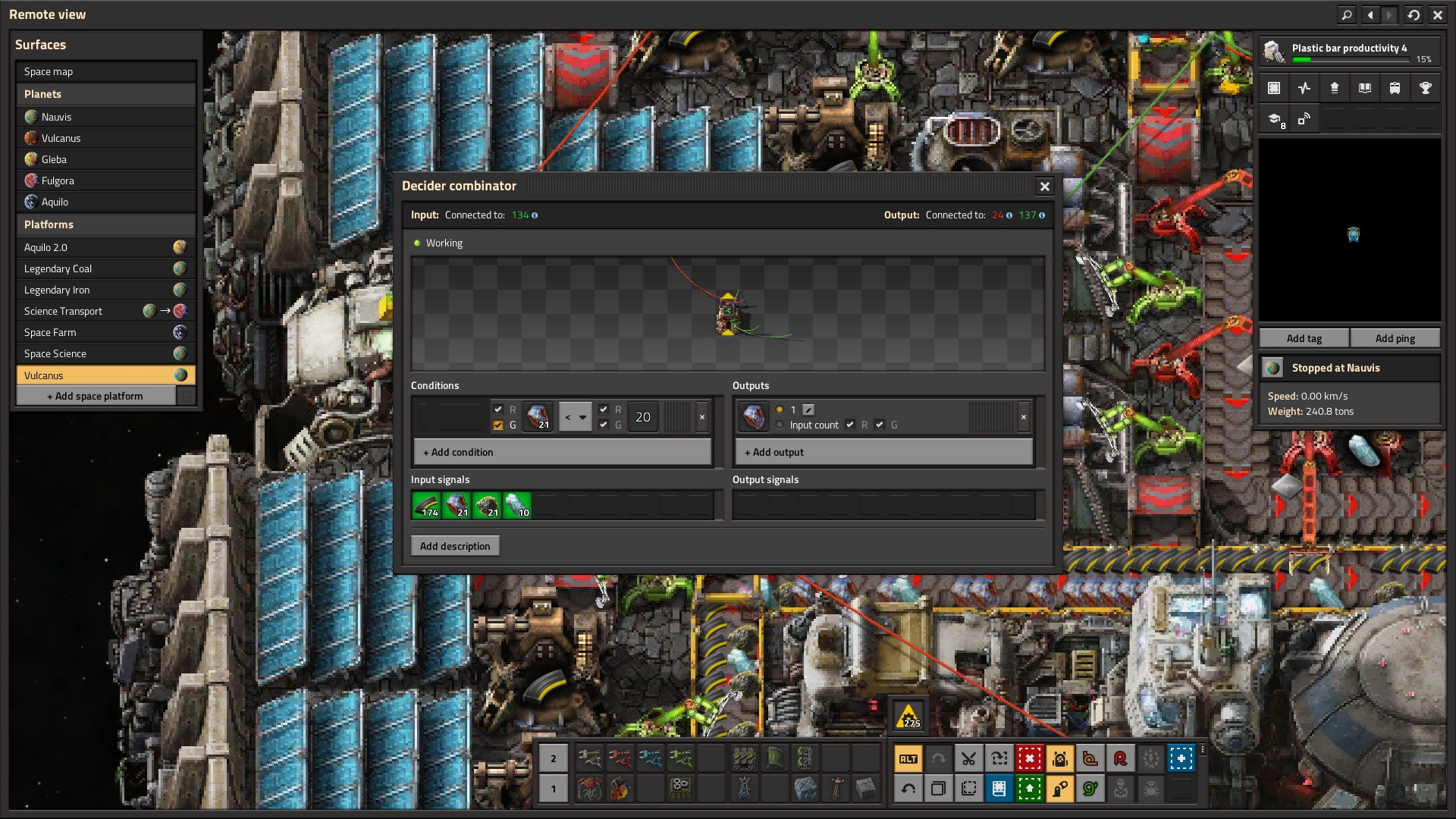
Constant Combinator with what you need to keep a base running, as well as rocket ship parts. This includes pipes, inserters, assemblers, plastic, LDS, and so on. See image as an example. Also good to have this set up as a demand on Space Platforms.
Arithmetic Combinator comparing the logistics network to the Constant.
The challenge is that the network is always under change as you produce items. Green belts are made on Vulcanus, and you ideally never want to request them from a Space Platform.
A Decider Combinator that filters the demand so that only items that need >5 items are actually requested. It is important that the lowest value on the Constant Combinator is higher than the Decider value.
Connect the Decide to the Landing Pad, set it to Request Items
A stack/bulk inserter connected from the landing pad to a purple chest, with 20 yellow chests next to the pad.
The output is only items >5, which allows for smaller variations of items without bringing them down from the space platform.
Space Platform Deciders
Space chunks are full of RNG, and it’s entirely possible to saturate your Space Platform with too much of a useless material. This is extra painful on Aquilo where 80% of the chunks are Oxide and you really want Carbon. There are a few ways to manage this.
Read all the contents on a belt through a connected wire.
Constant Combinator that has the maximum amount of a given type of chunk (all 3 combined should be ~80% of a total belt capacity). You can also manually set this in the next step.
Decider Combinator, per chunk type, that evaluates if you have less than the maximum. If so, output the chunk type. (so if you have less than say 20 Oxide chunks, request Oxide chunks)
Connect the result to the Collector network, using the filter option. If you need more, then it will filter to collect, else it will skip.
A manual setting to have less than 20 Metallic chunks.
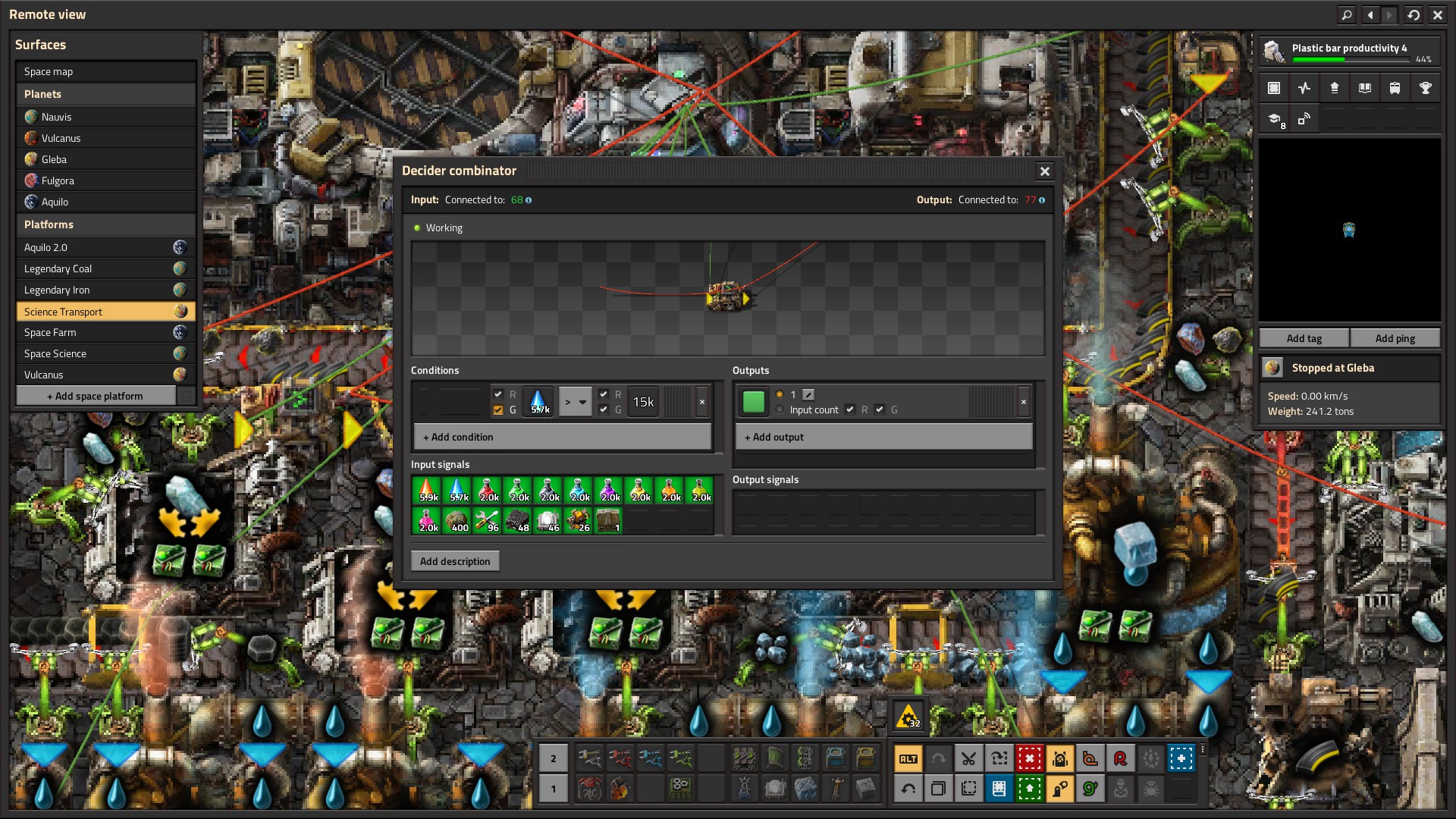
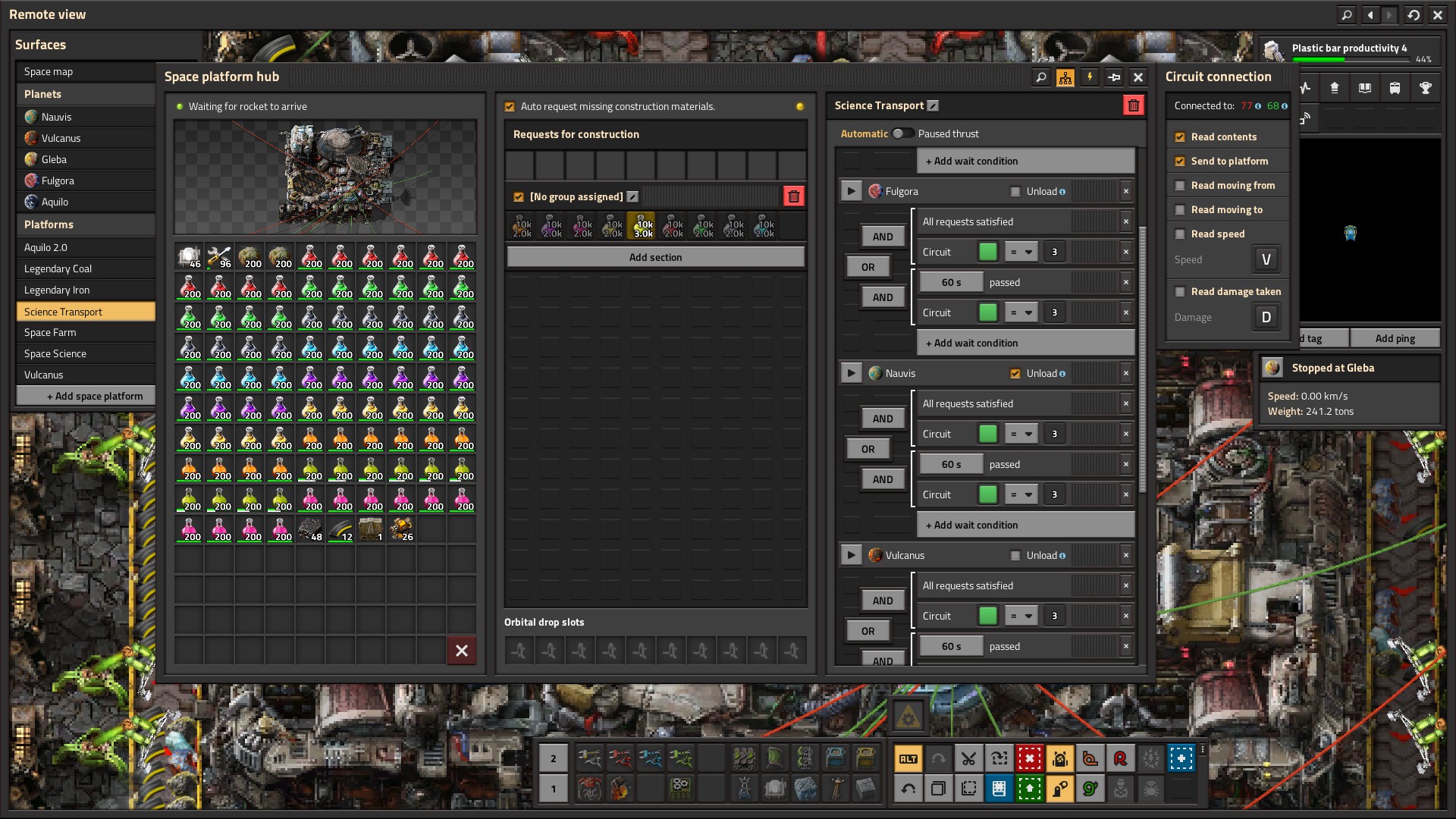
Fuel/Ammo Deciders can be used to set ship launch conditions. Same concept, read each item, compare it to a set value, and output a signal. If all signals are good, then launch the ship. On basic planet routes, that’s 12k fuel (each type) and 150 regular ammo. Aquilo is 20k fuel, 400 regular ammo, and 300 rocket ammo. Super simple and easy to maintain.
More than 15K blue fuel gives a green value of 1.
If all 3 conditions (2x fuel + ammo) are green, and I’ve been there 60s or I don’t need to collect anything, the ship can move on.
If you have the room to recycle chunks, you can use combinators to evaluate if you have too much of one type and not enough of an other, then recycle it. Aquilo needs this. If I have over 80 Oxide and less than 20 Carbon OR over 80 Oxide and less than 10 Metallic… recycle.
The OR condition is required across both groups. The lower one is true, therefore it will recycle the Oxide.
When you get the concepts of logistics, you realize that the game has so much more to offer that just filling boxes. Impressive the flexibility that math tools can provide.
I took a forward-looking approach in this run, which really means that I skipped some pieces to potentially save on rebuilds. In a “normal” playthrough, you’d optimize a bit of Nauvis with some red belts and more effective smelters. You’d likely use beacons as well. You’d create purple and yellow science. And then you’d launch a rocket.
I did not do that. And consequences followed.
First, the smaller build space on Nauvis is a good thing. It requires me to be more effective in the designs. What is saves me in long belts it costs me in undergrounds + splitters mind you, so the material costs are arguably higher. Power is substantially more efficient though, and a whole lot less poles. I skipped upgrading to red belts and everything that follows. While I had crafted logistics containers, I didn’t actually use any until the first rocket went up.
Almost to first rocket, only needed to add blue circuits to the left.
That was the point where I realized I had a more difficult path ahead.
It is entirely possible to build a space platform with basic logistics. Storage containers are all you really need as the rockets will self-request. Taking the platform to Vulcanus was simple, landing was a relative breeze, and set up was quite fast. It certainly helps when you know what you need for a first landing! (Funny story, I forgot to add a Landing Pad and had to reload a save. Well I thought it was funny.)
Vulcanus has 4 main phases, though folks are likely only to see 3. The initial setup, which is about unlocking foundries and big miners. The mid-game which makes the planet self-sufficient for rockets, meaning LDS, rocket fuel, and blue chips. The late game when you’ve unlocked Aquilo and realize that all chips can be made for free and super speed on Vulcanus. The end game, when you then realize that Vulcanus is the absolute best factory planet in game and you transfer 90% of production there.
Sidebar. I recall in Satisfactory the first few run-throughs I absolutely didn’t account for scale and needed to rebuild the entire factory. And then I’d unlock something new and realize I had to do that again. That game doesn’t naturally support modular design and scalability, you need to bring the mindset with you. And mods. The 3D layouts and free-form placement are unique, and the challenge is in that freedom. Satisfactory works on a 2D grid and has a pile of automation. Scaling is extremely simple, and moving a factory 2 spots to the right is a mouse click.
Back to Vulcanus, or rather all planets for that matter. Accelerating to get to phase 4 is friggin hard-mode. Without purple/yellow science on Nauvis, you need to build a main transport hub on Vulcanus and then transport it back to Nauvis. This is very expensive, as blue chips are a nightmare to build before Fulgora is unlocked. Did I mention that blue chips are needed for yellow science? The good news in this is that while they are very expensive to make, they are infinitely cheaper on Vulcanus than on Nauvis. But wait there’s more!
Blue chips need plastic, which can only be refined from oil products. There is no oil on Vulcanus, so you need coal liquefaction, behind purple science. You see how this is a catch-22? To get blue chips, you need blue chips to send rockets of purple science to Nauvis. But the devs thought of this and gave us simple coal liquifaction, which produces heavy oil from calcite + coal. Using that recipe, I can kickstart plastic generation with a rather complicated oil factory. Blue chips –> purple science –> get me the Fulgora ASAP.
Oh, and during this time I needed to lay out some rail networks to get copper + iron to my Nauvis factory. Big miners do wonders here as they are 5x more efficient and only consume half the resources. Foundries are not an option, as I can’t efficiently ship calcite to Nauvis yet. 50×50, ground-based rail systems are I guess “easy” to build, but the space limitations really play a number on making it all work. Actually being on the planet would make it a lot easier, but that’s not really an option right now.
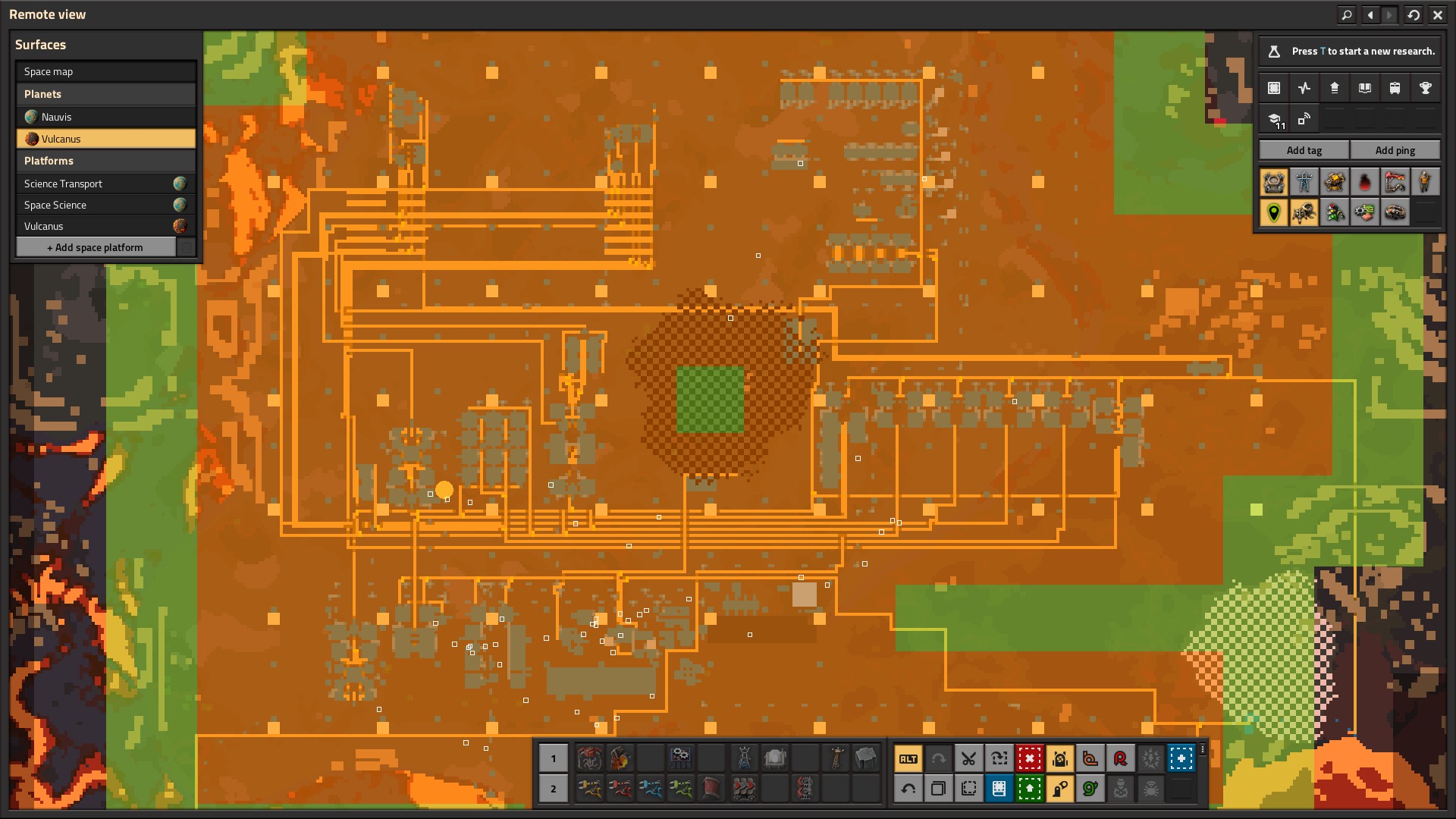
Vulcanus just before Fulgora. Oil factory top right, main bus in the middle, purple + yellow science in top left.
I’m heading to Fulgora now, and the electromagnetic plants are the absolute priority. They will practically trivialize chip production and shift the game into overdrive. Oh how I am looking forward to that!
I “played” Monster Hunter in the dark mobile ages, but never really got into it. Too many rough edges. Monster Hunter World though, I spent time in that sucker. Both on the PS and then again on PC. That was eye opening. I’ve played Rise and now Wilds.
World first though. I died (carted) a lot. Anjanath was a near wall for me, and that semi T-Rex was like the 4th monster in the game! Nergigante took me a week to kill due to the dive bomb mechanic and just really bad skill on my end. I stuck with it, got better, and found a solid groove. I played with multiple weapons, notably dual blade, charge blade, and heavy bowgun. It was a journey.
Rise was different. I carted, sure, but it took a long time to reach that point. Most of the issues were with the game design itself and having to collect bugs to boost my stats enough for a fight. The wirebug mechanic took me a right while to figure out, and the bosses felt like it was 1 hit kills. I swapped to long sword to see what the fuss was about and no lie, it took me a couple weeks to figure out that dance, in particular the defensive portions.
And truly, MH is a dance. Every monster has their own theme song and you need to learn the steps. Do so, and things are relatively easy. Try to waltz when it’s 2-stepper, and the cart awaits. That said, there’s a limit to how many steps you actually need to learn. I wouldn’t say I mastered the long sword, but I was damn good at it by the time I was done with Sunbreak.
The transition to Wilds was simple by comparison. I kept the longsword and the mechanics feel similar in pace. I understood the need for cooking good food. Collecting before a battle isn’t needed. Upgrading armor (using spheres) makes a much bigger difference than weapons when trying to learn a fight. Radial wheel access to heals + the seikret mount means I can very quickly leave a bad place and heal up. It also means that mounting an enemy is so much easier!
Now, the question really boils down to “Is Wilds easier or am I better?”
Obviously it’s a bit of both, but I’d put a significant amount of weight on the latter. I get the game, I get the mechanics, I get the timing. I still carted on the ice/fire dragon with a crazy AE attack, but I haven’t failed a single quest yet. The moment to moment portions still feel great, the hit delays work, the defensive agility gets the blood pumping, and it never feels old when you get a crazy massive combo on a 3 story dragon who crumples to the ground!
Wilds is a good game. It isn’t as earth shattering as World, and doesn’t take major steps like Rise did, but it polishes almost every aspect down to a clean and fun sheen. It is by far the most accessible Monster Hunter has ever been, and there’s plenty of difficult challenges for those searching for it. Put in non-stop carts at the start though… and you’re not going to have good retention numbers. And from the achievement % I see on Steam, it would appear that a lot of players have progressed in the game so far.
For those who find it too easy, maybe you’re just that much better than the last time you played.




 Leo's Life