Raid Trash

The idea of trash in a dungeon is not new, at all. What is more of a construct of online gaming is the idea that trash is infinite.

Way back in the Ultima Online days, which I still consider the grand-daddy, each dungeon had spawn cycles because it was all open. 500 people on a server could all be in the same location. Dungeons needed to respawn so that multiple people could participate. They were also structured in a way that there weren’t any bosses per say, you just had enemies.

EQ took the concept of open dungeons and then started adding bosses. It didn’t take very long for people to realize that bosses were not a good investment of time, at least in the leveling process – enter spawn camps. What we saw next was the concept of uber bosses at max level, which were designed for more people and focused rewards – raids. In most functional respects, they were just like dungeons, tons of regular enemies that respawned quickly. The bosses though, in order to reduce the odds of ‘farming’, they had day/week timers to respawns. If the good stuff was once a week and everything else took up space with no rewards (you didn’t need the xp), well, everything but a boss was trash to needed to wade through.

WoW’s model took the raid structure from EQ and found a middle ground with instancing. Group sizes were limited, depending on the content type. Raids were effectively just longer/harder dungeons. You had trash in both, and the trash could respawn if you took too many attempts at taking down a boss. Vanilla was really painful, like 15 minutes between dungeon respawns. That eventually got longer. Raids had a longer timer, a few hours, but also stopped certain spawns if you killed a boss.

They were still called trash, and for a reason. With very low odds, you could get a random drop upgrade while taking out trash. For some well designed areas, the events were a precursor to a new mechanic from the next boss. Otherwise, all the spawns up to a boss were just a time sink.

We’re 2021 and the top two dungeon runners have an interesting and split approach to this concept.

WoW – All dungeons are based on trash. Regular dungeons this is a time waste, while bosses are the challenge. In M+, trash is actually the hard part as you’re racing a clock. Raids have trash, and now there are spawns used to farm other items. There are a LOT of pulls of trash in raids, including patrols. The challenge here are the bosses, which can take dozens of attempts.

FF14 – All dungeons have trash, none respawn. Interestingly, you can often kill all the trash in 1 single mega pull, if you know what you are doing, dramatically speeding up the clear process. There are also trials and raids. Trials are just boss fights – no trash. Raids are quite limited (works out to 1 per expansion), and has a group of 3 parties. There’s non-respawning challenging trash (if you’re at-level), and they often represent the next boss’ attacks. Usually works out to 3-4 pulls between bosses, which is pretty quick all told.

This goes back to the fundamental understanding with players around time management. WoW still focuses on a single relevant tier at any given time, and in order to make that have some sense of value, it gets padded with as much stuff as possible. Castle Nathria is 100% irrelevant today (even less relevant than any Legion-era raid), and it’s less than year old. The Praetorium is 8 years old and groups are still running it. FF14 doesn’t have a need to pad anything, it can just offer you a seemingly endless buffet of choices. I will rightfully admit that WoW’s carrot-on-a-stick of increasing numbers by 2% is the core driver that pushes this model, and therefore has a different set of expectations that FF14’s ‘do what you want’ vibe.

I keep finding more and more example of conflicting design philosophies between these big games. You can read all about Ion explaining that he has a lot of players, with different playstyles to accommodate, and he can’t please everyone. Ok… so does every MMO, including the ones with bigger audiences than his. It’s interesting that the others have figured this out.

Metroid Dread

It’s a weird thing to play another actual 2D Metroid game again, nearly 10 years since the last one. Sure, there was a bunch of Metroid Prime games, but I was not a fan of the FPS view point. Plus, in that time there was a surge of Metroidvania games that hit the market, each one taking a slightly different approach but maintaining the 2D controls.

And that’s the kicker right. Look at all the amazing games we have had:

  • Hollow Knight
  • Ori and the Blind Forest
  • Axiom Verge
  • Dead Cells
  • Dust
  • Blasphemous
  • Guacamelee
  • Bloodstained

Some focus on the controls, some on rogue-like elements, others in the story or quests. Each one has a particular element that just plain shines.

So where does that leave Metroid? Being a Switch exclusive doesn’t help. Anything looks good on a tiny screen, and this game does look good, but in the dock it certainly doesn’t scale. One of those weird things were a Switch emulator is a better deal… welcome to 2021 Nintendo! (*insert thoughts on a 4K Switch being delayed*) It also has a sort of diorama experience, where Samus feels superimposed on the world, which I think works quite well. There are plenty of loading screens (15+ seconds), which is just plain dumb. No, dumb would mean that it wasn’t purposeful. Someone thought this was acceptable and designed around it.

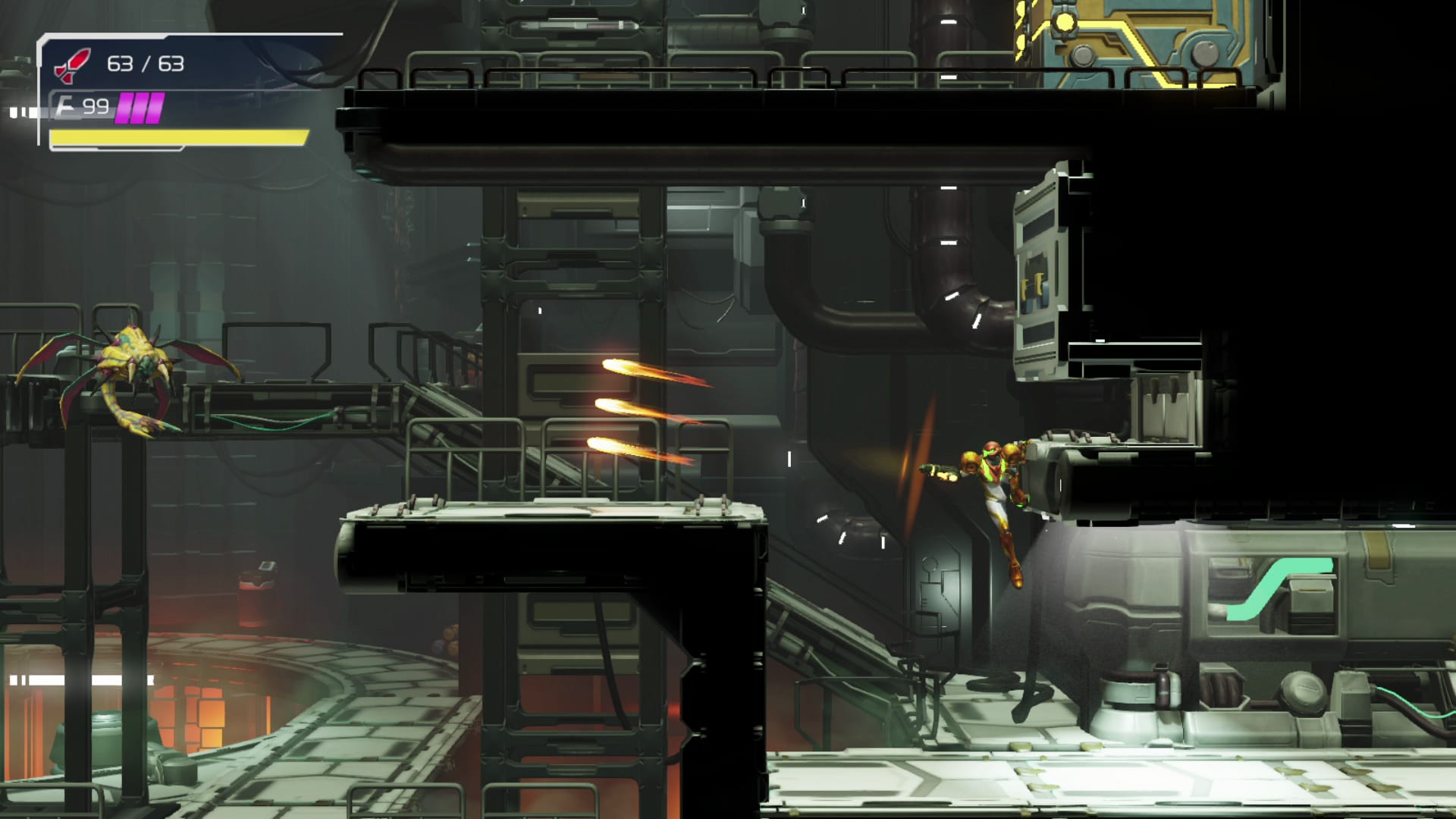
It looks clean.

The moment to moment gameplay is good, with decent controls. They are smooth nut not responsive, with better examples in the list above. This gets more challenging the more abilities you unlock… the dash and spin attacks lack precise controls and you’ll have a lot of trail and error to get it down. The skills you do get are more about opening new parts of the map, rather than changing the particular playstyle. Your beam attack gets more powerful over time, but it’s the same point and shoot from start to end. The solution to every problem seems to be to just put more bullets into it.

The enemies are diverse and certainly require you to take different approaches as the game progresses. The difficulty is relatively low, with only a few exceptions, such as bosses. Bosses here are more akin to perfect runs. You either ace the fight or die. There’s very little wiggle room, so you’ll die repeatedly until you learn the move set of the enemy, then feel like a gaming god when you clear it with no hits taken. It never feels overly painful and does increase the sense of progress. Kraid is here for some unknown reason. I will say the last boss is a right mess to learn all the patterns. It felt extremely good to take him down.

The EMMI droids are an interesting experiment. They are restricted to specific areas and if they detect you will kill you 99% of the time. So again, this is about perfecting a run, with some randomization where the EMMI will patrol. Sometimes it just isn’t fair, and other times you wonder where the EMMI is in the zone. You can never improve your ability to survive them, so there’s no sense of progress. If they were not present, and instead replaced with mini-bosses, this would be a better experience. Or more tools to avoid capture/delay them. It doesn’t work and you’ll just brute force your way through those sections.

The metroidvania part of the game is simplified compared to pretty much all competition. Every collectible is shown on the map, so reaching 100% is quite easy. There are no side quests, no currency, no hidden bits. Backtracking is required, and not terribly intuitive – I got lost a few times on the proper next steps. Teleporting around the map is quite painful (see loading screen item above), so the sense of scale/freedom isn’t there. I will say that there are a half dozen ‘puzzles’ in the game that relate to storing a speedboost (spark) and then quickly going somewhere else to use it. Figuring out how to solve those puzzles is a LOT of fun… if only the controls were consistent enough to let you do it.

This is a quite negative review of the game, but it’s only when compared to the rest of the genre. I can sum this up in one sentence – if Metroid Dread was released 10 years ago, then it would be an extremely high bar. But it didn’t. Every game in the list above is better – better controls, better story, better exploration. This feels more like a new coat of paint on Super Metroid than an actual fresh take. It’s not a bad game, far from it. It’s good and will keep you going. But in this case, the students have far surpassed the master.

Diablo 2 Woes

Over 9 years ago, Blizzard launched Diablo 3. I was there at launch, and for over a month there was the dreaded Error 37, preventing all play. A few months after that, SimCity launched with a similar model and collapsed almost entirely under it’s own weight with the same issue. 9 years ago the interwebs were dealing with the inability to scale their servers.

This is 2021 and Diablo2 servers have been up and down for a month since launch. No skin off my back, I’m done with Blizzard for the foreseeable future, but I also don’t live in a cave to ignore a behemoth like Blizzard not figuring this stuff out. And to be clear, it’s not like Blizzard wants to disappoint players.

I did post a while back about cloud architecture, and how Blizzard runs a hybrid model to manage peak load, for non-sensitive components. Authentication is one of the sensitive bits, for a billion reasons, and not something a AAA company would want to put in a “public” cloud. There are “private” cloud offerings, which are an interesting conversation on their own. I am not a Blizzard network engineer, so this is all speculation here based on prior experience. I am not at all saying this is easy, even less so when you are trying to re-jig (*checks notes*) 21 year old-code.

And yet, this reads like more bad news on a company that can’t really seem to find much positive to report. In some alternate world I’d feel bad for kicking a company while it’s down… but this is really all self-inflicted.

Dyson Sphere Update

In the last couple weeks there have been a couple big updates to Dyson Sphere Program, and then a larger comment on the alien combat content.

Achievement System

For the most part, these are meta goals to change the way you play. Completing the game without using rare materials is certainly doable. Doing it at 0.5x production rate is a scalability challenge. It adds some replayability to the game that isn’t solely focused on SPM at high levels. It will likely generate challenge runs through specific seeds. That would be pretty cool!

Icarus Customization

Less a big deal, but the Icarus (your mech) can now be customized to a decent degree. You can change the color and the art looks better. It is much smoother and doesn’t feel like you’re pasted onto the world. The big gain here though is what this means to the modding community. There are now more hooks to customize your character’s look. It will be quite interesting to see how that plays out!

Combat Engine

I consider this the largest gap with Factorio. The idea that you would encounter hostile aliens during play is both interesting and confusing. Factorio has some sprawl, but it’s dramatically limited as compared to the sprawl in DSP. You’re going to cross solar systems, so whatever defense you do develop has to be highly automated, you need to know what’s going on (imagine fighting on like 12 fronts), and then the ability to impact that context.

Given the complexity of this, the devs are stating at least 6 months of dev work – which makes complete sense. Been lucky so far that DSP has been relatively bug free, the massive blueprint update underwent nearly 2 months of tweaking to get to a really solid spot.

The devs also said there’s more content on the way in the meantime, but I’d be hardpressed to see them as major developments and more focused on QOL items.

tldr; DSP is still in EA, will be for a while, but unless you’re looking for Alien battles in a factory game, it’s pretty much feature-complete.

FF14 Quirks

I’m on a dozen “positive” posts for FF14 of late. They are not effusive in praise, just that they tend to finish on a rather positive note. Looking back on my WoW post history, I don’t think I’ve gone more than 5 in a row without a gripe post, or armchair design item. Heck, my Anthem series has 1 positive post total (to which my brother kindly asked why I was playing it at all). Hindsight here is that I was playing WoW out of habit and small bits of fun – I was clearly not enjoying it as I once did. It was somewhat cathartic to hit the uninstall button a few months ago.

I do need to find the balance in some constructive (?) comments with regards to FF14. It’s not perfect… nothing ever is, but it’s leaps and bounds the best themepark MMO out there, across pretty much every meaningful system. Now, there are some bits that are a bit harder to swallow…

  • New player experience. I am somewhat convinced that FF14 has given up on this as for almost any practical purpose, you’re better off buying the MSQ skip + level boost. By doing so, you actually lose out on all the tutorials (there are many) and the rather solid on-ramp experience from 1-20. That player counts are growing is astounding to me.
  • MSQ time spent. I enjoy the MSQ, I think it’s well written and consistent. You can’t actually see any of the Scions outside of the MSQ, so there’s no weird time travel issues here. (Compare to Khadgar being everywhere and nowhere in WoW). That said, you’re looking at 40 hrs per expansion, with a good 75% of that stuck in cut-scenes. Relevant for the current expansion, but good golly, anyone trying Endwalker for the first time has nearly 200hrs of content to get through. A more obvious way of getting to NG+ would help here.
  • Glamor & Customized looks. Given the small inventory size and multiple jobs, it’s a right mess to have a set of customized looks at the top end. Which is kind of odd, since FF14 really is a glamor competition.
  • Gil costs. Ok, this is not really an issue for top-end players, but it is for anyone going through the MSQ and doesn’t understand the Aetheryte system. Teleport costs don’t scale with level, and the sources for Gil are not readily apparent for anyone who is leveling. Plus, the process of gearing for any MSQ post-campaign quest is stupidly expensive. I don’t think it makes any sense to force an ilvl for a dungeon that you can faceroll through.
  • The default UI. Clearly designed to be console friendly, the base UI is a mess to look at. You don’t really understand how bad this is until you’re in group content and half the real-estate goes away. You can (and should) manually change a bunch of settings/layouts, but if ever there was a place to mod, this is it.
  • Job variety. I guess this depends on your perspective. There are really only 5 classes (tank, melee, physical ranged, magic ranged, and healer). There is not objective difference in playstyle between two warriors. Jobs are akin to WoW-specs which change the buttons, and order of button presses, to execute the same goal. That means there are currently 17 (19 with Endwalker) variations in play. This DRAMATICALLY helps with balancing. Look at WoW and the 36 specs, 4 covenants, half dozen ‘valid’ talent choices, and the nightmare that results (36*4*6 = 864!). I didn’t add Shards or Legendaries either (note: covenants, shards, legendaries will all be wiped in next expansion too, making this a borderline dumb approach to design). tldr; if you like min/maxing, FF14 ain’t really the game for you. Is that a negative? Maybe?
  • Player housing. I personally think that there shouldn’t be any, only guild (free company) housing, where you get a room (and perhaps a fee for a slightly larger room). You’re just not going to find any (problem A) and the design interface is really rough (problem B). I am continuously amazed at how creative players are in regards to decorating – just wow.
  • Inconsistent mechanics. This is a personal one. FF14 does a great job at using a set base of UI elements to train responses. Red = bad, blue = good. Rotating arrows show direction. Icons above your head indicate stacking or spreading. There are however times where there are either no indicators (meaning you need to look at a boss, with particle effects going all over) or the indicators do not correspond to the learned behavior (e.g. the stack icon but you should not stack). These feel like anecdotes that players need to memorize.

That feels like nitpicking. There aren’t any systems that are inherently bad. Everything in the game has a purpose and even stuff from 8 years ago is relevant in some fashion today. When’s the last time you tended your garden in Pandaria, or even visited your class hall in Legion?

What would be interesting to see is FF14’s ‘quit wall’. The point where players generally decide to stop playing due to the effort no longer being a match for the rewards. I’d be super curious to see how many people make it all the way through the MSQ, how many folks have a 2nd job, and the type of content consumed on a daily basis. Even with New World launched, I still have a daily queue on Cactuar, so anecdotally there are still a LOT of players logging on. How long will this increase go post-Endwalker?

The Continuing GPU Shortage

I purchased a gaming laptop in 2019 (17″ MSI Ge75 Raider / RTX2070 / i7-8750) for a decent price. At the time I was debating a full blown PC, knowing that the 30X0 series was due in short order, and that it was likely to be a generational change (like the 20X0 series prior). I had done the math – I could not beat the price of the laptop and had little interest in just swapping out a GPU in a year. One key bit here is that I have 2 kids, so hand-me-down laptops, in particular gaming ones, can last for a very long time, rather than just having PC hand me downs which are a real PITA to manage.

Still, one I have an itch it’s darn hard to scratch it. The 30X0 series was announced and for a bunch of reasons, including the pandemic, there’s been a massive shortage of components for a year now. I can’t blame the companies for the shortage – supply chain issues are crazy complex today. I can blame them for not doing anything about the scalpers/bots. Best Buy in Canada won’t let you order any of them online, and you can only get 1 in-store. The last batch had people waiting 20+ hours for it. Now, can they flip those cards for 1 day’s wait? For sure. But 1 card is a much easier thing to swallow than the bot rampage of multiple cards.

I can buy a card now, but I’d be paying scalper markups. A $1000 MSRP is easily double right now. It’s already hard enough justifying the lower price to play Minecraft in 4k. There are maybe a half dozen games a year where a dedicated PC rig would actually matter. Control is the last one I can think of where it actually would have mattered, and I’d be stretching if I said it mattered for Outriders. The Ascent would be one I guess.

So the base kit would be something like ($CDN)

  • ATX mid tower – 85
  • IAO cooler + fans – 150
  • 750w 80+ gold PS – 90
  • 1Tb Samsung 970 – 190
  • 2x 8G DDR4 3600 – 110
  • B560 ATX board w/ WiFi- 280
  • i7 11700 – 500

That’s around $1400 and I don’t have a 2nd drive (so maybe another $200), and it doesn’t go all out on RGB or color coordination. I’d need an OS ($20 OEM), plus a keyboard mouse ($150) and finally a decent monitor ($300). So let’s say that brings it up to $1900.

Video cards should be (small rant here but Amazon sucks something fierce to search cards):

  • 3060 – 700
  • 3070 – 1000
  • 3080 – 1400
  • 3090 – 3000

The 3090 makes no sense to me, so it’s really a choice between the 3070/3080. So the total rig goes between $2900 and $3300 – add another $1000 if I want to buy from scalpers. I can get a 17″ laptop, with similar specs and a 3070 for $2500. Well, stock levels seem to be there now.

It would certainly be cool to build a rig, and share that experience with my daughters. Maybe in another year when this stuff sorts itself out… or I win some lottery of luck.

FF14 – Stormblood + (4.x)

Spoilers in here I guess. Stormblood is 4 years old… does that matter?

The challenge with any series is that any individual story within still requires a start and an end. The Lord of the Rings isn’t as much a trilogy as it is one story, and with different beats. The movies did a rather admirable job finding the strong points here, but it did differ from the books. Back to the Future one has a clear ending, though it leaves the door open. Back to the Future 2 exists almost solely as a direct set up for the 3rd one. Books are often written with trilogies in mind, and while that act structure is more refined now, that wasn’t always the case. Ender’s Game, Foundation series, even Hunger Games have weird pacing issues as you move through them.

Stormblood has a similar challenge, as the primary plot is the restoration of Doma vs Garlemald, yet also sandwiched in the middle of the larger Hydaelyn arc. The start of 4.0 is a mess, where you fight one big war for no reason (characters make a point of this), unlock Kugane, then travel across the map get into the real story (Hien). Once that part starts, then every single stage of the MSQ is focused on gaining allies for a very large final battle against Zenos. You do end up fighting Zenos and wining. Not only winning, but in the uncharacteristic trend of FF games, he actually dies in front of you. Characters can catch meteors on the forehead and walk away in this game… death is a rather rare event so it tends to be a big deal when it does occur. I don’t think Zenos was a particularly interesting character; he has 1 dimension, and barely any logic in that, but he is certainly set up as being extremely powerful. Anyhow, Stormblood ends with you reclaiming the land, Hein the lord of multiple races, and Zenos dead. It is, after Kugane at least, relatively clean.

The + content starts off as a post-war scenario, which few games ever talk about. When you spend a generation at war, what happens when it all ends, who picks up the pieces? 4.1 is about the politics of leading a newly restored country, and all the characters are pretty much from ARR. Cool to see the Bull get his place though. Oh, and you find a bajillion gil in a lost city (???)

4.2 deals with rebuilding Doma an the miraculous return of Gotetsu (+1). Something is wrong with my map because I can’t see Doma unless I’m on that specific map, and the teleport has to be manually selected. It does still have a relevant mechanic where you can sell stuff for up to 2x vendor value, up to 40k per week.

4.3 is the full-fledged return of Yotsuyu, through her insane half-brother Asahi. This one lands pretty well because there was a lot of setup in the story behind Yotsuyu all along Stormblood proper. She feels like an anti-villain in a lot of respects, where you can empathize with her rage. There are not many such examples of empathetic villains in FF14. It also has some interesting twists here, where Garlemald seems to be playing 3D chess, while Doma is just shooting arrows. If it wasn’t for you being a superhero, then this whole thing falls to pieces. This one does a strong job of closing out the final loose thread (Yotsuyu) that was put up in the closing scene of Stormblood, but it does Gosetsu something dirty having him just abandon everything and walk into the sunset as a monk.

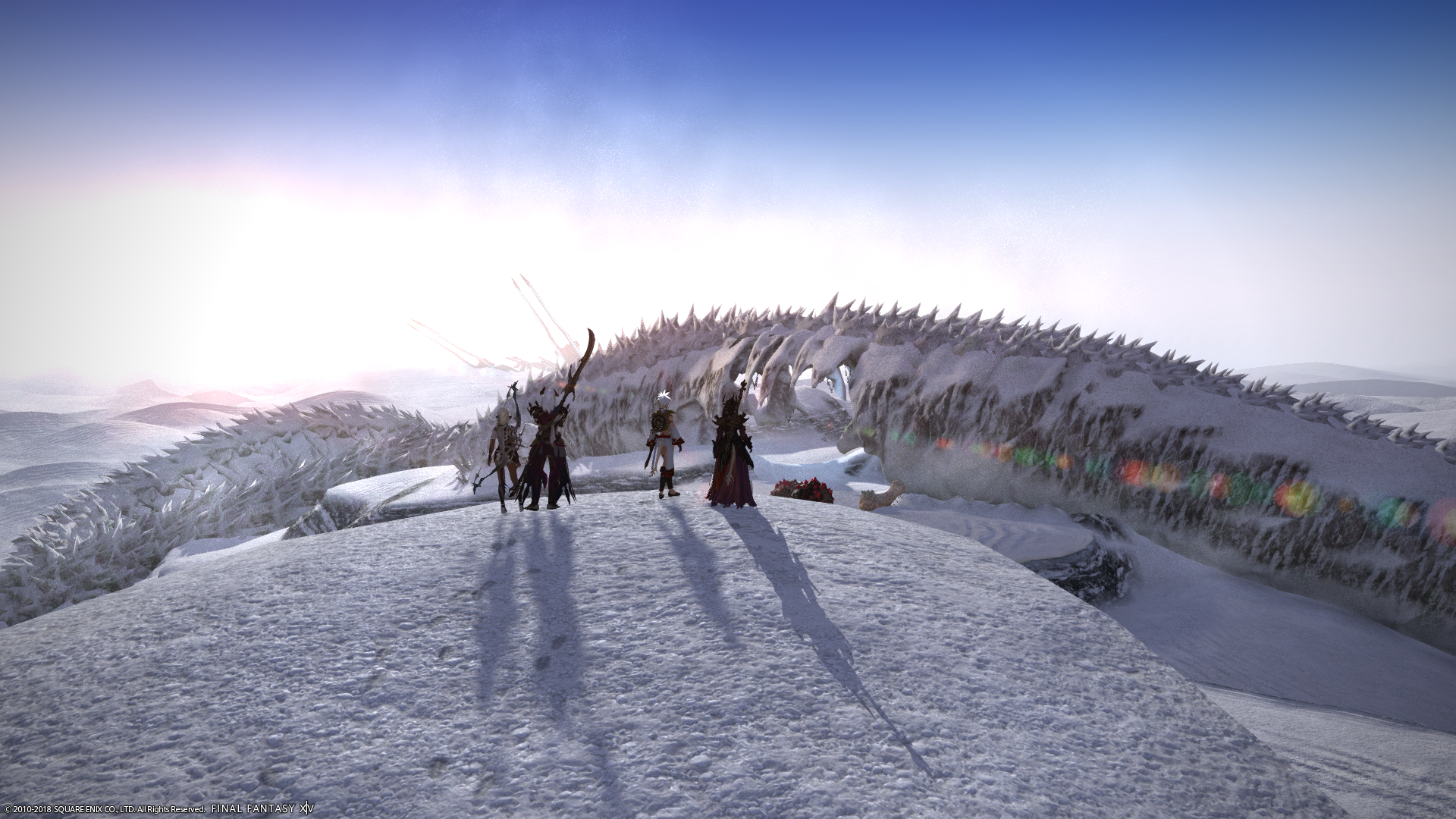
The lighting here is amazing

4.4 is the attempt to build a peaceful relationship with Garlemald (insane this) and one of the coolest dungeons in the game, The Burn. I don’t think it’s a complete chapter though, as 4.5 is the flipside where you negotiate with Garlemald’s leader – Emperor Varis. The parley scene is pure exposition, and you can partly understand Garlemald’s larger motivations. The dungeon here is oddly placed at least in terms of context. 4.6 is just a battle against 1 person, which doesn’t land.

See, Zenos is both dead and possessed by an Ascian. The end result is that he remains physically powerful, now has access to magic, AND suddenly has some sort of strategic sense. Building a god from a corpse, not so much fun. He wasn’t a good primary villain for Stormblood… all the other characters were more interesting with more nuance. If he really wanted to ‘fight the good fight’, it isn’t by oppressing farmers.

Stormblood isn’t a bad storyline compared to other games, and the + content is all logically bound to what preceded it. But the story beats are just off because the story invests so much into Zenos and Yotsuyu. If you ignore the villains and the world building around Doma + Kugane, that part works pretty good. Plus, it has ninja turtles. But the start of it all feels really off, and there’s no real ending because Zenos is still ‘alive’. The lead up to 5.0 (Shadowbringers) feels like a sharp left turn, given that Garlemald is in the process of declaring war on the rest of the world and all the Scions are ‘teleported’ to another place. Perhaps the best way to describe it is that Stormblood lacks a consistent tone.

It seems weird to talk about Final Fantasy storylines not being logical when we’re talking about fireballs, summons, pirates, ninja turtles and a whole bunch of odd bits. I’m not expecting Nebula-level writing either. It just feels like this entire expansion could have done without Zenos at all, and it would have been much more cohesive.

White Mage Thoughts

I still have a decent chunk of MSQ to go, only about halfway done the core Shadowbringer story. Yet from a skill perspective, there are only 2 bits left to go – Afflatus Rapture (AE heal through blooms) and Temperance which is a boost to healing and reduction of damage received. The former is a replacement for Medica, the latter a raid tool for large AE spurts.

Kaylriene has a few posts on this, coming from a more end-space view and both of us have some healing experience in WoW. There are some concept beats that are important to understand in FF14, then the specifics of how the WHM addresses them. First though is being clear that WoW’s healing model is about reactive healing – the tank is always getting beat down so you’re always triaging who needs healing more. If you actually can DPS (a fistweaving Monk is an example), well that’s gravy.

FF14’s healing model is a pro-active one. There are only a few non-telegraphed attacks in the entire game, so for nearly the entire game all damage is predictable. This is helpful as there are cast times in FF14, which means you will learn the dance of seeing a cast bar, and timing your heal to land just after the enemy attack does (if you need to do it at all). For non-tanks, the majority of deaths are due to not moving in time for the AE attacks, or getting cornered because of overlapping effects. The beauty here is that there aren’t a whole lot of 1-fight only mechanics, quite the opposite. You will learn to recognize good and bad AE (colors), stacking icons, spreading icons, and so on. The order of those attacks, and the speed at which they are thrown at you impact the difficulty more than anything else. So, assuming that damage is predictable and mostly avoidable, you should not be healing much at all – you should be doing DPS to bring down the target.

A second important bit is that FF14 “syncs” your stats to the level of the dungeon. If you’re 80 doing a level 34 dungeon, then your stats will be brought down to that level. You can manually un-sync if you wish, but the LFG tool (Duty Finder) applies it. The HUGE benefit here, from a healer, is that few tanks can actually manage a “wall to wall” pull (if the zone even allows it), because they can’t overgear the dungeon. At max level it’s a different beast, but for leveling, you just won’t see it.

DPS for a WHM is simple – one DoT, one direct damage, and one AE attack. At top levels, you effectively become a Glare canon.

Healing is about as straightforward as you can make it. The player has damage, you heal that damage. Until the later parts of the game, you need to be standing to cast, but once you unlock the healer gauge, you get access to some instant-cast versions, on a timer. You don’t have stances, pets, shields, or any multi-step processes.

That makes the class have the lowest skill floor for healing in the game. And because FF14 puts so much emphasis on player control of damage, there are very few instances where healing mistakes cause a wipe. The DPS likely will have stepped in the wrong thing, or the tank will not be actively using cooldowns on “tankbusters”. It’s a thoroughly enjoyable experience!

Are Subs Still Relevant

I would think that many folks that read this blog also read MassivelyOP, which has a recent post on the value of subscriptions in 2021. I have opinions, and I will write them! (In all seriousness, the Massively Overthinking column is probably my favorite one.)

Remember the old days when you didn’t have any choice? Them’s was the good old days, where you paid out of pocket and that was that! If you didn’t like the cost, then you farmed and sold some virtual assets on eBay. In 2021 dollars, I made a lot of money off UO this way. As Evercrack exploded, and the internet in general, a whole lot of dev studios formed to send us out half-baked ideas. WoW + EQ2 are still around, but there aren’t many left from those days anymore. With a bit of internet gaming history, there remained a east/west development wall. The concept of gaming arcades and internet cafes exploded in the east, where the west put internet into your house. That created two different ideas that stayed apart until the wide-scale use of the iPhone.

I won’t lay this all at the feet of mobile devices, but F2P absolutely owes a damn big chunk of it’s existence to it. This is primarily due to the AppStore interface and the ability to sort by price in a sea of garbage. For console/PC games, you could get a decent idea of what the game was by reviews. This is near impossible for mobile games, and the amount of pure garbage on the AppStore at the start was impressive. F2P meant that you could install a game, try it out for free, and then optionally invest money over time. The devs just wanted the app on your phone after all. This model was extremely effective, and it’s pretty much the gold standard for mobile games today.

Success begets copies. We may harp about horse armour being the first amazingly poor-value DLC, but the trophy really does go to EA’s ability to make it pervasive. Box price + micro-DLC for death by a thousand cuts. FIFA makes crazy mint from it! That this model moved into the MMO space only makes sense. MMOs only work if there are people. Even a few free players are going to be an audience for the paying ones to show off. Devs then hope they can get enough whales (or optional subs) to make it all work. SWTOR took this path, though it certainly took the long path to get there!

Value

Paying for something means that as a consumer you are able to estimate the value of an item. You wouldn’t pay $50 for toothpaste, when you know that the there are options at $5. This is possible due to choice and market size, so that you can compare. As items become more widespread in the consumer space, the foundational cost becomes set. When you are presented with a different price, your brain automatically questions the value. If I see a cup of coffee at $1, I am automatically assuming it tastes like old socks, where a $10 coffee better come with a massage. I wouldn’t blink for a $2 cup though.

MMOs aren’t much different. For the older players, we sort of have it burned into us what the value should be. For newer players, that have only every known a world of F2P options, every subscription game looks like a $10 coffee. Why would you spend that there, when you can spend $0 instead? Then there’s the comparison between games. Is there sufficient content in WoW to spend $15 a month? I don’t think so. For FF14? A bit for the content, but more for the environment. SWTOR? That’s entirely the social aspect for me. Look at ESO and GW2, they have no subscriptions – though that then makes you question the up-front cost of any expansion/content.

So perhaps the question is less about what subscription price point is acceptable, and more about how much you want to spend per month on an MMO. I’m less interested in the content/mechanics present in most F2P games, as they drive a different game behavior – which really sorts itself out because I don’t like the actual games. I’m good at the $20 per month range, at least in terms of usage I get out of it. I certainly spend more than that in my social settings, assuming I like the people I play with and the content being presented. I currently spend about $60 a month on gaming in general, so this is just a slice of that pie.

This meandering post really does go into that more general concept. How much do I want to spend on my hobby per month, and then how much of that should be aligned to MMOs. Which then bleeds into the question of what is an MMO in 2021 anyways?

FF14 – To Do List

The achiever in me has a love for lists. In most games I play, I enjoy reaching the end of the main quest, and then discover the various side-quests as I go along. Depending on how those side quests go, I can spend a fair chunk of time in them. AC Valhalla is a good example. There are like 20 different types of sidequests. I’ll say that boat raids are right near the bottom in terms of long-term fun. While I did finish the main quest, I only had about half of the icons cleared. In the MMO space, I tend to avoid the irrelevant side quests as they are often not integrated into the larger story, or are time-gated in such a manner to make it feel like a gatcha game (e.g. Tillers)

FF14 is somewhat different here, as it makes attempts to keep all the content relevant in some fashion. Now, attempts is a big word here, cause success is a different matter. Still, compared to something like WoW, FF14 has a massive chunk of extra content that has some meaning at level cap. Finding it, well that’s a challenge in itself.

The ‘Quest’ icons over NPC

You will have the MSQ icon burnt into you skull by the time you reach 80. I don’t think it’s even possible to get to 80 without it. As you progress in the MSQ, the other icons start showing up. The Sidequest icon (!) is small piece content that gives some small unlock. Chocobo rides are an example. It is generally safe to ignore them, but they do add some interesting content as you go forward. The Repeatable Quest icon is where the dailies show up. They do have some relevance, like clan hunts and so on, but if the goal is leveling then not a whole lot. (The Levequests icon, sort of like a card deck, is a bit like Repeatable Quests).

The blue icon with the +, that’s the unlock quest icon. You will see hundreds of them, and taking them on feels like chasing rabbits down holes. Following an MSQ, you’ll only unlock about half of the content of any given expansion, if not less. Taking on these quests will open new areas, dungeons, raids and so on. If you ignore them while leveling, odds are you will be going back to unlock them over time. There are usually a half dozen or so of these near every Aetheryte crystal. Keeping track of it all though… woo

Enter XVIToDo. Import your character from the Lodestone and get a very simple interface of all the stuff you have unlocked and the things you can unlock. The mobile interface is also super clean. I entered my character information and took a big sigh realizing that as much as my journey has been long, it’s still missing a LOT of big pieces.

Still, now I have a list to work through in addition to the MSQ. Fun times ahead.