IXION

Frostpunk may be my all-time favorite city builder. It provides you with a limited set of tools, a near constant set of cascade failures, really tough choices to make, and the tiniest spark of hope throughout. That balance between the edge of control and the edge of failure is what makes the game superb. And it’s success certainly pushed for imitators.

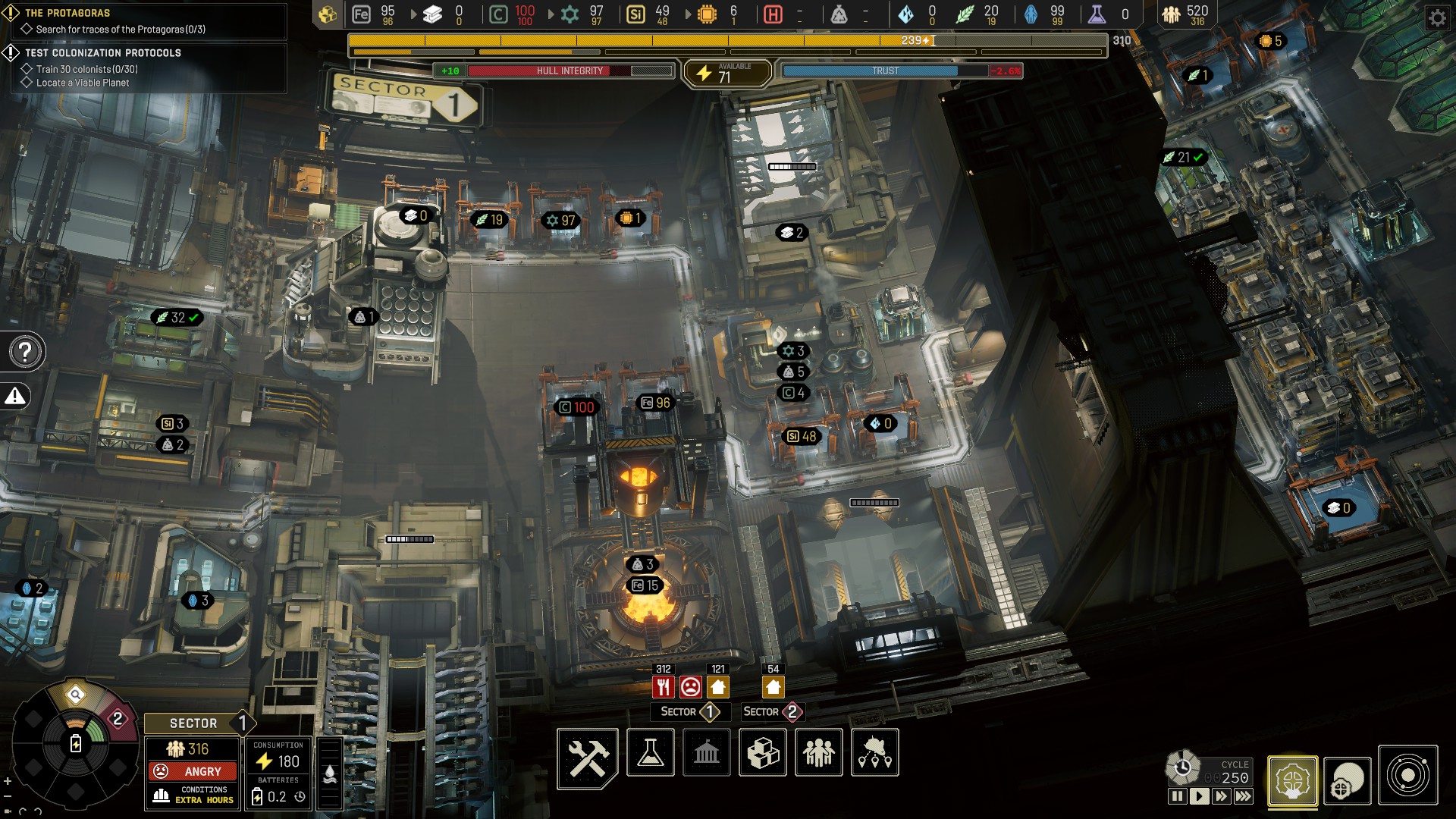
IXION is such a game. The story is simple enough, the future of humanity is focused on an ark of sorts, that is on a space journey. The challenges are also cascading, with balance a constant battle. The tools are your disposal take a while to uncover, and some decisions can massively hamper your progress… to the point where save scumming is a running thought.

The start of phase 3

Space to construct is limited, and each building has a specific set of location needs. Build enough of a type of building and the sector (of 6) becomes specialized, providing a bonus. As with most games of this genre, small percentages have large impacts, so you are likely going to want to specialize.

Resources are scarce. You can find more people in frozen capsules – which feels really weird when you population quadruples somehow. These people need food, shelter, work… and if they don’t, then you start to lose trust, which causes a mutiny and game over.

The ship you are in is in continual decay, and each mission makes the damage greater and harder to repair. This means a constant drain on resources, and intelligent use of time as there are periods where you have to stop repairs to improve power generation, or move the ship. Oh, and each sector you unlock also adds to decay.

Research is both hidden in layers, and difficult to progress. Each “zone” has a limited amount of research points to collect, effectively giving you a soft-wall of progress and forcing you to move, and therefore increase difficulty.

Combined, as is the genre, you can be going along smoothly, only to encounter a massive cascade of failures because one small piece stopped working. Like collecting iron… which repairs the ship and helps construction, which generates housing, which causes trust and decay to increase, and that’s the end of that run.

I do enjoy the logistical challenge of keeping resources balanced between sectors, and overseeing the various needs of the population. That said, I also think there are some balance passes required in how they interact and how they are set at default. Logically, the system should default to complete balance between the storage in each sector… but it doesn’t. Food created in one sector won’t move to another unless you set up that swap… which caught me off guard and caused a rather negative event.

I also enjoy the compounding complexity of various decision points, where you can have a general idea of how something will help you in the future. Some of those decisions are very obtuse… like research for items you won’t be able to use for a very long time. Given the scarcity of some resources, it makes it so that there’s an order of priority that simply is not evident on your first playthrough, and little grace for those types of mistakes. I will point that each chapter requires a very long process to complete, which not only feels like padding, but is likely to generate additional challenges. Like how collecting 500 cryo pods creates discontent as its faster to collect than thaw… Discontent that increases accidents and deaths, making it spiral.

I’ll also point that the pace of the game is rather odd, with random acts of sabotage that you can do absolutely nothing to prevent, and that can hobble you substantially if you’re in a balancing act. They act as time padding, preventing progress for the sake of making the game longer. The rate of accidents increases substantially as happiness decreases, which happens when there are accidents.

I will point out that some decisions you will make can have dramatic consequences down the road, to the point where you won’t realize it until it’s too late. Some mission options have catastrophic consequences, so that you’re better to save scum that hobble through. Some sector construction layouts (in particular around things requiring external walls) can be disastrous… to the point where it’s better to revert to a save an hour+ ago than to rebuild. In a “normal” city builder, you are not continually facing failure, just delays. In here, to a stronger degree than I was expecting, a single bad decision can be enough for a game over.

These are quality gripes, and I can only see them because I’ve been fortunate enough to play Frostpunk. If you’re coming from something like Surviving Mars, then you may not notice these smaller bits. The pace and impact of decisions, in particular hitting massive milestones that alter the gameplay, are key to these types of games. If it’s just continual fire fighting, then that loses appeal quickly as you run into the next fire before the last is put out. IXION straddles that line, and doesn’t always have that work out. For a game that’s been out a month or so, this is super normal and balance passes are part of the deal. I’d still recommend the game in its current state, but can only imagine how amazing this game will be with a few small tweaks. All the pieces are here.

Scaling and Multiplication

Over many years, I have written a lot about power curves. Most games have a logarithmic scale, which climbs quickly at the start and then slowly increases near the end. At least in the context of the “main game”. Some RPGs provide god-tier weapons, but those are also meant for god-tier challenges.

MMOs also follow this curve, yet this is most often within the constraints of an expansion or a major patch. The major patches add minor increments to the end of a curve, while expansions write out an entirely new curve. This to the point where it normally invalidates a large amount of the previous curve, so that “fresh” players don’t have to grind through content at the end of one expansion to access the next. Some games really abuse this model, where the top tier gear from one expansion is replaced by starter gear of the next expansion – thankfully this is much less common today (WotLK was notable).

Base logarithmic curve

The power curve is related to the challenge curve. Depending on where those two are, you either need to perform better or can blindly plow through. If you are on the right side of the curve (high power) and are facing the basic enemies at the start of content (low challenge), you can faceroll most of it.

Power vs Challenge

In most games, this relationship is static. Picking on WoW for a minute here, these were initially hard-coded, making the item/level squish activities very complicated. Changing the value of a Challenge isn’t easy, less so when it hasn’t been looked at for 8+ years.

FF14 has a similar structure in overworld content, and explicit group content (un-synched). You can, if you want, plow through low level content with a high level character (in fact, its the best way to do Wonderous Tails). However, the game has had scaling applied since ARR came out. The Duty Roulette (LFG tool) automatically scales your power relevant to the content, if too high. The net effect is that you can ignore a few mechanics, but not all. FATES also have a sync feature if you want to extract any rewards.

Now, where things really start getting wonky is how games apply bonuses to power. Scaling only applies to the base elements of the power curve, and temporary bonus to apply throws that scale out of whack. Temporary (or borrowed) power is not an issue with FF14 – the bonuses are usually in the 10-20% range and very limited in sources (food, some temporary buffs). You may see 6 buffs total on a character. WoW has had issues here for years, where the temporary boosts are measured well over 100%, if not bursts of 1,000%, from dozens of sources. It’s meme-worthy to have a couple dozen buffs active at any given time, let alone seeing how they interact as they can compound. It makes it next to impossible to balance or scale… hence why borrowed power simply does not work in Timewalking content (scaled). It’s also why some content tuning feels impossible until you get the right RNG, then it becomes trivial.

In general, I enjoy content that has some level of challenge, and where progression is noticeable without being god-like. If there was no challenge, then just turn on some streaming service instead. FF14 is able to make nearly all of the content relevant and challenging (to a degree) so that I do need to pay attention. One key issue with WoW was that the challenge was focused on 2 areas – raiding and Mythic+ – content that built less-than-pleasant social constraints. There was no middle ground left.

I could go on about how Monster Hunter applies this model… though in super simple terms it moved from near-assured death to this is fun. Way different model.

Forspoken – And Why You Should Not Pre-Order

I’ll say this, no one ever plans to do a bad job. Especially in a creative field. Everyone wants to do the best they can, and depending on how complex things become, it can be insanely hard to make all the pieces fit together. A great leader is one who can find all these good ideas, and make them sing together in harmony. And in today’s age, those leaders have bosses, who may not have harmony in mind.

On to Square Enix. I have no idea what’s going on in this place, aside from the fact that the number crunchers are on some serious meds. Aside from FF14 and FF7 remake, they have struggled to get anything out the door that made a lick of sense (Babylon’s Fall) or remotely within sales expectations (Outriders). Marvel Avengers has to be a painful realization on top of it all. There’s a meme somewhere in here that as a publisher, it just can’t get it right.

Forspoken had a really weird vibe in terms of generating buzz. Amy Hennig (from Uncharted fame) was a big name involved here, so there was some confusion in what was being presented vs what people had come to expect. A game with good writing can be undone with gameplay, and vice versa after all.

The real kicker here was that it appeared few media outlets (IGN is the only one I can find) were provided any release codes to the game, meaning that they’d get their hands on it when the public did. This is no different than movie reviews, where if critics aren’t allowed to see it, then that’s usually a very bad sign. And well..

Back to my first point. I am convinced that everyone involved here had the best of intentions and wanted to knock this out of the park. The end result is a good reminder that even the best of intentions do not make a great result, and further re-inforce the need to not pre-order until the game is actually out.

Been a really, really long time since a game before release actually ended up being impressive. Maybe Fallen Jedi? There’s just dozen more examples on the other side of the coin.

Hopefully, Square Enix can learn something here and find some new groove where they can release games that people are interested in playing. There’s only so long you can just give away money…

Living Ships

The whole Twitter stuff is enough distraction. I disabled my account yesterday and I’m moving on.

No Man’s Sky doesn’t have many timegated systems, 2 that are quite obvious – Frigate missions and Settlement Upgrades. The latter doesn’t have any real impact on gameplay today, and feels more like the seed of an idea. A sort of ant farm really. The former is a very weird (for this game) system that allows you to send smaller ships on missions, where they can return with various items. With two exceptions, these items can be found through other means, so this activity acts as a more passive gameplay than much else.

Obviously, I am not considering mining operations as timegated.

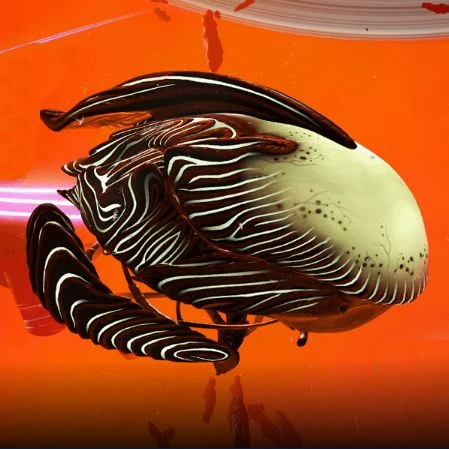
In 2020, the Living Ships update was added. This is a quest that starts in the Anomaly, requiring 3200 Quicksilver (a unique quest currency, takes less than a week to collect this much). Using the Void Egg, you embark on a quest that spans a few systems with relatively simple steps. Each quest then has a 24hr timer, so it ends up taking about 5 days to get to the final part, where you unlock a new starship. Living Ships are starships in a practical sense, all S class, and cannot take any normal upgrades. Selecting your ship is dependent on the system in which you unlock it… so some save scumming is advised to get a look you want. All told, about 2 weeks or so to get one. Now, aside from looking cool, in nearly every other regard it’s worse than any exotic ship due to the upgrade issue. Less cargo slots, slower speed, less damage…

One of many, many designs

In July 2022 the Endurance update added an upgrade path for Living Ships. You need Psychonic Eggs, which only come from Frigate Missions, and then only from missions where there is an Organic Frigate. To get the first Organic Frigate, you need a Dream Aerial, which is a random reward from a normal frigate mission. Getting more Organic Frigates pretty much requires Anomaly Detectors (found in asteroid fields), and then pulse driving until you get the proper encounter (could take 20 mins). Frankly, that is a ton of RNG and timegating to get something that does look cool, but is a real struggle to actually improve. I’ve got my ship, 10 Organic Frigates (that was not fun), and 3 upgrades. Now it’s just a matter of sending them on mission and hoping for RNGesus.

A view of some of the organic frigates

I do get that none of this actually matters in the larger scale, and it’s truly more of an end-game customization thing. The real joy in NMS comes from the discovery and building phase, and then slowly drifts off as the new-car-smell fades away. That joy lasts for way longer than I had expected. There’s a true sense of achievement when you finally reach one of your goals – be it automated mining, a cool base, or a new ship. The fact that you’re not pigeon-holed into a single activity in order to find progress is amazing.

I know I’m in the long tail now. I could reset the universe (crazy typing that out), build an underwater base, or complete a full farm setup for every remaining element (there are only 4 I don’t mine currently). Regardless of where this goes in the next few days/weeks, this ride has been absolutely amazing.

NMS – Stasis Device

No Man’s Sky has is an open ended game, where the goals are mostly self-driven. There are certainly crumbs along the path, to give you an indication that something exists to chase, but the decision to do so is mostly yours to make. Now, compared to most MMOs today where the systems are not at all connected (or just dumped at the next expansion), most of the systems in NMS are interconnected. Derelict Freighters, Frigate Missions, Nexus Quests, and Mission Boards all get you to a similar goal – improving your own freighter.

One of the challenges of these open games is that the initial breadcrumbs often lead to a massive gulf of content, before you can find footing for the actual goals. Examples are things like Factorio or Sim City, where you will likely reach a point where you need to undo a lot of what was built in order to move to the next step, as you didn’t fully understand the logistical implications of earlier choices. Minecraft sort of has this, where you have “starter homes” before you get the idea of the larger/complex systems. NMS is more like this, where development is almost always forward. It’s certainly possible to make bad choices, but they are clearly bad choices when made, and you can recover from them quickly. Even your starter base isn’t a bad thing, because you unlock more blueprints, see how the various systems interwork, and rather simply grow it to something larger (though likely, you will want a base on another planet for reasons…)

Along this path is the RNG of loot. There’s a ton of it, and all of it has some use. Either you craft with it, eat it, upgrade with it, or sell it. Some of these items are of a rarer quality than others and are therefore worth more. When you find your first item that’s worth 500,000 credits, you’re going to be extremely happy. On the 5th time, you’ll start wondering how you can more readily acquire said item, and if there’s something beyond. Well, there is a path for both.

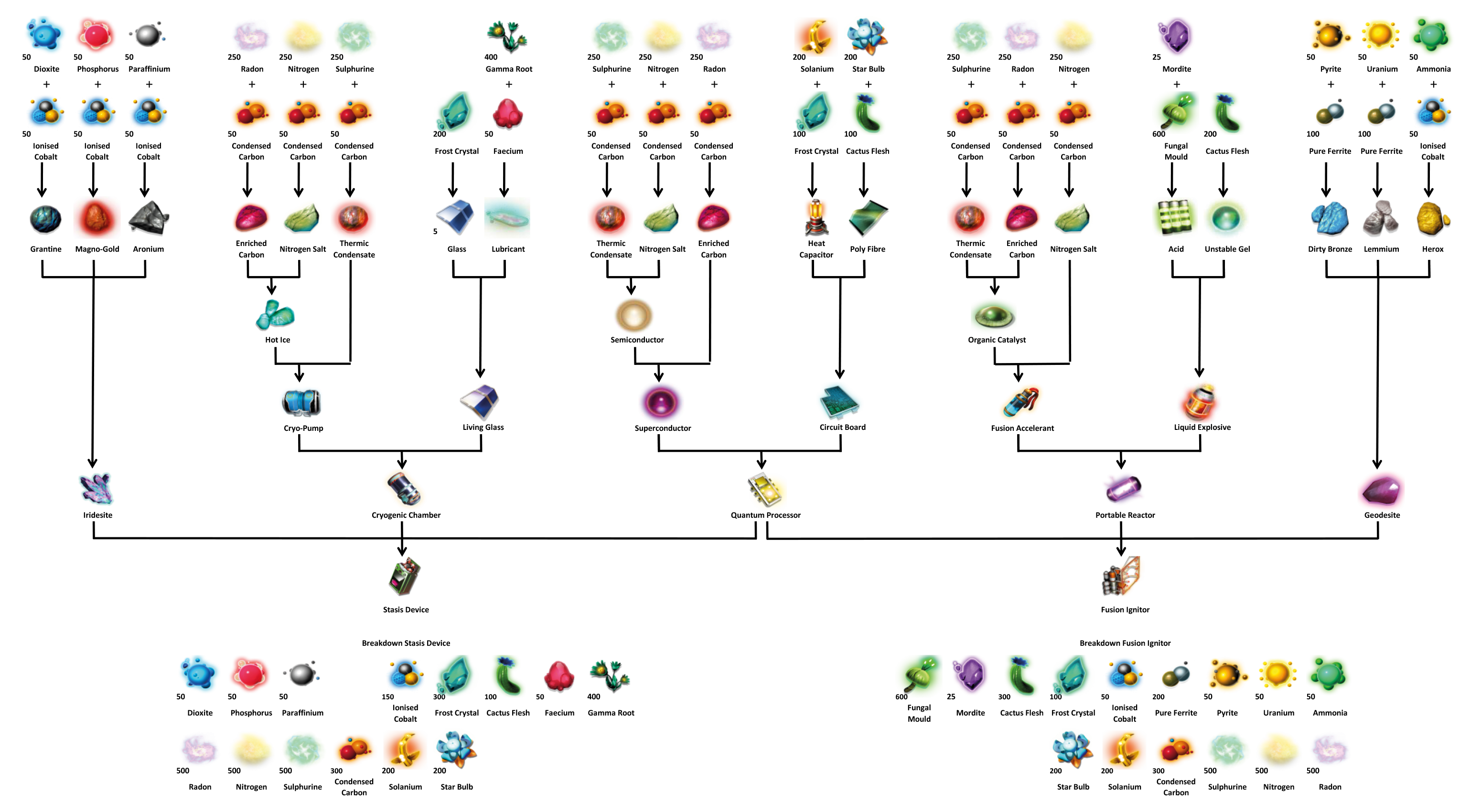
NMS Crafting Tree

Currently, there are two “ultimate” crafts – Statis Devices and Fusion Igniters. Each is worth approximately 15m credits. The top row of that image is the base material required to start. With the exception of Mordite, each one can be farmed in raw form, though the pre-requisites to do so varies a tad. The metal & gas items have to be mined, while the plants need to be harvested.

The harvesting part isn’t too bad, you need glass Bio-Domes to harvest 16 plants. You need seeds and some elements to get started, so it will take a few days to get it all sorted out at a single base. No power required, just the glass to build it all (which ideally is bought).

The mining part is less obvious. You need a Survey Device in the multi-tool in order to find gas/mineral hot spots. It’s a hot/cold game to find them, and then fingers crosses it’s the actual material you want. Finding Paraffinium took me way too long. Once you have those 2 elements, then you need to find a power hotspot, giving you 3 points of interest. Finding the center of those, you build a Base Computer, a Portal, and then some Supply Depots. You then branch out from this base, back to the points of interest and build various collectors (harvester, miner, generator) and then connect all that back to the base you built. Repeat for all the base materials you need (3 to 4 bases). Building each base like this also has a cost, mostly in Metal Plates. You’ll also learn how to “extend” your base past the 300u limit up to the 1000u limit (this really feels like there’s a bug preventing the true size).

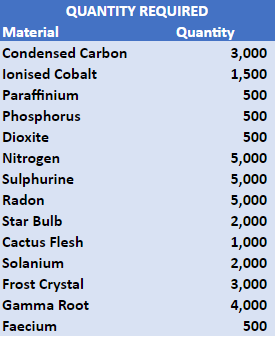
The table above gives you an idea of the materials required to make 10 Stasis Devices. The first 2 items listed are actually a combination of Oxygen + Carbon/Cobalt. In most of the scenarios, you can expect to wait 24 hours between collection timeframes, assuming you have 50 or so of each plant, 2 harvesters of the elements, and 5 supply depots along with it. Getting the entire production chain ready is a good 10+hours of effort, with a fair chunk of shopping ahead of time to stock up on construction material (metal plates, ferrite dust, chromatic metal and glass most notably).

Once it’s up and running, it’s a rather simple affair to collect the material (<5 mins), process the Carbon/Cobalt (2 mins), and the craft the materials (2 mins). If you time it right, you can queue the processing for the next day, making it even faster. That’s a nice 150m in your pocket per day.

Scaling to MORE than this is a tad more painful, mostly due to the fact that items only stack to 9,999 and you will run out of inventory space. Plus, with perhaps 1 or 2 exceptions, there is no object in the game that costs more than 150m credits. Being a billionaire is more status symbol than much else. Though perhaps it can help seed a massive gold mining farm…

Loaded RNG

No Man’s Sky has both determinate and RNG elements, and they intersect in very interesting ways.

Obviously, in the “near infinite” variety of planets, there needs to be some randomization. Theoretically, there should be enough random to have bubble shooting dragons somewhere in this game. There’s a “pool” of events that can occur given fixed conditions. Every planet has creatures, plants, caves, secrets and so on. The variety of each changes, and the quantity, but they are there. Systems are classed on the star type, which impacts the resources found within. There’s a random element to the major race in a system, and then the type of industry. This also impacts the types of events in a given system, as well as the types of ships you’ll find. What remains random (in general) is the quantity and quality of an object.

NMS has a ranking system for many things, from the lowest (C) to the highest (S). Within each rank is some additional random aspect to stats, so that the best rank A item may be better than the worst rank S item, though the overlap is min-maxing in practical terms. A Gek system, for example, will have 7 shuttle types, 7 Haulers, 3 Fighters, 3 Explorers, and 1 Exotic. These types are randomly selected from a pool, but are fixed for that system – realoading will not change the look of these ships. This also applied to Freighters, which is where I’m going with this.

Freighters are acquired through space battles. These battles only trigger when both the following have occurred: 3 in-game hours have passed, and 5 warp jumps have completed. (They will not occur in an unoccupied system, a black hole system, or an Atlas system.) When you warp into a system, it will be assigned a specific Capital Ship Freighter, which is selected from a given pool. The “largest” of them require you finding the correct – random – system. I wanted a Resurgent Star Destroyer, the largest of the bunch inspired by Star Wars. To find this thing, I needed to ensure I had a save prior to my 5th jump. I created a save point and then made single warps until I found the ship TYPE I wanted. That’s RNG phase 1 down, which took about 30 minutes.

RNG phase 2 is finding the highest rank ship, S. That means reloading the same TYPE until I found the proper RANK. To do this, I entered the battle, went to the nearby star station, and created a restore point. This meant I could enter the freighter, scan it to see the rank, and reload if it was not S. The odds of finding an S aren’t exactly high, reports vary between 2% and 5%, with “better” chances in 3* systems or Outlaw systems. The good news is that the reload doesn’t require a battle, simply flying into the freighter. It took about 90 minutes of reloads to finally get an S class.

Effectively this was save scumming, where I limited the RNG portions to only the ones I could not control. Under normal circumstances, you can only roll the dice every 3 hours for a TYPE and RANK, which is a crazy level of random. All told, it took me just over 2 hours of reloads to get what I wanted, which is over 100 attempts. At regular rate, that would have been closer to 300 hours of gameplay. Yeah, I’m good.

Does this freighter have any practical value over others? There are some minimal stat boosts. The real benefit here is 100% cosmetic.

Next up is finding an exotic starship. The good news is that they always spawn as rank S, though the odds of spawn are relatively low. I think I found a way around this though… while I was hunting my freighter, I noticed that starships landed inside the saved freighter, and there was almost always an exotic within. Now the kicker is figuring what type of exotic I want, spawning a space battle (3 hours + 5 warps) in the proper system, and then entering the freighter to collect. Sounds simple, let’s see how that works out.

Diablo 3 Design Time Travel

An interesting article about ex-D3 lead Jay Wilson talking about the original launch of the game. I won’t shy away from thinking he did a poor job and is exceedingly good at deflecting any responsibility from being you know, the actual LEAD.

First in the area of dumb, is that the RMAH was honestly thought to be a good idea to fix the 3rd party market…clearly a solution in search of a problem as 3rd party sites launched at 1/3rd the price of the AH. Duping was fixed with the always online bit, way back in 2012 when cloud computing and dynamic demand management wasn’t yet a thing. The AH was a bad idea from the start, every metric said so, and the gameplay loop clearly pushed people towards it. The truly bonkers reason for keeping the RMAH though… that it was on the box. For fear of being sued and the lawyers needed to confer on this. It took 2 years to remove it. Amazing. I’m all for innovating and taking risks, but you need a back-out plan. Which leads me to…

Jay mentioning that Blizzard’s design approach was iterative perfection, rather than good enough. The old saying of “it’s ready when it’s ready”. Which I think with rose coloured glasses is certainly a valid point and most assuredly delayed a lot of the work on D3. And yet, in that exact same train of thought, the RMAH was therefore “perfected”. Indeed.

Today’s Blizzard is not what once was. The pipeline to delivery is ultra long and their release quality does not indicate perfection. Which I think people are willing to take in stride if the cadence is reasonable, and the corrections doubly so. The last few years of WoW certainly was certainly a head scratcher, where the beta feedback was pretty darn clear about the faults, followed with a “trust us”. And history certainly tells us how that has gone.

It’s a fickle world, where the smallest of soundbytes can be taken out of context. Jay Wilson has spent the last 10 years trying to find every reason why the launch of D3 and its design was someone else’s fault. This older interview with Kevin Martens is a much better take on listening to feedback and an iterative focus on content in Reaper of Souls. Wild how much better than expansion was/is.

Achiever vs Explorer

No Man’s Sky attempts to hit the Bartle archetypes, to various levels of success. You’d have to put a lot of effort convince me that either the Killer or Social types have much weight here, which dramatically reduces the feeling of competition and FOMO. The Achiever and Explorer types are the main targets.

Achievers are goal setters, where progress for the sake of progress is the main joy. The goals can be self-defined or system driven, but they are there, and the goal is often times worth more than the journey. RPGs tend to scratch a crazy itch for achievers, as there are numerous levels of goals within (quest, levels, stats, items). Games with logistical challenges are also a big hit, be it Valheim, SimCity or Factorio.

Explorer certainly have goals, but the journey is the key driver. Looking under each rock, they take joy for cataloguing the world and see how the pieces fit together. A goal is often just another part of the journey to the next exploration bit. Games with large maps and interconnected systems really resonate here, so things like Minecraft and Skyrim are like crack.

NMS has a lot of content for both types. A practically infinite world to explore (I am the first human discovering some planets in a game that’s 6 years old). A very large swath of procedural tasks to accomplish (on a per-planet basis, this dwarfs most “games”). There’s a substantial amount of “stuff” to find and catalogue – language alone has 700+ words for each of the 3 species. There’s a tiered systems of resources, where complex ones can only be crafted. There’s a “system of trade” that has market forces within (you can “crash” a market by flooding it). And there’s a collection system with an RNG rarity tier on top of it, meaning that there’s usually a carrot of sorts to aim for.

One of the twists here is the interconnectivity of these systems. Valheim forces you to explore in other to achieve, that’s where all the bosses are and by consequence, the ability to use any of the new materials. And exploration is generally gated through achievement, you simply need a better boat to get across the ocean, or armor to avoid squito. NMS is in this vein, where you absolutely need to move between planets and explore them to some level of detail in order to acquire necessary stuff. There are certainly “golden planets”, where you can set up self-sufficient mining operations – I mean it’s a game of odds after all. But you still need to find them, and the only way to catalogue a planet is to land on it.

This effectively placed tiers on NMS’s various systems, in that in order to progress (achieve) you need to find (explore) the necessary components. Some of them are obvious – find copper. Some less so – Vykeen Daggers are randomly dropped from specific events in certain systems.

Where things get a bit tougher to digest is when you apply scale, as with all other logistic games. You will find dozens if not hundreds of systems in your travels – let alone planets. Organizing them is just bonkers. Mining is useful, until it’s not because you have what you need. There’s no automation of this system, just some standalone pieces. Exploration will reach a point where you simply accept the infinite variety of things – which I suppose is a message in itself. Never have I seen a game better reflect the adage of “stare into the abyss and the abyss stares back at you”.

These are far from complaints. The journey along the path lasts as long as you want it to last. The infinite goals are there as long as you want to achieve them. I’m frankly amazed that this game even exists.

No Man’s Sky

In all the history of gaming, there are only a handful of games that we can generally accept as “comebacks” from their launch failures. FF14 gets most of the attention, but we forget how it was shut down and relaunched, acting more as a sequel than an iteration. No Man’s Sky however, that’s something altogether different.

Launched in 2016, it was touted as a near-infinite procedurally generated miracle. The hype machine was going full speed. What actually launched was a proof of concept of a universe builder and exploring simulation. A sense of ownership and place just didn’t exist, and gamers were not pleased. The developers took the flak, shut down most social media, and then decided to get to work.

Foundations was the first post-launch release, about 3 months later. It started things off with being able to create a home base. There have been 30+ releases since launch, culminating with version 4.0 – Waypoint, and a Switch release. The most recent one streamlines a lot of the starting experience, and provides a “relaxed” mode that fits between survival and sandbox.

I’ve had NMS since 2018. It was on my radar for a very long time, and the mid 2010s continued failure to launch junk had me wary of jumping in. The whole “no presales” bit eventually dove into “wait for reviews”. It was the tail end of the 1.x content, which if I recall was what the game’s original launch vision was supposed to be. I gave it a go, and lasted a few days. The training wheels section was both painful and too short, with survival mechanics that were a major source of friction.

I’d pop back in every year and a bit, start a new save and see where it lead. The pandemic certainly gave time. If I played sandbox mode, the sense of exploration was dramatically neutered because you had everything at hand. If I played the normal mode, then it felt like I was in the northern wilderness continually finding base materials to fix my mining laser. I wouldn’t say I despise, but certainly have an aversion to survival mechanics that are simply time padding. I think we all have enough of that in the real world, right?

4.0 came out a week+ ago, and with it came relaxed mode. The “default” relaxed mode is essentially survival without so much friction… things take the same amount of materials to construct, but they just last longer. Not having to recharge your suit or mining laser is AMAZING! Death is far less frequent as well, which is a huge boon as combat is not this game’s strong suit. The game just becomes substantially more accessible to everyone. And on top of that, there’s a slew of additional toggles you can use to add/remove difficulty to the game.

I realize I haven’t even gotten into the game mechanics yet, and honestly, I think that’s for the best. There’s no singular answer to what NMS actually is. The things it does offer are rarely in isolation of each other, which makes it that much more surprising as you go through. You can treat it like a base builder if you want. A pirate hunter. A trade empire. An exploration adventure. In small spaces, it had multiplayer as well. It may be easier to explain the things it doesn’t do.

I’ve personally focused on the main Atlas Path quest, to find the source of truth of the universe. I’ve got a simple base, my starter ship, a stupidly powerful multi-tool (through sheer RNG), tons of new languages learnt, a settlement to take care of, and two dozen or so systems discovered. And it still feels like I’m standing in the surf of an endless ocean. A clear research path leads ahead of me. There are a dozen breadcrumbs quests open to add more complexity to the gameplay loop. And I’m still enjoying the gameplay loop.

I’m frankly awestruck as the sheer volume of content here, and overall polish. It’s one of those few games that everyone should give a try.

Surviving Mars

I have a soft spot for city sims, in particular when the settings are a large step away from typical urban settings. I have an even softer sport for incremental builders (Dyson Sphere Project is superb). There’s just something about logistical planning that I enjoy… fancy that. Surviving Mars is a mix of both genres, and in order to merge them, both are diluted.

The setting is simple enough, you’re sponsored and given a rocket ship with some bits that can be used to establish a martian colony. In true red planet fashion, the world is inhospitable and you need to balance restocking from Earth and discovering elements to become self-sufficient. The first “larger step” is building a dome for colonists, which is where the city sim portion comes about.

Colonists have specializations that improve performance in certain tasks, and diminish them when doing something else. There are social factors to ensure they stay happy and don’t go bonkers. They can have kids, go to school, and have perks/flaws that impact their behavior. They also die. See, children in space can only work at a given scale. They take a lot of resources and take a very long time to mature to be “useful” when in a survival mode.

And this is the logistics piece. Mars has a ton of resources to be discovered. Collecting them is very painful. Surface elements are sparse, and most of the elements require you to have a specialized building. Buildings that can only be staffed by people. People who can only live in domes. Domes which are expensive to build and maintain, and have a very limited range. It makes it so that the cost to harvest is often well superior of what you can collect.

Now, there are some solutions to this problem, but nearly all of them are locked behind research, which appears to have some amount of RNG in availability, as well as a significant time investment. Breatkthroughs are a type of research that are unlocked through random events and is completely gamebreaking as it removes the need for people. In the “logic” part of the game, you can also create bionic folks, who eat/sleep, but can’t die of old age. If I can create that, how in the world can I not automate mining?

The logistical challenge of the mid-game is often a frustrating point in many games, as it should be a struggle to balance things while working to add automation. Frostpunk is probably the best example of this mindset, where you’re always on the edge of failure, but the hope of automating one small step has a huge payoff. DSP’s mid-game has undergone a lot of tweaks in early access, and is in a really good spot now – the challenge is moving from a planetary scale to a solar system scale.

Surviving Mars (the base game, I have yet to try the DLC) has a rather large gap in the middle portion where automation should be the goal, yet the carrots to achieve this is hidden behind RNG. I enjoy the balancing of resources, both harvesting and refining. The game just puts a massive hurdle in scaling that system where the goal of colonizing Mars is stalled due to the inability to optimize. Contextually, I understand why research is hidden and breakthroughs are so powerful… that’s the whole point of exploration. Mechanically, the game portion suffers from the RNG in scientific progress and direction. Never to a point of critical failure, but in a frustrating lens.

Domes offer a nuanced tweak, where you can prefer specialists and then build accordingly. Space is limited in domes, meaning you need to build another one. The initial and upkeep costs make that a serious investment. Then the people need food, which is a practical challenge. You reach a power wall, where a single building may require 50 and your best tool only provides 5. The thought process here is to build a housing dome, then attach other specialist domes for specific production in the others. A hub and spoke model is theoretically the best path (and what, you know, NASA wants). The practical implications are that you will need multiples of these as mining requires a hub well away from the main cluster, which needs power/water/food/housing. The net effect is that you are better building core infrastructure and then routing it all over the map – with redundant components so that if they are damaged everyone doesn’t die in a half-turn.

And don’t get me started on both the need and pace of research. Argh!!

Boiled down, the game is about 10 hours longer than it needs to be. I ended up setting the speed to maximum (triple time?) and just stepping away for a while. Give me a problem and the tools to solve it.

This comes off as negative, but it’s more an articulation of frustration from the logistics portion. I like the art, I like the challenge of exploring a different planet, the idea that you could be on the edge of something new. There are some neat ideas here, and it would be interesting what would happen if the mechanical components of the genre could better fit the story. And I am very willing to accept that I have simply not cracked the nut of this puzzle.