WoW Alts

When BfA launched my first 120 was my Monk.  Seems to have been the case since Pandaria, for reasons I’ve gone into a bunch of times.  My 2nd was a Horde Demon Hunter, on another server due to the DH restrictions.  I wanted to see the Horde storyline and DH is a ridiculously efficient leveling class.  When both hit 120, there was a major gearing wall, and the azurite system made by blood boil.  I dropped out until a few weeks ago.

I figured with double faction and xp, it was an ok time to use my pile of WoW tokens.  When I started, the roster looked like this:

110: Hunter, Rogue, Death Knight, Demon Hunter, Paladin, Druid

100: Shaman

80: Mage, Warlock

Warrior and Priest as bank alts.

Before I get into the details, there’s a question of why?  Alts are easier to play in BfA than Legion (by FAR!), and allow running older raids for pets/drops with less waiting for lockouts.  Also lets you see if you want to run another class as a main / fun factor.  It is in no way practical to run multiple max level characters.

Goals

First up was unlocking flying.  That took just over 3 days, as I had already unlocked Pathfinder 1 way back at launch.  Mechagon was the holdout faction, even with a contract that added +10 per world quest.  The bugger here is that Mechagon doesn’t have world quests, only dailies.

While I was unlocking that portion, I was testing the waters with the 8.2/8.3 content.  The Heart of Azeroth boost in Naz is quick enough, and you unlock a huge power increase.  That’s enough to survive the invasions that 8.3 brought, though you need an ilvl close to 420 to do the horrific visions for the cloak upgrade.  The side areas can’t really be done by anything but a tank and low ilvls.

I was keeping mental notes of what happened when.

The Alt Plans

Heirloom gear to 120 (head, shoulder, chest, legs, cloak) gives +45%xp.  The generic 100% boost helps.  The choice was with or without war mode.  I wanted to try without to see what happened.

Gearing would be weird bit, since scaling in BfA is all over the place.  I know that starting BfA gives you a weapon, and that there’s 1 quest per zone that gives you another.  Starting Nazjatar gives you a i370 weapon, and there are really high odds you get enough mana pearls to get 4 benthic (i385) armor pieces.  Get that sorted out, then WQ to fill in the ring/trinkets, and then armor again.  Mechagon is effectively useless for this.  That’s enough to start an invasion from 8.3.

The Execution

The Rogue was the next up to 120.  Stormsong Valley + another dozen or so quests in Drustvar (unlocking the first village).  That was pretty quick, a single death, but felt like I was hitting with a wet sponge compared to my Monk.  Gearing went relatively smoothly, focusing on upgrading the worst pieces first.  The cloak quest was painful to get through.

Next is the DH to 120.  Drustvar + up to the boat crash section in Tirigarde.  While it took more quests, the Drustvar experience was much faster than Stormsong due to the quest design.  Stormsong has at least 4 quest hubs that are just a massive pain to get through due to mob density.  If people aren’t leveling, then it’s just not fun.

Finally, I brought my mage up with War Mode enabled.  I’ll talk about that mode in a bit, but the experience gains were massive.  Drustvar alone was enough to hit 120, and that’s without any rested XP.  However, the mage died a LOT.  A bit from ganking, but way more due to power balancing.  They have no real armor, making them ultra dependent on damage output.  I leveled Frost, which is super proc dependent, which is greatly impacted by Mastery.  Crappy gear = low weapon power + low mastery. = low damage.

War Mode

This is a really, really weird system.  +25% experience and +25% rewards (gold while leveling).  Since every single zone up until Legion is designed to be faction specific quest lines, you rarely ever see anyone from the other faction.  When you do, it’s clear you’re both leveling. The gains are significant XP-wise, but 25% more gold on a 3g reward is meaningless.

Legion has some rough spots, as you can’t really use AE or trigger a massive fight.  If I did, it was often just easier to stand there and die than waste time fighting back.  The optional “clear this area” quests were skipped for that reason.  It was pretty quick, though I have to say the Artifact Weapon stuff is a bummer without the special skills.  Since Legion doesn’t give any weapon rewards, getting the artifact at 100 is the only thing you’ll see for 10 levels.

War Mode in BfA.  80% of Drustvar is cool.  The last 20% in the haunted village is less so.  I got ganked, and then corpse hunted for 10 minutes.  Being level 5 or 119, you are going to get stomped by any geared 120.  The flipside is that the XP gains are solid (saved ~1hr or so), and the BfA gold rewards are significant.  Was around 10k total by the time I hit 120.  That said, the second I hit 120 I turned off War Mode.

Why?  Cause 95% of world content is better in a group, and that means AE.  AE + War Mode = massive battles.  Useless battles.  I would much rather complete a WQ / event 5x faster than get 25% more gold.  More in another post.

Lessons Learned

There are many, many tools to help level up faster.  Only a few are really worth it.  Doing dungeon runs in LFG can be substituted.

  • Heirlooms armor – getting +45% xp is easy enough (head/chest/shoulder/back).  I suggest only having 1 cloak for all alts, rather than 3 of the (int/str/agi) if money is a thing.  A single piece costs 500+1000+2000+5000 = 8,500 gold.  Armor type matters (e.g. cloth for casters)
  • Heirloom weapons – from 1-100 this is very useful and relatively cheap.  At 100 you get an artifact weapon, and BfA is over quick enough.  1-100 costs 2,250 for a single weapon.  Getting it to BfA quality adds 10,500 to the cost.  The stats on the thing make a difference too.  Hunters are the worst here, since they are the only gun users.
    • Flying.  Sweet baby jeebers, make sure this is unlocked before leveling in a zone and that you buy the associated skills (Master is optional)
  • Zones: 1-60 any Vanilla zone is fine.  60-80 you want to do Borean Tundra (this is the slowest portion).  80-90 is Jade Forest.  90-100 is the starting WoD zone of your faction.  100-110 is Azshara.  110-120 is Drustvar / Vol’dun.  You’re only going to see 1 zone per level range.
  • Bags:  Get 20 slot bags.  You’re going to fill up like crazy.
  • War Mode: Turn it on.
  • Professions:  Mining and herbalism gives great xp.
  • Treasures / Rare mobs:  Treasure chests are worth collecting for xp.  Rare mobs should generally be avoided.
  • Gold: At best you’re going to make 15,000g from 1-120 doing quests and selling loot, and nearly all of it coming from BfA content.  Flying (280%) will cost you ~5,000g.

Heirloom Table

To give you an idea of where you can re-use Heirloom gear, as a full set of armor + weapons for 1-120 = 55,250g.  Druid as a Cat saves money.  Shaman as Enhancement as well.

STAT TYPE WEAPON
WAR STR PLATE 2HDN/1HND
DK STR PLATE 2HDN/1HND
PAL STR PLATE 2HDN/1HND
MNK AGI LEATHER 2HND/1HND
ROG AGI LEATHER 1HND
DRU AGI/INT LEATHER 2HND/1HND
DH AGI LEATHER 1HND
HUN AGI MAIL RANGED
SHM AGI/INT MAIL 2HDN/1HND
WLK INT CLOTH STAFF/1HDN+OFF
PRI INT CLOTH STAFF/1HDN+OFF
MAG INT CLOTH STAFF/1HDN+OFF

Bit of a Rant

Within the first 2 weeks of this COVID emergency, things were a mess.  People were stressed to high hell for what was coming next (they still have stress), and there’s a wide swath of people whose income streams just dried up.  I’ve been pretty consistent in saying how fortunate I am to be able to do all my work remotely, or I hope I’ve been.

At our first team meeting in this new setting, we were all taking time to bring up concerns with the work from home situation.  Expectations and whatnot.  As added context, this meeting happened after 9 days of working 20 hours, and the end wasn’t exactly in sight.

One leader was doing their job, and raising some members concerns around entitlements – things like having an extra monitor to work from home, refunds on parking fees, monthly mass transit passes, and home internet packages.  In the best of times, I need to bite my tongue when it comes to entitlements, things that are often seen as a perk.  The majority just see it as a neat thing to have, there’s a tiny part of any group that will argue for it.  I know this leader has at least 1 member who is part of the tiny group.

So this question just threw me over the wall.  I am 99% certain my first sentence was something like “you’re telling me they have a well-paying job, they want an extra $100, while their neighbour can’t put food on the table?”  The rant lasted a solid minute, then silence.  I could feel my blood boiling, so I took a few deep breaths, apologized for the outburst, thanked the individual for bringing the issue to the table, and told them to not bring it up again for 2 months so that we could take stock.  If the person wanted an extra monitor – they could buy one.

2 months go by.

Leader brings the topic back up again as the staff is asking questions. This time we had done some prep work for the concern.  Since all the transport items were private organizations, employees would need to sort it out themselves.  The extra equipment (for those that didn’t sort this out themselves in the past 2 months) would be managed through a central warehouse, but with a standard offering.  Topic closed.

Campfire

I’ve retold this story quite a few times now.  My wife has as well.  It is very interesting to see the reactions from people to this story.  Most are astounded that people are even thinking about this, given the situation.  Some go quiet and avoid eye contact, through some sense of guilt.

I mean, I can understand why someone would think this is reasonable.  Their own stress, combined with a near complete lack of social empathy.  As soon as I talk about people who haven’t been able to work a day for months, it just clicks.  There is the odd chance that they are in a relationship, their SO has lost their job, and this $100 is a tough decision.  It’s a bit easier than people with zero income (CERB aside).  In the larger context, an extra monitor or a parking refund is a luxury.


The Hunt for Fun

At some point, the RPG went from ROLE playing to NUMBER playing.  Sure, the P&P games always had numbers (THAC0 was my bane), but they were more indicators than absolutes (the quad power gain of wizards is a thing long gone).  The dice had a major impact, and with a solid DM, you could act your way through a ton of content.  When’s the last time you saw a Bard trick a dragon to killing their mate because they thought there were planning to usurp them?  That sort of insanity is only found on paper.

There was a point of yore where even video games focused on the classes rather than the numbers.  They were simpler times, where zerg-rushes and tank/spank was the norm for challenging combat.  No we’ve moved into roles, where pretty much any class in a given role can fulfill that role to the 98th percentile.  Unless you’re aiming for a world first, you’d be hard pressed to only accept a priest instead of a pally to heal.  On one hand, this has provided a larger breadth of viable choice to the players, in that it’s practically impossible to make game breaking decisions.  On the other, this has homogenized the content where the player really isn’t relevant.  In WoW, the Proving Ground NPCs are pretty much as effective as any LFG group.

So if the choice is not the class utility, it becomes the class fun/constraint as the driver.  Mat Rossi (BlizzWatch) is a super example, where he only plays Warriors – always has, always will.  Not because of game utility, but because of his enjoyment of the class.  The “fun” aspect is the skill kit – what the class can do, and how it makes you feel.  In WoW, I have to say I absolutely love the Demon Hunter toolkit.  Double jump, eye beam, and metamorphis are used often enough to pack a visual punch.  I can only play a Panda as a Monk ’cause my brain can’t make that race be anything else, or that class be any other race.

Other classes, they have some interesting bits.  I love the concept of a Rogue, always have.  The implementation in WoW isn’t fun to me anymore.  Paladins feel like holy crusaders.  Hunters have the whole pet collection bit that is borderline obsessive (pet battles scratch that itch too).  The Druid utility kit is admirable, but the bear/cat rotation is just boredom.  Monks have a great toolkit and have that old martial arts movie feel to them (as long as you play a Panda).  I can’t seem to find fun in Warriors, Mages, or Priests.  Mechanically they are sound, but they feel like the archetype.  I mean, imagine if Mages had an avatar form, where they because the focus of their given element!  Or Warriors had a bladespin move that sucked opponents towards them.  Or if Priests called down a Valkyr (I know) for a major group heal.

Looking back, this is one of the best parts of Legion.  There are classes I played solely for the class halls (Shaman) and their story.  As much as it was largely about following Illidan about, I still felt like my character mattered and the smaller story did too.  Aside from hunting Sylvanas and then Azshara/N’Zoth, can someone tell, me what the character did in BfA?  If you didn’t raid, then there’s no actual character beats.

I’m picking on WoW here because it’s low hanging fruit.  What I find fun, others don’t, and vice versa.  WoW is a buffet of choice.  Buffets aren’t known for amazing cuisine, but they are known for pleasing a very large crowd.  If I look to something like Monster Hunter, the weapon choice is the most important factor.  I love Charge Blade.  Love it to death.  The bow guns are amazing for their utility, but nothing beats a SAED to the head of a massive dragon.  That the game tries to make all weapon choices viable – without forcing you to master everything, is a great achievement (and my largest gripe with Dauntless).

Now, I may optimize my character to be best at what they do, but my choice of that particular class is still based entirely on if it’s fun. And we can all use some fun in our lives.  Now if there was ever a fishing class… oh man.

Strategic Planning

There are parallels, sure, but this post isn’t directly related to current world state.

My strengths focus on strategic planning.  Which is a fancy buzz word to say “I am good at pointing to things, explaining why those things are good, building a road to those things, and convincing people to come with me.”  A lot of people think they are good at the first 2 parts.  There are people who are great at the last 2 parts.  There aren’t a whole lot who can do all 4.

A job change in the fall was meant to have me focus on this particular skill set, and I was really stoked to get going.  The original goal was to look at the service offerings to clients and then help refocus them.  What ended up happening for the first 6 months was putting out internal fires and (re)building a new work culture.  The reasoning is simple, you can’t run shop if your house is on fire.  And whooboy, was the house on fire.

There were 3 main streams of effort – human resources (people), finances (money), and leadership (people).  I won’t bore on the details, but the general steps include:

  • identify the problem
  • consult internally and externally to get perspective on the problem and potential solutions
  • determine a realistic goal, but it has to be a goal that’s worth celebrating, not one that no one knows you’ve reached
  • break it down into chunks that can be measured with SMART metrics (specific, measurable, assignable, realistic, time-based)
  • find the culture enablers (the heart of a team) and the workhorses (the blood) and break it down into smaller pieces that can be communicated
  • plow the road of obstacles, manage the escalations, and provide a stable point of reference
  • publicize everything.  Platitudes are window dressing.  Results are what motivate people, build tr
  • measure progress regularly and modify the plan as needed
  • recognize the achievements for the various chunks

After 6 months, the HR request went from 2 hour meetings and 80% rejections to 20 minute meetings and 90% acceptance.  The finances have automation and logics rules applied, and forecasts are more aligned to actuals.  And the leadership teams have been moved from temporary folks to permanent appointments.

Looking back, I have some pride in the progress.  Some big foundational items have been set up to make life easier for everyone.  We’re saving a ton of time not arguing, just working together.

I’d like to say that the next step is the service offering change – and that is certainly one of the items I’m working on.  COVID has pushed a massive change on my services and my clients.  We already had plans to do some transformation, but this event has put that into overdrive.  What would have been done in 2 years now needs to be done in 6 months.  People are freaking out – rightfully so.   Same process as above, each of my direct reports has to articulate their personal vision and achievable plans, then we work together to mesh it all up, and publicize it.  In this paragraph, I have grossly understated the effort and impact – it’s a year’s worth of work, impacting nearly 800 people.

The other change going on at the same time is an internal restructuring to manage the load.  While I fixed part of the house on fire, I’ve been unable to replace the front door.  People keep walking in and asking for work to anyone they see, and people stop work to help them out.  The intake process is non-existent, and the people delivering the work are currently managing client expectations.  You ever tried doing something important, yet kept getting interrupted?  Takes you 10x as long to do the work if they left you alone.  That’s what I’m trying to fix.

‘Course, people have built up their own domains and claimed kingship over them.  There are verticals everywhere, with people who don’t want to talk to others.  My job now is to break all of that down, rebuild it functionally, and establish a sense of trust between the leaders of those teams that working together is going to be more effective.  Convincing someone that they need to let something go and trust that someone else will keep their interests at heart…that is a really tough ask.  It takes years to build trust and minutes to lose it all.

It’s a much easier conversation handing someone a $5m invoice for peaks in consumption or scope creep than it is to change a broken culture.  There are a few key aspects that I’ve found very useful.

  • Find the enablers.  These are the positive social glue.  The ones that instigate a watercooler conversation.  Get them into the plan early.  They are the health and pulse of the work.
  • Find the disablers.  These look near identical to enablers, but they actively work against change.  It’s possible (and ideal) to covert them to enablers if they help build the plan.  If you don’t, then these people will derail you.
  • Find the workhorses.  In most organizations, 10% of the workforce does 80% of the work.  I don’t mean the day to day stuff, I mean the above and beyond stuff.
  • Take every punch thrown and don’t retaliate.  Have those conversations in private.  Change is tough in the best of times.
  • Focus almost entirely on the goals and let the experts manage the details.  They are experts for a reason and you need to trust them.

Seeing as how I’m repeating the same process again and again, I figure it would be best to “package” that plan as a teaching tool.  And that’s my personal career goal for the next year.  I’m still working out the broad strokes, but I figure if I’m able to do it well, then I should be able to teach it to others in some fashion.  And I should at least try.


Cynicism in Trying Times

(More of a diary than a dialogue.)

I am (mostly) conscious of my inherent privilege.  There are doors that open for me that will barely budge for others.  I am allowed to make a serious amount of mistakes before paying a price, while others are not provided that same leniency.  It’s systematic, it’s cultural, it’s tightly woven into some fabrics.  At the global scale, there are places where people will outright kill each other in a lost war of hundreds of years.  No reason other than “it’s always been this way”.

I make no excuses for this.  I have no ability to be articulate on the specific issues at hand as I’m barely impacted.  I won’t even bother to do so.  I’ll take a larger societal lens instead and let the experts dig into this complex issue.

This post is not a global post, it’s focused specifically on my southern relatives.  What’s going on now is the build up of years of events.  It’s built on the foundation that one life is worth more than another’s.  That there are “others” in our midst.  That isolation and division is a better way forward that working together.

There’s no one root cause just like there’s no one solution.  America’s version of capitalism is a warped affair that only benefits the already-rich.  It’s not possible to become “wealthy” in that sense without being an athlete, artists, or getting an insane amount of seed funding / gift (which has it’s own gates).  The simple matter is that you become richer by getting the money from people who have less than you.  The lack of tools for the social masses effectively makes the US remain a state of servitude to survive.  How the “best country on the planet” doesn’t think affordable health care for all is a good thing is amazing to me.  Even more folly when you consider that the US is beaten by Cuba in health scores.

It’s a social dissonance to claim to have ethics and morals, only to not hold your elected officials to the same standards.  The concept of trusting the person representing a group of people is just plain lost.  That gerrymandering is not only allowed, but encouraged is disgusting.  2 party systems don’t work, there are enough historical examples of it.  Pendulum swings cause larger and larger after effects, and there is only 1 outcome – social upheaval.  Sure, you may have a dictator (self-appointed leader) installed in the interim (like say China or Russia) but the end result always ends in the same place.  As long as you think of people as “them”, then there’s no real progress to be had.

Being a first responder is a calling, it is not a job.  They are meant to represent the best of us, a position of trust at our weakest points.  In Canada, all first responders go through a psych assessment prior to deployment.  I won’t say it catches everything, but I do know that it filters out a lot.  When something does happen (it will eventually), there’s an inquiry and they are treated with the same laws as everyone else.  It is not perfect, but it says something that in 2019 7 people have died in Canada to law enforcement, compared to 132 in the US (403! in 2018).  There are deep seated cultures in law enforcement, and it only takes a tiny percentage to exemplify the worst of those qualities to bring out the marches.

Now we get to the cynicism part.  Peaceful protests are ok, but kneeling is not.  Respecting all values and lives is ok, but supporting Hong Kong is not.  Taking no responsibility but claiming all credit.  Abortion is wrong but letting seniors die is ok.  Supporting businesses in need is ok, but first you need to pay your friends.  It’s ok to have white folks with guns charge a government building, but people walking in the streets deserve attack dogs and to be shot.  You can have one or the other, but not both.  Speaking from both sides of the mouth means you can’t actually do anything.

ezxvqb6x0aedkoi

There’s a limit to society’s patience.  It’s like a wave of change, and the dam that people in power put in to try and change the flow, or reduce the impacts.  That dam works for a while, but eventually the flow becomes too much and destroys that dam. Now the cynic in me says that this is a phase, and that a new dam is being built because of a lack of leadership & power in that wave.  The people that could implement meaningful change simply don’t want to because it means less power for them. (I am bitter about electoral reform up here).

The video of the Canadian PM reflects my own ability to digest and respond to these events.  That 20 second pause says more than everything else that follows.

Sometimes, the house just can’t be renovated anymore, and you need to build a new one.  The US hasn’t seen that for 200+ years.  Dozens of countries have undergone it in the last 100 years.  All of them, without exception, were triggered by social unrest.  I would be surprised if that was the case today, but it’s not far off.

Putting the RPG in MMORPG

There’s been a homogenization of MMOs in the last 10 years, where there really isn’t a whole lot to distinguish one game from the other.  In continuum of RPG features, older games were more in the RPG space, with playing a specific role, choices made, and impacts that were felt over time.  Something like an FPS had little RPG to it, so that the start of a game resembled the end of a game (think Halo).

Time goes on and both of those have started to meet in center.  Nearly every game released today has a stats mechanic, often employed as a carrot for retention (bigger stats).  Fornite and League of Legends may have everyone start on “even” footing, by the end of the game there are large power spikes from the RPG mechanic.  Not to dismiss that an “underpowered” player can’t use skill to overcome, but the disadvantage is there.

MMORPGs on the other hand are moving into a more digestible experience, where the gap between a long term player (investment) isn’t so far away that no new players can come into the game.  Say what you will about WoW’s model, but it is much more willing to let new blood in as compared to EvE’s skill point system.  But is the WoW model where a new player can level to max in about a weekend’s effort the right path?  Or where a new 120 can hit near raid level stats in a couple days?

I’m going to posit that it doesn’t matter primarily because the world of RPGs has so many options today.  20 years ago the people using MMOs were the typical geeks (self-included), so the RPG aspect was attractive.  UO hit that button something fierce.  EQ was a glorified chat bot that tested those social structures that made geekdom work.  WoW’s greatest achievement isn’t the size of the playerbase, its that it normalized the playerbase in the eyes of society.  My kids will never know a world where video games were derided, where geek is something that’s ostracised.  The conversation has moved to from “you play games?” to “you play that game?”  I’ll take that shift as a positive one.

Within a game you’re always going to have exclusionary activities.  There’s not a developer on the planet that isn’t running some sort of heatmap of players vs. engagement.  I am not some ultra wise guru that can divine the inner workings of games or gamers.  So if a situation seems ultra obvious to me now, it most certainly was obvious to the developers beforehand.  NGE in SWG was immediately clear.  The Trammel split is not what killed UO, it was how long it took to be implemented vs. the launch of EQ.   Atlantis in DAoC.  EQ2’s grind vs. WoW’s open beta must have made people sweat bullets.  Someone, somewhere, greenlight FF14 v1.0 as being acceptable.

The decisions are not bad except when measured to the stated goals.  You want to increase the player base, you need to make it more accessible, not less.  You want to respect the existing player base, you don’t wipe all their progress and have them start as fresh as a green leaf.  You want to provide a perception of value, you make sure that the rewards are measurable and trend forward (*cough*azerite*cough*).  You want to provide an element of choice, you need to make sure that there are multiple relative options to choose from.  All of this is simple when written down.  All of it is a nightmare to code and balance.  But at the end of the day, that’s what gamers are paying for, and the insane amount of player choice today means that if devs don’t do this, then players will just move on.  There is no single horse in town anymore.

Opportunity Costs Everywhere

This post was drafted a while ago.  This blog is as much about gaming as life, and it would be ignorant of me to not point out the sheer insanity going on around us.  It would be further folly to say that this wasn’t the obvious outcome of a seemingly infinite amount of factors.  I’ll come back to this point in a more fulsome view later.

Opportunity cost is where you lose the opportunity to do something while doing something else.  This is, impressively, one of the pillars of society.  You can’t have workers if you don’t have farmers.  You can’t have artists if you don’t have workers.  You can’t have X without Y.  Games like the Anno series are examples of this system of dependencies and plateaus.

At the micro scale, it can be something as simple as the time you spend prepping food vs. buying pre-made meals.  The former is certainly less expensive if you look at it from an ingredient perspective.  Where it gets more complicated is in labour costs.  Even though you may get paid more per hr, odds are the service costs are higher because that takes into account a bunch of overhead costs.  So for argument’s sake, let’s say making a gourmet burger at home costs 8$, picking it up costs $15, and getting it delivered is $20.

The opportunity costs is the time it takes for you to do this, giving 3 cases.

  • Making it yourself : 40 minutes @ $8
  • Ordering and picking it up: 20 minutes @ $15
  • Ordering and having it delivered: 3 minutes @ $20

Then you look at what you could have been doing during this time.  Learning to play guitar.  Spending time with the kids. Washing the car.

Again at the micro level, people see this come up everyday, multiple times.  In my neighbourhood, over half of the folks pay for someone to plow their driveway during the winter, yet none of them have someone mow their lawn (so time is less of value here than effort & comfort).  I could paint my house and spend a week doing it, or pay professionals who will get it done in 1-2 days.

I tend to classify these choices into two categories, the large and small.  The large ones are where I have a choice to not work and do it, or pay someone to do it.  Those choices are much simpler as my pay/hr is motivating.  When I was working part time as a kid, this was even easier as I could do it for cheaper.

The smaller ones at the individual level are actually the hardest to do because they appear to be convenience but often have much larger impacts.  Using the food example above, the one-off is fine as long as it fits in the budget.  Making a habit of it has health impacts (since 95% of ordered food is not healthy choices) and financial ones (since most people are not offsetting the financial impacts of the choice).  Something as simple as a breakfast sandwhich and a coffee before work is $8.  Do that every day in a month and it’s $160, or close to $2,000 a year.  Prepping it at home is closer to $1 per day.

I like to fish, and that costs money for bait.  Worms are $7/18, and plastic baits (with hooks) come out to around $1.50 each.  I can get through the worms in a weekend with the kids, and 10 plastic baits.  Each weekend can therefore cost me $22 in bait.  Breeding my own worms is $40 of material investment, but reaping is nothing for 6 weeks, then a limit per week (to maintain breeding).  Making my own plastic baits is $120 in material investment (then ~50c in material per item) and an hour of effort, but I can’t make hooks.  My napkin math says I’d need to make ~200 baits to get a return on investment – or 20 weekends of fishing (2 seasons).  If I used more bait on a regular basis it would make sense, but for now the costs are entirely manageable.  Right now, it would cost me more in time than it would in money.

I know this isn’t a common viewpoint.  It doesn’t account for the emotional aspects of an activity, the skill growth, the expertise, or the networking benefits.  But if people take a step back and think about why they make certain choices, they will realize that they likely apply this thinking instinctively.  The entire concept of convenience is based on it.

Cause really, I can always make more money, but I can never truly buy back time.


The Joneses

When I bought my house nearly 15 years ago, I was the young buck on the street.  GF, no kids, rather simple life.  Parties most weekends.   Had friends over to reno the majority of the house as it was owned by an 80 year old who kept it like most 80 year olds did.  Neighbours were a mix of older parents, most 15 – 25 years older than me.  Of the 40 or so houses on my dead end street, 4 of them have been resold multiple times, and only 4 others have been sold in 15 years.  It’s getting older around here.

Life goes on, I get married, have kids and the neighbourhood has grown up around me.  A large chunk of the street is now retired folk, very few kids.  And what retired folks have in abundance is time.  And people with time fill it with all sorts of things.

The easiest way to find the retired people is to look at their lawn in the spring or driveways in the winter.  There are fields of yellow dandelions up and down my street, with pockets of pure green.  It’s even funnier when two neighbours share a lawn without a fence – you can see the clean division.  The people with green lawns spend hours meticulously manicuring their lawns.  Whether for their amusement or competition with the others is a good question.

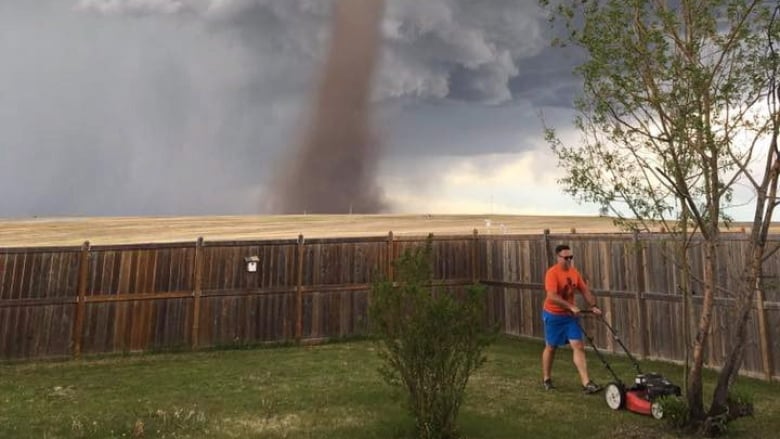
So here I am mowing the lawn (I guess it’s still considered a lawn) the other day and looking out and about.  I’m sweating like crazy in the humidity, amazed that I am even finding time to mow it once a week.  And then trying to napkin math out the effort required to get it pristine, let alone maintain it.

do-not-reuse-wea-alta-tornado-mower-20170603

Here’s a line & here’s another line

Then I come to the realization that the lawn is pretty much the most important thing in their lives, or at least the thing that they spend the most time working on.  My grandfather is an active person, always out and about.  I can’t ever recall his lawn being this shade of green or ever being weed-free.  He never had time for it because he was busy doing other stuff.

This isn’t a judgment on what the people are focusing on, if they value their lawn and never leave the house, that’s up to them.  Just because I don’t share that particular obsession, doesn’t mean it’s bad.  It’s the definition of “their own backyard” after all.

Here I am, mowing the lawn & weeds cause it just needs to be done, as a step to doing the things I really want to do.  Then I’ll pack up some food and drinks, head up to the cottage and enjoy the outdoors.  Do some social distancing with the neighbours.  Plant the garden.  Get in the boat and fish with the family.  Play some boardgames, and have a pint around the campfire.  The weeds will be there when I get back.  And I’ll let the Joneses worry about their own lawn.


The Box Syndrome

This is more in line with psychological debate than gaming topics, but it applies across a lot of life.  We generally like to categorize people, and this is a similar attempt.  I call it the Box Syndrome, and it is one of the archtetypes I use to engage with people on terms they understand.

The premise is somewhat simple.  People with this syndrome believe that their world is a finite box.  They are unable to see outside the box, and don’t believe that anything matters but what’s in the box.  They view the source of things entering / exiting the box with mistrust or wonder.  If you’ve ever tried to play a magic trick on a toddler, then you can see what the Box Syndrome looks like.

Everyone starts in this mode, and with time (and willingness) they move on.  There are plenty of people who find comfort in the box, in the familiarity of it.  They are shown that there are things outside the box, but make a choice to ignore them.  They make that choice for a wide set of reasons.

Social media dramatically enables this mindset.  There’s a reason they call it an echo chamber.  Flat-earthers, anti-vaxx, conspiracy nuts are all stuck in their box, and regardless of what happens outside the box, they just don’t care.  They will do whatever they can to paint the walls of the box to reinforce the ideas within that box.  There’s very little you can do to deal with this mindset, aside from creating a new box within their existing one, then moving that new box elsewhere.

There are people where the box isn’t so large a negative, simply a safety blanket.  People who fall into routines and forget why.  Folks who have been doing the exact same job for years and never changing.  They are hyper resistant to anything that questions the existence of the box.  Dealing with them means respecting the safety the box represents, and helping them find a new safety box and a path towards it.

This isn’t to say that the syndrome is all bad.  Everyone needs a box from time to time in order to recharge.  Non-stop change is a rollercoaster that no one can maintain.  It also protects you from un-wanted change.  If you hit a rough patch on the job front, then you need to box your budget to survive and ignore the more frivolous items.   But there’s a time where you’ll need to remove that box.

In the middle of an emergency is the time to start paying attention to the box, or at the very least aware of its existence.  There are more than enough examples of people making, uh, interesting choices because they only see the walls of their box.

I find myself challenging this mindset more and more lately.  I’d say the majority are willing to accept that change is required, and help take part.  There’s a small group that is aware of the box but unable to do something about it.  Then there’s the smallest group who are in their box and unwilling to do anything about it.  The sad part here is that regardless of what they think about the solidity of their box, no matter how much they’ve shored it up, they can’t survive without the people outside the box.  Change is going to happen.


The Golden Age

The first Age is always the Golden one. Where things are new. Where the impossible seems possible. Where mistakes are made and accepted as part of growth. Where hindsight after many years makes you really question the sanity of that time as the time context is gone.


Bhagpuss has a summary series on EQ through the ages. It starts, as they all start, with a Golden Age, a pinnacle, a decline, a resurgence and then… meh. It’s always meh for the current age.


You can apply the model to pretty much anything. Sci-fi. Cinema. Music. Food. And when you apply today’s paradigms, you can pull out all sorts of nonsensical items. Fahrenheit 451 has nothing to do with books – it’s a social commentary on technology making people into zombies. But since we’re all zombies beholden to technology, we don’t get that.


UO, EQ, WoW at launch were a gift from the higher heavens. Each of them was pure and focused and perfect. Time made them less so. Design decisions brought them to earth. The magic was lost. They are broken today. Hyperbole clearly, yet people still want to defend the idea because they find solace in it.


We were all 15-20 years younger. All our lives were simpler. We all had more time. It was new and different. It had other people! People like us! It was a level of social acceptance that really didn’t exist elsewhere. It was geeky before geeky was sexy. It provided shelter to people with different social skills and holy crap did that resonate.


Mechanically the games were ok. They were best guesses. UO was a skinner box, where PvP greifing was discovered (and exploited). EQ in particular was a glorified chat tool with the insane downtime in the game. WoW made the meta (resistances and raid checks) more challenging than the gameplay. Without each of those steps, the market would not be what it is today. And in the aggregate, there is no way that geek would be cool without them. Each built on the success of others and pervaded our larger social fabrics. Not everyone knows EQ, but everyone knows WoW – gamer or not.


The Silver Age is what follows the Gold. It is a time of trials and tribulations. Of experimentation to see what sticks and what doesn’t. It’s an age of refinement, not of creativity. What down the road will often be seen as catastrophic failures, but those are needed in order to stage a rebirth. And everyone loves a rebirth story. 

We’re in a time where ages are measured in shorter and shorter spans.  The Dark Ages lasted 1000 years!  Renaissance was 300.  Golden Age of sci-fi was less than 10.  Gold + Silver + everything else is just a tad over 20 for MMOs.  2 years for Gold EQ (which I’ll let others debate).

Time is a fickle thing.  Einstein had it right, our concepts change depending on the context.  A game is perfect when it fits your needs perfectly, and is horrible when it doesn’t.  That’s not the game, that’s you.  Viewing it through the Age lens, is just applying the larger social needs vs the game.  UO thought non-stop PvP was what people wanted, it wasn’t.  SWG thought people wanted a combat revamp – woo did they not.  EQ thought doubling down on challenge would keep people around – nope.  Blizz thought people wanted to play Cataclysm and hit walls of difficulty, people didn’t.  There isn’t a single dev that had instructions to follow.  They did what they thought was best… and here we are looking back with so much hindsight it’s like judging a baby that can’t do a backflip.

Games have grown.  We have grown.  It’s a veritable buffet of choice today.  I’m certainly appreciative of it.  Thankful for the people that came before to lay the foundation.  Time to enjoy today.