These games all have very long tails, and Factorio is entirely bound to the legendary farm. In the goal of ‘making numbers go up’, the long optimization requires the productivity bonus of legendary material.
Let’s math it out:
Normal: A Cryogenic Plant has base base speed of 2, productivity modules (x8) of 4% and -5% speed, beacon of 1.5, and speed modules (x2) of 20%. Works out to 2.2 speed x 1.32 items = 2.904
Legendary: A Cryogenic Plant has base base speed of 5, productivity modules (x8) of 10% and -5% speed, beacon of 2.5, and speed modules (x2) of 50%. Works out to 4.25 speed x 1.8 items = 7.65
Factorio is often (outside of Nauvis) about building in confined spaces, so having 2.5x the productivity for the same footprint is amazing. Getting all the material required to reach that productivity is it’s own challenge, and one that’s been optimized by more invested people (with blueprints!)
I am not interested in reaching 10kSPM (currently at around 3k), as it would require a near complete retro-fit of my entire production line. Getting to the Shattered Planet in one piece, and then returning to Aquilo is ‘complete’ enough for me. That can certainly be done with normal items, and in fact should be normal weapons. Upgrades to Rail Gun speed/damage to the 100k ranks is ample.
Closing Thoughts
The experiment here was two fold. First, build more compactly on Nauvis. Second, only use normal items.
Compact on Nauvis is a cool puzzle set and relatively less challenging than I would have thought. The largest impact is on science production, and then not a whole lot. Coming in knowing that I didn’t need massive oil production chains saved a ton of space. It also made my roboports much more effective as the distance was a fraction of what the last playthrough was. Until the game allows multiple landing pads per planet, Nauvis really should stay small.
All the other planets were already 50×50 builds due to space limitations, so not much changed in that regard. Having existing blueprints, or at least advanced knowledge of the puzzles dramatically sped up my playthrough – Fulgora a bit, Gleba by a factor of 10, and Aquilo was simple enough this time.
Playing without legendary items is a more pleasant experience, in nearly every regard. Fulgora benefits from uncommon/rare batteries, but that’s truly the only super useful instance. Aquilo was completed with normal stuff, and then I opted to try to optimize prior legendary builds. I could have (and did for personal reasons) built a normal-quality space ship. It goes slower and needs to be a bit bigger to effectively buffer/process all the things, but it works. A legendary version is useful for the crushers, foundries, assemblers, and chemical plants. Legendary weapons are bad in this game, as it increases the range and wastes ammo (laser weapons would be the only exception).
Overall, I really do like the puzzle aspect of Factorio. Making the numbers go up while your investments is rewarding. Each planet brings a new set of variables to adjust and there are optimal solutions for each. I still think Aquilo’s bar for entry is too high as you can’t fail-forward. I think that the legendary ‘farm’ is a red herring for many players, and one that could have been implemented differently or behind a later research gate. There are only two meaningful quality types – normal and legendary. Everything else is simply fodder along the chain.
Factorio remains the gold standard, if only because of the QoL and detail applied to every single step. Moving from here to any other logistics game feels like time travelling backwards. It’s frankly astounding the level of depth present, and I remain convinced that it should be required in any engineering program. If you can’t solve Aquilo, then I don’t want you solving anything that matters.
Maybe it’s a GotY contender, maybe not. Rogue-lite puzzlers are certainly uncommon. I’ll avoid spoilers here, as that’s frankly part of the joy of these games. Suffice it to say that I have reached Room 46 and leave it at that.
Blue Prince (say it quick) tasks you with finding a mystery room in an ever changing layout of connecting rooms that you select from a random pool. Most of these games have the obvious puzzles to start, and then some complex interconnected pieces as you discover more. The Rogue- portion means that you will face resets. The -lite portion means you do have access to upgrades along the path to make your life (potentially) easier. You have limited resources each day, then reset and try again.
I think Outer Wilds is one of the best game ever made. The DLC was not enjoyable to me primarily due to the repeated friction on just accessing it. It didn’t have RNG, but it did have steps you needed to repeat ad-nauseum.
I think Blue Prince does a great job is setting up a foundation that is clean, crisp, and identifiable. The puzzles themselves are interesting (some are super obtuse, especially the latter ones) and note taking is absolutely required. That said, I am tired of the artificial friction. If I have successfully completed the billiards room a dozen times in a row, I will not fail a future attempt – let me bypass it. Some rooms are so rare that you can go 20 runs without seeing them, and not quite understand the conditions of making them available – one particular room holds a critical key that is behind some rather punitive RNG. Having to ‘farm’ the RNG machine for a specific outcome is not fun game design.
Let me super clear, the path taken to reach the ‘RNG wall’ is amazing. Some of the best out there. The little bits and pieces are sharp, and learning the colors of the rooms, cross-dependencies, and interactions a neat meta aspect for future runs. When the game has minor relationships between room, the game progresses well. Every room (well, except the lavatory) has an actual purpose and likely some hidden feature. Like smaller puzzle boxes!
When you’ve done that and there’s nothing left to discovery because you need a specific set of RNG rolls to move forward, that is not fun. The latter puzzles require you to discover a complete set of uncommon rooms in order to have a chance to move forward. It makes the journey a slog, and rather than enjoying the craft of a puzzle, it turns to pure friction as you need to get the ‘right roll’ to get to the new stuff. I mean, how many times can you solve ‘two truths and a lie’ before you’ve had enough? 20? 40?
I should mention the meta progression is present but not immediately obvious. There are specific upgrades you can acquire that are permanent, and are all but mandatory to meaningfully progress. In only one case across the entire game did I reach a point of energy exhaustion before running out of other resources, which makes me wonder why energy even exists. There’s a random drop that can upgrade a random room to some new benefit, but no real way to tweak it down the road if you haven’t understood the implications of that choice. (One particular egregious super RNG mechanic deals with permanently removing crates. I saw it occur once and never met the conditions to trigger it. Once.)
I am not looking for the puzzles to be easier, at all. I am however looking at a meta progression that allows me to say ‘I’ve mastered this, let me see what’s next’. It feels like I’m asking to skip a tutorial at this point.
One last bit regarding the story/lore. If you play this game simply for the meta aspect of solving all the puzzles, you will achieve that in a reasonable timeframe. If you play this game to understand the larger story/lore context, you won’t get that unless you get most of the achievements. Not that the achievements themselves unlock lore, but that they are all bound to uncovering every RNG nook. As of the drafting of this post, there are ~15% of players who have reached the first achievement, getting to Room 46. It is a journey.
Back to the GotY point from above. If you like puzzle boxes inside 3 layers of puzzle boxes, and that they change every other attempt, then do I have a game for you! It sticks to its design principles throughout, rewards discovery like few other games I’ve ever played, and for a long time gives a sense of progression. It’s certainly an achievement. Just not sure it’s one I can fully appreciate.
A legendary farming space platform runs a simple concept. Recycle chunks with quality mods for a percentage chance to upgrade them. Each recycle has an 80% success rate, and they can take 2x mods. Regular Mk3 mods are 2.5%. Epic are 6.2%. So double that per attempt.
You do it for regular, uncommon, rare, and epic. Then you crush it for an output. This assumes you have the type you want and don’t need to recycle the legendary chunk.
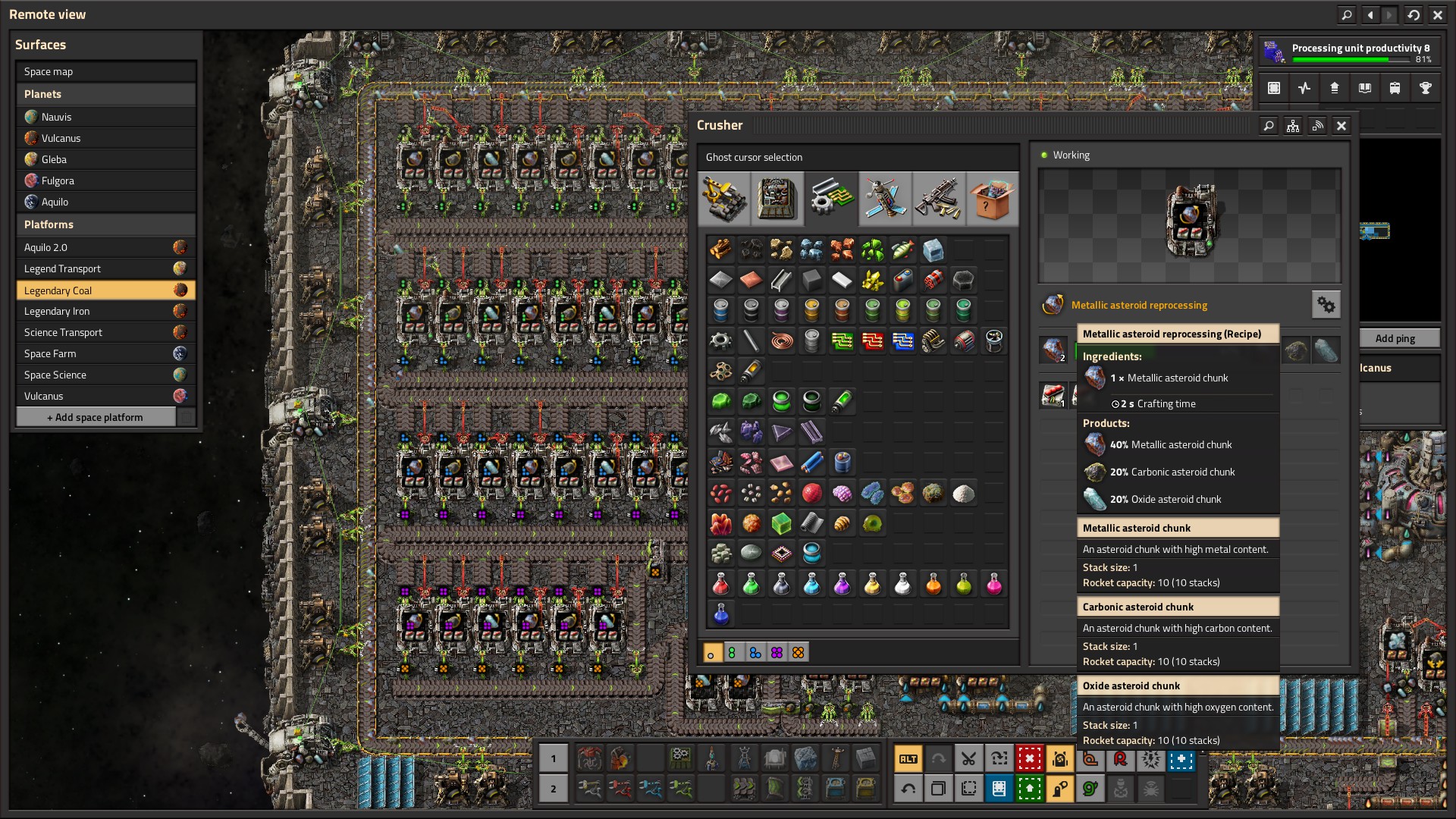
A legendary farming platform
Compound math is both simple and not intuitive. If I ask the odds of flipping a coin, simple 50% chance. If I ask the odds of flipping heads 5 times in a row, it’s 0.5^5 or closer to 3%.
So let’s look at the difference between regular quality mods and legendary mods in this setup.
The first stage has an 80% chance to get something, and of that result, 5%/12.4% are upgraded.
The result is 4% and 9.9%
This happens 4 times.
Regular odds: 0.0003%.
Legendary odds: 0.01%
There are 2 zeros between those odds. Or put differently, you should get 3 per 1 million chunks for regular and 1 per 10 thousand for legendary. No need to explain why that is a great improvement.
The challenge is getting legendary quality mods. It is more of a time sink than seems at first as you need a lot of blue chips. Way more than you think.
Real World
Compound interest applies in the real world, mostly with banking and credit. I won’t delve into the ethics of credit, but the math is super interesting. Let’s pretend you have a $500,000 mortgage, with a 25 year amortization (total duration)
At 5%, and monthly payments you would pay $34,800 annually. After 5 years, you’ll have brought the debt down by $57,000. $117,000 in interest.
At 6%, and monthly payments you would pay $38,400 annually. After 5 years, you’ll have brought the debt down by $50,800. $141,200 in interest.
A 1% change increases your payments by nearly $4,000 a year (so $20k over the 5 years), but end up reducing your debt by $6,800 less. That’s $26,800 gone due to 1%… not what you may instinctively think as being $5,000 (1% of $500,000).
Option 1 – Farm Materials
Build a legendary farm space platform to collect iron/copper/coal
Get LDS research to 15.
Use coal to make legendary plastic, iron + copper to make legendary blue chips
Make 4 legendary Mk3 productivity chips first, put them in a foundry. That gives 300% productivity.
Make LDS from 5 legendary plastic and molten (free) metal. Get 5 legendary plastic + 5 legendary steel + 5 legendary copper.
You can do this step before LDS research at 15, you’ll just lose plastic. Which may or not be a big deal depending on how much legendary coal you can get, and investment in plastic research.
The copper (recycled) can be used to craft blue chips.
Option 2 – Upcycle Materials
Get blue chip research to lvl 13.
Build blue chips on Vulcanus (materials are free here). Start with normal Mk3 productivity chips. Upgrade to legendary when you can to give 300% and no-loss recycling.
As above, you can do this before research 13, you’ll just lose materials.
Recycle the material with recyclers + quality mods.
Use those results to build uncommon chips, and recycle those
Same with rare, and epic.
You now have mats for legendary materials.
This process improves the more you research blue chip production. At level 14, you technically could recycle legendary blue chips for more mats than you put in.
A simple blue chip upcycler.
Option 1 is where you will end up eventually. Option 2 may be faster, it’s significantly less research but it’s also on Fulgora. Research there takes up material you’re going to want to use for other things. Option 1 can be done 100% on Vulcanus. Next up, legendary production.
The first time I landed on Aquilo, it went really bad. Scratch that. The first time I tried getting to Aquilo it went really bad. And then it went worse.
See, the ship you use to get there needs to be built in a specific way, and is the first time you need rocket turrets to survive. The challenge here is that rockets need a rather specific set of ingredients to be built, which are rather uncommon, and they do no real damage at the start. You need to invest in research to get max shooting speed (340%) and a good amount of damage (~400%) so that it doesn’t take 9 rockets per asteroid.
In my second run, I forgot this. I didn’t lose this ship on the way there, but it wasn’t able to build enough to survive in orbit. That took ~30minutes for me to figure out and a save reload. And then a heavy investment in explosive research. Meh.
Landing
This is the hardest part of Aquilo as you’re likely not bringing the right amount of stuff with you. Aquilo has oil and 2 other gases that are specific to Aquilo tech. Nothing else. It’s also so cold that everything needs a heat pipe nearby to function, robots take 5x the power, and solar power gives 1% return. The first 10 minutes or so of Aquilo is basically survival with the tools you brought. I did mention in the past that I parked a space farming platform above Aquilo – it gives iron, copper, sulfur, coal, carbonized coal, calcite, and ice.
I opted to take a slightly different approach this time. 50 solar panels to get some trickle power, then a heating tower power by rocket fuel that I brought along. It burns crazy fast until you hit 500 degrees, and with a logic control to only feed if it drops below 550, I could set it and forget it. 2 heat exchangers + 4 steam engines was enough to get the basics off the ground.
Rather than having a bunch of rocket fuel heating towers and complex routing, I opted to focus on solid fuel. That gives more than enough power for the rest of the build.
This thing is a miracle. Takes 400 heat pipes mind you.
Growth
Expanding Aquilo needs ice platforms, which take a while to build. And concrete if you want to put something on top of it. Stabilizing Aquilo means Foundries for iron, steel and copper. You can build most things with just that.
From there, you’ll build the first Cryo plant – no production bonus but does have 8 mod slots. From there it’s a rather small jump to a lithium plant, then to fluo liquids, cryo science, quantum chips, and finally fusion power. Never had a power issue this time, which was glorious!
Note about fusion power – it allows you to put production modules in all buildings, along with speed module beacons. Doubles the planet’s productivity. Doing this before fusion will cause a power outage.
I added a rocket fuel plant later on when the rest was stable, and then built my old fusion plant layout. Honestly, I think Aquilo took less time than Gleba. If you know what you’re getting into, and ship the correct materials, it’s not that bad. If you’re going in blind, and don’t have any blueprints, then things are going to be rough and take forever to ship what you need to get going. This may be my favorite planet to crack.
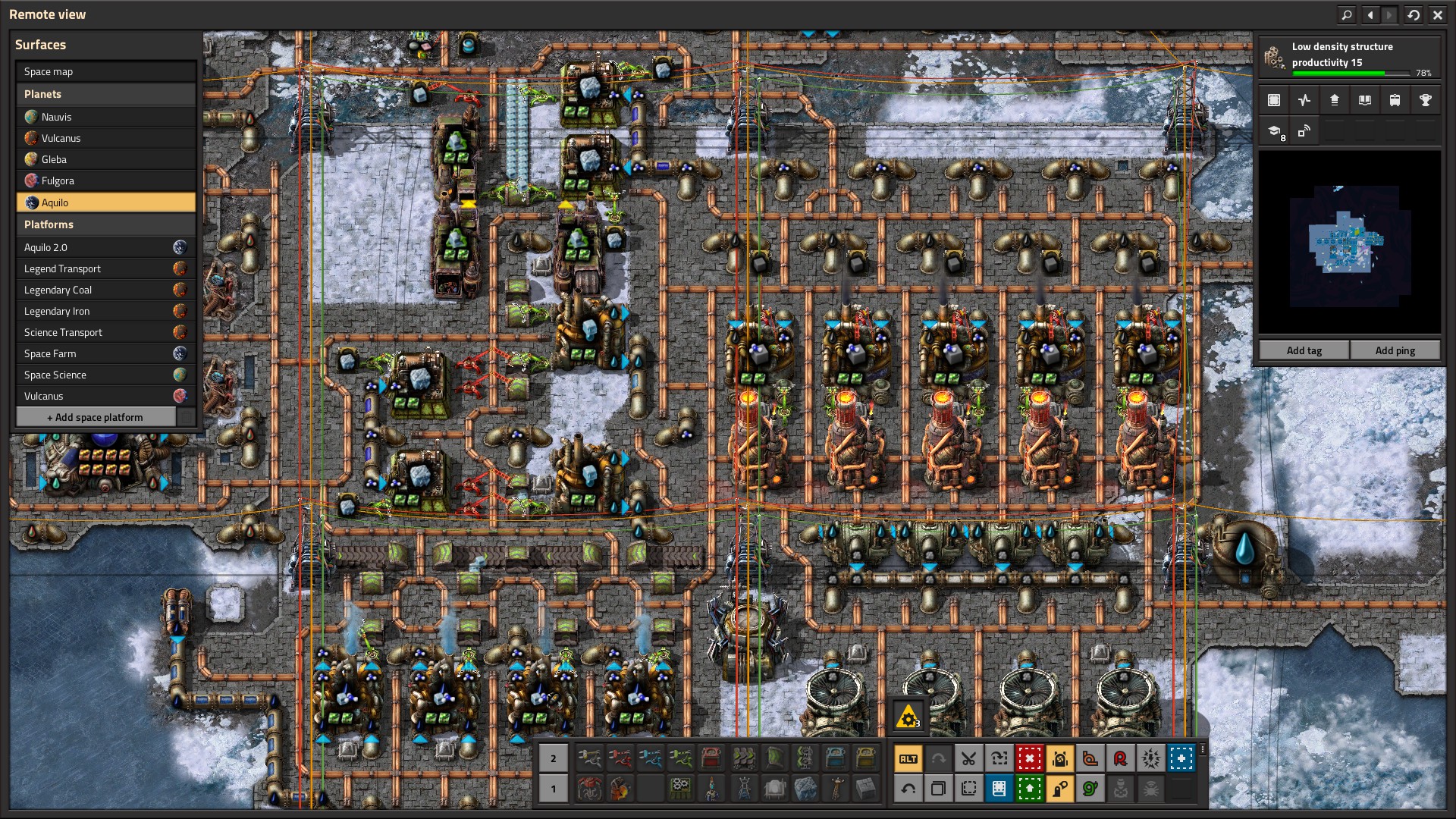
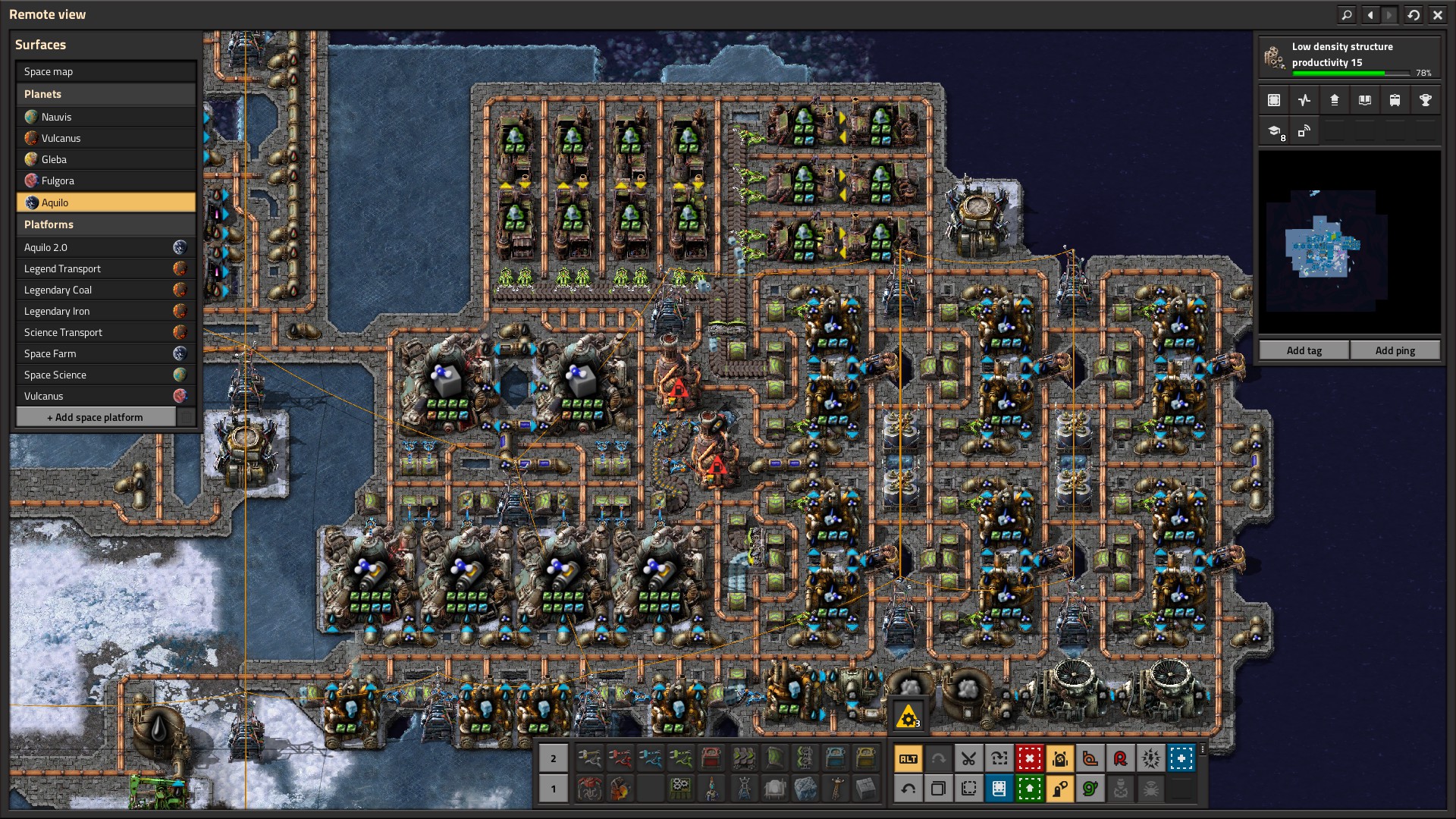
Self-sufficient and overly complicated due to heat pipe needs. Takes about 15 minutes to “warm up”.
Planet Power Shifts
Fusion power is needed on other planets, and that takes a huge amount of materials to get done. Vulcanus is the urgent one, in order to scale productivity. Legendary space farming platforms are next, followed by Fulgora and Gleba. Nauvis doesn’t need it, Nuclear is more than enough for everything that will remain.
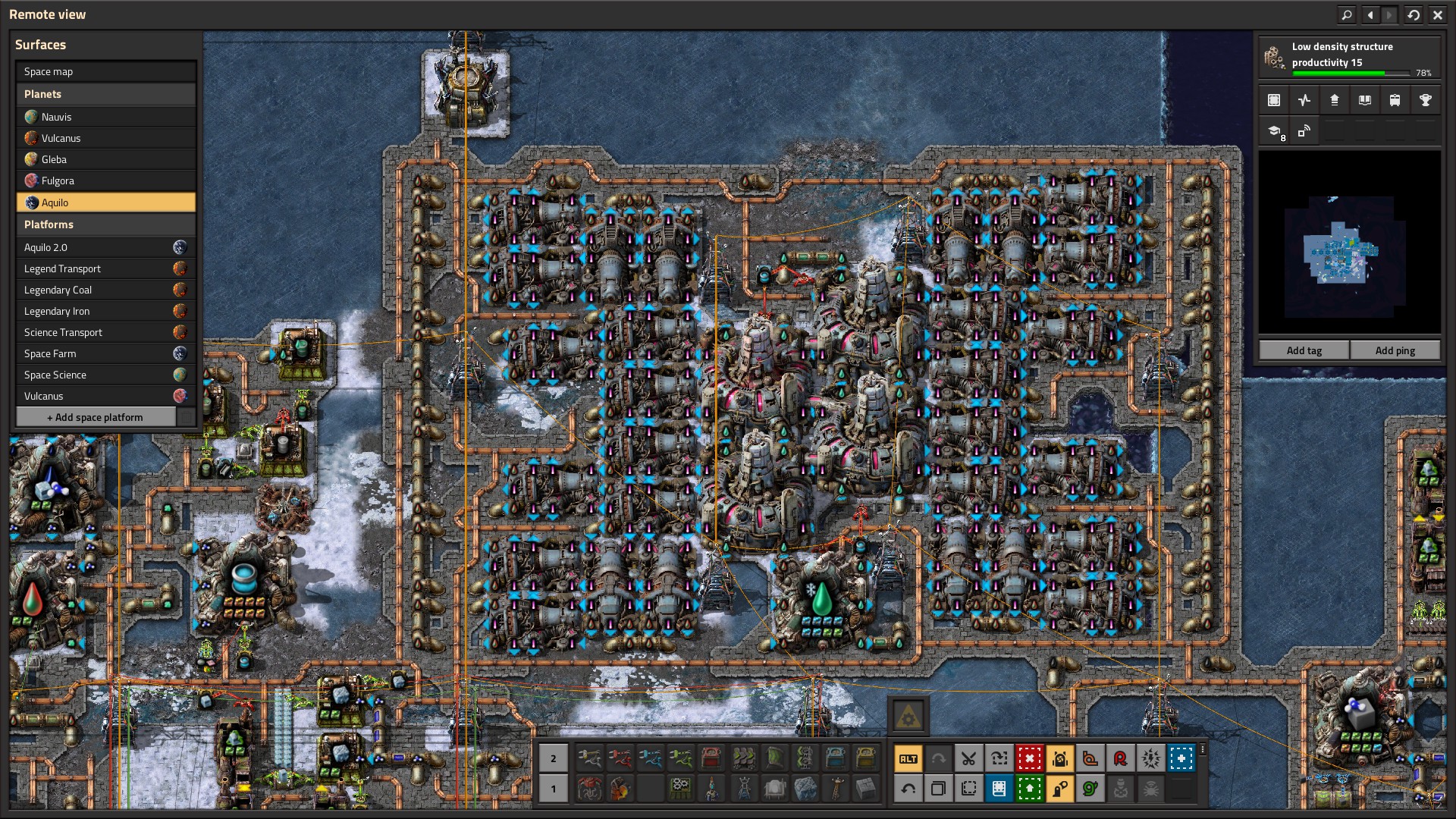
28 generators max at 50MW each…this thing gives gigawatts.
Next Up
Legendary farming. Unfortunately this run was significantly faster than the last one. I think I ran through the entire thing in just over 10 hours. Since I haven’t created upcycling farms, I don’t have any legendary mods. That’s going to be a hurdle. Research is also quite a bit behind, with most near level 8. I need LDS to be 15 for self-sustainability, which is like 100x farther to go.
That means, I need to optimize the heck of out Vulcanus, and ship out a constant feed of research packs. Compound percentages are the enemy… more on that in a bit.
Actually, three of them. One for basic material (which is needed for Aquilo) and two for legendary material. Both can be built early, but can’t really be used until certain steps are completed.
Basic Farm
A square shape, that has walls, gun turrets, and rocket turrets. A belt goes around the whole thing, with the space material on the inside, and the weapon material on the outside. You can power most of it through solar, but that is likely to create problems down the road. Nuclear (only feed it when needed) is the best option. Remember to request nuclear fuel!
There are areas to generate fuel (near the engines), areas to generate ammo/rockets (with foundries), and importantly, the actual farming area.
A logic gate.
There’s one loop per rock type, and each rock can give you two results. The arm has a logic gate that opens if you need the material (less than 2k copper in this example) or the belt has room (less than 60 on the belt). The results go to the main storage, and overflow is split to the right and dumped over the side.
More logic.
Since I don’t want storage overful with one item, I limit each to 2k. The arms shut down if I have that amount. The line naturally backs up to the splitter, and excess is dumped. The left side is a chemical floor that splits Carbon into Coal. End result is 2K coal, carbon, sulfur, iron, corrpe, calcite, and ice.
Recycler
This is the real magic, since there are times where you have too much of one rock and not enough of another. This is the metallic trigger, where too much metallic (80+) and not enough of another (less than 10) causes the metallic rock to be transformed into a random other one. This is important outside Aquilo, where 80% of all rocks are Oxide (ice). If you don’t recycle them, you won’t have enough metal for ammo.
It is possible to finish Aquilo without a space farm, no question. Be aware that you’ll need to ship an incredible amount of iron, copper, calcite and coal as a result – you will hit bottlenecks.
Legendary Ship
Think regular farming ship but twice the size. The idea here is the last bit I put on the regular ship – recycling. More specifically, upcycling.
Using Quality Modules (the best you can), you recycle rocks with the hope of getting a higher quality result. Do it again for uncommon, rare, and epic rocks and maybe you get one legendary from it. Crush that legendary stone and get either iron/copper/calcite (one ship) or coal + sulfur (another ship). I have a future post on why you want to invest in legendary quality modules – short answer, they are 100x more effective.
Since you don’t need to head to Aquilo (Vulcanus to Gleba has the best type of chunks), you only need gun turrets. Power is a challenge. Since you should unlock Fusion power before Legendary items, it’s a straightforward thing to put fusion on a ship as it runs on it’s own once primed. Again, remember to request the fuel!
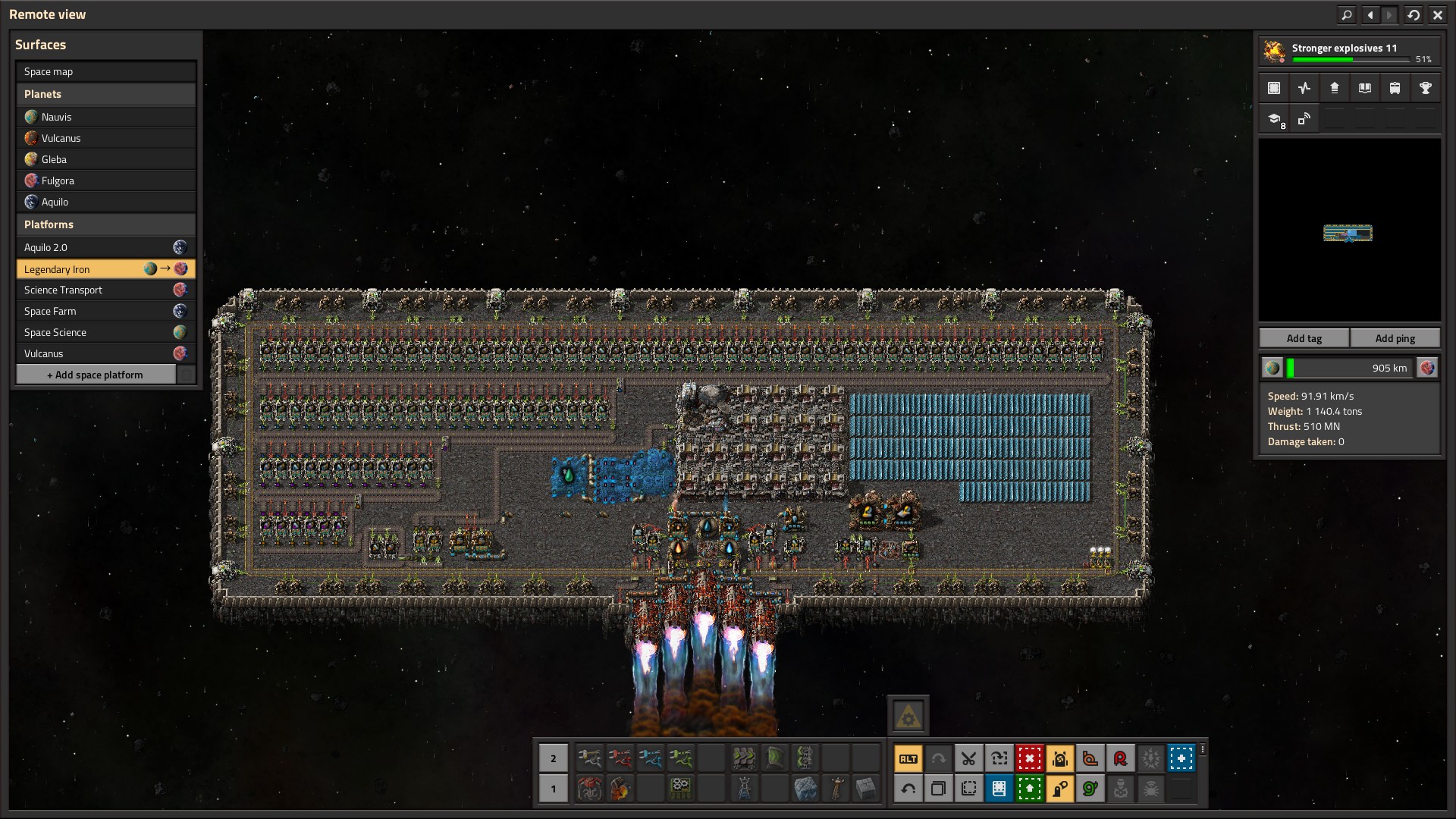
Yes, this thing is massive. I needs nuclear (or ideally fusion) to really work.
These legendary ships are 100% optional and 10,000% end game. My entire run, with the exception of Fulgora power batteries, with only normal items. This is different than my first playthrough, and I honestly prefer it. If I took the time to find a mod that allowed multiple rarity items to be used in crafting, then we’d be talking. But the sheer amount of waste in gambling drove me crazy.
I’ve spent so much time talking about design that I’ve missed sharing the key principle in it all, which is oddly relevant today – logistics. Specifically, the act of moving things from one place to another, in the right amounts, at the right time. It sounds simple, but logistics is how actual wars are won. I will try to simplify that down.
Important note that of all the factory games I have played, Factorio is by far the most robust/complex. I’m of the growing opinion that graduating engineers should be forced to play this game, it’s that complete.
Concepts
Moving things from one place to another. Easy right? Sort of.
You need to know where things are, how to get to them, how much you need, and then move those things to your transport vehicle.
Your vehicle needs a path, fuel, storage, and travel time to reach a destination.
Your destination needs the ability to store said items, and how much it needs. It should not store things it doesn’t need.
If I want to ship aluminum powder across the ocean, I need trucks to get to the supplier, then to the docks, onto a ship, to another dock, then a truck again, to the receiver. That takes weeks to complete, so the receiver places the order well ahead of time. In a war, think guns + ammo.
If I want to eat a banana, I go to the grocery store. Bananas don’t grow in Canada, so again, farmers, trucks, distribution centers, grocery stores. That takes a few weeks, so the bananas have to be collected before being ripe, and have to be placed in the small timeframe before they go rotten. Perishable goods are extremely time sensitive. In a war, think food or people.
Tools
Factorio has a lot of tools to help here.
Belts. Simple enough, they move things at a given speed across a map. They can be split or merged. A belt is saturated when it’s full.
Pipes. Similar to belts, the move liquids across a map. They have a maximum distance before needing a pump. They have no throughput limits (which is a BIG deal on Vulcanus).
Trains. Bulk belts with schedules. You often don’t think you need them, and then you realize you absolutely do, and have to tear half your factory apart. Trains require blueprints for you to stay sane. At ultra late game levels, they are the only solution to landing pad throughput issues. I won’t detail much here, they aren’t as useful as they were in vanilla.
Logistic Robots. Can carry a maximum of 4 items, and their speed can be upgraded infinitely. Used to move things between lading pads + logistic chests. They need a Roboport to function (yellow to move items, green range to build things). Roboports can, if connected, read the logistics network.
Space Platforms. A combination of a train and Logistic Robots between planets. Train in that it’s scheduled, Robots in that you can select specific items.
Logistic Network. A planet’s interconnected system of logistic containers. Only items in specific storage count – colored chests + the landing pad. Items in transit or on you don’t count.
Circuit Network. Math and logic tools that set conditions for the network to function.
Colored Chests
There are bunch of options for logistic chests, each with a color and a purpose. Some you will use a lot, others barely.
Active (purple). You can only put things in manually or with an inserter. The chest will automatically request itself to be emptied. Extremely useful on Gleba (as things spoil) or to keep a landing pad empty.
Passive (red). You can only put things in manually or with an inserter. The chest acts as storage. Ensures that robots never put anything inside. Useful for storing multiple items, or to avoid having to filter a yellow chest.
Storage (yellow). Can be accessed by anything, for storage and removal. 90% of your chests are this type. Can only filter for a single item. Useful to put 20 or so near a landing pad so that the purple chest can dump into here.
Requester (blue). Requests items from the network so that robots find them. Items in blue chests cannot be removed by robots. Items in blue chests do not count to the logistics network. Extremely useful to construct complex buildings in late game instead of belt weaving.
Buffer (green). You set requests, which will then feed other parts. I have found zero cases where this is useful, certainly not with Space Age.
Circuit Network
These tools are math based, and can be used in a variety of methods to present decision points for a logistics network.
Constant Combinator. A tool that has a fixed set of items listed, sometimes in groups. If you always want to have 200 red belts, you set it here. Has no inputs, and 2 outputs.
Arithmetic Combinator. A tool that performs basic math functions (+ – / *) on a given set of inputs.
Decider Combinator. A tool that compares inputs and provides an output. If something is larger, or the same, or a threshold has passed. Has 2 inputs and 2 outputs.
Selector Combinator. Think of it as a filter. This thing has very niche uses and not worth exploring until you understand the first 3.
Wires. Used to connect things. The color matters (red/green) as your inputs are color specific. You can connect to nearly all items in the game, including belts (to read all material). It transmits the math.
Simple Setup
When you start the game, you’re extremely resource starved. You only want to build what you need and no more. The simple circuit can help!
This assumes that you have Assemblers that are putting their material into storage containers.
The Assemblers are all connected to power poles through a colored wire (let’s say red for now), building a connected network.
All the chests (wood or steel) are connected to power poles through a different wire (let’s say green).
A Constant Combinator that has a list of the maximum amount you want, per item constructed. (let’s say 300 yellow belts).
An Arithmetic Combinator. One input is from the Constant Combinator (red wire), the other is from the chest network (green wire).
The math would be Red (what you want) – Green (what you have). The output would be a red wire to the assembler network.
If you have too much, the number is negative. If you have too little, the number is positive.
Each Assembler is configured on the network so that it is enabled when the item being produced as a positive number.
The end result is that each Assembler will only produce and store what you need, and automatically stop past that.
You can evolve this with logistics networks with colored chests + connecting to a Roboport to read all the chests automatically (replaces the original green wire network).
The red is what I want, the green what I have. Output is the difference.
Decider Setup
Taking the example above and moving into a Logistics network. I find this required for space travel.
Constant Combinator with what you need to keep a base running, as well as rocket ship parts. This includes pipes, inserters, assemblers, plastic, LDS, and so on. See image as an example. Also good to have this set up as a demand on Space Platforms.
Arithmetic Combinator comparing the logistics network to the Constant.
The challenge is that the network is always under change as you produce items. Green belts are made on Vulcanus, and you ideally never want to request them from a Space Platform.
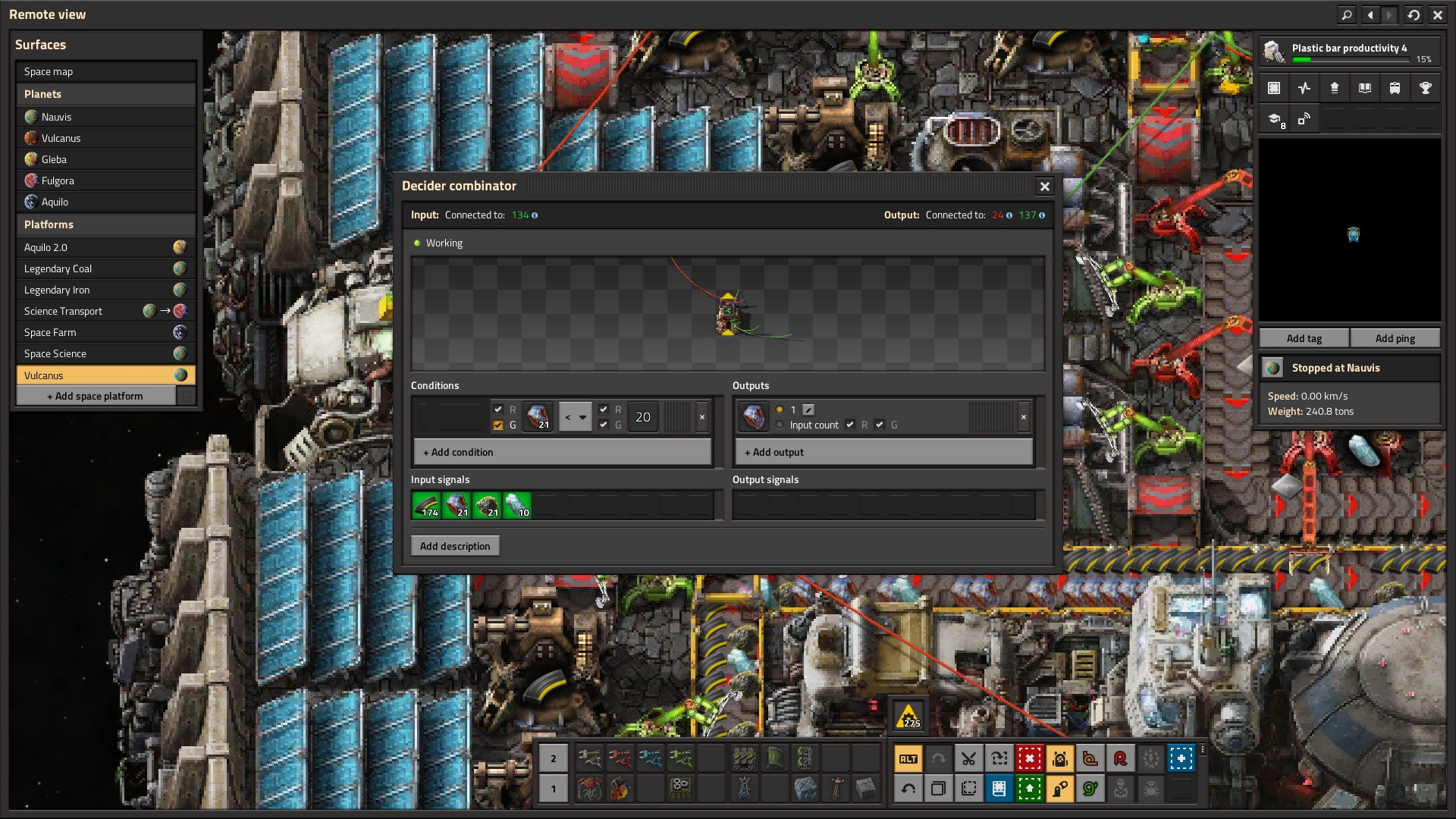
A Decider Combinator that filters the demand so that only items that need >5 items are actually requested. It is important that the lowest value on the Constant Combinator is higher than the Decider value.
Connect the Decide to the Landing Pad, set it to Request Items
A stack/bulk inserter connected from the landing pad to a purple chest, with 20 yellow chests next to the pad.
The output is only items >5, which allows for smaller variations of items without bringing them down from the space platform.
Space Platform Deciders
Space chunks are full of RNG, and it’s entirely possible to saturate your Space Platform with too much of a useless material. This is extra painful on Aquilo where 80% of the chunks are Oxide and you really want Carbon. There are a few ways to manage this.
Read all the contents on a belt through a connected wire.
Constant Combinator that has the maximum amount of a given type of chunk (all 3 combined should be ~80% of a total belt capacity). You can also manually set this in the next step.
Decider Combinator, per chunk type, that evaluates if you have less than the maximum. If so, output the chunk type. (so if you have less than say 20 Oxide chunks, request Oxide chunks)
Connect the result to the Collector network, using the filter option. If you need more, then it will filter to collect, else it will skip.
A manual setting to have less than 20 Metallic chunks.
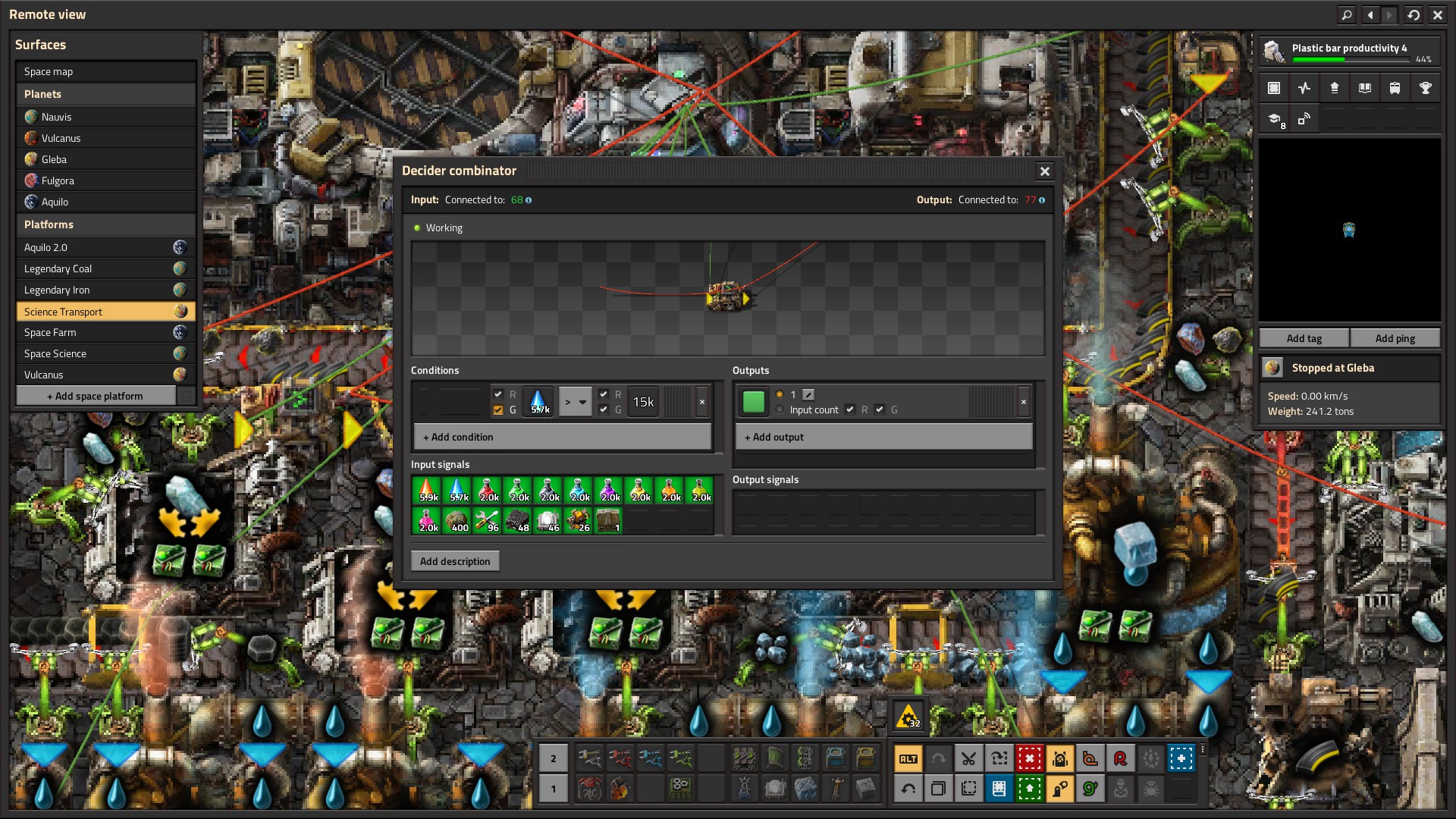
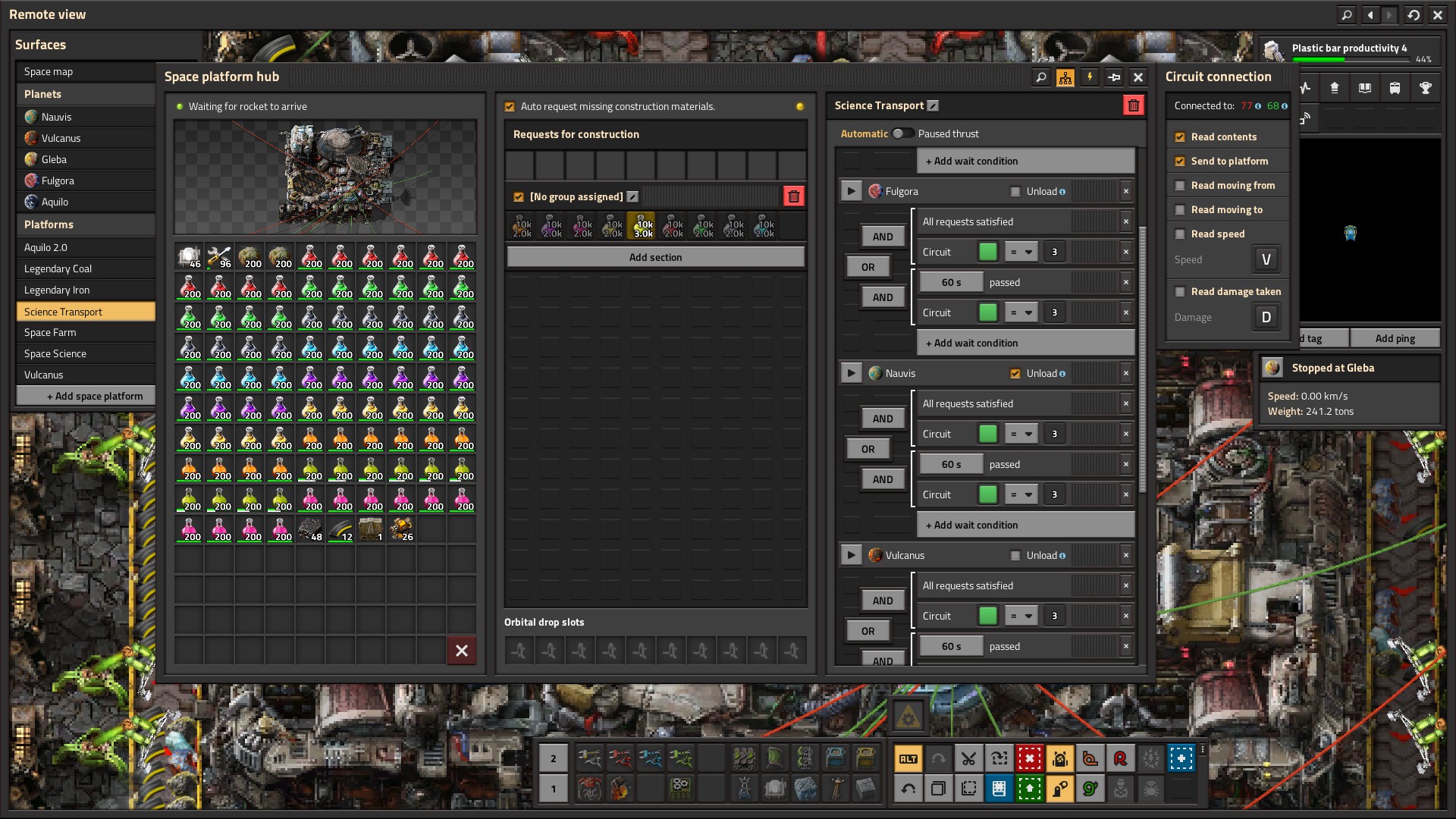
Fuel/Ammo Deciders can be used to set ship launch conditions. Same concept, read each item, compare it to a set value, and output a signal. If all signals are good, then launch the ship. On basic planet routes, that’s 12k fuel (each type) and 150 regular ammo. Aquilo is 20k fuel, 400 regular ammo, and 300 rocket ammo. Super simple and easy to maintain.
More than 15K blue fuel gives a green value of 1.
If all 3 conditions (2x fuel + ammo) are green, and I’ve been there 60s or I don’t need to collect anything, the ship can move on.
If you have the room to recycle chunks, you can use combinators to evaluate if you have too much of one type and not enough of an other, then recycle it. Aquilo needs this. If I have over 80 Oxide and less than 20 Carbon OR over 80 Oxide and less than 10 Metallic… recycle.
The OR condition is required across both groups. The lower one is true, therefore it will recycle the Oxide.
When you get the concepts of logistics, you realize that the game has so much more to offer that just filling boxes. Impressive the flexibility that math tools can provide.
Biolabs are amazing. Not only do they have an innate 50% productivity boost but they go twice as fast (5x at legendary level). It may not seem like much, but when research takes 1+hr and 10k science packs, it’s massive.
The challenge here is that they require biter eggs to build. 10 of them in fact. You can only acquire these by sending capture rockets at biter nests in the wild, then feeding them bioflux to create eggs. You can eventually build your own nests, but only after completing Aquilo. I waited last time, I will not make that mistake again.
Main Steps
Get Bioflux to Nauvis before it spoils. It has a 15m shelf life, so a direct path from Gleba to Nauvis is required.
Build a capture rocket. That needs Bioflux.
Find a biter nest. This may be the hardest part with no enemies. I’ve yet to encounter a single one on Nauvis.
Capture the nest, feed it bioflux and harvest the eggs. Manually.
Create 40 Biolabs, which is 400 eggs.
Profit.
Normal Play
Biter eggs normally expire, and spawn, well, biters. In a normal game, you would need to defend buildings with eggs in case they expired. No enemies means that this risk is entirely gone, as is the challenge of actually acquiring the initial eggs as they would often be in the heart of biter land. This is a very welcome change.
Upgrading Nauvis
This is an interesting decision point, as the value of Nauvis drops massively once you’re done with Gleba, and becomes only useful for research and biter eggs when you complete Aquilo. As I plan to build a legendary factory on Vulcanus, it does make sense to keep Nauvis running for a little while as it’s my ship building yard (no meteors). Building any ship requires a few truckloads of steel, and the absolute best way to get that is through Foundries – from less than 5/s to over 40/s.
So I figure if I’m going to upgrade that, may as well upgrade the rest.
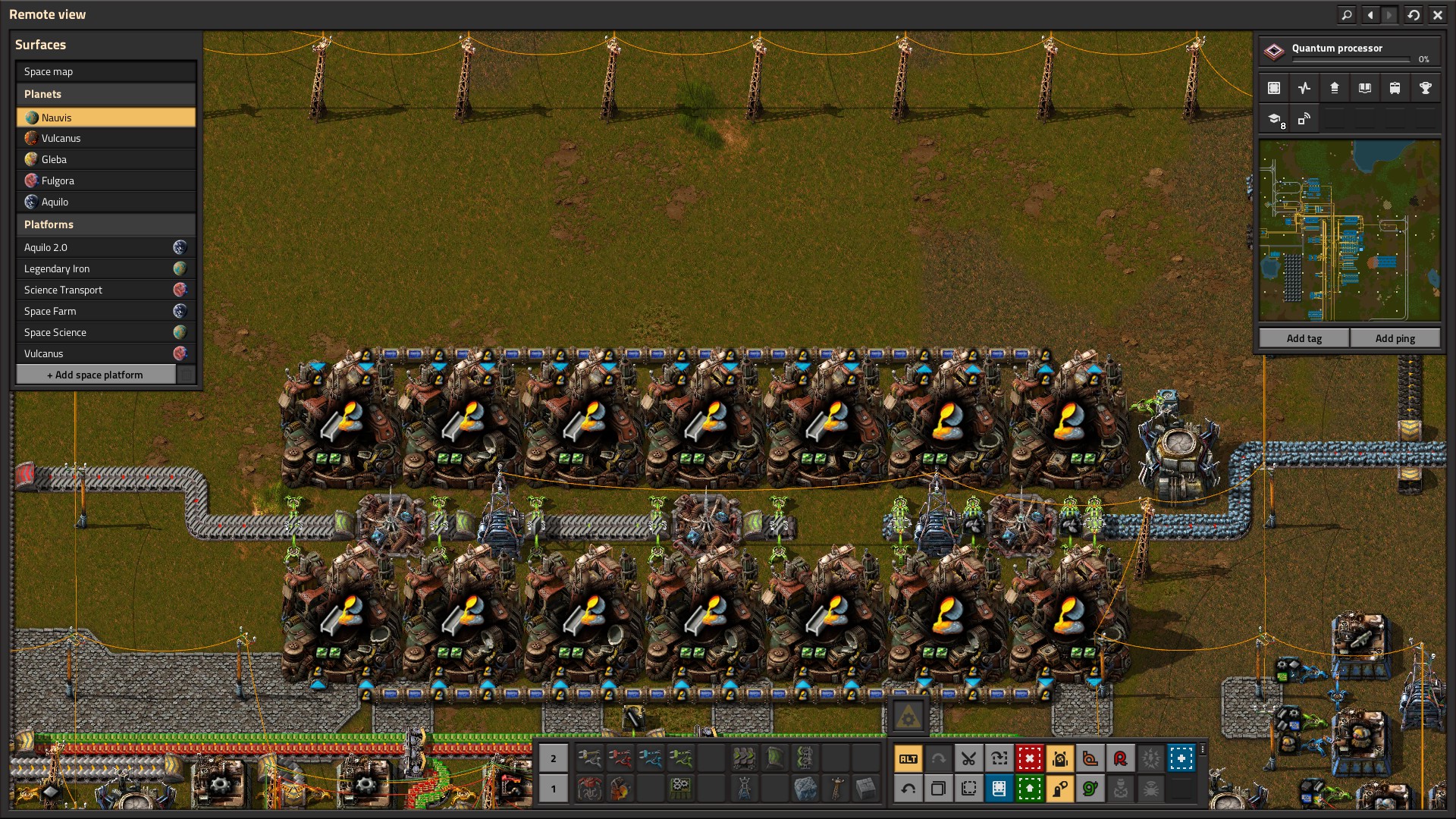
Foundries on Steel, Iron and Copper. This creates a significant need for calcite shipments.
Electromagnetic Plants for red/green/blue chips
Big Miners everywhere
Steel Foundry. It’s great!
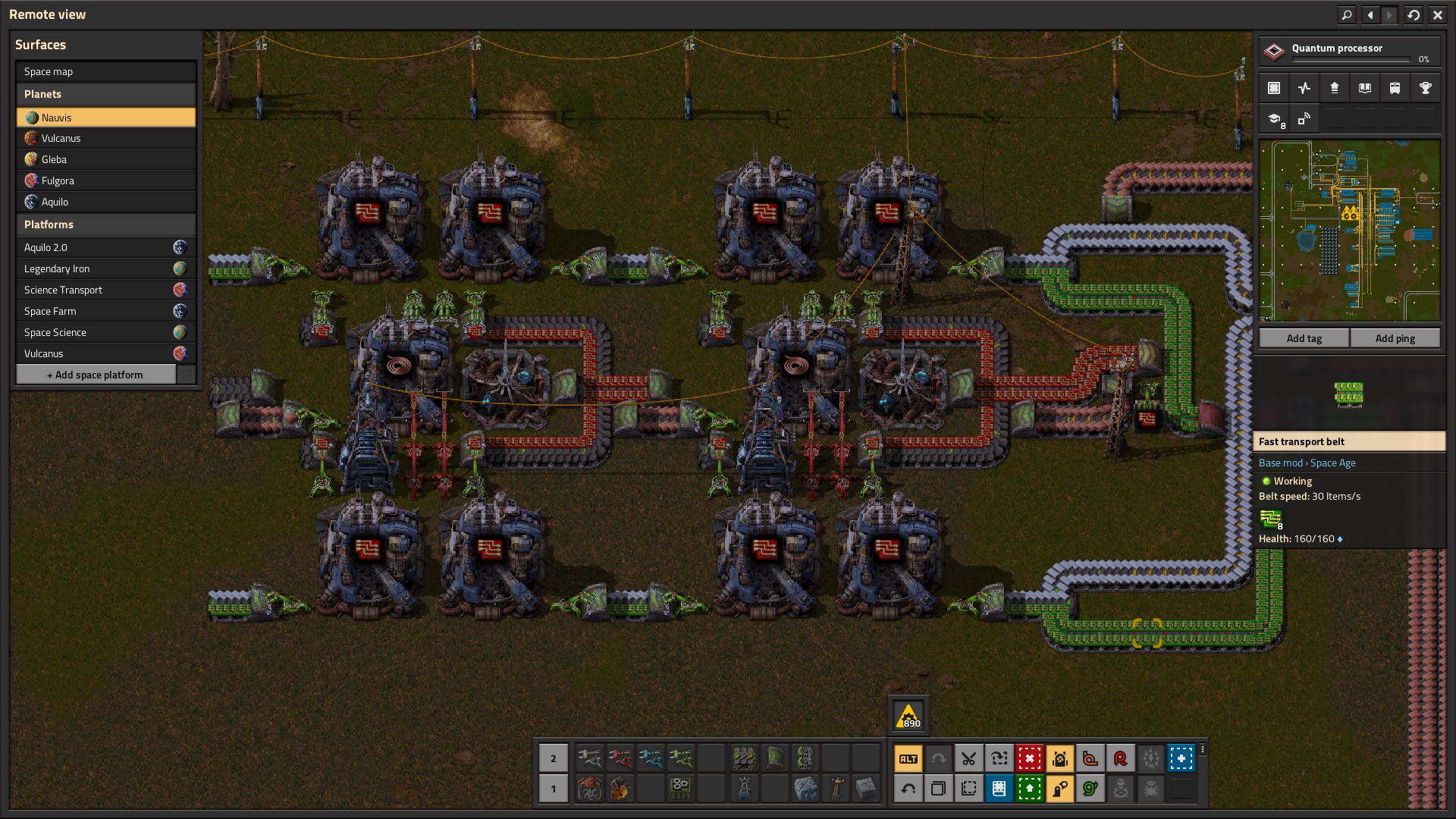
Red chips. Super efficient.
Next Steps
Aquilo is next, but to get there I need a farming ship and a rocket-enabled ship. The last time I did this, it did not go well.
I have a large dislike for Gleba, and the list of grievances is long my friend! In order.
First, the enemies. I don’t mind biters, you can build walls and by the time you launch a rocket, no biter will ever enter your base. Gleba has stompers. These buggers take a beating, and each step they take breaks stuff. Walls are meaningless. And you need to farm material from quite a ways, so the spaces you need to defend are massive. You need lightning guns that have AE/stun attacks and they are constantly firing. Turning on no enemies mode is awesome!
Second is that nearly everything you can produce on this planet has a spoiler timer. There are only 2 practical items you can ship off planet as they have 15m+ timers. The rest you need to have built-in off-ramps to remove spoilage. It means you cannot truly have a main bus, and instead mini-factories that are rate controlled to reduce the chances of spoilage.
Third, the Biochamber is the only way to build anything here, and it takes nutrients as a power source, which you guessed right, spoil. Creating nutrients is a fun little challenge, as it starts off being from spoilage itself, then you realize Bioflux prints it for free.
Balancing items #2 and #3 are a fun little puzzle. Trains are useless here, and only robots can get stuff around quick enough without spaghetti belts to actually be optimal. It takes 200 or so running at all times to keep the basics going. Everything becomes modular, so you can’t really add 1 or 2 buildings, but a cluster of them to keep it working. The end result is a very organic factory, with dedicated cells. I really do think that this is an amazing design achievement.
This actually is way cleaner than my prior build. Closer = the bots have less distance needed to fly around. I opted not to ship Calcite and use Foundries… likely to revisit that choice.
Having #1 around meant that I was always under attack and non-stop messages about armies attacking my base. I had a ship just flying between Gleba and Fulgora for lightning ammo and to replace busted pieces. It was also an absolutely massive power draw. Without enemies, Gleba is actually fun!
Sure, shipping the spoiling science packs requires some extra math, but it works! Power issues are non-existent. Supply is easy (mind you collecting Pentapod eggs is it’s own journey), expansion is simple, and the planet went by in a relative jiffy. The items research unlocks are extremely useful – access to Aquilo obviously, but also stack inserters (amazing for Vulcanus), essentially free plastic/rocket fuel from Gleba, rocket turrets (needed to get to Aquilo), and Biolabs (which give a 50% bonus to research production).
Next step is not actually Aquilo but:
building a farming space ship to put above Aquilo, since the planet has no natural resources
building a space ship to go to/from Aquilo
moving all research production from Nauvis to Vulcanus
getting Biolabs
Upgrading Nauvis to use Foundries + getting enough calcite to make it run
Starting the build of a legendary farming station. It takes a long time to build and I’d rather have it ready for when I need it.
With Vulcanus done, time to move to Fulgora. The Electromagnetic Plant is key for all chips, and is priority #1. And honestly, #2 & #3 since it is that powerful.
Fulgora has no water but instead islands of trash in seas of oil. Every 5 minutes or so, a massive lightning storm hits the planet, and if you or your buildings are hit, it’s 2 hits to snoozeville. Thankfully the planet has a bunch of natural lightning rods strewn about, mostly near the minable trash piles. Mine that by hand, recycle the trash for some RNG materials, and that’s enough to unlock the Recycler, and off to the races.
The Recylcer randomly generates stuff from trash, so you need to build a triage line to store the items together, then let the overflow go back into the Recycler line. Some items are results of other items, so it can get a bit busy. With quality items, you need chests/filters per rarity, which is honestly painful and very low return. Blue concrete has very small value. The epic stuff is super hard to get, and therefore even less useful. I made the choice to keep everything normal quality, and when I’m done with Aquilo I can build a legendary farm method instead.
The net result is that Fulgora took about 1/10th the time because it honestly is quite simple. The planet gives you everything you need, with the exception of plastic. The Recycler/triage line is on one area, liquid processing in another, and finally holmium processing. That’s it. 10 Big Miners and I’m done this place.
A very simple layout for Fulgora. That’s 32x Recyclers in the bottom left.
Well sort of. Power is a challenge on this planet, as you need to collect lightning. You can build batteries (you need them for the planet research) but this is the only time I actually did do a quality roll. Two plants building batteries, one of them randomly upgrading the outputs. The regular ones go for research, the upgraded ones replace those on the map. An uncommon (green) battery has 2x the storage, rare (blue) 3x. This is an absolutely massive difference. And this is the first planet where I had to put in efficiency modules. Two of the Mk2 bring the power usage down by 80%, which is needed to have power last the entire cycle.
Didn’t take long to get my Electromagnetic Plants back to Vulcanus. It is now raining blue chips, which allows every pass of my science space platform to collect 2k purple, yellow, and pink research.
Preparing for Gleba comes next. Good news, with no enemies mode enabled I am actually going to enjoy this ride!
I took a forward-looking approach in this run, which really means that I skipped some pieces to potentially save on rebuilds. In a “normal” playthrough, you’d optimize a bit of Nauvis with some red belts and more effective smelters. You’d likely use beacons as well. You’d create purple and yellow science. And then you’d launch a rocket.
I did not do that. And consequences followed.
First, the smaller build space on Nauvis is a good thing. It requires me to be more effective in the designs. What is saves me in long belts it costs me in undergrounds + splitters mind you, so the material costs are arguably higher. Power is substantially more efficient though, and a whole lot less poles. I skipped upgrading to red belts and everything that follows. While I had crafted logistics containers, I didn’t actually use any until the first rocket went up.
Almost to first rocket, only needed to add blue circuits to the left.
That was the point where I realized I had a more difficult path ahead.
It is entirely possible to build a space platform with basic logistics. Storage containers are all you really need as the rockets will self-request. Taking the platform to Vulcanus was simple, landing was a relative breeze, and set up was quite fast. It certainly helps when you know what you need for a first landing! (Funny story, I forgot to add a Landing Pad and had to reload a save. Well I thought it was funny.)
Vulcanus has 4 main phases, though folks are likely only to see 3. The initial setup, which is about unlocking foundries and big miners. The mid-game which makes the planet self-sufficient for rockets, meaning LDS, rocket fuel, and blue chips. The late game when you’ve unlocked Aquilo and realize that all chips can be made for free and super speed on Vulcanus. The end game, when you then realize that Vulcanus is the absolute best factory planet in game and you transfer 90% of production there.
Sidebar. I recall in Satisfactory the first few run-throughs I absolutely didn’t account for scale and needed to rebuild the entire factory. And then I’d unlock something new and realize I had to do that again. That game doesn’t naturally support modular design and scalability, you need to bring the mindset with you. And mods. The 3D layouts and free-form placement are unique, and the challenge is in that freedom. Satisfactory works on a 2D grid and has a pile of automation. Scaling is extremely simple, and moving a factory 2 spots to the right is a mouse click.
Back to Vulcanus, or rather all planets for that matter. Accelerating to get to phase 4 is friggin hard-mode. Without purple/yellow science on Nauvis, you need to build a main transport hub on Vulcanus and then transport it back to Nauvis. This is very expensive, as blue chips are a nightmare to build before Fulgora is unlocked. Did I mention that blue chips are needed for yellow science? The good news in this is that while they are very expensive to make, they are infinitely cheaper on Vulcanus than on Nauvis. But wait there’s more!
Blue chips need plastic, which can only be refined from oil products. There is no oil on Vulcanus, so you need coal liquefaction, behind purple science. You see how this is a catch-22? To get blue chips, you need blue chips to send rockets of purple science to Nauvis. But the devs thought of this and gave us simple coal liquifaction, which produces heavy oil from calcite + coal. Using that recipe, I can kickstart plastic generation with a rather complicated oil factory. Blue chips –> purple science –> get me the Fulgora ASAP.
Oh, and during this time I needed to lay out some rail networks to get copper + iron to my Nauvis factory. Big miners do wonders here as they are 5x more efficient and only consume half the resources. Foundries are not an option, as I can’t efficiently ship calcite to Nauvis yet. 50×50, ground-based rail systems are I guess “easy” to build, but the space limitations really play a number on making it all work. Actually being on the planet would make it a lot easier, but that’s not really an option right now.
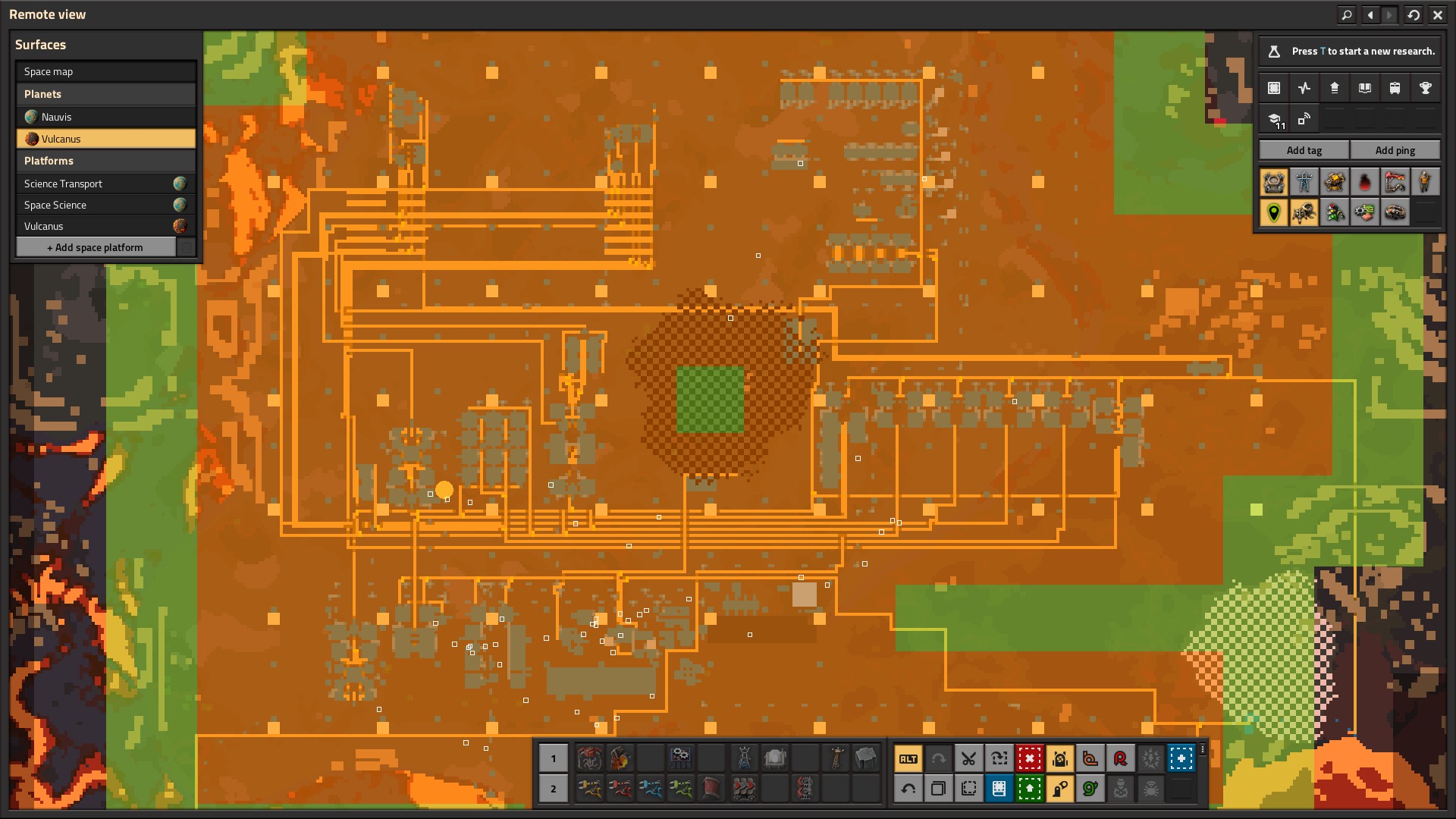
Vulcanus just before Fulgora. Oil factory top right, main bus in the middle, purple + yellow science in top left.
I’m heading to Fulgora now, and the electromagnetic plants are the absolute priority. They will practically trivialize chip production and shift the game into overdrive. Oh how I am looking forward to that!










 Leo's Life