TR-49

I have a penchant for puzzle games, especially those that focus on deduction. TR-49 is from inkle, the same devs behind Heaven’s Vault. Both focus on language as the key puzzle component.

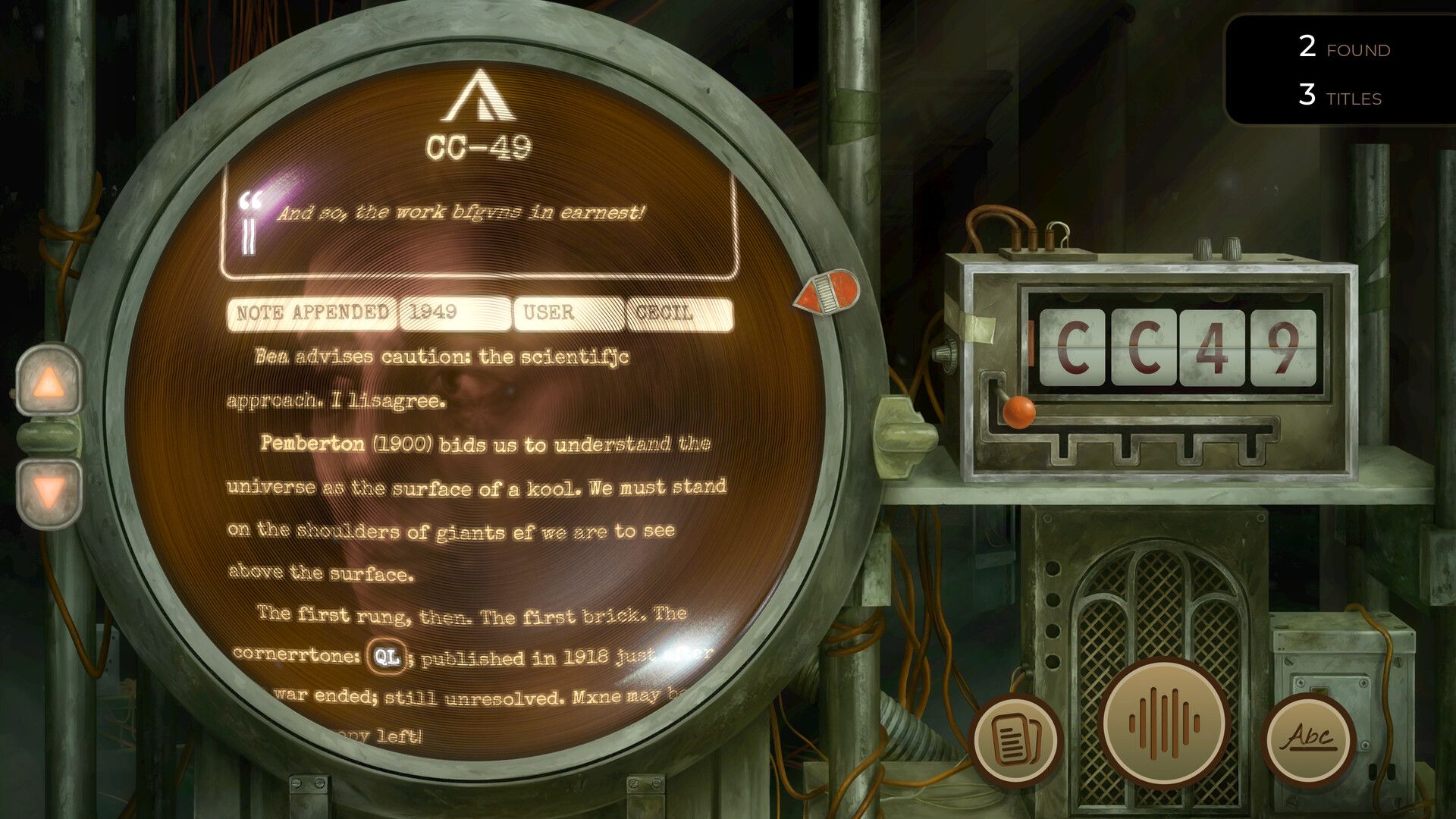
The principle interface is above. You have text on the left, and a code on the right. Through combinations of XX-## you navigate through what’s effectively a broken wikipedia, trying to restore the links. The main goal of the game is to wipe a particular record, and depending on your choice, there are multiple endings.

There are some automated note taking tools that help you deduce some pieces together, and milestones that let you know if you’ve hit a particular point. That adds a sort of boundary on the puzzle, which is key when you are presented with seemingly infinite options.

Each set of coordinates follows a particular pattern, which can be used to infer other links. The format always follows a XX=object and ##=date structure, it’s how they are intertwined that matters. The text itself may present something like ‘6 years before their death’, which gives a ## pivot for the same object. You can brute force the ## portion as it’s 100 choices if you’ve found an object code. There are other object codes that are used once, or coordinates that act for separate purposes.

While you’re solving this, there’s ongoing dialogue for the setting. It’s a weird setting and one that is best experienced fresh as it tightly bound to the multiple endings. This does add a lot of voice acting, where you will want to play with headphones in order to isolate the sound and truly focus on the puzzles.

The total journey isn’t exceptionally long, maybe 6 hours, but it is quite fulfilling. Well worth the purchase if you’re into this style of game, of which I am a HUGE fan.

StarRupture EA Launch

I like factory builders and tend to give them all a shot. Mileage certainly varies here, with two main reasons. First, is that the math needs to friggin’ math. Ratios and scalability are key so that you can compartmentalize a factory. I’ve gone over this bit a lot, and was probably the only gripe I had with Techtonica.

Second is manageable and achievable goals. Making the numbers go up is an inherent goal, but the actual steps to get there are key. Satisfactory has milestones (good) and hard drives (bad). These goals have to be incrementally harder to reach and ensure there is no downtime where you’re just waiting for a ticker to complete. This is much harder said than done.

Comparables

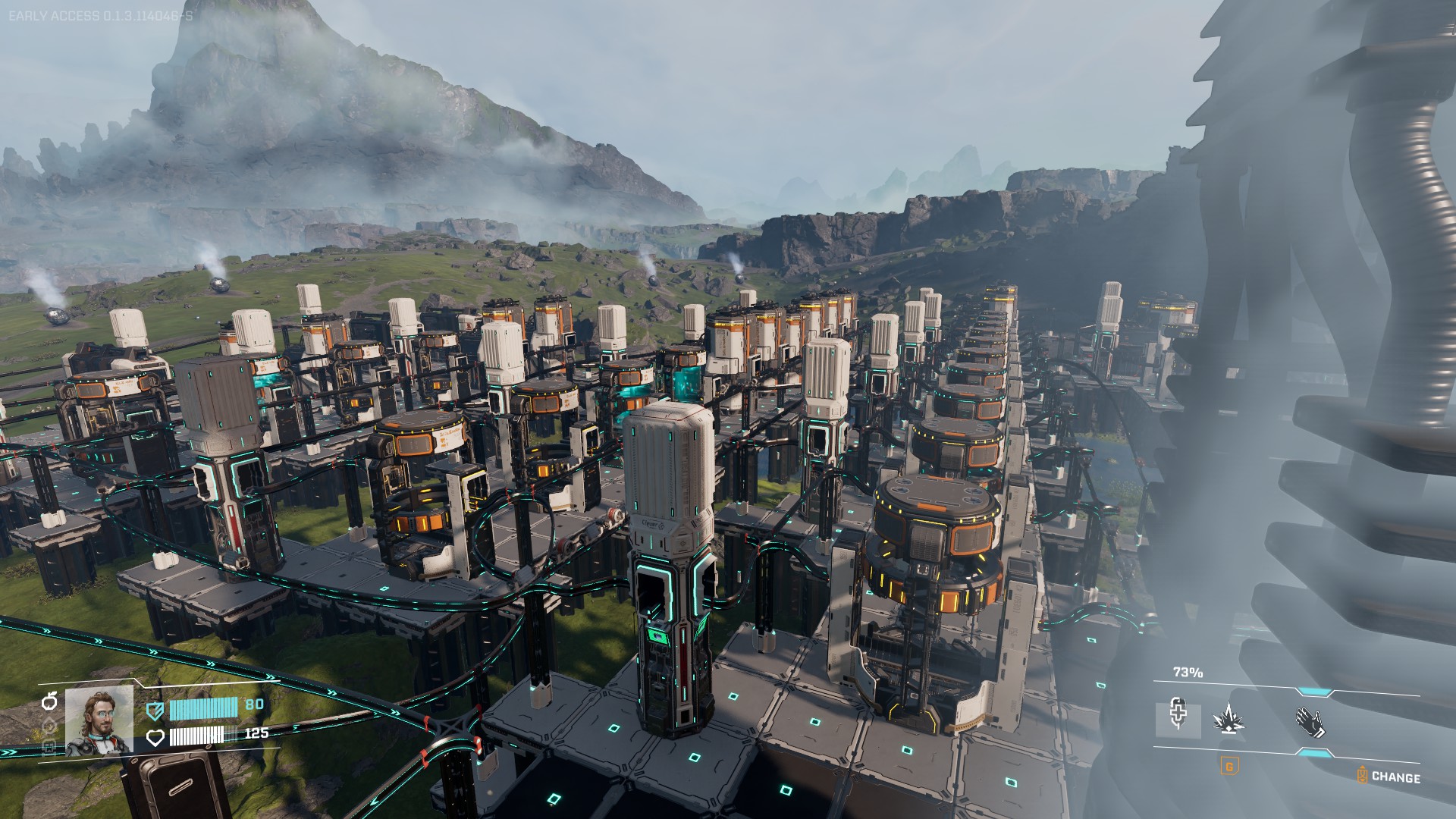
StarRupture (why one word?) is a mix of multiple games in the genre. It’s a preset 3D map, with research that leverages usable products, and has some PvE against planet bugs, so a tad similar to Satisfactory here. It uses a grid structure for placement of stations, which is very nice.

In terms of differentiators, every hour or so, the planet receives a massive solar flare that burns everything that isn’t under a shielded protection. That giant fire causes the factory to stop working until it auto-cools and adds new things on the map. Cavern access is one, which doesn’t yet mean much that I can see. It also spawns some fireballs you can mine, which are only used in 1 recipe to date, as well as meteors you can harvest which allow you to build more bases. It also has hunger/hydration gauges, which are closer to Planer Crafter in nature. Somewhat uniquely, it doesn’t use belts but instead rails under a pull mechanism.

Rails

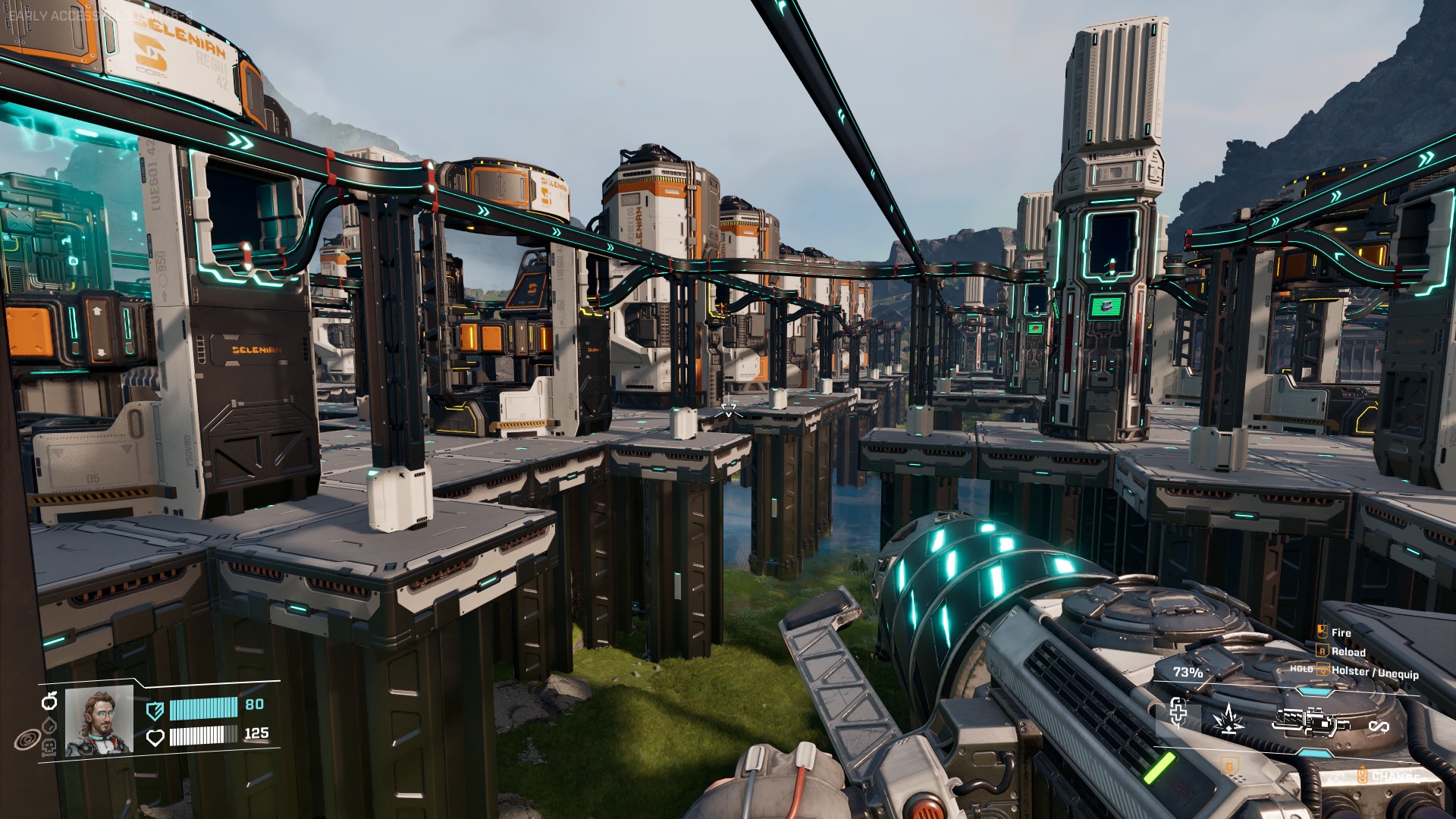
Worthy of it’s own point here, rails are functional connectors between buildings. If a building needs something and that something is connected to an available rail, it will traverse the entire map in order to meet that need. A rail is not dedicated to one item, as you can connect multiple together. Their only limit is throughput, which is generally only an issue at the ‘mouth’ of a factory. Since a rail only transports what is needed, you can have 1 rail supply 3 items to a factory without causing jams.

Factory Design

Resource collection can get a bit weird as the nodes are spread out – Helium 3 for sure. You’ll eventually unlock the ability to ship things between bases, which opens the door on a mega factory of sorts. World design requires foundations (which don’t always work), meaning you can’t cover the entire planet like you could in Satisfactory. Even the base shields you deploy have a hard limit on the number of buildings you can deploy (higher than you think mind you). I’ve ended up with sort of micro bases, where they harvest raw material, smelt it, then ship it to the larger base.

Research gates start off a buffet style where you will invest in 5 at the same time. Eventually, you will end up focusing on a specific research and dedicate everything to getting it done. Dedicated bases with shipping is key here.

The relatively great news is that actually building something requires 1 or 2 items total, no matter the complexity. This dramatically simplifies building more bases, or a quick shelter if a flare is coming up.

Early Access

I haven’t had any crashes, which is nice. The ratios generally work, and figuring out how to best use rails is a nice thing. Progress on research generally means you always have something to do and/or tweak. Exploration has progressive risk, with some areas feeling like death traps due to a combination of poor shooting controls (yes, guns) and a lack of combat options – standard EA issues.

Exploration is required to progress, as you need blueprints for research items, and Helium + Sulfur is nowhere close to where you start off. It’s certainly more enjoyable to explore than most 3D games.

There’s a decent sized list of QoL bit here, like how much research is needed for an upgrade, how maps work, how consumables work, and general factory design. But it’s all QoL items and not simply ‘broken’, which honestly speaks volumes to how the dev team took their time to launch something good. The major design risk here is going to be the rails and how they work at scale, time will tell. I feel like the potential here is higher than many others in the genre given the various bits at play here. To be clear, it’s only potential at this point – that’s the nature of EA.

Overall, I am impressed with what’s here. Well worth a pick up!

Maneater

I have played a dozen or more games of the genre of ‘you are a creature, you eat to get bigger, in order to eat bigger things’. Maneater is what happens when you expand on that idea and try to make an sort-of-RPG from it. Mileage varies. On sale for like $10, including the DLC.

High level, all of these games suffer from the same type of issues. You start off extremely defensive as you’re very weak, with nearly every corner a type of death. You eventually reach a point where the environment has no real challenges and it snowballs into a sort of ‘god mode’ game. The best games here add new mechanics to add challenge, the less good games add hit point walls.

The core of the game has 2 main streams of effort. First is a bunch of map markers that ask you to attack a landmark, chew some meat things, or open a tunnel. It’s rather free form and simple enough, back to basics from 20 years ago. There are some tunnels that connect locations, so you’re generally rewarded for exploration.

The second stream is the RPG element, where you have mini-quests, mini-bosses, levels, equipment, and stats. Make the numbers go up! This is different than most games, and uses Chris Parnell’s as a sarcastic narrator. There’s a really tough balance with comedy, and if you like Chris Parnell’s sarcasm, then this will work for you. If not, well, not. In my case, I enjoy it.

The combat portion is relatively straightforward. Attack and dodge. In most games, combat takes place on a relatively linear plane. Here, it’s more like Xwing, with full 3D movement, including breaching the water to attack surface dwellers. There are camera issues, and nuances to the lunge attacks on the surface that generate a significant amount of frustration. The ‘target lock’ feature is wonky. The game is relatively easy, the hardest boss battle will remain the controls.

The story itself is over the top without being campy. Thankfully it’s only about a dozen or so hours. Which gets me to the final point.

There’s a soft spot here in terms of price and value. Gone are the days where any game can justify an $80 price tag and truly reach mass appeal, without some extra bits involved. Live Service games sort of work here (though honestly, Roblox + Fortnite absolutely dominate that market). What’s left is this middle ground of games in the $10-$20 range that need to find the right balance of quality and content. Something like Tower Wizard at $5 and taking 6hrs to complete is a good deal. Seance at Blake Manor too. Maneater at $10 is a solid pick. I think there may be some area here to explore further…

Final Fantasy Retrospective

Importantly, the Steam Deck is the go-to for nearly every FF game, even the remakes. FF16 is the only one where it doesn’t work as well as it could, more on that later.

To me, the games all seem to fit into eras. Each with a starter entry, and then a capstone. There’s some experimentation within, but you really feel the difference between eras.

Old School

FF1 through FF6 fit here, all of them pixels with turn-based battles. FF1 (the OG, not the remake) has a tone of quirks but works well. Each game along added some new bits to it, some worked (ATB), some didn’t (usage-based skills). FF6 just is at another level though, and frankly set a bar that could not be met, but had to be avoided.

Early 3D Era

FF7 to FFX. FF7 was a crazy experiment, moving to 3D gameplay, limit breaks, and a wild amount of FMV. One-Winged Angel is tattooed in my memory. FFX took all the fun along that path and condensed it to a near-perfect experience, as much as FF6 did before. It’s still my favorite FF game, with near perfect pacing.

The MMO Era

FF11 to FF14. Bookended by actual MMOs, the main concept here is that you are a leader and lose control of the party. FF12 has a sort of hybrid system here, and was more side-content than main content (frankly needing a wiki/guide to see it all) and FF13 was, well I dunno what is was. Divisive for one, auto-played for most in another. For a 40hr game, only about 5 of it is decent.

The Open World Era

FF15 and FF16. Personally, I think FF15 is the worst of all the mainline games released. The story never worked, the gameplay either. Felt like it needed more time in the cooker. FF16 is a very strange game, and aside from the setting, you can’t really see any FF at all here. It’s an action game with no RPG elements, less than God of War. What it does poorly, it leans into (side quest and exposition). What it does exceptionally well (20 minute kaiju battles), it paces out so that they are meaningful. It may also be the easiest of all the FF games as a result.

Remasters + Remakes + Expansions

You should play the remasters of the pixel games (except FF6) as they are better than the OG. FF7 remakes is a nostalgia cake, so your mileage may vary. FFX-2 is a buggy mess that offers very little. But you get it for free with FFX. FFXIII’s 2 extra games are not good and should be avoided.

Forward Looking

It’s no secret that Square Enix’s main source of income is FF14. The good news is that FF16 is a ‘good’ game, not great, and a nice cleanser after the FF15 launch. FF16 is not a Final Fantasy game though, at least not according to 30 years of games. Expedition 33 is more FF! It’s a curious thing to look forward and see where the games do go. I certainly expect large spectacle with crazy boss fights. Some throughline about some monopoly (religion/kingdom/company) being bad and you playing a knight of some kind. I don’t see the game going back to turn-based, though a hybrid option is a possibility. And quite unlikely that we see team-based RPG elements return, though honestly, that would make me quite giddy.

Perhaps, just perhaps, FF is best looked at as an event in the past we can look upon with nostalgia and not try to replicate but simply inspire. FFX is 24 years old now (!!!) Maybe it should just be respected for what it was.

….

Nah. There’s money to be made!! (Oh, that would be quite meta…)

2026 On The Go

I am not one for New Year’s resolutions. Most of my reflective / change time is during the summer when things tend to slow down. Holiday season is often a mix of surviving / recovering / enjoying, not so much to make large scale changes. But that’s me.

Now, 2025 objectively sucked. I am fortunate enough to not be old enough that I don’t really have easy comparatives of bad years, though 2020 is a bar I would prefer to never reach again. 2026 is off to a rough start – at least on the world stage. It’d be cool to go a few days without some stupidly aggravating world event. Can we be cool for a bit?

Family stuff is straightforward for now. Enjoy the moments. Appreciate the moments. It certainly feels fleeting. Hockey is both a safe space and an outlet that the family can enjoy. That’s nice to have.

Health is improving but not great. Found some courage to try a modified exercise program that now let’s me wake up without backpain for the first time in.. hell, I don’t know when. I used to spend most days with a 4/10 of lower back pain, so this improvement is very welcome. Holiday eating habits were rough, so glad to get back to the standard routine.

Games coming up… well this is a weird one I guess. GTA6 may actually launch. Control 2 as well. Aside from that, not much on the radar I am paying attention to. If you look at the 2025 games in review post, there were only 3 big-name games there. I find I am gravitating much more towards the indie/middle pack games. Star Rupture (a sort of Satisfactory clone, in EA) is worth a poke. The commoditization of game dev, and frankly evolution of AI means that almost anyone can translate an idea into a decent game. The moral pitchforks of ‘no AI’ are the same we had in 1993 with Jurassic Park (animatronics vs CGI). It can’t be used everywhere (well, perhaps James Cameron has thoughts here) but it would be kind of moronic to not experiment some. The clear danger here, and it is a significant one, is that ‘people’ in general are idiots and self-serving. Social Media is the best example I can think of to showcase the stupidity of humandkind propelled by the quest-for-more-money of oligarchs. It’s not about doing more with less. It’s about doing more with the same.

I am sure that we’ll get some solid deliveries this year, likely a larger focus on portability where the Steam Deck and similar devices can truly start to shine through. It seems that is a more likely path forward given the RAM shortages around today. We’re still a few years from integrated graphics being fully viable. Close though!

I will point out I’ve done a recent replay of a few Final Fantasy games. More on that in a future post. For now, let’s just hope we have a decent 2025. Or at least a decent January 2025!

2025 In Review

May you live in interesting times. Indeed

I think we’ve all had enough of the “world news” to fill our socks for a couple years. I am certainly trying to avoid the insanity as much as possible, with so-so results. For sure I am desensitized to more than I should, which doesn’t really speak too well of me I suppose. I’ve opted instead to just try to live with as much kindness as I can, and give where I can. I would like to think that speaks better of me.

Physically, this has been a tough year. Work stress has been off the charts, and my lower back seems to continually trigger with sciatica. I wake up with a 4/10 of pain, and it fluctuates throughout the day. Treatment does help, but it feels more like tolerance than progress. I need to be more active – a piece I’ll focus on in the new year.

Mentally, well the lack of posts here I think speaks enough about that. Rough year. And I am damn sure that January is going to be the worst month on record.

Games

A decent amount here actually, mostly in the order played.

  • Indiana Jones and the Golden Circle. Way better than I had expected, and certainly better than the last 2 films. I really like the exploration here.
  • Pacific Drive. I’ve had this for a while but the latest patches add way more replayability and less punishment to the game. The mechanics are better than average and the story is excellent.
  • Lorelei and the Laser Eyes. This is a puzzle game that had great reviews. It’s obtuse, has poor controls, and reminds me of puzzlers from the early 90s. Meh.
  • Monster Hunter Wilds. 50 hours here. I enjoyed it.
  • Core Keeper. A sort of exploration/survival game with some minor automation. 85 hours here, and absolutely rocks on a Steam Deck.
  • Blue Prince. I played up until room 46 and lost all interest. I love puzzle. I love roguelites. I very much dislike their combination here. Having to re-do simple puzzles 40 times is dumb. Looking at you dartboard!
  • Outworld Station. A factory builder in space, without belts. I enjoyed the first part of it, up until the 4th zone. Then some serious balance issues popped up. Multiple patches since then though. Interesting mechanics here.
  • Clair Obscur. If you haven’t played this, well, I fell sorry for you. There’s a very good reason it swept so many awards.
  • Avowed. To me, this is what an open world RPG should feel and play. This would have been my GotY if not for Clair Obscur.
  • Warhammer Space Marines 2. I got it really cheap and finished it in a sitting. I’ve followed 40k for a long time and while the setting is interesting, Space Marines are clearly fascists. The story just doubles down on it. Mechanically it’s a solid game, but the through-line is tough to swallow.
  • The Crust. A game that tries to mix factory building with exploration (a la Frostpunk). It’s in open beta and is worth the ticket price.
  • Two Point Museum. It’s ok.
  • The Alters. Hard to describe this game. Exploration, automation, story driven wheel of near-death? It’s a weird game, with failure states you only realize later on. I need to replay this.
  • Tales of the Shire. I am disappoint. Unless you get this on a massive sale, pretty much any other cozy game is better. There is so much promise here, but it revolves into 90% fetch quests.
  • Strange Antiquities. Puzzle games that focus on inference are a fave of mine, and combined with an occult storyline, this game kicks. Amazing.
  • Assassin’s Creed Shadows. Ghost of Tsushima did is better in all regards. The minimap is again full of pointless activities, long-tail grinding for materials, and cut&paste environments. I do like the differing playstyles, but the game is rinse & repeat from the moment you unlock the 2nd character. It looks pretty.
  • Hades 2. It improves on Hades in every regard and has amazing replay value. #3 for me for the year.
  • BALL x PIT. Breaker + roguelite = amazing. For the price, you’ll get more than your dollar’s worth. Also works great on Steam Deck.
  • Rise of the Golden Idol. The story is great. The puzzles increase in difficulty, exponentially so in the DLC. Lots of inference required here, and the characters show up multiple times. Excellent game(s).
  • Strange Jigsaws. Remember the Flash era of puzzle games? This is right up there. Very weird. Only $5. I liked it.
  • The Seance of Blake Manor. A mix of Blue Prince and Golden Idol. You’re sent to solve a mystery, learn about 20+ characters, discover the nooks of a manor, and experience some neat hallucinations. It’s just the right type of haunting. With a very minor exception, all the puzzles can be solved with ample time. Very solid pick.
  • Absolum. Beat em up roguelite. Where BALLxPIT allows you to grind your way to victory, Aboslum requires you to gitgud in order to succeed. My only gripe here is that some enemies cannot be stunned, and at random points you get multiple ones show up making it an exercise in frustration. I consider it a sleeper hit, very very good game.

I think the list is less interesting about what’s on it than what’s not on it. I didn’t play Silksong (I will though!) and didn’t give Death Stranding 2 a shot (yet to play the first). I didn’t get a Switch 2 so nothing there. And zero multiplayer games.

Oh, and aside from Indiana Jones, MH Wilds and AC Shadows, none of the games would be considered AAA. I think that speaks volumes about where the industry is headed.

And there’s still some time left to pick up some more games before the year ends.

Physical Stress

I’m about 5 days away from a major project milestone, the initial delivery. Quick rewind, I onboarded to this project in September, did some homework, and relaunched it at the start of October. So about 10 weeks to get to the first delivery point. Projects of comparative size/complexity usually take 2 years to get through, given the amount of gates & approval stages required. So delivering anything in this timeframe is already a major achievement, getting something useful is practically unheard of.

I remember watching variety shows when I was a kid. Sort of like America’s Got Talent today I guess, but it wasn’t a competition. I always enjoyed the magicians. There were a few acts that were edge-of-your-seat – think of knife throwers, tightropes and whatnot. One particular act involved putting bowls/plates on long poles, and spinning them. It started with 3 or 4 of them, and then they just kept adding more and more. You’d see the plate start to wobble, ready to fall, and they’d magically find a way to get it back on track.

Project management is a lot like this. It shouldn’t be, I’ll readily admit that. Not everything goes perfect in any project, and with adequate planning and time you can manage a few wobbling plates. With less time, a LOT less time, you still have the wobbling plates just not enough time to get between them all. As as result, you need to prioritize which ones need to keep spinning and which need to crash.

The biggest problem here is that while I am talking about spinning plates, the reality is that each one represents actual human beings. They have a vested interest in keeping that plate going. Most of the time, the wobbles are outside their control and they just need a quick hand to get things back on track. Telling a group of people that the work is a lower priority and therefore has to stop, well, that has all sorts of impacts. Sometimes they take it well, sometimes not. In the current work climate… stopping work isn’t usually a good sign that the work is going to exist long-term.

Right, more analogies.

We are all sponges. We can absorb a lot, but we need time to release it in order to absorb more. We each have different reactions to being oversaturated, sometimes mental sometimes physical. I know that my symptoms are primarily physical. The body just doesn’t want to fully cooperate, sleep is hard to come by. Without some relief, the mental part starts to fade with lower engagement and lower patience levels. I can still problem solve relatively well, but I gradually lose the ability to consider the people impacts and focus solely on the end goal in order to get some respite.

So right now, as I’m typing this, my lower back feels like it’s gone through the wringer. Sleep is fitful. Patience is low. The stuff I generally enjoy has lost a lot of shine. I am convinced that this will release next week, and I’ve already set time to take some steps back and breathe.

Looking forward to it.

Ball x Pit

I remember playing Arkanoid when I was a kid and being amazed at what a mouse could do. Ball x Pit is pretty much Arkanoid on steroids.

To state clearly for the record, this is not a game you play forever. After about 20 hours or so, you’ll have seen pretty much everything. The NewGame+ mode isn’t more than reskinned + harder levels. Still, for the price of entry it’s hard to find a better deal.

And as always, the game is amazing on the Steam Deck. Very easy to pick up and go.

The Basics

You have a character, they shoot 1 or more balls towards enemies that gradually move towards you. There are 2 mini bosses and a final boss per level. Complete the level with a few characters (that you gradually unlock) to get access to more levels. Rinse and repeat.

The Twists

There are a couple big ones. First, you have a home base where you place buildings and farmable areas for resources. This is the meta progression of the game. These unlocks come through random drops (blueprints) in levels and gradually increase in power.

Second, you are provided ‘special’ balls that have additional effects, like more damage, poison, frost and so on. You can combine these balls to new balls (evolution) or merge them for mixed effects (fusion). Understanding how these work together is important at first, and less so as you progress when you can brute force some pieces. Iron + Fire = Bomb, a super strong option for early levels. Ghost balls pass through opponents, quite useful.

Third, each character has a perk of some sort that you need to work through. Maybe it’s more balls, maybe the balls come from a different location, or you use a shield to bounce them. The last character allows you to AFK. You also acquire passive boosts per run on your character, pick those that complement the character perks. Increasing a character’s stats, even by 1 point, has a significant impact. Trophies for clearing zones improve the more character’s clear it, also a significant boost.

The Optimization

Rogue-like games always have optimizations and here is no different. Resources are key to progress and initially gold is a huge bottle neck. To start you can only harvest once per visit to town, which resets every run. With a few gold mines put together so that the harvesting characters ‘pinball’ in a small place, you can acquire some gold, start a run, quickly fail it, then get more gold.

Eventually you gain the ability to buy more harvests, and as long as each harvest is 75% or less the cost of a purchase, you can farm more and more gold. With all characters and max gold mines, you should be able to get 3,000+ gold per harvest. Takes a while to get there though.

Harvesting wheat/wood/stone is different and honestly less than pleasant until the final building is unlocked. 1 farm, 1 lumberyard, 2 quarries gives you 4 people harvesting big fields every few minutes, with everyone else in a gold mine. You can use the gold you get to buy more resources through the market. When you finally DO get the last building, then it’s honestly about being offline (game closed) with 3 farms, 3 lumberyards, and everything else in quarries. When you restart the game you’ll have tons of items, probably 500k gold worth. With that you can upgrade the infinite buildings for more stats.

The more stats piece is only relevant to the NG+ mode in truth. By the time you get there, you should have a good grasp of the game.

Factorio – Maraxsis

Maraxsis is a planet mod that’s meant to be available at the same time as Aquilo, which means a significant amount of challenges. One of the challenges is spelling the name of the planet!

The planet is covered by water, preventing most buildings from functioning on the surface. You need to build pressure domes, which significantly limit your floor space. The good news is that these act as roboports, the bad news is that you need to ship in barreled atmosphere to get them to work. You can overlap their logistics range so that robots can work in and out of the domes, and across them. That leaves space between them for other buildings and dramatically reduces the need for belts. Maraxsis also has spots on the map that lead to a trench that has no light, very high pressure preventing nearly all buildings, spots of lava, and no method to move things between the trench and surface.

Now, the real pain in the butt part of Maraxsis is the main new building – the Hydro Plant. This building gives a base +50% to quality, which means you need to deal with 5 potential outputs/inputs. There are ways to get logistics to filter based on quality but it’s finicky. You can either build 5 versions of a building (useful for salt filters and research) or you can just recycle the material based on quality (e.g. rocket fuel).

Maraxsis requires a ship that can head to Aquilo, needing rockets and significant storage space. If you’ve already solved Aquilo and unlocked fusion power, you will solve some fairly large headaches. If you haven’t optimized Vulcanus / Gleba / Fulgora you will have a bad time. There’s a ton of back and forth here as you need odd items that shouldn’t be crafted on the surface (such as 8 types of new pipes – required to interact with the trench).

Note that once you land on Maraxsis you are stuck there until you solve all the core puzzles, which unlocks rockets. And it will take longer to solve this planet than most others.

Complex vs Complicated

These things are very similar. Quite a bit of life is complicated, where things are intertwined without a whole lot of rhyme or reason – lacking design principles. Everyone’s initial attempt at automation games is complicated, with belts everywhere. This is normal – you don’t know what’s coming and can’t really prepare for it. At the start, a single mine with a single smelter produces more than you think you’ll ever need. Eventually you’ll dedicate a planet and have hundreds of smelters. You can either build those one at a time, and have a complicated setup, or plan better.

Which is where complex lines up. Complex is when order and efficiency is applied to complicated. Computer chips are complex. They are tiny little things that perform magic miracles. Your phone is infinitely more powerful that the tube and vacuum computers of the late 50s which took up floors of a building.

Factorio is notorious for complicated. Space Age even more so with the roulette aspect of legendary materials. Some pieces can be ‘easily’ simplified. Others are insane. Try building a legendary upcycler for quantum chips on Aquilo – that is a wild exercise!

Maraxsis is very complicated, as it throws a bunch of curveballs at you. Multiple types of quality, very limited construction space, complex production chains that require buildings from every planet except Aquilo, and a near permanent shipping of off-world items to keep the planet running.

Starting Off

Consider this a first landing on any planet, and one where you will need at least 10 of every building you can make – including Biochambers and Agricultural Towers. You’ll also need a decent shipment of blue chips, tungsten plate and carbon fiber. Depending on if you have fusion power or not, you’ll be shipping that or nuclear plants. You’ll also want to build a diesel submarine as soon as you land – you’ll die in 15 minutes of exposure to the planet surface otherwise.

Place the landing pad, bring down a chunk of stuff, build a sub, then delete the pad and explore. You want to find a spot that is near a trench (a dark gash in the map) and near a coral reef. Your eventual base will need quick access to both eventually. The closer to a trench, the more cliff explosives you’ll need to clear the land.

Your first goal is to lay out a power grid – I always use a 50×50 one which is based on roboports (which cannot be used on this planet). Build a hydro plant, and then build a pressure dome. Placement of that dome should be 1 grid away from the trench and generally in the middle of the grid. Without power you can’t really tell how much range it has, but pretty much anything within the 50×50 power poles will be withing robot reach. So place down the landing pad in that spot, and eventually it will connect to the dome network!

The power pressure dome, which also processes atmosphere. I had done Aquilo thankfully – yay fusion!

From there, the progress is somewhat linear. You need to refine the salt water, then you need to pump lava from the trench to get foundries running. That will require a new production line on Vulcanus for the new types of pipes. From here, you’ll need to set up a fish farm and refinement with biochambers + towers – very similar to a Gleba setup, nutrients and spoilage to manage. This part starts complicated but design experience here helps a lot to optimize with an external pipe bus. You only need to unload atmosphere in 1 dome, and you can pipe that to the next ones. The hardest part here is going to be the shipping of logistic bits to the planet.

The factory dome. Note the recycling station in the top. The left side is the water filtration plant and a really simple quality management option.
After having solved Gleba, this was pretty easy. A good example of complex vs complicated.

Phase 2

After you solve the fish farm part – now it gets complicated. You need to create material in the trench, which has no power sources. Maraxsis went through some design changes and the salt reactor is both simpler and more complicated than before. It’s a nuclear plant on steroids, and you need to pipe the supercritical steam down to the trench to power a specialized turbine. This also means you need to build a patrol for the submarine to move material from above to below and back again. This requires ports and is quite similar to train logistics – if a bit more finicky. This unlocks the hydro science – which has 5 types of quality ingredients to manage, so you need 5 production plants. Feels like details at that point. Project Seadragon opens up and allows you to build rocket launch pads! Finally an exit!

The Trench. Wyrm processing on the left (and power) and the 4 ducts leading into and out. Not shown, a recycling plant to manage excess quality items.

Phase 3

Except it isn’t. You need to build sealant. Sealant requires gas from the planet and heavy oil. Heavy oil is acquired in the same way as on Vulcanus – painfully, oh so painfully. This part honestly sucks, because it’s complicated instead of complex. Interacting with the trench yet again to create sulfur, breaking down carbon with calcite to get coal, kickstaring coal liquifaction, then a chain to refine light oil and petroleum oil. This production chain takes up half a dome, and pretty much completes the planet.

The processing dome. Science in the bottom left (double regular), and sealant processing on the right. So many pipes.

By the time I left I had 4 domes.

  • One for power, steam, atmosphere, batteries
  • One for foundries and assembler crafting
  • One for processing fish products, research and oil processing
  • One for power in the trench

Residuals

There are 3 pieces left to manage here.

  • Prometheum science is unlocked with this planet’s research. You will need to export it and bring to Nauvis. This sucks because you need to import 5 different qualities of research packs, and then set it up on Nauvis for import and distribution to your labs. Aquilo research is required, so head’s up there too.
  • Balancing is an issue. 99% chance you don’t have enough salt and you have way too much hydrogen. You will need to apply balancing here, notably flare stacks (another mod) that burns any excess gas – a pump with a condition to only activate over 20k in storage is enough. There are other balancing issues you’ll need to sort through, notably wyrm containers having so many quality types
  • Extra Research. More cargo landing pad space is a weird thing to need – but I guess it has uses for late-game 1million+ SPM folks. The nuclear sub costs is 5x the cost of a regular sub for twice the benefit, and the diving equipment just means you can survive outside a sub. There’s a new type of beacon with greater range and less effect (which I’ve yet to craft) and some other bits and bobs. Other than gating prometheum science, nothing to write home about here.

Conclusion

Maraxsis is a very interesting puzzle. It is more like Aquilo in that it requires near constant babysitting with space logistics, and a generally limited floor plan to get the pieces working together. The quality piece is a choice – either you manage it through logic gates or multiple stations, or you just chuck all the stuff you don’t want in the recycler.

The only true negative piece I have here is the interactions with the trench. The duct piping is annoying to manage as it has to be crafted off-planet, has too many pieces, and getting what you need in/out requires a very specific placement of vertical pipes. Getting power down there was harder than it should have been. I was able to solve all the problems myself here, which was different than Cerys’ death machine of a nuclear plant, so that’s something. I am not a fan of Maraxsis research being tied to late game science productivity mind you.

The overall good news here is that while Maraxsis is a very complicated planet, it allows enough flexibility to optimize to reach a complex state. I’d recommend a pressure dome flow away from the trench (e.g. trench on left, domes progress to right), with the pipe bus on the opposite side of the fish farm (above or below). 5 topside domes, spaced for maximum roboport distance, allows you ample room to build everything at massive volumes, and have a good quarter of one dome meant solely to recycle/destroy excess items. There’s a lot that can be done to optimize here.

Let’s see what come next…

Factorio – Cerys Complete

Noting there are spoilers in this post.

Again a note that Cerys was attempted right after the starter planet (Nauvis). The net impact is that some research pieces are not complete… but honestly none of that matters as you can’t ship anything to the planet. Generally, what you can build on Nauvis you can build on Cerys, so you need to be somewhat creative in your options. This excludes robots for a very long period, as lubricant takes a long time to sort out.

The initial landing is a mix between Aquilo and Fulgora. You have nothing but your suit and a mining pick. You need to mine some nuclear scrap and then, just like Fulgora, recycle it to semi-useful components. This feels more like the start of the game where you just don’t have tools or automation ready to scale, so you’re hand crafting everything. It’s super important to run across the small map and manually collect all the material you can see… it gives you a chunk of solar panels, accumulator rods (more on that in a bit) and blue chips. The same rule of thumb remains : don’t recycle items you cannot craft.

My version of a recycling plant.

Power is interesting here. Substations are easy enough to create and solar+accumulators work in the cold, so the lower right part of the map is the best location. Using a grid approach, you can generally map out and power the entire moon surface. Generally.

The issue is the slew of heating towers, crushers, and Cerys factories. Heating towers melt an area around them (if there’s water, it needs bricks to stay solid) and need solid fuel to work. I opted for a stupidly complicated sushi belt of solid fuel across the map to feed towers that were close to the middle, and then a second ring for the outer parts, on a lower priority. It takes about 10 recyclers running 100% on nuclear junk to generate enough solid fuel for the towers. This means you need to have a re-processing plant for all excess material, effectively doubling the number or recyclers needed. This is a fun exercise of logistics, compounded by a very limited workspace.

A plant in the middle of nowhere with belts feeding in and out.

Due to the nature of the frozen moon, you can’t easily build a main bus and you don’t have robots… so it takes a while to get it all sorted out – mostly through manual means. This is mostly stop-gap until you un-freeze the first of multiple factories, and where the 2nd major step takes place.

These factories are part of the map, cannot be moved, and must be kept thawed. Unlocking each requires blue chips and repair parts (which don’t stack). You can then use the factory to produce a given item – all of which are needed to proceed further. It’ll take about 10 of them by the end, all producing something different, in order to complete the moon. This will generate spaghetti runs of pipes + belts to move things from one factory to the next. Ya gotta do what ya gotta do I guess.

It takes a bit to unlock all the various pieces in the research tree, which is fine enough with goals. You then reach a challenge in acquiring 3 key items: Carbon, Fluorine, and Plutonium. None of those have obvious methods.

*Spoilers*

Carbon is normally only craftable on Gleba or from space material. You can’t build rockets on Cerys, so you’re going to use Gun Turrets to shoot the small (and specific to Cerys) asteroids, manually pick them up, and use the thawed crushers to turn them into Carbon.

Fluorine is on the right side of the moon, which is permanently frozen. You need to activate the main nuclear plant and use heat pipes to extend far enough to melt the mining locations (all of them), then use the Fluorine to make Lithium. It is a VERY good idea to have liquid storage containers in a thawed area in case the nuclear plant loses power. It will lose power.

To get the plant to work, you need plutonium. The only way to get plutonium is a random event where a particle interacts with nuclear ore. There are no instructions on how this works until very late in the puzzle. Complicating matters is that the nuclear plant, when active, shoots deadly particles that kill you in 3 hits. There are no explanations on how to prevent this from occurring but the answer is oddly simple… liquid storage containers with liquid water – not ice – water. You need to run heat pipes out from behind the containers, so a minor puzzle to sort that out. Getting enough plutonium is a crazy stupid exercise of trying to manipulate particles using the charging rods with polarity settings. Odds increase the more uranium per container, so the problem gets easier to solve the further along you are.

That this is the solution to not dying is obtuse. Hope it saves you time!
My version of the plutonium generation plant. Particles move left to right and use magnetism to hopefully trigger a reaction on these boxes. Each has 500 uranium at least.

*End Spoilers*

Once you have those pieces sorted out, the immediate priority is building robots through lubricants. Roboports are easy enough to create and having a dozen logistic bots completely trivializes all the puzzle pieces. Heating towers + plutonium problems all go away. Collecting asteroid chunks is 100% automated. Cerys factories can be easily automated. You’ve effectively solved the planet and can move on…

After you leave the planet, it’s still a good idea to keep researching Holmium boosts as that is a right pain to manage on Fulgora long-term.

End Thoughts

I rather enjoyed the puzzle aspects and the need to really be aware of the total environment. Expanding the available area takes a while to sort out in any sustainable manner. It’s fun to have different things to sort out without the typical toolkit of buses and robots. Honestly it reminds me more of the first time I played Factorio and just trying to figure out how to get 2 buildings to talk to each other without me being involved.

More directly, I would recommend Cerys more for new playthroughs and the first planet visited rather than adding to an existing save. You don’t really gain anything super long term here, but the loss of all automation tools is extremely jarring, even if the duration is ‘short’.