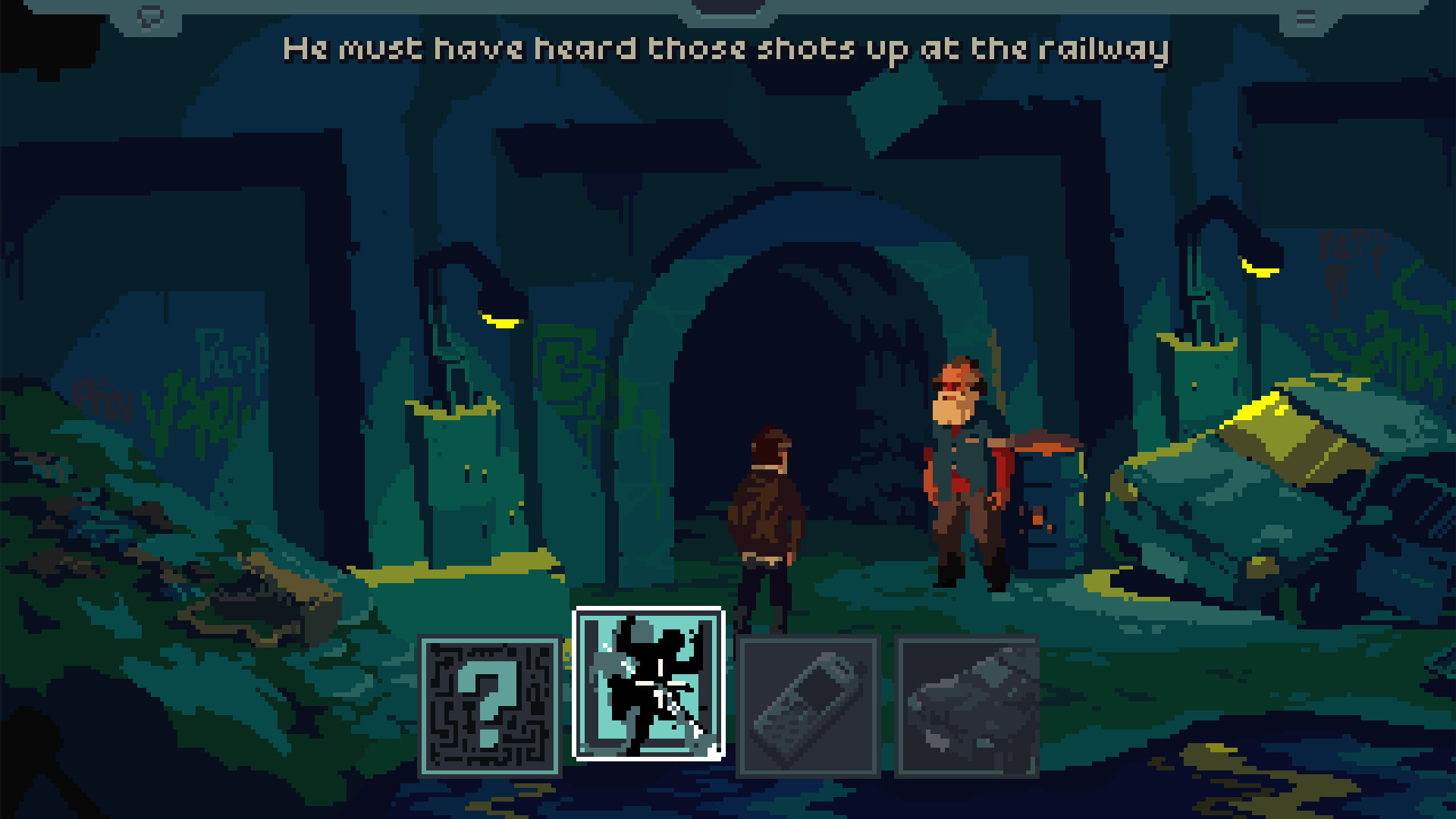
In the golden age of point and click adventures, LucasArts was king of the mountain. You could tell it was a LucasArts game just by the art style. Nostalgia is a hell of a drug!
Tell me this isn’t straight of the early 90s!
Puzzle games and adventure games are similar, think Golden Idol for a minute. The difference is failure state. You can, and will die in an adventure game, forcing a restart at some key point. Sierra had notoriously bad failure states where you would have to reset to hours prior. Thankfully we’ve learned a lot of lessons on that front, and games today have you lose a few minutes at most.
The Drifter has all these modern mechanics and trappings, wrapped in a deliciously voice-acted sci-fi story. From the first act, you are slipping between reality and nightmares, trying to find some sense. With 9 total acts to get through, and quite a few puzzles along the way, it’s a solid journey from start to finish. As with many of these games, the logic in some of the puzzles can breakdown if you’re not paying attention… but at no point did I think that a solution was completely bonkers.
The pacing is such that you can either dig through the whole thing in a single sitting, or take 1 chapter at a time. There’s no timer, and the act of gradually unveiling the mystery is quite fun. Thankfully, the twists themselves are also super logical, so no real deus ex machina here.
Give it a shot, well worth your time and money. Can certainly use more games like this in the future!
Satisfactory 1.0 launched in September 2024, 2 years ago. 1.1 came out which focused mostly on QoL items, including improvements on fluids and transport. I’ve done a couple playthroughs now, and do consider the game to be relatively feature complete at this point. Surprisingly, there’s a DLC announced – Core Values.
In some of the news circles, the devs have tried to explain the thinking here. If you compare to Factorio, it’s pretty obvious that the two options are a) find another physical location (Space Age) or b) rebuild the entire production chain (Krastorio). Quite a few logistic games have tried the cave construct, which comes with caveats.
Size. The factory must grow, and games that are architected around tight builds can generally work in confined areas. Games that are built on the concept of size/scale, the size of a location is a major factor. Factorio put temporary limits on land mass size, which you eventually could compensate. Foundry has elevators and caves, which are a right PITA to manage, but generally have ample space to collect items, just not process them. Satisfactory has no real size limits currently, with a very large focus on 3D builds. Very curious as to how this will work.
Logistics. How factories work has been optimized, any new location needs some new logistic tweaks. Satisfactory has horrendous liquid mechanics, so I do hope they don’t mess up there. Driving vehicles are better than before, but still very rough due to clipping. Trains work very well, but need insane space to work. Drones are ideal options in many cases, but obviously won’t work the same way in caves. Belts are apparently going to be tweaked. I’d gather there’s some limiting factor here with a new transport mechanic required.
Production Chains. The current game has you producing teleportation and quantum power. I’m not quite sure what could come on top of that, but there certainly is an option for some mid-game changes, which begs the question ‘At what point does the expansion take place?’. I’m sure there’s some integration with max-level factories, but is this something that goes into Tier 2 production? Will it impact that construct?
Space Elevator. The game is wrapped around the concept of shipping things to space, not sure a space elevator works underground. So does production require shipping between surface/caves, or is it a separate system? I’d certainly assume the former.
I do think this is an odd choice of DLC, likely limited by the game engine. I mean, the whole point is to build a space ship after all, and you do that. It would seem a potential option to unlock other planets or locations, rather than a space-limited construct. And space-limited with a game engine that does NOT support a destructible world.
This does pique my interest, as Coffee Stain has a good track record on building cool things and integrating player feedback. And really, Satisfactory is a top-tier option in the logistics space. More of that is certainly a good thing!
Factory automation and a skinner box? Let’s give it a go. Free demo, why not?
The main concept here is that you want to empty the pile of hay, 1 strand at a time. In that pile are 6 needles that provide absolutely atrocious buffs, but acts as a sort of meta-badge I guess.
You start as all automation games do… manually. It takes about 60 minutes before you can truly start automating anything. It takes even longer before you complete the 10 delivery quests that unlock all the available tech.
Progress is gated through money, there are no building materials or anything complex here. You need cash to build machines. You need cash to build belts. You need cash to build power stations. You need cash to upgrade machines. You need cash. And the best source of cash quickly becomes obvious as paper mills.
Eventually you do realize that you no longer need cash, you need throughput. At max level, each arm can extract about 3,500 strands of hay per minute (if there’s hay in range). That’s about 48 hours to eliminate 10,000,000 hay. You need a lotta arms! Which then fill your belts with hay, which also get saturated. The belt merging causes a slight hiccup in throughput, actually slowing things down. Oh, and to find the needles, you need to scan the hay, with 1 scanner per 2 arms.
The end result is a massive spaghetti run of belts, mergers, producers and power poles. Did I mention that there’s collision detection? That then means you need some 3D magic to make it all work together.
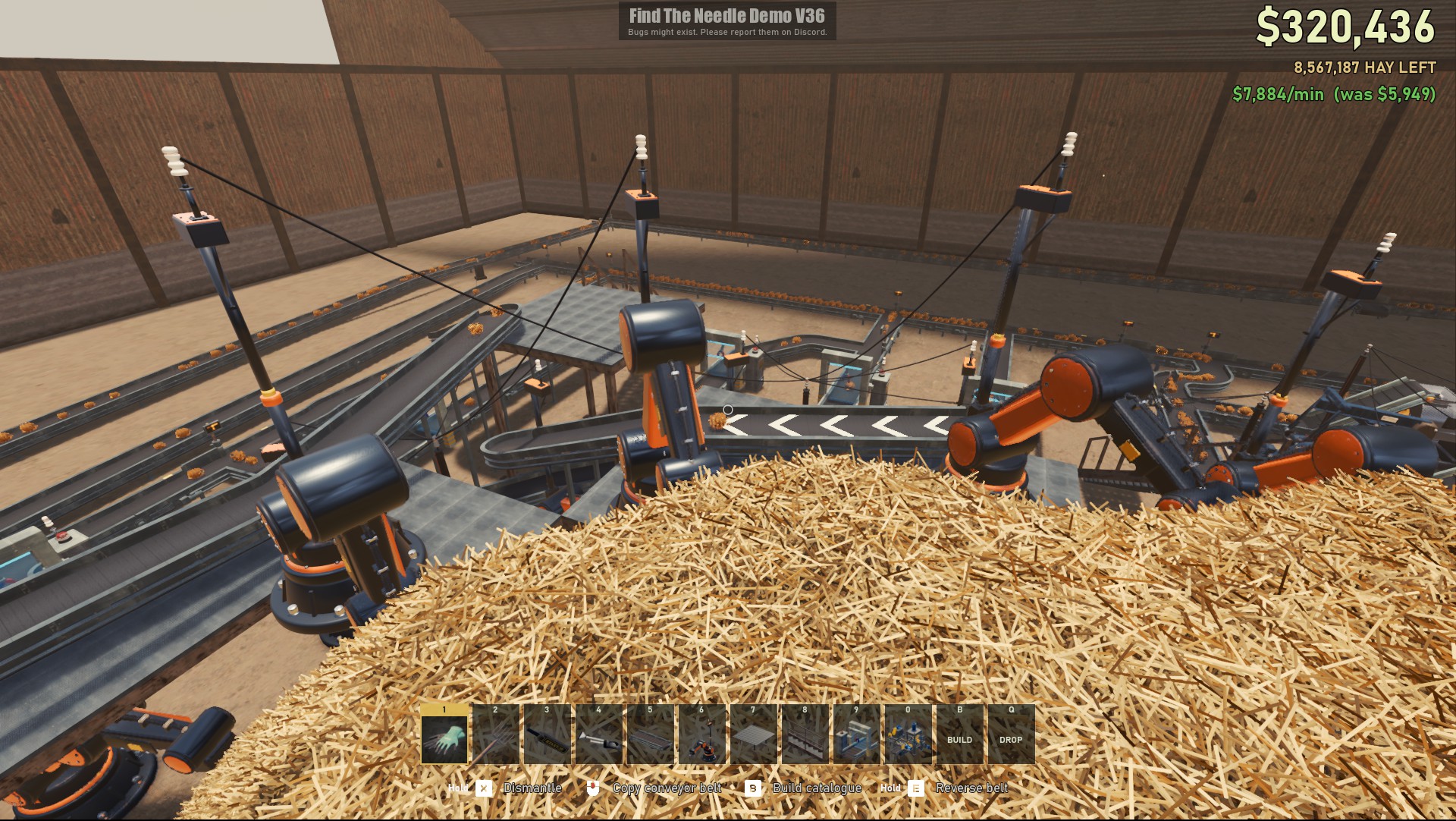
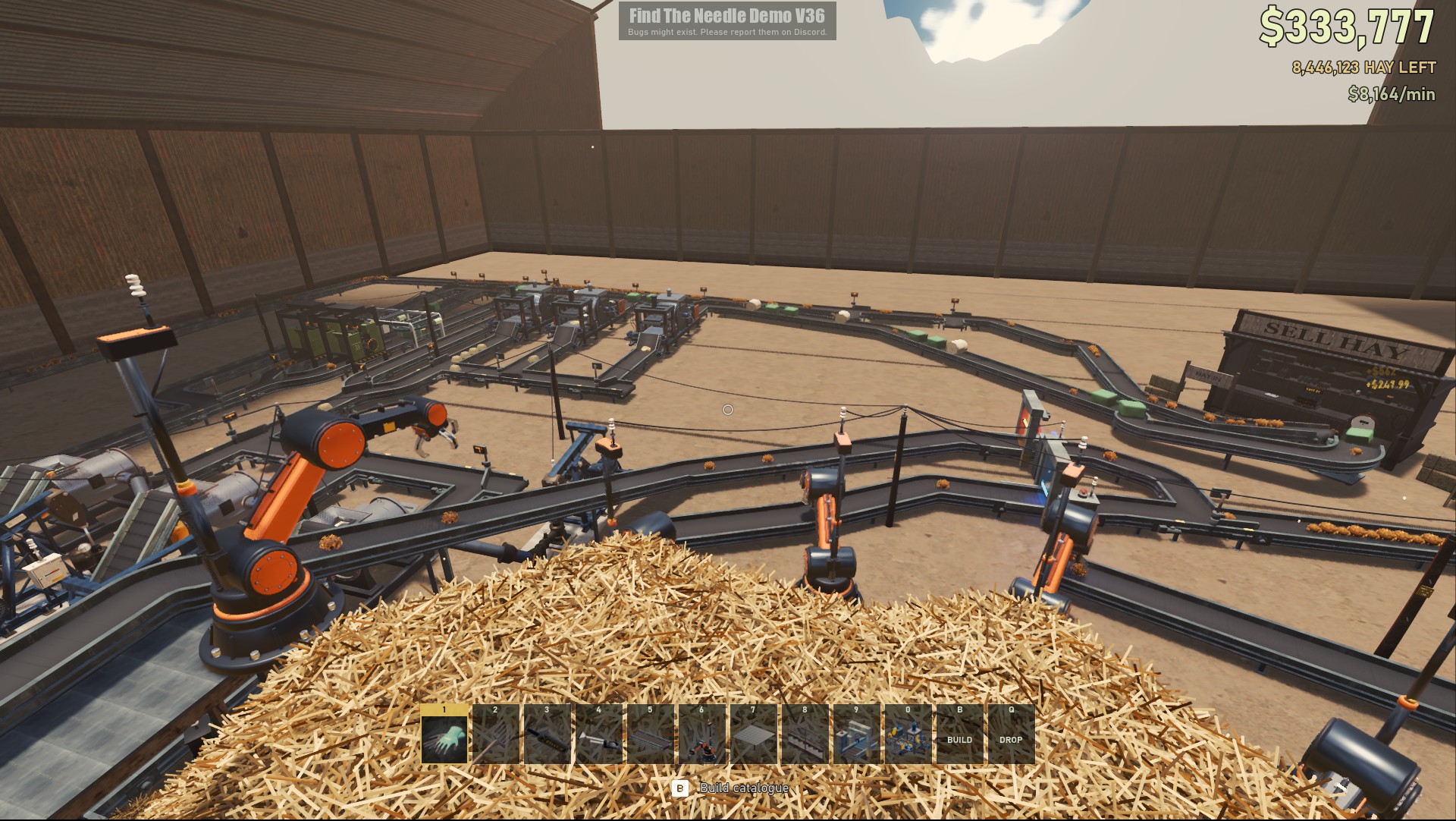
The two images below have maximized the number of arms possible (again, due to collision) at about 20. There’s 8.5m hay to go. That’s 2 hours, at best, to get to the bottom. The reality is that the arms will need to be moved closer together as the pile shrinks. I generally dislike AFK automation games, and there’s really nothing left to build now, just waiting. So I guess for all intents and purposes, I’ve completed the demo. It’s a neat idea, with a ton of rough edges. Free demo though…
Logistics games work on a rather simple concept. Insert material into a machine, extract the results. The complexity lies in the amounts of those 3 items, and their relationships. End-game factories have dozens of production lines to keep track of. The unique aspect of each of these games tends to lie with mass-distribution mechanics – moving things. Some use robots for low volume/high frequency, some use belts for a medium view, some trains for mass transport, and some ships for large distance transport where trains cannot work, normally providing less material than a train would.
DSP has robots, belts, and ships. It does not have trains.
Robots are used extremely sparingly, primarily for keeping your personal inventory filled with buildings, but also in support of uncommon building requirements on a bus.
Belts maximize at 60 items per second, which is only truly impactful in base ore processing. 20 smelters will saturate a belt. Stacking / piling is different (more on that in a bit.)
Ships have 2 types, local and between planets.
Local has some small limits that can be improved through research, and are generally effective at large scale transport on a given planet.
Planet shipping is slightly more complex, as the time it takes to ship can be long, especially when travelling between systems. Large factories require dedicated off-world shipping, which then distribute locally.
Small Scale
Until you unlock the ability to use ships, nearly everything is managed through belts. Throughput is low, a main bus can ship things effectively between buildings, and it generally keeps power usage low. The downside is that a significant amount of material is located on the belts at any time. Noting that this period also includes you travelling to another planet for silicon + titanium, smelting it there, and manually hauling it back to your main base.
“Simple” starter planet main bus.
Planetary Scale
When you do unlock ships, you’ll want to immediately move to the non-lava planet in your system. Some basic power options will be laid out, and you’ll focus on the basic smelting lines, effectively replicating all items on your starter planet here instead. That means all material up to yellow science.
Power is a massive issue here, as all logistic towers require an insane amount to charge, and you’ll be starved quickly. You’ll also have few ships available for distribution between towers, maybe 5 local and 1 planet per. That’s a start though, and enough to rebuild a main bus on this planet. Keep the starter planet running until you unlock purple science!
The power issue is going to be addressed by 2 methods. First, put as many wind turbines as you can on each pole, it will take a few hundred for sure. Next, on the lava planet, you’ll need to build a charging station, which requires a combination of wind/solar power and a battery construction plant. Use the extra power to charge batteries and ship them to your factory planet for discharge. Ship the empty batteries back. It’ll take a bit to build up, and charge rates are entirely related to the amount of excess planetary power… so keep improving it here. Eventually, you can supplement it with Deuterium Rods. Unfortunately, these batteries will be the only viable option until you get a Dyson Sphere running.
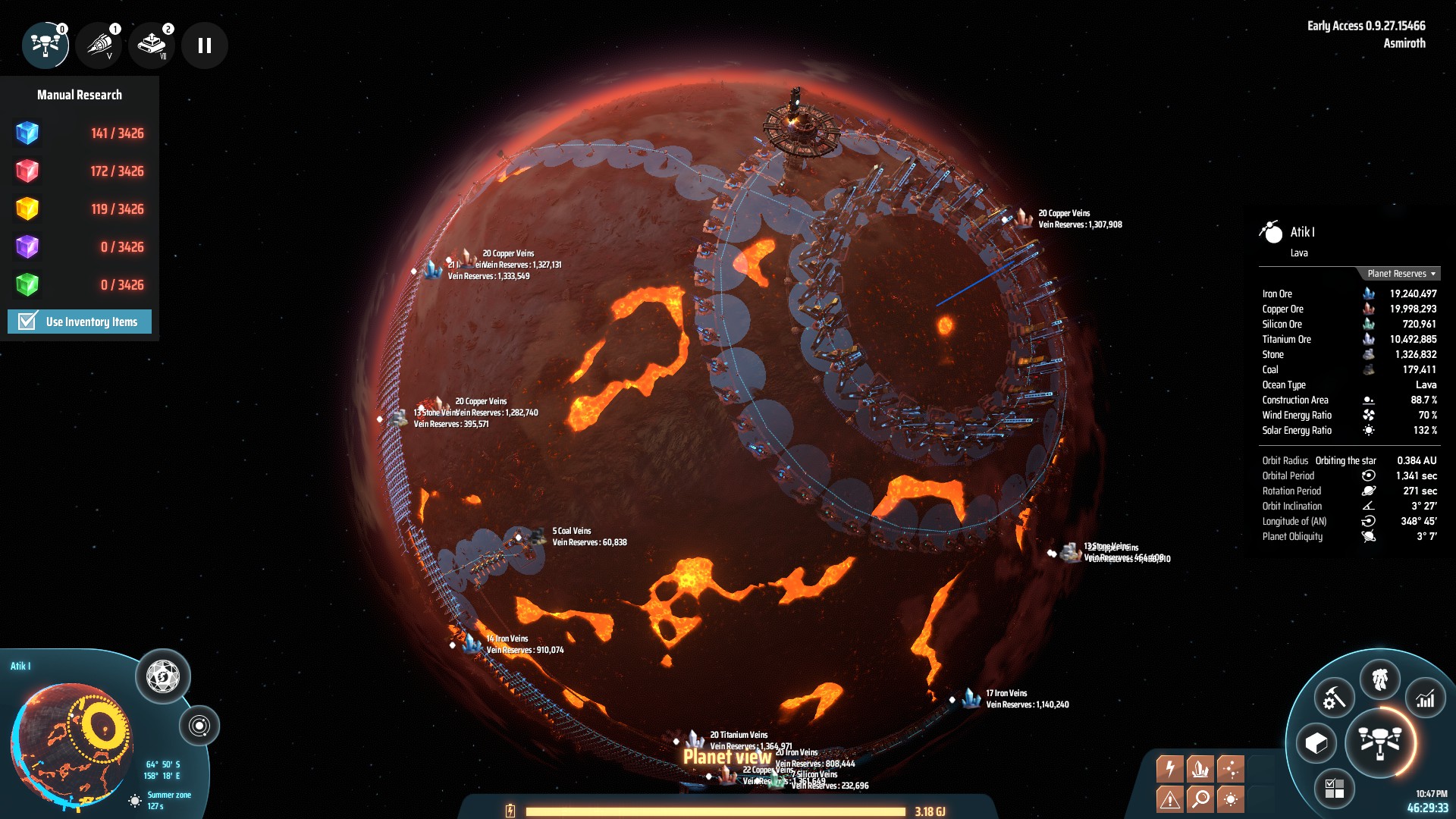
A lava planet with an equator of solar panels (for battery charging), deuterium processing, and rocket silos.
Proliferation
This is analogous to beacons in Factorio or Sommersloop in Satisfactory – they boost your output costing significantly more power. Mk1 sprays only cost Coal, and you should proliferate every single item (except raw ore, fuel, and dyson sphere components), including the spray itself. Make Mk3 spray once you unlock additional planets, as the nanotubes required need rare resources. Same rules. The 25% bonus to output is massive on multistep chains, which means you need less buildings, and therefore less power.
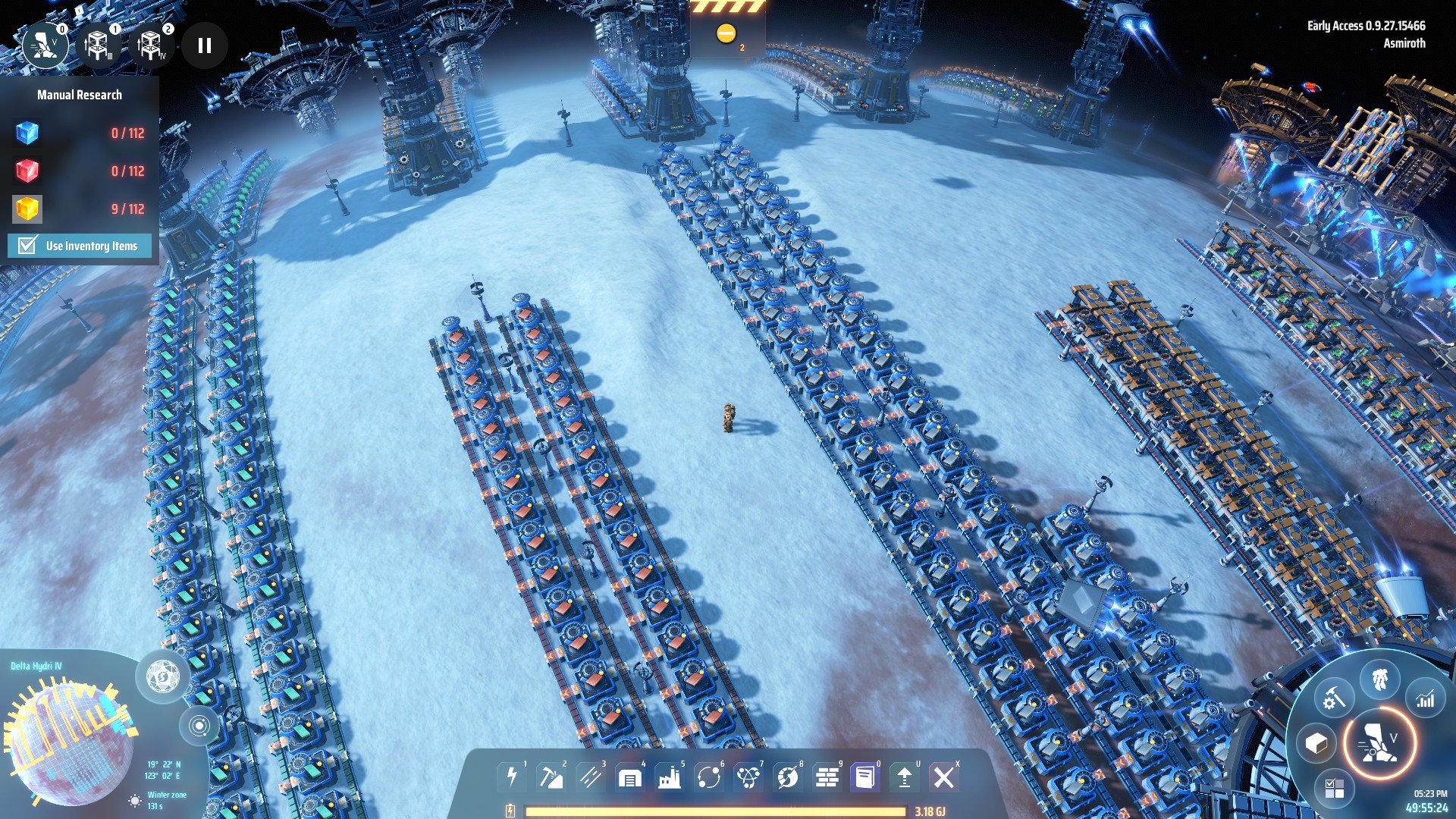
Easily scaled proliferation Mk3 plant. I keep Mk1 in storage for emergency purposes.
Interplanetary Scale
This happens when you start collecting rare resources outside your main system (kimberlite ore, sulfuric acid, and unipolar magnets all require level 4 exploration). These rare resources require warpers (green science) to move between systems, and dramatically simplify production chains. You can’t scale without these, and likely will need 1 dedicated logistics tower per.
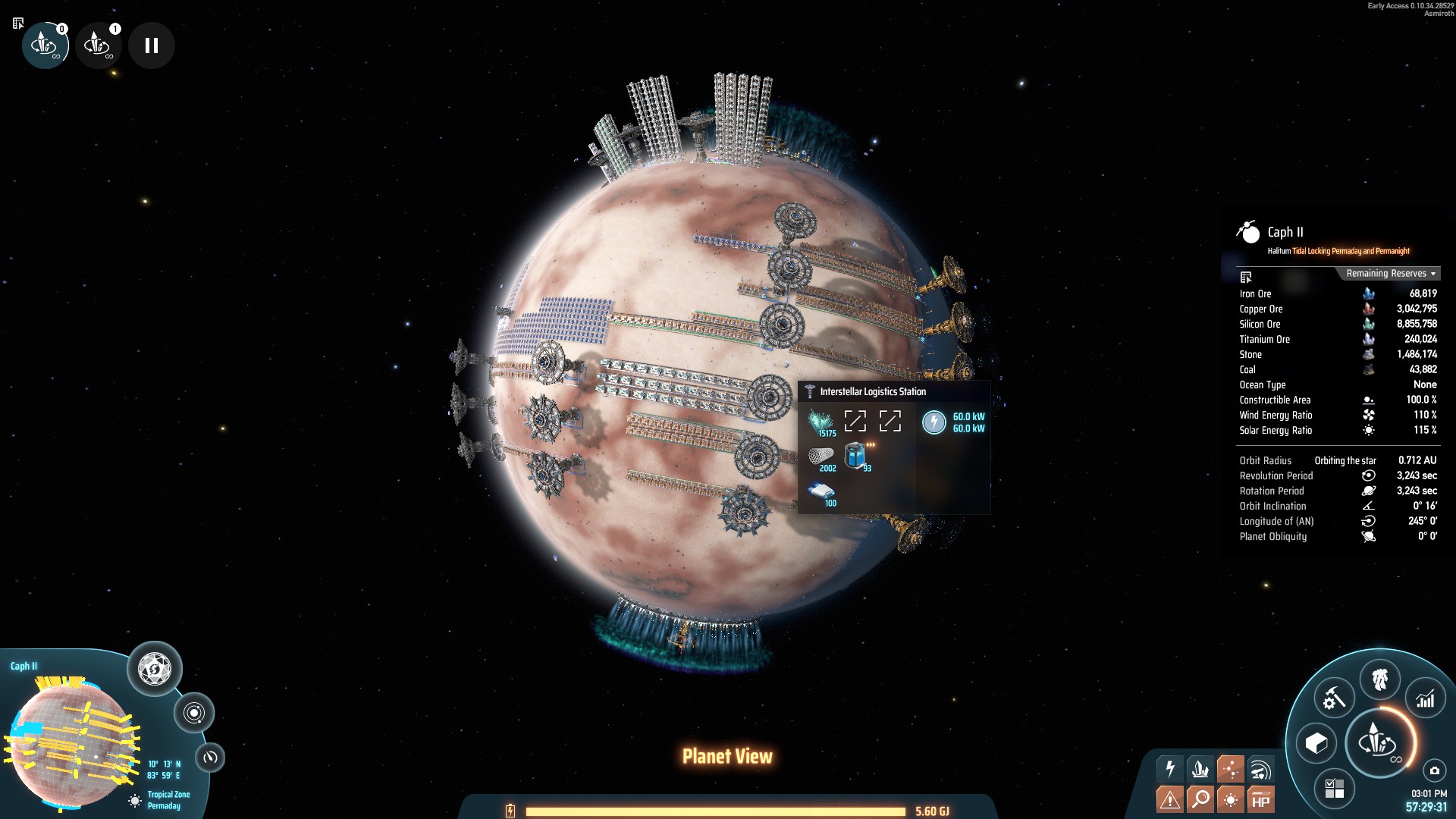
You’ll likely build a dedicated manufacturing channel per item as well. Why? Because this is the only effective way to build a modular design that can scale to meet Dyson Sphere requirements. If you build a self-contained red engine plant, eventually you’ll need 8x more of it. It is much easier to lay down more belts and assemblers than to lay out an entire new blueprint. Further, each logistics tower can only accommodate 5 items in storage, or seen differently, the end product cannot require more than 4 ingredients per tower. Excepting white science, this isn’t an issue if you dedicate 1 tower per product. Complex builds will require multiple towers, which a) costs a LOT more power, and b) you have to build them a certain distance apart from each other. Modular builds ftw!
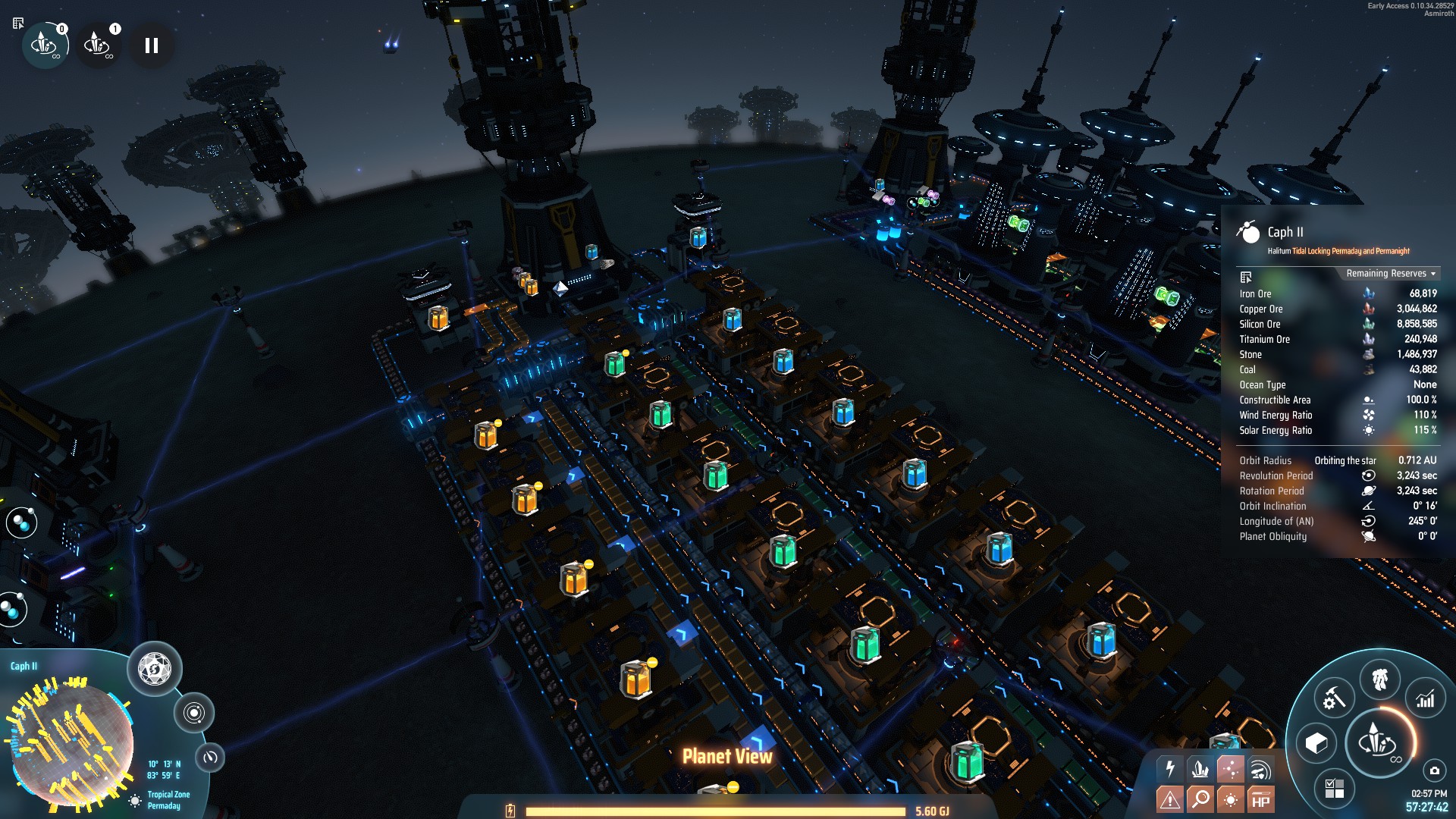
This modular design (20 spaces each) allows for a ton of room to expand each item processing.
There are 3 main exceptions to this however. First, your main bus will have 5 towers to feed all the base material. Anything that is used in 4 or more buildings should be in the bus, the rest you can robot in. Second, your main construction material (inserters, belts, assemblers) should be in a concentrated build. It’s 3 towers of material to build level 1 through level 3 items. Extremely worth it. Third, proliferators. You will build Mk1, Mk2, and Mk3 items from the same tower, as it only requires 3 main ingredients and you will blow through them too quick to use ships. It’s only 1 tower mind you, but a very compact build.
Smelting Math
A Mk3 belt can support 30 items a second (1,800 per minute). That seems a lot, and for a decent part it is. A basic smelter takes 1 ore and gives 1 ingot per second. 30 smelters = a full belt. Cool.
Plane Smelters works 2x as fast, Negentropy Smelters (only with Dark Fog) are 3x. Your belt can neither feed in nor out that volume. Enter stacking, and two options, one of which is false.
Pilers take items on a belt and stack them. To get to 4 stacks, you need 4 pilers. You should never use pilers, ever. Pile Sorters are the right answer, through a relatively simple upgrade that automatically inserts and extracts up to 4 products. They take a lot of power, but they are better in almost every other way.
Noting that advanced logistics research (12k+ white science, multiple times) is required for logistics stations to automatically stack outputs. You want this.
Mega Basing It
So here’s the kicker that you eventually realize, there are only 2 main outputs of any given base, components for the Dyson Sphere (rockets + sails) and research, and you need 3 or more orders of magnitude less rockets than sails. If you want more than 1 sphere, then you’ll need to ship the material to another system, and build the relative ray receivers. I do not recommend this.
This is a 300SPM base. The Carbon Nanotubes are 75% full in their lane, with 33 Mk1 Chemical Plants. 1,000 SPM will require 54 Mk2 Chemical Plants. 33% more productivity, 80% more power.
What you’re left with is the chase for more SPM, which is rate limited based on critical photon generation from ray receivers. It is unlikely you will hit that particular limit mind you, as you there are other key pieces along the path that you need to scale at late game. This assumes you have all stacking options unlocked (you want this for the recipes needing 12 Hydrogen per craft)
Deuterium. Used for Strange Matter, you need a ton of this. A gas giant helps a lot here, more than one is better. Otherwise you need to make it from Hydrogen. You need a LOT.
Plane Filters. The materials are easy enough to find, but it takes a lot of assemblers to make enough. This is likely where you will first use Mk3 assemblers.
Carbon Nanotubes. You need these for so many things and will absolutely tear through production area doing so. Mk2 Chemical Plants are needed here first. The compression rate (6:1) should incentivize you to craft this on the planet where you harvest Spiniform instead.
For high SPM builds, you will want to dedicate other planets to specific research outputs. This will mean shipping Artificial Stars to get power running, fuel, and Mk3 proliferators on a regular basis to keep it running.
Blue requires copper + iron. Very easy. All planets can do this.
Red requires coal + hydrogen. Coal is generally limited to specific planets. Hydrogen you want from a gas giant. The starter planet + system is a good option, though there are plenty of others.
Yellow requires titanium and organic crystals. No single planet will have both, so select a system with the latter and use 2 planets.
Purple is a pain. You need rare resources. Fractal Silicon, Oil, Water, Fire Ice, and Spiniform Stalagmite Crystal. There are a dozen or so systems that meet this need. You’ll need to harvest from multiple planets, and be located on the one with Oil/Water.
Green requires a lot of Deuterium, Grating Crystals, Fire Ice, Water, and Kimberlite Ore. There are not many systems that fit this bill – not sure if I’ve ever actually seen one that has Crystals and Ore together. Given you need Graviton Lenses for your Dyson Sphere collection, I would build this on the starter planet and just ship in the base mats.
White requires antimatter, which can only be refined within a Dyson Sphere system, so no real options here.
It is entirely possible to hit 5k SPM on a single factory planet. It isn’t ideal, but is certainly feasible.
I gave this a shot a year ago, in EA. Last week it hit 1.0, which brought mostly mid-/end-game activities to the table. Pretty obvious I’ve played my fair share of simulation / logistics games and this one still fits that general bill.
Right, to the point here. The start of the game is poorly paced. The tutorial does a good job of explaining the basics, but then you get into the meat and potatoes of it, which is as slow as molasses. Early on, you’re given a quest to prepare your base for the arrival of stranded space folk. To to this, you need to complete about 20 steps and have the ability to pump out an absurd number of materials to construct it all. To use my previous buffet analogy, you are shown all the options, but can only order soup. And you better like that soup, cause it’s all you’re gonna get for 4 hours.
This is an unfortunate design choice as I can’t see too many people sticking around that long watching 1 tile at a time be constructed. Once you get to the actual factory building part (multi-regolith processing), the game actually becomes an interesting balance between production and advancement. You have, generally, meaningful decisions to make and prioritize to have the game move forward. This is what a good game should focus upon.
It’s a better game than it was a year ago and brings some interesting items to the table. It just happens to have one of the worst extended tutorials I have ever played. A tutorial that would easily be remedied by providing you the construction material to build the quest requisites. Then you’d get the right amount of taste for the systems and make a better choice. Hopefully this 1.0 launch gives them that feedback.
Last one for a bit on this game, as it’s more on the conceptual side than the implementation. Again, Zero Company is a solid game, and I’m overly impressed that it does so much while restricted by the Star Wars IP.
A great man once said that a game is a series of interesting choices. A great game is therefore a series of very interesting choices. We can think of a few dozen examples. Zero Company has a fair share of interesting choices, some hidden, some obvious.
Hidden choices, where you commit without any understanding of the possible outcome are generally anathema to strategic games. You are given a limited set of resources to achieve a goal, and you need to therefore maximize them for success. What happens with hidden choices is you alt-tab to a wiki, cause the only other option is to scum-save to get informed. I am pretty sure there’s a mod out now that removes all hidden choices in the game, and just provides you with the info at hand. This isn’t about an easier choice, you still have to pick between spending money, losing bond, or increasing reputation – all which are limited for most of the game. I’d guess this will change in some future patch.
There are some strategic choices to be made, in that you need to think long-term on their impacts. Coil Upgrades are certainly the most obvious, but you have others strewn about. Den upgrades for passive buffs and Bond buffs are choices you cannot revert, and can snowball. Investing early in +intel boost per mission is hugely beneficial if you do it 30 times, not so much if you do it once. There are no choices that are automatic game overs, like in XCOM where you lose massive funding options if you don’t defend a continent. It’s all forward progress and mostly relating to difficulty increments. Now, if you pick a continual amount of + resonance Coil upgrades, you’re gonna have a bad time!
In the missions themselves, all decisions are tactical. Since there’s no Fog of War, you can see every enemy all the time and never get ambushed. This drastically shifts the mindset to an offence-first push, as you can easily optimize line of sight without fear of reprisal. Think of XCOM2, where trying to get a proper line of sight somehow triggers 3 new enemies – none of that here. Additionally, nearly every decision you make has a cost of 1 action point, so you never feel like you’re over-committing resources to a particular set of actions. The net result here is that blaster rifles become the optimal tool for combat, especially at later levels where damage ranges become a bit too similar. The pistol deals too little damage (and is superseded by an insane amount by a Gunslinger), the repeater uses all your AP for linear gain, and the sniper rifle doesn’t scale and has no 1AP options.
Important to note that 90% of all missions need you to reach an extraction point. Further, each map will have continuous spawns so that not only is it rare that you take out all enemies, it will only ever last 1 round. You can’t really go into a defence mindset, you’ll never exit the map.
With only 3AP to use per character, per turn, you have at most 12 actions to take. But wait! You gain advantage points (1 per enemy hit), which can be used for alternate attacks. You’ll quickly math this out, where some advantage attacks are way better than others for their point cost (e.g. 10 advantage rocket attack is worse than nearly all other options). What you’re looking for then is free damage, where possible.
Backup Assist. Once per turn, you can select an Ally to attack the same target as you, for free. Use this every turn, also increases your bonds. Extremely deadly on elite enemies.
Knockback. For every hit object while an enemy is knocked, they take 4 damage. Can knock into the void for an instant kill. Grenades do this, most melee, Jedi, and importantly, Cly’s jetpack.
Fire. If alight, they take the listed damage at the end of their turn, and retain 50% of the stacks. For most purposes, this is useless as the damage is much too low. If it was start of turn, then maybe.
Jae. Her talent passively shoots enemies below a certain HP, up to twice per round, 100% chance. It triggers frequently.
Gunslinger. They have an active skill that costs 1AP, shoots enemies for slightly less than a normal blaster, and rewards 1AP if you kill a target. This applies much more than you may think. Oh, and each shot also gives 1 advantage.
At any given point, you’re given a list of potential targets and actions. You want to maximize your AP usage. Sometimes you want to get closer, sometimes knock them around to get near a gap for an instant kill. Sometimes you know reinforcements are coming and want to set up Overwatch instead.
And then, then you have Cly. When you first unlock her, her toolkit feels weird as it’s not exactly damage focused and comes with pistols. If you invest fully into her jetpack, for 2 advantage you can cross half of the map, and land with an AE knockback effect, about half as effective as your best grenade. This is great for knocking people out of cover, throwing them into pits, or quickly getting to an objective. And then, then you get 2nd specializations for all classes and you truly appreciate the Gunslinger. Maxing their quick shot ability gives you a 1AP attack that refunds the AP on a successful kill, meaning you want to stack damage & crit chance as high as possible. With both these tools, Cly can clear half a map in a single turn, and still find full cover at the end.
While most maps will eventually rely on Cly’s insane movement ability and free damage, there are still cases of tactical choice. Grenades are bad for damage, but fire grenades wipe out defence stats, a big increase in damage. If you knock Droidekas, their shields drop allowing you to deal quick damage if you’ve set an Overwatch trap. Dazed enemies move at half speed (mostly useful for bosses, one in particular), while shocked enemies cannot attack you. So the question becomes, can I take down this enemy this turn, or do I prevent them from acting?
This is different than other tactical games, where you tend to focus on one character, exhaust their moveset, and then go to the next one. Primarily due to fog of war and the sheer risk of moving 1 step forward and unlocking 4 new enemies. Zero Company actively rewards you for swapping continually between characters – one is a set-up, the other the closer, while always knowing where the next attack will come from. These are positive, fair (!!), and interesting choices. The net result is an extremely accessible tactical game with clearly laid stakes in every map. For all the quibbles, this is an fairly impressive achievement.
Story beats aside, The Coil are the frankly ‘unique’ mechanic within Zero Company. All the other pieces are generally refinements on previous bits you’ve seen, even the frankly awesome backup mechanic (free assist on attacks). The Coil are both the primary antagonists, key difficulty choices, as well as a core piece of combat planning. I’ll ignore the lore bits.
At their base, The Coil are relatively simple humanoid NPCs – melee, ranged, captain and so on. With no buffs (more on that later), when you kill a member, they transmit ‘resonance’ to the nearest live Coil target. At 2 stacks, some will heal. At 3 stacks, they will heal and gain a semi-permanent buff – like they explode on death, or charge melee when hit. Once at 3, they won’t gain any more stacks. You really want to plan this out, as having multiple 3-stack Coil in a combat field is not a good thing. Noting, that if you knock them to their death, resonance does NOT transmit. Super useful info. There’s also a main story bit that adds a tweak to this system, no spoilers there, but it does dramatically reduce the enemy’s offence as a result.
The complicating matter in all this is that you will, at planned time intervals, be presented with a dilemma that will buff the Coil. The choice you make BLOCKS an upgrade, meaning the other will go through. Some of these are annoyances, some require thought, and some feel like a snowball-to-game-over.
For example, adding retaliation to weak droids is a nothing-burger, they die in 1 hit anyways. Adding resonance stacks when they take damage, that is a very bad thing. Increasing defence is a bad thing. Increasing their chance to hit is manageable, but stacking damage buff… you’ll end up with Coil Snipers taking out your entire squad from range.
The main issue with this system is that you are effectively blind to the impacts of a decision for the first 3-4 choices. You likely haven’t even seen that enemy type yet, or don’t quite understand how it all synergizes. I’ve played a ton of these games, and I needed to reload after my first choice because it was clear it was a very bad one. Functionally, this system acts as an incremental difficulty to the game as your own party gets stronger. I get that, and it saves having to add a bunch of new classes. I actually think it works! When you see 6 Coil reinforcements show up on a map in the later parts of the game, you will freak out. That’s cool!
What I really like about this system is that enemy progression is tied to player choice, rather than an arbitrary scale. XCOM2 has an enemy power scale that determines who you see based on the number of missions you’ve completed, so that bad luck runs can snowball easily into dead ends. Phoenix Point gives enemies evolution points per mission you complete, which impacts their enemy response. Zero Company instead presents a clear decision point, and assuming you understand the mechanics, you get to choose specifically how the difficulty increases. Maybe it’s more ranged damage, maybe you focus on supped up melee enemies. With that information, you are better equipped in the next mission. You can’t defer the choice either, so it’s extremely obvious that you’re entering a new challenge point.
Now, whether this added difficulty is actually difficult, is a separate matter. This relates more to overall balance, or I guess the pure imbalance that Cly and Jae bring to the table. Those two combined can take out 4-6 enemies a turn, if you build them moderately well.
Straight to it then, this is a good, if not great game in the tactics space. It is not a strategic game, which is what differentiates it from XCOM2 or Phoenix Point. What I mean by this is that the game is driven by story rather than choice, which will reduce it’s replay value a decent chunk. So in that way, it’s a whole lot closer to Mario + Rabbids, which is also great. Noting immediately that 100% hit chance exists here, and always works, no rounding errors. That is a crazy good feeling!
The game gives you a decent amount of control in combat, rewards aggressive play, and even more team dynamics. With the right roster, you can clear out a ton of enemies quickly. Overall difficulty is low compared to other games, so unless you’re playing on a higher difficulty, you won’t need to heal or replace roster. In fact, in most cases it’s cheaper to fire & hire a new person than to heal them (main roster aside).
Which brings me to general balance bits. Tactics games are about maximizing the math. Characters that can replenish their action points are deadly. Characters that can quickly move around are essential. Any character that struggles to use their action points is a hindrance. The good news here is that for almost every character, you can swap their weapon AND their class, so if you like the look, you have a ton of flexibility. The less good news is that a lot of the math is not explained, requiring experimentation to figure out. For example, at no time should you ever use a pistol.
Bonds are a prime example of this. Use characters in a mission, increase their relationship, and get the opportunity to add stat boosts to both. In nearly every case you’ll select +1 damage or +movement, as this continually adds to your power. It’s easy to see how you can end up with +20 damage on your main character as a result, and you can see some of those stats in one specific area in the main base. Not all of it though.
In terms of classes and characters, this is where things get spicy. Some classes just plain suck because the game drastically rewards damage-per-action-point. The heavy is meant to taunt and attract damage, but that’s a defensive move that is only of value against 1 target per mission. Medics are there to heal, not damage. There are many such cases. A repeater blaster uses all your action points, which is wildly inefficient! Pay attention to the skill descriptions.
Eventually you get to unlock a second class, and I would recommend you look at the passives (either ignore 4 defence or add 2 damage) as the first option, and maybe invest in move distance if you need it (assault).
In terms of the main roster:
Hawks – You always have to use them, they can be any class. Their unique ability increases assist and defence, super useful at the start, much less at the end.
Kabb. Their uppercut, if it executes and enemy, restores AP, but can’t be reused that turn. You can change their class.
Trick. Auto-revives in combat, and at max level (21 points!) won’t require healing after battle. You can change their class. Trick as a character is amazing. As a combatant, ugh.
Jae. Right, OP much here. They automatically execute, and 100% hit chance, a target below a certain HP, up to twice per round. Pretty much mandatory in every battle.
Droid. This is all about utility, not about damage. I can think of no case where you would want to use this character, which is unfortunate.
Tel-Rea. The only Jedi character, and with a completely unique kit. Extremely weak until you max their Padawan Training, and then they start to shine. Their second class is wildly strong. They do not shoot, they are a strong melee character and can push enemies from a distance… this means their boost from bonds are often less useful.
Cly. A unique kit as well, though the wild thing here is Combat Jump. It’s dirt cheap to use, can cross half the map, knocks back enemies (often 1 shotting them into an open pit), and has an AE damage attack too. You can clear out fields of enemies with her. Her second class should be Gunslinger, trust me.
Luco. Their unique is practically identical to a regular sniper skill, but feels worse as you lose the buff when you hit targets, and can’t re-apply it. You gain this character later in your playthrough.
If you recruit someone, you can customize their talent + class, so there’s a ton of flexibility here if you want it – making them arguably better than Trick and Luco right out of the gate. That said, Jae and Cly are so incredibly useful that it’s hard to not use them. Tel-Rea starts very weak, so you’re likely to avoid her, but I will say by her 2nd class unlock she is a damn monster – just remember to invest in movement speed.
Which brings me to the final early thought here and that it relates more to balance. Tactics games are notoriously hard to balance, impressively so when you think of all the possible combinations there are! XCOM2 was a buggy unbalanced mess at launch, we only really remember War of the Chosen being the real masterpiece. Pheonix Point took nearly 2 years of patching to get to a decent place. Zero Company starts off in a much, much better place than either of those but there are still some significant tuning pieces to go. There are a few bugs, sure, but nothing game breaking I’ve seen. But balance… there are some rather wild swings here if you’re not paying attention – like Coil Upgrades (resonance chains are death).
With that, my initial thoughts are very positive. The tactics portion works quite well. The story is a solid Star Wars romp. The art and characters are very well done. And you always want to take on another mission (or another turn), which is truly the right spot for praise.
Scaling in any logistics game is based on three factors. Space, Resources, and Power. You need the real estate to lay down tracks and a factory (time to deliver is a big deal). You need resources to process. And you need Power to run all the machines. In DSP, these concepts are present, though the implementation is a bit different.
Space
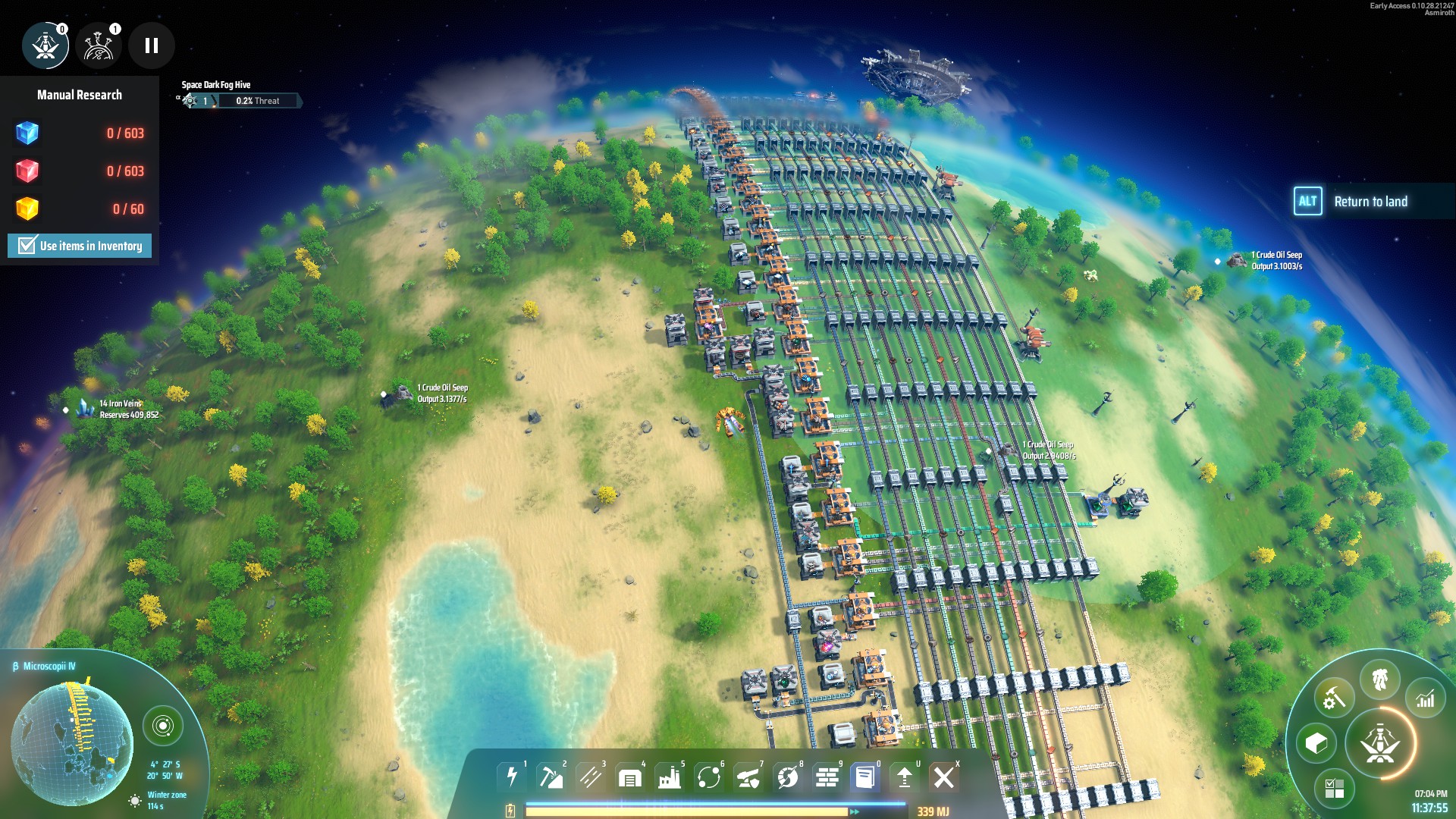
As with nearly all games like this, you’re on a grid to place items. DSP uses planets (spheres), which provide an upper boundary on size. There are a few hundred planets, but getting beyond the first 3 requires ships to warp between them. Honestly, by that point this post is somewhat irrelevant. The individual planets though, they are organized in bands, meaning you can place more items in the equator band than the polar bands. Very large factories tend to avoid anything outside the equator bands as a result, using Ray Receivers or research there instead. If you truly want to mega-base, it will be across multiple planets and multiple systems… impressive logistics in that actually.
Resources
With a singular exception, there are near infinite resource to collect. You can improve your mining ability to both speed up collection (+10%) and reduce resource drain (-6% compounding), making some veins near infinite. It’s generally best to concentrate mining on a given set of nodes rather than spreading out. Unipolar Magnets are the exception to all this, there’s usually only 1 million that spawn on any given game, and you need a crap ton of research to make that pile effectively infinite.
I will say that while resources are near infinite, the ability to process them is not infinite, with an upper limit based on the buildings you are using and distribution speed. Here I am thinking about something like Factorio with legendary buildings and speed modules pumping out hundreds of items per second. That’s a whole other topic…
Power
Put plainly, I dislike power management in this game. There are too many potential sources, nearly all of them suck (or create major problems), as compared to the final Sphere/Artificial Star option. Let’s cover them.
Wind Towers. The best starter option, they provide a decent amount of power for small builds. Takes about a half dozen per mining field, which need to be spread out. Some planets have little wind, so less good there. They do not scale, consider them purely temporary. They can be placed on water (this was a major QoL change).
Solar Panels. They take a lot of resources to build, only work when the sun’s out, and on a per-grid deployment are only marginally better than Wind Towers. The ‘best’ option is to have a 5 wide band run across the equator, that is if you don’t have a tidally locked planet.
Fuel Burner. Coal, Graphite and other items can burn here. These provide very little power for the time invested, and should be treated as hydrogen sinks only.
Fusion Plants. These burn advanced fuels, of which only Deuterium Rods are a viable option. You need a planet-full of those rods to build a sphere.
Thermal Plants. Only works on lava, which means the 2nd planet in your starter system. They pump out less power than an equivalent footprint of Wind Towers. Their only real use is when Dark Fog digs holes – put these to block them.
Ray Receivers. Assuming you have any part of a sphere running, receivers can capture rays and transform it to power. Or, you can use them to create photons, required for end-game research and artificial stars. You’ll end up with both, at least one deployment per pole. It takes a while to charge up mind you, and provides power relative to the construction state of your sphere.
Batteries. Let’s say you have too much power on one planet and want to move it to another. Charge some batteries and discharge them on the other side. 90% chance this is actually the only viable option in a starter system. It works, it’s not terribly hard to scale, and has a decent transfer rate. But it’s not power itself, it’s a mechanism to move it between planets. A quarter planet of solar panels + batteries = ‘free’ power anywhere. There should be an infinite research that increases the maximum charge of a battery.
Artificial Star. Assuming a sphere is running and assuming you have ray receivers making electrons, you can make this. In nearly all cases, it doesn’t make sense to use these in any system with a Dyson Sphere, as Ray Receivers are better options. But they are absolutely essential for mega-base foundries in other systems, as the material is much simpler to ship around. Each is 72MW, which seems like a lot, but a fully running factory planet will be 1-2GW of drain.
From this, there are really 4 phases of power management
Early game, up until you unlock yellow science. 100% wind powered.
Mid game, up until you start a Dyson Sphere. A power planet, using solar panels, charging + shipping hundreds of batteries a minute. A destination planet consuming said batteries.
Late game, Dyson Sphere under construction. Ray Receivers, lots of them.
End game, aiming for 120+spm for white science. Ray Receivers in the Dyson Sphere system, Artificial Stars in others.
The good news is that consumable power is rated based on draw, so you never burn more than you need. Also in the good news, as long as you’re above 40%, stuff will work, just slowly. Building your fist planet-sized factory, you will have this happen all the time. In the great news, the major power draws will come from logistics centers, and you can set how much they draw at any given time. You also only need to power only 1 end of a logistics chain, not the whole thing, very helpful when mining on a different planet as you only need to power mining, not shipping.
The bad news is that it’s very hard to build dedicated power channels, and very difficult to manage them. If a planet you’re not on loses power, tough cookies. If you want to change the settings on a group, I’m not aware how. Finding the source of a problem is also difficult. For example, improving storage on logistics towers causes them all to try to fill up the new space… effectively adding a 1GW surcharge until they fill up – ain’t no way you’re going to avoid that.
I think my main gripe here is that only the renewable power is self-contained, and even then needs an absolutely massive area to work effectively. Any consumable power is going to encounter throughput issues… either your nodes dry up, the material is needed elsewhere, or it will fail and getting it running again is a miracle and a half. More to the point, I think I’m somewhat spoiled on the ease of power generation in Factorio, or even a Rocket Fuel factory in Satisfactory. Understanding that ‘ease’ here is certainly relative.
It boils down to one key conceptual issue. The entire reason a Dyson Sphere exists is to capture all the output of a sun. The game currently doesn’t reflect that, and power issues are going to be your limiting factor throughout your playthrough. Which, I guess in hindsight, is more accurate to real life than not. Hah!
Logistic games function on the premise of making a factory grow. You generally start off hand mining some metal ore, and eventually build spaceships that shoot laser beams and ponies. There are steps to get from start to finish, and typically that comes through researching the next batch of things you can build. Conceptually, they all work the same way: construct a lot of basic things, put them in a kajigger, now you can make more complicated things.
The practical application differs between games though. Some games create intermediary products that are then processed, while others simply take the base items themselves. The former takes more planning as you need to build these products, especially if you need those intermediary products all the way to the end of the game. A key balancing piece is the ratio in that construction as well, some products are much more complicated than others. Some future research products need the first intermediary as well, creating exponential needs for products. Satisfactory has a system I personally don’t enjoy, as all research builds are temporary (best to put it in a box). Factorio and Dyson Sphere Program have a better system that scales to mega factories.
The next piece is the actual items that get unlocked, and their dependency. The worst case here is that you somehow research an item you can’t actually craft because you need to research something else first. Most games offset this risk by grouping unlocks, ensuring that if you unlock it, you have all the pieces available to craft it.
Factorio absolutely rocks this one, where if you unlock oil processing, you get everything you need to process oil. While I’m sure it’s possible, I have not ever found a situation where I unlocked a piece of research and was not in a situation to use it.
Satisfactory is middle ground of sorts, as the research packages unlock multiple items at once, and generally there are few of them. It’s generally well thought out so that you’ll only need to unlock one extra bit, reducing thumb twiddling time.
DSP is the worst case – you’ll have a dozen+ examples where you won’t have the dependency unlocked as typically you get one item per research. As a result, you get research paralysis, where you need to research a dozen items in order to get the actual product you want. Warpers a good example, where Particle Colliders are a pre-req. To build those, you need space structures, which are a completely different part of the tree with 4 extra steps of research. From yellow research to purple, the entire tree is filled with these cases, a balancing pass that hasn’t been done in years. This compounds if you have Dark Fog enabled, as the military buildings have their own dependencies. I get the design principle that each research step is unique and meaningful, but the fact remains that there are simply so many intermediary products and steps that it greatly diminishes the joy of meaningful progress.
The main issue with balancing the DSP tech tree is that you are limited in levers. If you group things together, you need to add the costs together, or you’ll just get them too fast. And let me tell you, when you get to green science, balancing research and productivity is not super simple. If you restructure the tree itself and build new (and proper) dependencies, you’ll end up with tiers, rather than a tree (closer to Satisfactory). If you truly wanted to balance it, you’d actually end up removing a ton of intermediary items, which means a near total re-balancing of all logistics, pretty much a new game at that point. And that’s without addressing the 6 super-not-obvious degree upgrades to even build a Dyson Sphere.
This is more a gripe about general game design than specific to DSP, and the concept of gradual reward for effort, while staying busy. I am fairly decent at logistics game, with a general eye for optimization. The ‘lulls’ in action felt here are more a result of smart early decisions by me, where instead of finding issues in hour 4, I solved them in minute 30. It’s a very weird balance where if you’re good at the game, there’s way less to do. If you’re so-so, then the time you’re spending fixing things is the time research ticks away. I’ll get into the reason why you can’t do much about this in a future post.
To sum, progress in these types of factory games is primarily gated through research. That system has it’s own balance of investment (resources & time) to feel meaningful. How you manage resources and time… well the factory must grow after all.