Warhammer40K – Rogue Trader

As per the prior post, I don’t tend to pick up ‘premium’ games at launch. In many cases I end up waiting for a promised DLC to launch, as that often comes with a major balance patch. Think about Diablo3 pre- and post-RoS. Completely different games. Rogue Trader fits this model.

It’s a CRPG, which more or less means it’s like Baldur’s Gate. You control a party of characters who go on a very long set of quests, see stats go up, and make character defining decisions, almost always in an isometric-type view. BG3 pretty much perfected this model and everyone has been trying to find a niche along that path.

Now, Warhammer40K comes with baggage. It’s a world of constant war, where everyone is a shade of evil. If you look at the D&D alignment model, there is no good, there is no neutral. The Imperium (where you reside) is lawful evil. Anyone who says otherwise doesn’t understand satire. You play the titular Rogue Trader, a sort of vanguard to the imperium, conquering newly discovered planets, and building a financial empire. If you see it, it’s yours. Thankfully, no spreadsheets to manage here. Along the way you’ll collect a slew of party NPCs that fit various classes and backgrounds. Deluded space wizards, gun toting priests, deranged blood worshipers, and so on. You start off inheriting a part of the galaxy and need to stabilize it. Along the way, ‘bad stuff happens’. You can be dogmatic (be lawful evil), heretical (chaotic evil with space madness), or an iconoclast (which is frankly more pragmatic than good). Now, CRPGs in general prefer an iconoclast approach and first time players are going to see more here. Heretical is hard mode. Dogmatic makes sense about 20% of the time (e.g. purging a planet that’s converted to madness), and dumb the rest of the time (e.g. an ally offers you their services for free and you shoot them instead). The writing is thematically aligned to 40K, very lengthy and full of complicated terms. It works.

Quickly, the companions here are well done and thematically resonant. They have very little interaction between them, but their individual perspectives and side quests are all quite interesting. Who you bring along on the journey is personal choice, unless you’re on the hardest difficulty.

Mechanically, the combat is a bit of XCOM (with action points + cover) and BG with various skills. It’s often your team of 6 against a dozen or more enemies. AE attacks and multiple single target attacks per turn are key. Generally, this works well. More in a bit, but there reaches a point where compounding levels and skills make you effectively run in god-mode with some crazy OP builds. It can get a bit much and overly complicated, but it works.

Inventory is weird. Still trying to make sense of any of it. Your bag will be filled with generic items that have a 2-5% stat difference… but they have a very big integration with skills. Heavy Bolters may deal less damage on paper, but with the proper build they are infinite bullet machines. Keeping track of all of this is complicated, not to mention actually finding items that fit a build. YMMV.

The stats and builds though, that is a friggin’ mess. Every level you’re given a set of options, often 30 or so, that you can select from in a list. A list! You can’t easily see dependencies or syngergies, and each one of them practically requires you to scroll to read the definitions. On the one hand, congratulations on having so many skill options! On the other, you can see how this is practically impossible to balance. I keep thinking of Path of Exile’s skill tree and build options, it’s just so much. Min-maxers will love this, but it is absolutely a challenge in terms of broader appeal.
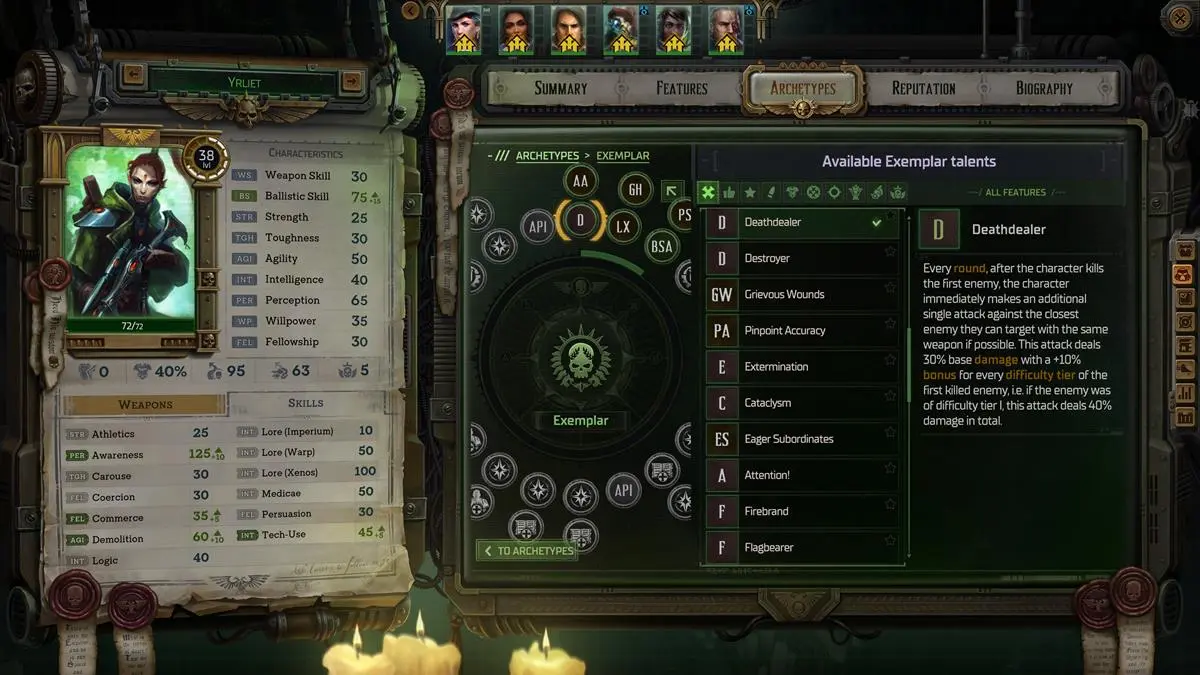
Stat geeks rejoice! Note the scrollbar on the list of talents.

Side note, you remember the D&D issue with quadratic growth for mages? In that a warrior hit very hard and was sturdy for a few levels while a mage was a wet tissue, and then they acquired a few tier 4 spells and turned on god mode. That model is here too. Melee is dramatically limited in damage and movement by the mid-point. Ranged AE attackers can clear an entire field with multiple tools and turns. I mean, I still love the bladedancer cause they can decimate 5+ weaker enemies in a single turn and it looks damn cool. I can also shoot an arc rifle at the same group and AE them all for triple the damage, then get another free shot for the next group on the other half of the map.

There are a multitude of other systems in here that work at various levels. Space combat is meh. Space exploration has overly complicated (but absolutely nails the thematic pieces). Merchants are amazing, where if you have reputation with them and a given ‘profit factor’ that measures overall wealth, you simply by the thing. I really like this model.

Is this game better than BG3? No, and it’s not trying to be which is actually refreshing. It can easily take you 100 hours to get through a single playthrough, and very few games ever offer that these days. Replay value is iffy, as it’s less about build diversity than story choices. Well, I guess that particular statement is a matter of perspective with so many skills to choose from. Still, the question boils down to…

Is it any good, and is there value? An absolutely emphatic yes to the first part, the game is quite good. It has quirks and leans heavily into the theme, and frankly may be the ‘truest’ 40K game out there as a result. Value is subjective, but consider this – it’s 100hrs of content, with voice acting and quality writing throughout, it has meaty DLC, and is on a banger sale. I think there’s a lot of value, and I am rather picky on these sort of things.
Obsidian & Sales Targets

Not often I comment on news, but interesting article all the same. Avowed + Outer Worlds 2 didn’t meet sales targets. The PoE setting will continue but not likely to see Outer Worlds do the same. Which makes me ponder, why?

Avowed

I liked this game as it delivered a ton on nice beats in a decent IP. It had a fair chunk of accolades, available on a bunch of platforms, and had a really good post-launch buzz. It had a month’s head start on Clair Obscur. It peaked at 20,000 on SteamDB, which is slightly lower than PoE2. It was priced as a sort of premium game. Maybe the targets were too high?

Outer Worlds 2

This game is still on my wishlist, and frankly, it launched in the mess of other games that took my attention. There wasn’t much buzz here, at least as compared to the first game. You could get the first game, plus all DLC (Spacer’s Choice) for a damn good deal. It peaked at the same level as the original, which is the same as the other one. The price point though, what the flying fart?

Clair Obscur

This game was priced at 60% of Outer Worlds 2, and 40% of Avowed. It peaked at 7x the amount of both of the others. It was also, quite clearly, better than the others.

Game Industry

Over the past 2 years, about 30% of the US game industry has seen layoffs. That is a wild statistic. Sure, there’s the post-pandemic slump, but there are other factors. Sources of funds have dried up. Game companies are spending way too long making games, with less meaningful returns. Gamers are primarily spending their times in the same 10 game today as they did for the past 3 years (Roblox + Fortnite top that list). The lower end of gaming is chock full of slop that can’t be triaged (50 games launch each day on Steam), and the middle tier has to really do something amazing to get any buzz going. And you know, the whole “everything is more expensive and I need to chose between food and games” thing going on.

Point being, the market is saturated and there’s a limit to how much anything can actually sell in the current climate.

Steam

This is an important factor, one that has impacted the general psyche of gamers. Steam has a wishlist function and nearly every game goes on sale at some point. Some publishers will drop their price by 30% or more within a month (looking at you Ubisoft!), and very few games launch nowdays in a functional state. You are almost always better off waiting a week for a major kitchen sink patch before diving in.

The only reason to buy something now is a sense of FOMO, which is insanely hard to predict. On top of it, that FOMO has to compensate for the price of admission. For every Elden Ring, there are hundreds of other premium games with much less to offer.

Value

Which is the ultimate factor in any buying decision, which is arguably mostly perception. Sure, you can math this out on the aggregate, manage some trends, get the buzz, and ride a sweet spot that lasts a few days or weeks. My persona preference here is somewhat straightforward, and related to the relationship between price and content.

  • $5 – Generally not much thought here, it needs some decent reviews and be between 2-10 hours of stuff.
  • $10 – This is generally reserved for EA games, and in areas I have a gaming interest.
  • $20 – My personal sweet spot, anything that has decent reviews and can keep me entertained for about 20 hours.
  • $40 – This is reserved for AAA games on sale, so I tend to only spend this during the winter + summer sales.
  • $60+ – Extremely rare that I will spend this much on a game, it has to be near perfect or a game I know I will devour. Clair Obscur for sure here. Monster Hunter Wilds too. Not much else!

I don’t think that Obsidian necessarily made a mistake here, their targets are clearly from Microsoft corporate who can’t seem to figure much out of late. Avowed is a solid game, Outer Worlds 2 seems to be as well. Neither are priced at a point where the perceived value is high enough to generate enough sales to meet some exec’s target. I’m hopeful some level of sanity gets applied here and a more realistic approach is used instead.

In the simplest of statements – make games that cost less.

StarRupture – Base Building

The core of any factory game is, well, building a factory. StarRupture tweaks the model a bit.

Material to build a base is extremely simple. It’s a single item type, super easy to transport. If Satisfactory had this, it would be a 10/10 game for me.

Placing a building requires you to be consistent with the Z axis (height) and cannot float in the air (stability). This is the only factory game I know of with this restriction, and is a challenge I’ll explain later. Basically, this limitation restricts any creativity or mega bases.

Each base starts with a Base Core. It allows building in a square radius, in particular allowing mining buildings to be placed. It also has a max amount of building points that enables protection from the hourly fire waves. You can upgrade the core, but doing so triggers continual enemy waves, which have poor mechanics at this time. So, level 1 it is.

You can also build habitats, which protect you from fire waves, give a respawn point, allow personal crafting + research, and a few other bits. Easy to build, easy to stack. These are needed for exploration, acting as save points.

Each base needs power. Solar to start, and then wind later. Set it and forget it, which makes it a pointless mechanic currently. I’m sure it will change.

Right, now to the actual buildings.

  • Smelters do what you think. They refine basic material. Simple ratios, standard output.
  • Fabricators allow up to 2 inputs and make basic material. Furnaces allow 3, Mega Press allow 4.
  • You’ll want storage buffers present, they are small enough in footprint.
  • Cargo dispatchers send things to cargo receivers. Build the receiver first. Throughput here isn’t spectacular, but it works.
  • Orbital Launchers send things to space in order to progress in content. Think simpler space elevators. It works well.

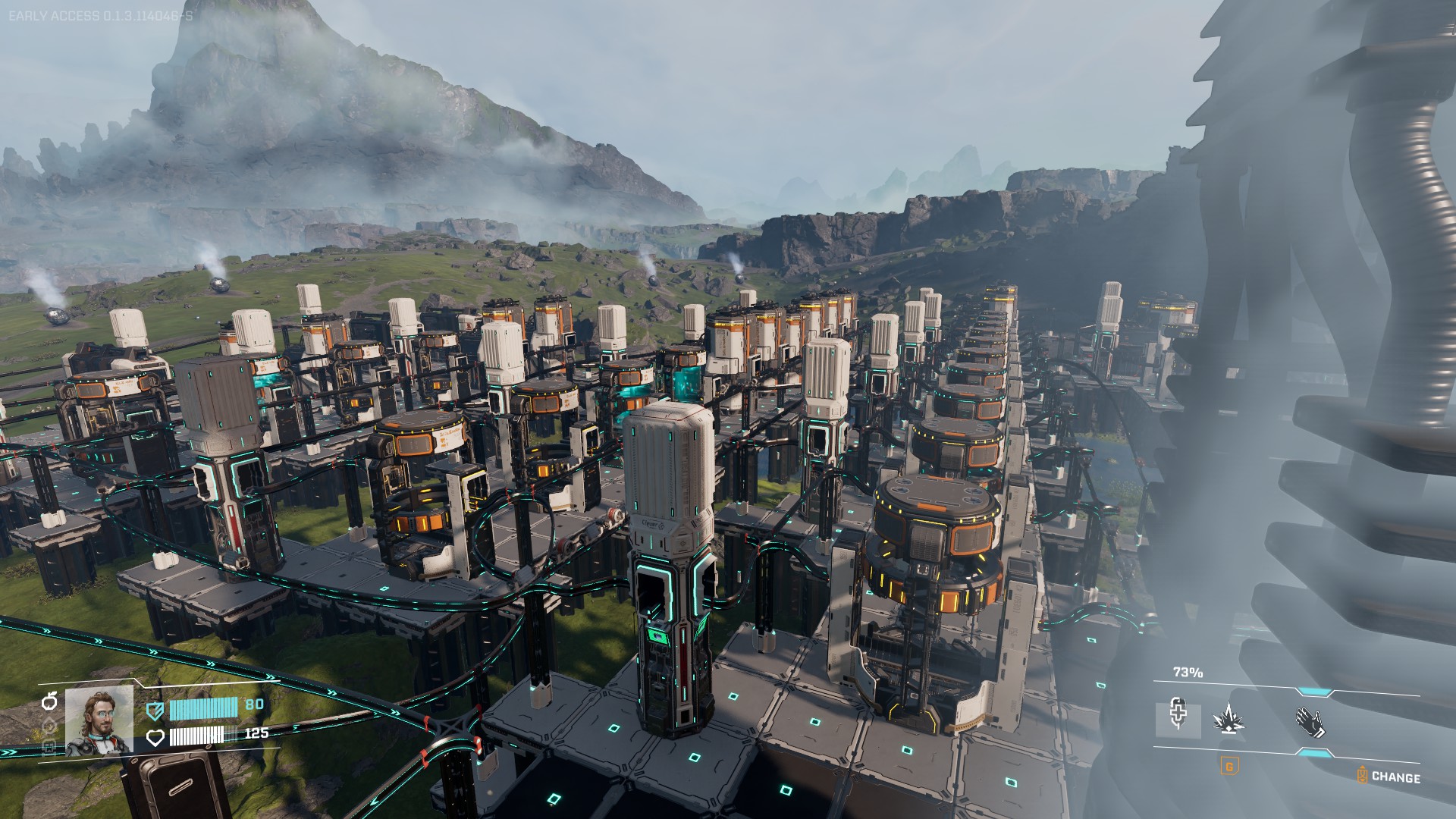
Rails though, rails are something else. They work in 3D and they clip, meaning they cannot overlap. There are 2 ranks currently, 120 & 240 items a minute. They are directional and can loop onto themselves. Importantly, the work on a pull mechanic, meaning they only have content on them if a building requires it. If rails are saturated (as you would with belts), you have some serious issues to work out.

An attempt at a clean base.

Mega Base vs Mini Base

Scaling a base requires two things. Space to build and modularity (for re-use). Blueprints only add speed to the building process.

StarRupture doesn’t provide space, both due to the world terrain and base core limits. Oh, you can build a dedicated base to a level 8 item, but not to 2 of them.

Modularity is the next bit, in that a template needs to be applied. The issue here is rails. If you build a single rail to transport what you need (sort of a sushi belt), it will either get jammed with other requests, of generate a pile of spaghetti. If you build dedicated rails per input, for sure you are going to have clipping issues. 4 rails into a mega press… that takes up a crazy amount of space to build and requires so much clicking to make the vertical portion work.

Recall that in factory games add compounding amount of material requirements per level. Level 1 may need 10 things, level 8 requires 1,000. That means bigger factories. The end result is that you’re much better off building bases that are dedicated to level 6 items, which can be relatively compact. The challenge then is about inputs and outputs.

Ideally you use cargo shipping. It works well for advanced items, not so much for basic material (except helium, you need this for helium).

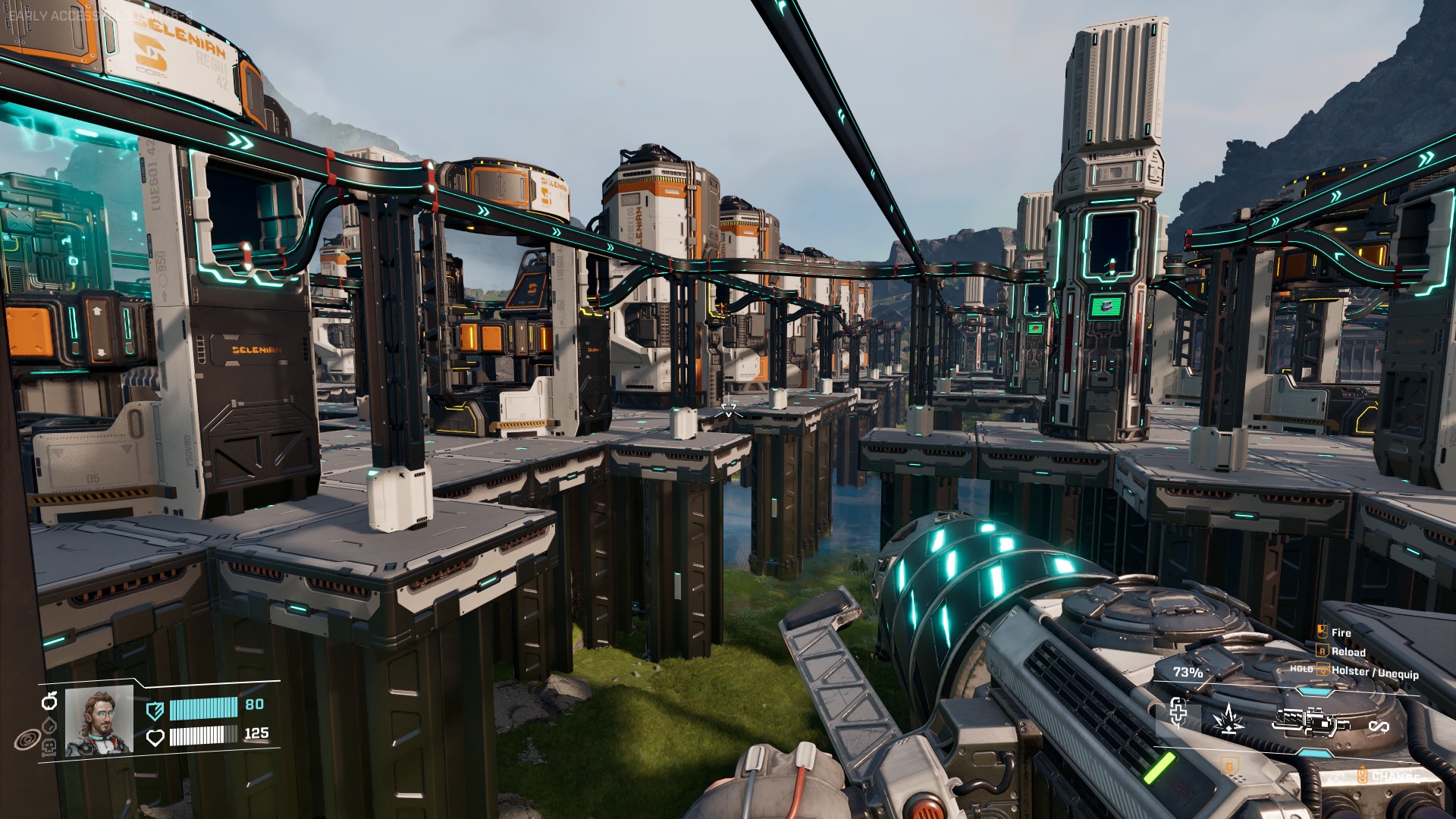
Sushi rails work at low volume.

This model works well enough up to the world engine. Looking at the item tree past that… what seems to be the result is a massive amount of drones shipping material across the map. Curious how this work long term.

StarRupture – Part 2

A bit further in. There appear to be 11 tiers currently, though only 8 are needed to reach the World Engine and the “end” of this version’s content. That’s about 20 hours or so.

A set of quick thoughts here, as there’s a sort of mixed bag train of thoughts.

The Good

  • This is early access and the systems are generally simplified. It makes little sense to add complexity now, get a solid foundation first.
  • The buildings + flow are a reasonable size and there aren’t 2 dozen of them. Effectively, you have 1 building per number of inputs, which is extremely nice to see.
  • The world itself looks and feels great. Exploration is rewarding. The pre/post flare world changes are also solid.
  • Material requirements for building are simplified, which is amazing! Imagine is Satisfactory didn’t require you to have 13 different items to build 1 thing, that’s here. It allows for base building anywhere with relative ease.
  • There are only a few raw material types to build with – effectively iron, copper, clay and helium for a large portion. You’re not stuck with super complicate spaghetti trains.
  • The movement + combat mechanics are generally responsive. You can double jump (2xspace) and dodge (left alt), which are not explained but essential for survival.
  • Building extended bases is relatively easy. A shield tower costs peanuts, and it’s dirt cheap to build a shelter with 2 clicks.
  • I like the idea of LEM (slot-in stat boosts), but the implementation feels wonky. The only ones that seem to matter now are +stamina. Would be neat to see this expanded.

The So-so

  • Base defence is interesting as an idea, but poorly executed. I strongly recommend never upgrading a base as that causes regular waves of attacks.
  • Moving items between bases becomes a requirement with helium. The tools to do so (cargo drones) can only be setup on the launch side, but need a target built ahead of time. This should be configurable from either end.
  • Enemy spawns are annoying as the world layout breaks your line of sight but not theirs. Very annoying near the world engine where multiple ranged enemies will attack you and no real ability to respond.
  • World traversal takes too long, and if you trigger enemies, they follow you for way too long. +Movement items are needed.
  • Rails (a version of belts) can get wonky, requiring a restart. I like the concept of a pull mechanic… more on that in a bit.
  • Base construction has a high dependency on the Z plane (vertical), in that it needs to touch the ground. If you’ve played Valheim where buildings fall apart if not on a solid foundation, see that same thing here. The concept is sound, but the tools present should allow you to build sufficient supports. Not the case. Which means very weird factory layouts.
  • Collecting recipes requires significant exploration. There map is a sort of L shape and you start in the bottom left. There are duplicate recipes in either direction, but actually finding those recipes feels more like luck. I don’t mind the exploration, but would be nice to have a sort of hot/cold mini game to pinpoint the ones you want.
  • Further to this, the only purpose of exploration is for a dozen or so recipes.
  • While I don’t mind the size of weapon clips (for reloads), the ammo stacks are too small. 300 currently, should be 1000.
  • Dying has you lose your weapon and items. If you died it’s 99% because of enemies and likely you will die during a corpse run. Creating a new weapon + ammo means you need to create storage boxes at every base. Meh.

The Bad

  • Base defence in general when facing repetitive waves of enemies. I have a large dislike for PvE in my factory games, it disrupts the zen. I can manage it to a degree if the automated tools present can be configured to manage that threat. For now, I would hope they add a toggle to remove wave spawns until the defensive options are overhauled.
  • Hunger / Thirst mechanics just don’t work here. They aren’t meaningful, the items you can produce are all worse than their raw ingredients, and provide no added game context. Having 12 different food items as raw ingredients counters the good of the game (simple).
  • The amount of items that can be crafted as you progress is, well, concerning due to factory design challenges.

There is a ton of cool stuff here, and it’s different enough to bring some interesting ideas to the table. It addresses a ton of the issues present in the genre, both with simplicity and continual goals to work on. Tons of potential here.