Bus Downsides

Clearly, I am an advocate for bus mechanics. It has a tremendous amount of advantages, significantly so when the items on the bus have an infinite shelf life. It saves you from spaghetti factories, allows for improved logistics, and overall more efficient use of material. With that, there are some interesting downsides that really only start to show in specific cases.

Available Space

Bus architecture is on the whole smaller than dedicated lanes, but it also comes with larger space requirements. 15 small paths take up more overall space than 1 large one, but that large path cannot be deviated. If you have mines, water, or obstacles in the way, you may not be able to build the bus. Satisfactory solves this with vertical factories. DSP can pave over planets. Factorio has this issue when you leave the main planet, which can certainly be mitigated through cliff explosives, landfill and ice.

Item Queues

A bus generally operates on a saturation model, where all parts are full. Any item on the bus is one that is not being actively used, and therefore you have a major buffer of items. This is good to manage burst demands, but can be bad when you have very expensive items sitting idle on the bus. This is a major issue if the items on the bus can expire, as the time to travel / wait, can cause it to spoil. Satisfactory will have a massive bus and a giant ‘waste’ of materials (which are infinite, so you’re wasting time). DSP doesn’t really have too much of a problem here as the ratios generally are in your favor. Factorio only has issues here with items that expire, mainly Gleba items.

Accuracy

The greatest benefit of a bus is the flexibility and simplicity of use. You can clearly see with your eyes if it’s working as an empty bus = not going well. The solution to an empty bus is relatively simple, add a bunch of items to it at the start until it backs up. No math, nothing fancy, just jam it full of stuff.

The flipside to this is that it becomes increasingly expensive to scale the end result items as each individual item on the bus may cause bottlenecks. Or, you may simply run out of space and need large scale transport logistics. In these cases, it’s often better to build mini-factories that are offshoots of the bus, especially in late game aspects. The net benefit of this model is that the input and outputs are controlled, and easily replicated with blueprints.

  • Satisfactory is very binary here, as you either make mini factories from the start or you make a bus all the way through, simply because there are too many items. You may end up using this model for a Nuclear factory though, even though it will take about 20 or so different ingredients to work. The lack of large scale blueprints absolutely prevents effective use of factories. You can make them for sure, but it’s going to be hours of effort. If the production chains weren’t so complex…a Ficsite Bar for a power plant has about 30 different production steps.
  • DSP’s bus is very different as there are 2 buses. One for buildings, of which you won’t ever build factories for. Another for everything else with Logistic Stations – which is like watching mosquitos fly around, moving items between towers feeding dozens of mini-factories. For late game, when focusing on SPM, there is some value in building factories dedicated for this as you can ‘easily’ increase your SPM by putting down a new blueprint. The game is extremely modular and flexible in this regard, with the absolute best production dashboard information around. An analyst’s dream.
  • Factorio’s bus is such that you will only ever have mini-factories. The bus itself is only ever relevant for items that are created in very high volumes. Where the starter planet may have a bus that feeds construction of buildings, this is absolutely not the case on the next planet as robots & requestors can address this for you. This is a net effect of simplified production chains, as compared to others. The casino portion of acquiring legendary material is a completely different topic highlighting the pitfalls of a bus, and while ‘fun’ to puzzle out an optimized method, absolutely sucks.

More Positives than Negatives

While there are niche cases where a bus is not particularly useful as the volume of items created are highly specialized (e.g. Nuclear Plants in Factorio), the wide majority benefit from a main bus for common refined raw material (e.g. the step just after raw material such as iron plates). Normally this main bus has 6-8 item types, generally in the space of iron, copper, coal, oil, then 2 more liquids and solids.

Full buses are different, where all items that have more than 2 uses are put on the belt. For some games, this means that the bus has 20 items. For others, 40+.

As a general rule, anytime I play a game with production elements, I opt to build some sort of bus in order to math out the long term requirements. They are relatively easy to build, provide a lot of flexibility, aesthetically please my eyes, and allow me to quickly diagnose production issues. Optimizing that bus would mean making it as small as possible, which really only comes from experimentation, knowing which items only have a short-term need. And with most of the games in this genre being in Early Access… well a patch can change a lot.

Plus, it’s fun to say bus.

DSP – Ratios & Math

The thing I like the most about DSP is the scale of it all. Visually seeing a planet turn into a factory is absolutely amazing every single time. Scaling at that level is, for 90% of the game, a cut and paste affair with little math required. Sure, the start is relatively linear as you have power and throughput challenges, but once you lay down the first interstellar transport, you’ll have 60+ smelters in a chain in no time.

The cracks do start to show once you hit that point though. Resource mining becomes a bottleneck that becomes harder to manage, opening the door for smelting planets. A fully upgraded set of smelters and belts will need pilers to stack items effectively and quadruple throughput. Adding proliferators to the chain is a choice, one with a not insignificant cost.

Mathing it Out

Put plainly, DSP has too many items that have multiple purposes. There are only 3 that come to mind that have a singular purpose and therefore fit into a production line. A production planet will have 50 odd production lines for various items in need in other lines. Add another 30 or so for the PvE portion.

The net effect of this diversity is that late game production chains will break earlier production chains and there are limited options to manage this ahead of time. Quantum Chips are a shining example, where they have a lot of late game usage, require about 120 raw material, and close to a dozen sub-steps. It’s not really practical to design a single factory to create Quantum Chips, as you’d never be able to effectively scale it, so you’re instead going to leverage existing production lines and pull from them.

Generally, it’s easier to add a dozen more smelters to a iron plate line than to rebuild an entire quantum chip factory. The exception to this is sub-factory planets.

Massive Scale

I’ve talked a bit about the starting phase (Titanium), the middle phase (moving planets), and the end phase (building the Dyson Sphere). Late game is about SPM, or science per minute, specifically white science (Universe Matrix) for the infinite research. Building one of these requires 1 of each other type of science block + 1 antimatter (requiring a Dyson Sphere).

Given that each science block requires a set of materials that are the sum of all previous ones, this acts as a sort of cascade of material. Each white science takes about 250 raw material to make, but involves almost every production step in the game (weapons, buildings, and sphere related items are not required). It is exceptionally easy to make blue science (1 per 3s), it is inversely difficult to make green science (1 per 24s). You can saturate these ratios, but then at larger scales that serves little purpose than to block storage and waste material. The production rate is set at 1 per 15s for white, so we get interesting ratios from it.

1W : 1.6G : 0.6P: 0.53Y : 0.4R : 0.2B

These numbers don’t really line up well…making it better to over supply to some degree – notably Green (wide effect of being used for Warpers too). To that end, I prefer a 1: 2 : 0.75 : 0.75 : 0.5 : 0.25 ratio that can withstand scaling needs and math. 100 SPM can be done somewhat simply by the time you have the resources generated from a completed Dyson Sphere. That’s 25 buildings making white science.

1000 SPM… that is not something that can easily be done. 250 buildings for white = 500 for green, and each of those requires around 500 raw material per minute of items…so 250,000 material processed for a single step. At that point, you’re better off building dedicated planets to meet your demands – and specifically invest in vein utilization research in order to extract more items for longer durations, having already researched increase transport to max level (and a similar level of transport speed).

Interstellar Transport

By the late game you’ll have access to a couple hundred solar systems, each with different materials. At first you’ll just ship back the rarer material to simplify production lines from a half dozen. Eventually, you’ll need to build smelting planets for specific components. A solar system that has a high iron count likely will have a central planet that receives all iron and creates ingots from it in bulk. There is no transport efficiency here, but there is space efficiency as a planet that’s dedicated to building 1 thing can build tens of thousands of them quickly. Now, you won’t need a planet for Quantum Computers, but you will need a planet whose sole purpose is generating blue + green science, one for yellow + purple, and finally one for green.

While power won’t be an issue at this point, what will be is the specific fuel used to warp ships about. Travel in a system is just regular power, charged at a station. Travel between systems requires warpers, 2 per round trip. At 2000 items of storage, this starts going sideways when you reach massive scales and create some bottlenecks that are hard to diagnose. Since warpers can be constructed from green science, that’s one reason for overproducing above.

Overall Math

I really like DSP’s gradual shift towards exponential growth. There is a big difference between when you put down your first smelter and when you complete an actual Dyson Sphere. From the small corner of a planet to an empire that controls multiple star systems. This is quite a bit different than Factorio’s linear scale but increased logical complexity. I really appreciate that in both games, if you want to go all the way, that the games give you the tools to do so. You may get a ‘Game Won’ message, but if you want, there’s still enough there to sink 10x the time in and build massive production empires.

And all of it though logical mathematical design. Ooh that scratches an itch!

Production Logistic Design

This is more of a set of thoughts regarding production logistics, where I can lay out some ideas that help drive some design choices. Key to this is a simple design concept that works at all scales.

The actual implementation of the concept varies to a degree, in particular the middle storage piece where it is often an option. Large scale factories apply the concept so that any one component can grown to meet production need. Example: Ore to Bars in Factorio.

  1. Miners generate ore
  2. Belts move ore
  3. Ore is put into storage
  4. Belts move ore
  5. Foundries create bars.

You can increase the capacity of any production step, or the process as a whole. Want more bars? Create more foundries. Running out of ore? Create more miners. Miners are backed up? Create more belts. This adds a ton of flexibility, at the cost of design space. There’s a limit to how many miners you can place, and if you build too tightly, you won’t be able to add more foundries.

Which brings me to the design principles of Saturation & Just in Time (JiT).

Saturation

Saturation is where all steps past Step 1 create a backlog. This is most evident when looking at production chain, where the transport layer is backed up (e.g. belts are full). This mode of production allows you the flexibility to add more steps down the production chain without the need to completely redesign.

As complexity increases, saturation becomes more difficult to achieve. Saturating ore or bars is relatively simple. Saturating rockets, less so. In that regard, saturating raw and basic materials is a best practice.

Just in Time (JiT)

JiT is when you produce only what’s required for the next step. Useful when items have an expiry date or are complex to product. These designs are notoriously fragile as they rely on precise mathematical relationships where the ratios between any two steps must be maintained.

A very simple example of ore to bars. The math says it takes 2 ore to make 1 bar. A miner extracts at 1 per second, a foundry produces a bar every 2 seconds. JiT means you need 1 miner per foundry. Let’s say you upgrade the foundry to be 10% faster, so 1 bar every 1.8 seconds. You miner is no longer sufficient to meet that need, and adding another one means you are saturating the production chain.

A complex example would be building a rocket though a half dozen raw products and steps. Anyone of those steps changes, even a little bit, and you will break the production chain. The earlier the step, the more impactful. Your choice then is to either upgrade everything, or redesign.

The core advantage of JiT is that it is more compact and less wasteful. You won’t fill a belt with expensive material, which saves costs in multiple areas. You can optimize to a crazy degree here, which limits resource utilization and often allows a more rapid production.

Saturation & JiT

In my mind, the best examples are when both principles are applied together and where bus architecture truly shines. To achieve this you have three key pieces

  • The main bus has basic material that is created in a single step from raw.
  • No intermediary products are put on the bus. Intermediary in the sense that the sole purpose of the item is to create another item.
  • Final stage items are created with JiT designs from the raw materials in dedicated production chains.

Satisfactory example now. Let’s say you want to build a computer. That requires Circuit Boards and an AI Limiter. Those require Copper, Plastic, and Caterium. Rather than put the Boards and Limiter on the bus and pull them to your production chain, you would create what you need from Copper, Plastic and Caterium in order to build the Computers. Note: Satisfactory is the best/worst example as you actually need Circuit Boards + AI Limiters as final products.

Dyson Sphere Program does not have any cases where JiT actually makes sense as the transport steps have near-infinite capacity and scaling is a major requirement.

Factorio lives in this space, where there are dozens of intermediary steps that need optimization, with often limited resources and transport methods. You will inadvertently saturate belts, but the main goal is to do it just the right amount to build what you need of that final product.

Constraints

In all designs you limits as to what can and cannot work. Even games that have unlimited scaling will eventually suffer from CPU/GPU limits (DSP can grind to a halt at galaxy scale production rates). The overall goal of ‘the factory must grow’ is a neat idea, and it will require some thinking to achieve.

  • Space: You will eventually run out of real estate to grow. This could be at the micro level where a building is taking up too much space to fill in the blanks and you either rebuilt from scratch (Satisfactory) or you build another factory somewhere else. In most games, raw materials are limited in extraction rates or simply the amount available – in those cases you need to find another area with raw materials to extract.
  • Power: Most production games have power limitations, where you need to generate ever increasing amounts to grow the factory. In some games this is easy, in some it is very complex. In all games, there reaches a point where power gains are exponential and extremely manageable. (DSP has you harness the power of stars).
  • Rates: This is on a per step basis, where a building has a maximum input/output rate, and belts have a maximum throughput rate. You can often upgrade these, but you’ll still find spots where you have too much output and not enough input. While it’s often easy to build another building, expanding transport layers can be very difficult. Moving more items between planets in Factorio often means needing more ships, which are not cheap to build.
  • Enemies: While I personally dislike having this in my games, quite a few have enemies that will react to your expansionary behavior and attack vulnerable portions of your production. You need to build adequate defensive structures that are furnished with production items. These often overlap with Space restrictions, where you need to take over territory in order to expand your factory.

Putting It Together

Factorio – Red Circuit Factory

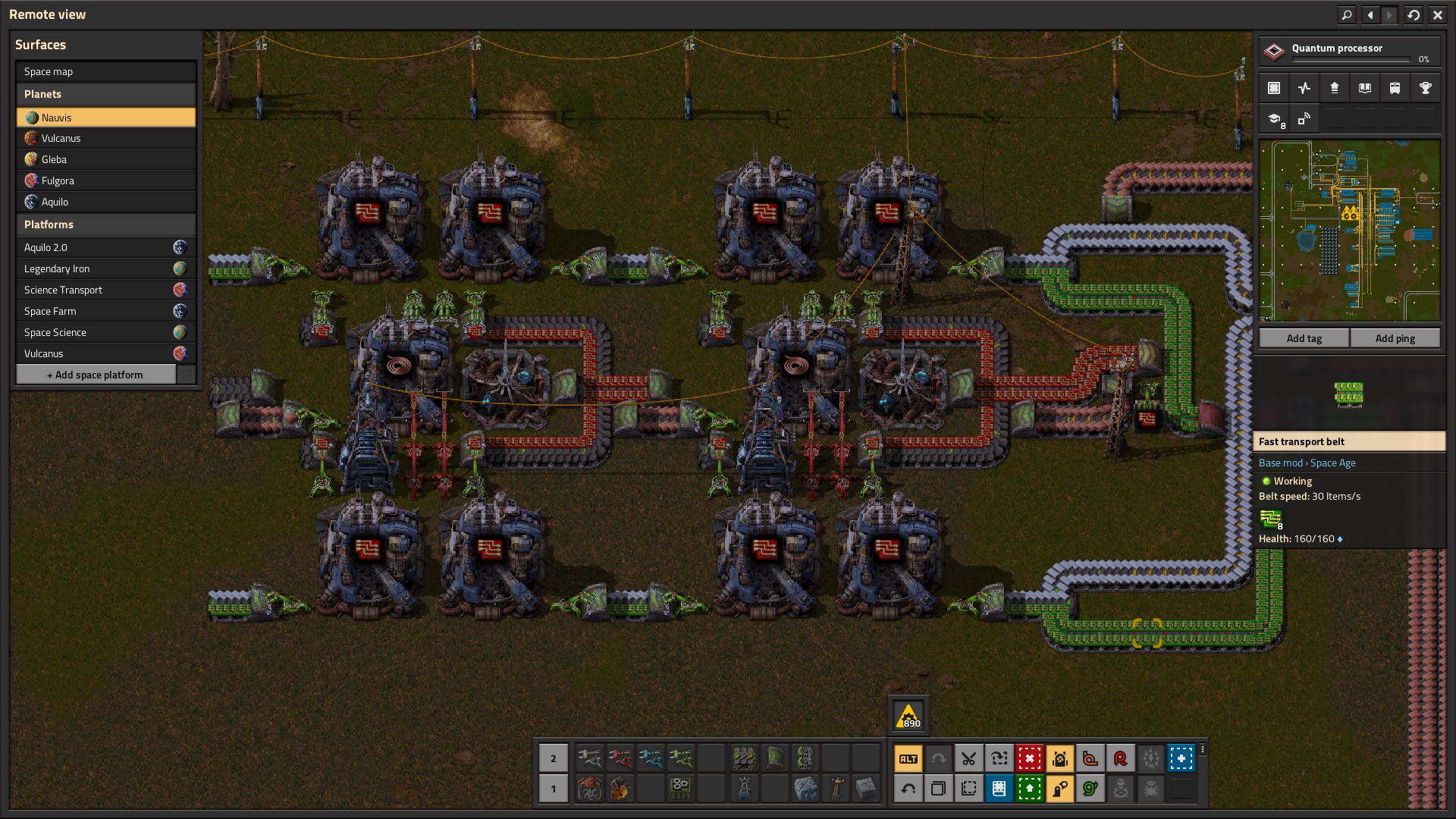
Factorio has the best mix of models, and circuit production is a highlight. The image above is an example of saturation. Copper, Green Circuits, and Plastic enter on full belts. The various production buildings select from the full belts and then put their end products which merge back into another saturated belt. At the right is a box that acts as a storage buffer for bots.

Since I use a main bus with that includes processed raw materials, it’s somewhat simple to pull into a factory. The wire is the middle building, which supplied the 4 outer circuit plants. The beacon is added to boost speed, and finally the belts are added to supply the material.

The wide majority of saturation builds in Factorio follow the same design principles. Place buildings so that material can be moved with inserters, place beacons, feed materials from the inside, exit materials from the middle.

DSP – Main Bus Late Game

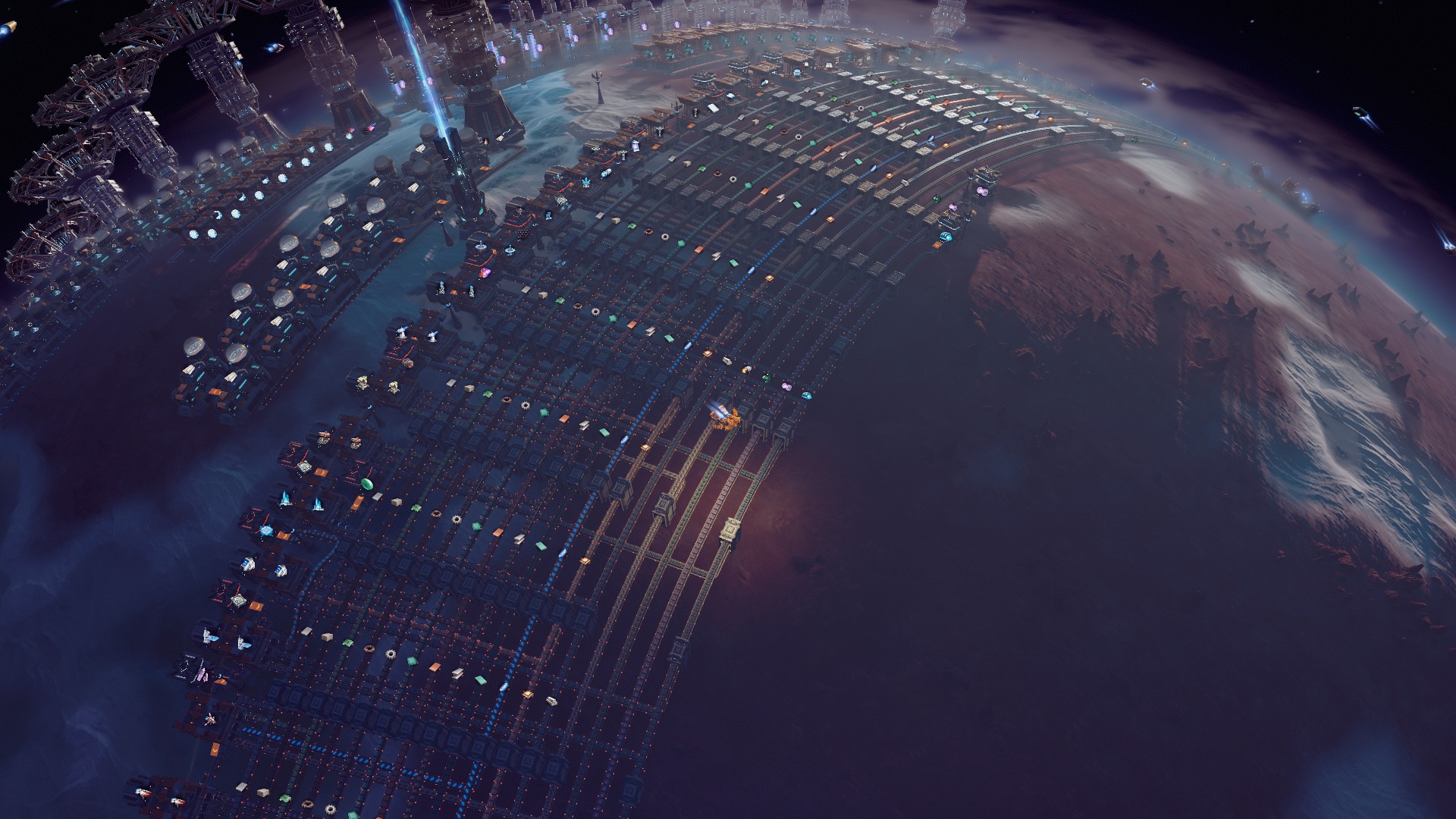
Most other games follow an expanded main bus due to significant intermediary steps. DSP is like this, were there are 15+ items on the bus needed to make 90% of all buildings. This is also a saturation model, and vertical splitters allow this construction. The bus is on level 2, and it feeds each building on level 1, which then stores material in a container.

Satisfactory is the same model, but slightly worse. You need a mod to manage storage limits (no one need 48 stacks of Computers), buildings are exceptionally large preventing effective blueprints/design, and you need to move things vertically at multiple points. The bus and factory floor are on the same level (2+) but the belt weaving is done underground. The end result is a thing of beauty, but more comparable to cable management in PCs. Hide all the junk in the back.

Tales of the Shire

It has been a long time since a decent LotR game came out, way back in the early aughts. (Shadow of Mordor is a bad story, but the Nemesis system is amazing). I understand why this is a challenge, the wide majority of fantasy archetypes are founded in LotR – people have flushed out from this for decades. There are few corners left to explore.

Tales of the Shire is a niche take on a very specific setting. Thematically, a cozy game set in the coziest part of Middle Earth makes a lot of sense. When you think of hobbits, you think of slooooowing down and enjoying the scenery. This game has pieces of that all over the place. However, it also has piece that conflict with this measure.

Main Activities

The totality of the game revolves around cooking meals. You collect materials, grow gardens, collect fish, and then leverage an obtuse mini game to craft a meal. Sharing said meals with the villagers increases your friendship levels, unlocking more stuff. As with other cozy games, there are seasons, cross-benefits between skills, items to acquire, and areas to unlock.

The menus behind all of this are more complex than I would think reasonable, if only because the actual mechanics of everything is more complex than need be. I am nitpicking here, as the data is certainly present, just not obvious to access.

Money

Is the root of all evil, and a major hurdle to overcome. Everything costs money, and money is challenging to acquire in amounts that are deemed ‘cozy’. A set of seeds may cost $50, work once, and the product sells for marginally more than the seeds. You cannot sell a final meal, which is very weird. Expanding the ability to garden also requires money, about 1000 a shot.

You will start by scrounging the landscape for things on the ground and sell them for minor amounts and a lot of time invested. Fishing is the best option, but only becomes so after you’ve reached level 2+ as the fish start to sell for 100 each instead of 20.

While I can appreciate the pressures of money (Tom Nook scars remain), its a weird thing to put in front of a hobbit just trying to relax. Money issues also don’t scale as in other games. I’m literally a multi-millionaire in Stardew Valley, when I hit 10k here I thought I was Scrooge McDuck.

Cooking

This here is both very interesting and complex. Ingredients matter. They have quality levels and flavor profiles (salt only comes from seasoning). Better quality = more friendship points when served.

You gain additional recipes over time, and more cooking stations as you improve your cooking skill. These stations allow you to alter the composition of a meal, making it more crispy, tender, crunchy or smooth. Get the right balance for some added benefit. You can only crisp/tenderize specific items, so ingredient choice matters.

Villagers also have tastes – sweet, bitter, salty, and sour. Recipes change their flavour profile based on ingredients. Some ingredients can be seasoned to change their profile, which may or may not change the profile of the meal (I have yet to figure this part out fully). If you combine two specific flavor profiles, you get a quality boost as well.

Serving food is the main point of the game, and you want to serve 4 people per day their preferred dishes. Higher quality boosts the relationship meter faster. Each relationship level gives something, usually a new recipe, which helps meet more villager taste preferences.

The Cadence

Aside from the main story – which is arguably a long tutorial – you generally follow the same daily pattern.

  • Wake up
  • Tend to the garden
  • Read the mailbox
  • Create meals for guests
  • Serve guests
  • ???
  • Make money
  • Invite guests for tomorrow
  • Go to bed

I think that is a valid and simple daily routine that aligns with my idea of a hobbit. There are other things you can do, such as trade, collect more ingredients, complete daily tasks to improve a skill. Each of them has some merit. My only true gripe here is that progression provides nothing more than the ability to spend more money through an expanded garden and house. Fishing in a new location is a cool idea, but you need to lose a chunk of the day to run to the vendors, when you could just fish in town.

I’d argue that this game is a niche of a niche game. You really need to like cozy games and also need to like Hobbits to truly appreciate what’s here. In that space, your mileage may vary.