Factorio – The Troubles With Transport

I took a forward-looking approach in this run, which really means that I skipped some pieces to potentially save on rebuilds. In a “normal” playthrough, you’d optimize a bit of Nauvis with some red belts and more effective smelters. You’d likely use beacons as well. You’d create purple and yellow science. And then you’d launch a rocket.

I did not do that. And consequences followed.

First, the smaller build space on Nauvis is a good thing. It requires me to be more effective in the designs. What is saves me in long belts it costs me in undergrounds + splitters mind you, so the material costs are arguably higher. Power is substantially more efficient though, and a whole lot less poles. I skipped upgrading to red belts and everything that follows. While I had crafted logistics containers, I didn’t actually use any until the first rocket went up.

Almost to first rocket, only needed to add blue circuits to the left.

That was the point where I realized I had a more difficult path ahead.

It is entirely possible to build a space platform with basic logistics. Storage containers are all you really need as the rockets will self-request. Taking the platform to Vulcanus was simple, landing was a relative breeze, and set up was quite fast. It certainly helps when you know what you need for a first landing! (Funny story, I forgot to add a Landing Pad and had to reload a save. Well I thought it was funny.)

Vulcanus has 4 main phases, though folks are likely only to see 3. The initial setup, which is about unlocking foundries and big miners. The mid-game which makes the planet self-sufficient for rockets, meaning LDS, rocket fuel, and blue chips. The late game when you’ve unlocked Aquilo and realize that all chips can be made for free and super speed on Vulcanus. The end game, when you then realize that Vulcanus is the absolute best factory planet in game and you transfer 90% of production there.

Sidebar. I recall in Satisfactory the first few run-throughs I absolutely didn’t account for scale and needed to rebuild the entire factory. And then I’d unlock something new and realize I had to do that again. That game doesn’t naturally support modular design and scalability, you need to bring the mindset with you. And mods. The 3D layouts and free-form placement are unique, and the challenge is in that freedom. Satisfactory works on a 2D grid and has a pile of automation. Scaling is extremely simple, and moving a factory 2 spots to the right is a mouse click.

Back to Vulcanus, or rather all planets for that matter. Accelerating to get to phase 4 is friggin hard-mode. Without purple/yellow science on Nauvis, you need to build a main transport hub on Vulcanus and then transport it back to Nauvis. This is very expensive, as blue chips are a nightmare to build before Fulgora is unlocked. Did I mention that blue chips are needed for yellow science? The good news in this is that while they are very expensive to make, they are infinitely cheaper on Vulcanus than on Nauvis. But wait there’s more!

Blue chips need plastic, which can only be refined from oil products. There is no oil on Vulcanus, so you need coal liquefaction, behind purple science. You see how this is a catch-22? To get blue chips, you need blue chips to send rockets of purple science to Nauvis. But the devs thought of this and gave us simple coal liquifaction, which produces heavy oil from calcite + coal. Using that recipe, I can kickstart plastic generation with a rather complicated oil factory. Blue chips –> purple science –> get me the Fulgora ASAP.

Oh, and during this time I needed to lay out some rail networks to get copper + iron to my Nauvis factory. Big miners do wonders here as they are 5x more efficient and only consume half the resources. Foundries are not an option, as I can’t efficiently ship calcite to Nauvis yet. 50×50, ground-based rail systems are I guess “easy” to build, but the space limitations really play a number on making it all work. Actually being on the planet would make it a lot easier, but that’s not really an option right now.
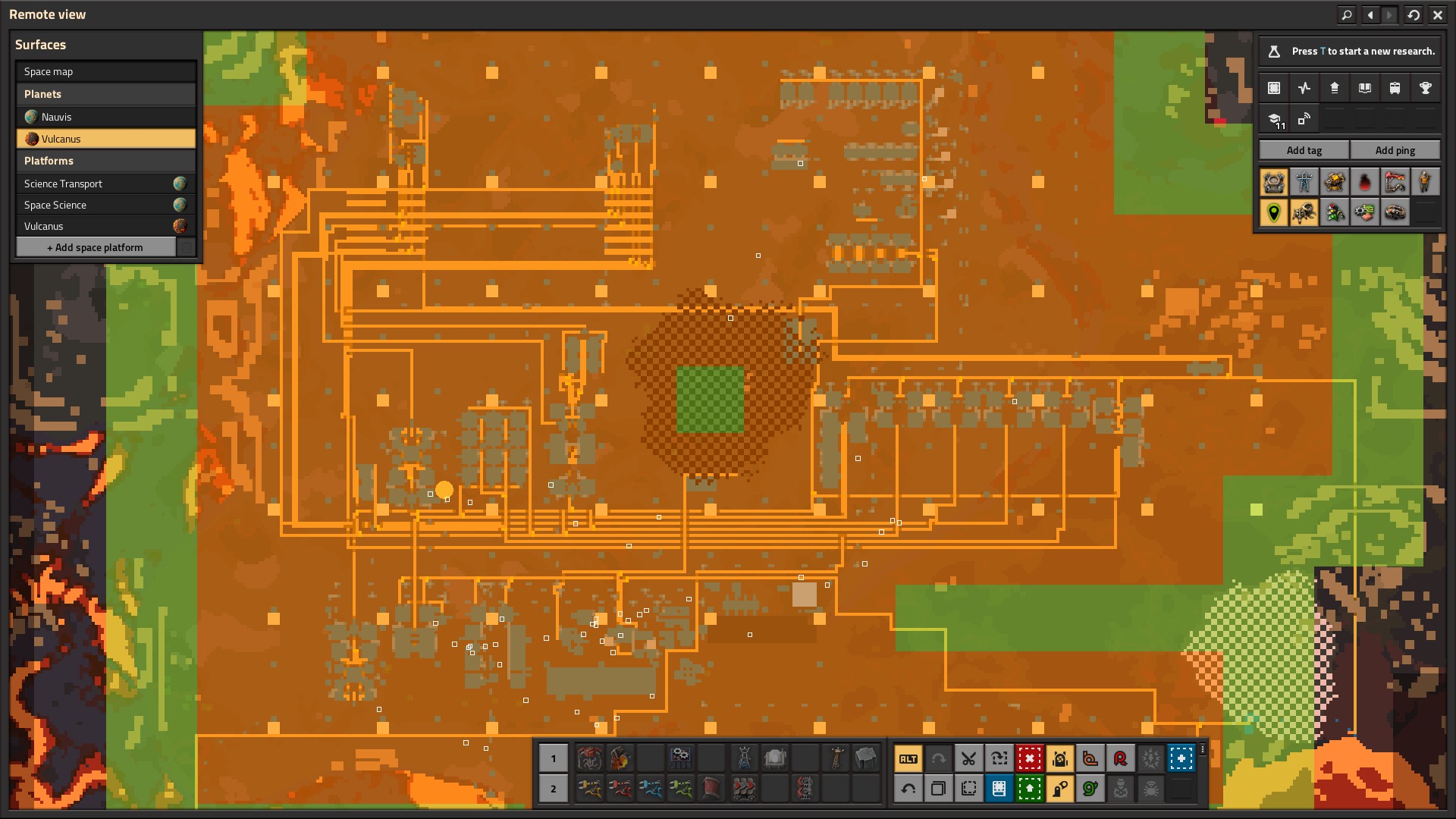
Vulcanus just before Fulgora. Oil factory top right, main bus in the middle, purple + yellow science in top left.

I’m heading to Fulgora now, and the electromagnetic plants are the absolute priority. They will practically trivialize chip production and shift the game into overdrive. Oh how I am looking forward to that!

Factorio – Smaller Starter Base

There’s a saying that you can’t cross the same river twice and that’s certainly true in games. The initial experience of discovery, trial and error, and simply awe just doesn’t exist the next time through. It may give the sensation of comfort, but it’s not the type of emotional event that typically marks you.

This is why NewGame+ exists, and why there are challenge modes. You have the sense of familiar, but with that extra challenge. I wouldn’t say this works for every game, especially those that are narratively driven, but it’s a relatively simple option to extend the shelf life of a game.

Logistics games are similar to action games, where you as an individual become better at the game. You’ve optimized builds, strategies and tactics. Think about it, rogue-likes are based on this exact model. The difference is in how long you gain that experience before a reset. MH Wilds is ‘easy’ because mechanically the game has less friction, but moreso because I’m just a better hunter.

End game Factorio has planet-sized factories that are ultra-optimized. I have spaceships that farm legendary material. Tons of blueprints to quickly build complex structures. And importantly, hundreds of automated robots to do all the menial work for me. I am build an entire factory while standing on a different planet as a result!

I have ziltch of that in a new game. I have a forest, rocks, a pick axe, and legs that run in molasses.

New Game Rules

To make this run different than the last, I need to set some ground rules. Concepts and goals that come from experience and desire.

  • Compact builds means maximum distance between roboports. 50×50. This also means that I need to build a blueprint from late game to frame things, as it takes hours to normally unlock this tech.
  • I want to get off Nauvis as soon as possible and head to Vulcanus. Vulcanus has absolutely every raw material I need in near-infinite supply with much smaller factories as a result.
  • To leave Nauvis quickly, I need to drastically limit my resource expenditure and sprawl. Smaller builds require less material, especially trains to get access to Oil/Nuclear.
  • I do not want any enemies or cliffs. Enemies are a resource drain, all risk and no reward. Cliffs on Nauvis are dumb because you can’t get rid of them until much later. I could care less about cliffs once the bombs are available to build on Vulcanus.
  • The planet order will be focused on meaningful unlocks. Vulcanus (will be the main factory planet), Fulgora (elevated trains and recyclers), Gleba (I really don’t like this planet, but you need heat plants for later), and finally Aquilo (fusion power).
  • I am not looking for quality crafting until after Aquilo is unlocked, at least not in any meaningful sense. That is a major resource drain, with minimal results until you have the appropriate unlocks available.
  • Space Ships will maintain the prior build structure. One for the interior planets, one for Aquilo, one for beyond.
  • The game is ‘complete’ at the solar system edge.
  • I am not interested in a time challenge. I prefer clean and optimized lines that can be re-used. Frankly, time challenges require some RNG luck and double the time in preparing the necessary blueprints to skip design work.

So let’s see where this goes.

Interesting Times

I am Canadian, no secrets there. While it’s been rocky times this past year+, the last month has been like no other. I am finding it difficult to sleep with the seemingly non-stop news of things that were inconceivable a few months ago. And well, a lack of sleep has all sorts of other impacts. And now we’re in election mode, with one month to go for some sense of ‘stability’. I tend to avoid writing anything that leans towards a political position, that will continue. What I will state is that these processes seem mechanical, but are social agreements. Trust takes years to build, and seconds to lose. So regardless of the outcomes of the process, the people will remain, and positive relationships are the fundamental key to long term prosperity.

Monster Hunter Wilds

Interesting crossroads here. A recent patch causes the game to randomly crash with any bluetooth controller. Not fun. Especially when I’m resting trying to get a decent investigation to pop up. Feels like a giant waste of time when farming 1-2% power increments. And honestly, at this point I’m really trying to farm level 3 decorations, which is better done through Pollen farms.

With title 1 update just around the corner, I’m going to put this game on pause. I enjoy it, but the time/reward math just isn’t there right now.

Hockey

Kids hockey is nearing the end. I’ve got 2, and one finished this weekend. Another in less than a month. Going to be weird having an extra 20-30 hours of free time a week. Knowing me and my family, we are for sure going to fill it with something. Likely a lot of time at the cottage.

Other Games

While I have a back catalogue of games to play through, I am finding it really hard to find one that sticks. My value of time is so out of whack right now, that I need to find comfort rather than exploration, and in bite size chunks. I don’t have the mental bandwidth to learn new mechanics, but I do have enough to optimize existing ones.

  • I’ve tried a few cozy games (similar to Stardew Valley) and none have stuck. Bunch of reasons, though most is due to their balance of time & progress.
  • Metroidvanias are everywhere, but the good ones are still the good ones! Animal Well is honestly too mentally taxing.
  • Base builder / survival games are not scratching the itch. I gave Enshrouded another pass, it has a ton of new content but there are still friction points that annoy me. I may give Nightengale a shot, the mechanics seem to have greatly shifted.
  • Logistic simulators are interesting. Techtonica is done. Foundry has a roadmap but no actual content for a while. Dyson Sphere hasn’t had a content patch in a year, and the last one (Dark Fog) really, really sucks. Satisfactory supports mods (yay!) and has yet to improve trains (boo!). 1.1 is coming with mostly QoL things. 1.0 was great and everyone should play it, but building for “beauty” is not what I play those games for.

Factorio

Ever since I put away my MMOs, no game has taken up as much attention as Factorio. There’s always some problem that is present, one with an evident math solution. The challenge in all logistics games is related to concepts. Your fundamental beliefs and design principles are challenged every minute, and sometimes pushed into very uncomfortable spaces. More than once I realized I made a design call a dozen hours ago that was so wrong that I had to rebuild it all to fit a larger need. The good news it that after you unlock robots (~4hrs or so in), these rebuilds are relatively easy to do. This is not the case in Satisfactory, which is a major friction point for me.

My first playthrough in Factorio was a spaghetti fest. I barely got to rockets and then put it to rest. My second playthrough was organized around city blocks (from Nilaus), which dedicated space and blueprints to focus on specific items. A block for smelting, a block for science, a block for rockets and so on. I played 2.0 in that mindset and got to the end game, RNG and all.

City blocks are a great design principle. The challenge is that aside from Nauvis (the first planet), you don’t actually have that much space to build when you land. So I am starting a new game, and using a smaller design principle that is based on the minimal roboport distance – 50×50 blocks. I will have much less space to use, requiring more creative use of belts, but also much less sprawl as a result. Should be fun to optimize.

Oh, and I turned off enemies and cliffs. I can get PvE in another game.

MH Wilds : HR 60+

At this point, I have ‘completed’ all the structured content in Monster Hunter Wilds. All the main quests, optionals, events, and side quests. I think I’ve mapped out everything so I can plop down camps across the maps. This effectively caps off the exploration phase of the game, and transitions to the achievements phase. That phase has 3 main parts – weapons, armor, and decorations.

Weapons

There are two types, and the ‘best one’ depends a lot on the type. Artian Weapons have a pile of RNG and the materials only come from tempered monsters (let’s say they are 20% harder than normal versions). Regular weapons are better for elemental damage and don’t have a RNG roller coaster, and they don’t need tempered fights.

If you do need Artian weapons, there’s some small RNG in crafting them and then a PILE of RNG when upgrading them with 5 random rolls. It is min-maxing at that point though and the long term grind for 1-2% gains. Good news is that only the material to craft the weapons is lost in the RNG machine, the material to upgrade items is always recovered. And if history is any judge, the weapons will be replaced in 3 months with something better.

Armor

This part is rather straightforward. Hunt for parts. It may take time for some pieces (notably gems that have a 2-3% drop rate), but optional quests are usually enough here. I would not recommend taking on tempered monsters here until you get to 300 or so defense, you spend too much time healing. You may need to for some material, but generally can be avoided. I personally find tempered Arkveld easier than Gore Magala, but your mileage may vary.

Upgrading armor is very useful. HR armor usually has 7 tiers, and each tier costs more to upgrade, so spread out the love. Later monsters will certainly unlock better armor, so I wouldn’t concentrate in upgrading them too much.

Decorations

Right, this part sucks, big time. Always has. At HR50 you can target level 1 decorations at the melder, and at HR 100 you can target level 2 decorations. So if you need either of those, wait until you reach the proper HR level.

If you need level 3 decorations, you’re gonna have to spin the RNG wheel. Either you get melding tickets or you hunt, both are quite long in the tooth. Is it worth it? I have never found so, but it is a carrot of sorts to keep going. Decorations are good forever, keep 3 of each.

Investigations

This is the bread and butter of the late game grind and somewhat obtuse as a mechanic. That said, it is a massive improvement on the prior versions… no need to run around and collect material to unlock quests. From the world map, you can take a look at available quests per zone, and then save them so you can repeat them up to 3 times. Don’t see a quest you want? Use the rest feature to reset the quests.

Understanding what makes a GOOD investigation is part of a dance mind you. Once you get the hang of it, the cadence is pretty decent. Right now, there’s optimal investigations and then everything else.

Other Notes

  • Capturing monsters is best, unless you have the rare food buff for extra carving. So 95% of the time, capture.
  • The AI hunters are both great and ok. Great in that they are super helpful in combat (heal + tank) and WAY better than actual people in terms of etiquette. Ok in that their damage is substantially less than actual people. I’d strongly recommend them until you are at the end game and solo work becomes much faster.
  • ‘Farming’ materials is extremely hands off and RNG heavy. Seems that there’s missing a Palico farming system.
  • Cooking is still super important, but now consumes material for stronger buffs and longer durations. I personally dislike this change, if only because getting the cooking material is cumbersome. I fully expect farming to tackle this issue in the future.
  • The Palico is much less useful than before. You can’t select their skills, and some have massive cooldowns.
  • The Seikret mount is both amazing and curious. It can traverse the entire map in less than a minute, vertical and horizontally. It defeats the purpose for camps/exploration, with very specific exceptions. It will save your life when a monster is about to kill you as well.
  • There’s very little incentive to actually explore the map. This is very jarring coming from Rise that forced you to collect boosting bugs before every fight. Which is too bad, because the map is really cool! (end game, still a good idea to have a maxed herbalist/geologist set of gear to get mats)
  • I find that the game strongly focuses on raw (physical) damage and avoids nearly all status effects except frenzy. Given that there really are only 2 relevant monsters at end game, it is less complex and therefore easier. Or more accurately, Arkveld is substantially less complex than Nergigante.
  • Finally, it’s important to note that the content in the game today is a fraction of what it will be within a few months. That’s how Capcom keeps people playing. Judging Wilds against Iceborne or Sunbreak is not even close to being fair. What’s here is good, really good.

Cutscene City

I played Pillars of Eternity + Avowed more for the plot than the mechanics (slightly). Both are dialogue heavy games, where choice matters and you want to be involved.

Monster Hunter Wilds is not that type of game, you are there to attack big monsters and the story itself is more of a blur than much else. For some odd reason, the game has 2 types of cutscenes, one where you can skip ahead on the text, and another that’s locked to the entirety I always play with subtitles, too much experience with key words missed in some elvish language or something. So reading during a cutscene is instinctive and miles faster than any voice actor can deliver. Some games it’s super worth watching the nuance (Mass Effect 2 is a real highlight), others not so much. Monster Hunter Wilds is far from a bad game in that sense, but the story is superfluous and the lines given to the actors right up there with the best Monster B-movie. I get it, the whole point is exposition, so they need to tell much more than they show. I will say it’s interesting for your character to have spoken lines!

You can gather than I have the majority of the main line stuff done by this point. I’m into a multi-option quest in Chapter 5, with an HR of 30+. By my math of MH games, I should have 1 or 2 steps left after this, which would them put me in the farming stage.

I had it last post, and will say it again here, MH Wilds is mechanically a superior game to its predecessors in every regard. Combat, movement, interactions, crafting, monsters, environments, sound, art, group play… you name it, it’s done better here. The Seikret mount negates almost all of the in-world friction points from prior games and I absolutely do not miss the Wirebug from Rise. The difficulty is still here, the last quarter of the game is full of 1-hit kill monsters if you’re not paying attention. The grind is there at the tail end, so that you don’t need to farm in Low Rank. Cooking may be a bit of an adjustment as the ingredients are not infinite, but the ability to cook anywhere is amazing.

I’m still in the mix of things now, and normally only come up for air near HR50 or so (e.g. once I have the armor & weapon I want, not the decorations). The top end consumables are not really a consideration right now, nor optimization. So far, the entire vibe is Monster Hunter World 2 – Even Less Friction. Impressive.

Monster Hunter Wilds – Git Gud

I “played” Monster Hunter in the dark mobile ages, but never really got into it. Too many rough edges. Monster Hunter World though, I spent time in that sucker. Both on the PS and then again on PC. That was eye opening. I’ve played Rise and now Wilds.

World first though. I died (carted) a lot. Anjanath was a near wall for me, and that semi T-Rex was like the 4th monster in the game! Nergigante took me a week to kill due to the dive bomb mechanic and just really bad skill on my end. I stuck with it, got better, and found a solid groove. I played with multiple weapons, notably dual blade, charge blade, and heavy bowgun. It was a journey.

Rise was different. I carted, sure, but it took a long time to reach that point. Most of the issues were with the game design itself and having to collect bugs to boost my stats enough for a fight. The wirebug mechanic took me a right while to figure out, and the bosses felt like it was 1 hit kills. I swapped to long sword to see what the fuss was about and no lie, it took me a couple weeks to figure out that dance, in particular the defensive portions.

And truly, MH is a dance. Every monster has their own theme song and you need to learn the steps. Do so, and things are relatively easy. Try to waltz when it’s 2-stepper, and the cart awaits. That said, there’s a limit to how many steps you actually need to learn. I wouldn’t say I mastered the long sword, but I was damn good at it by the time I was done with Sunbreak.

The transition to Wilds was simple by comparison. I kept the longsword and the mechanics feel similar in pace. I understood the need for cooking good food. Collecting before a battle isn’t needed. Upgrading armor (using spheres) makes a much bigger difference than weapons when trying to learn a fight. Radial wheel access to heals + the seikret mount means I can very quickly leave a bad place and heal up. It also means that mounting an enemy is so much easier!

Now, the question really boils down to “Is Wilds easier or am I better?”

Obviously it’s a bit of both, but I’d put a significant amount of weight on the latter. I get the game, I get the mechanics, I get the timing. I still carted on the ice/fire dragon with a crazy AE attack, but I haven’t failed a single quest yet. The moment to moment portions still feel great, the hit delays work, the defensive agility gets the blood pumping, and it never feels old when you get a crazy massive combo on a 3 story dragon who crumples to the ground!

Wilds is a good game. It isn’t as earth shattering as World, and doesn’t take major steps like Rise did, but it polishes almost every aspect down to a clean and fun sheen. It is by far the most accessible Monster Hunter has ever been, and there’s plenty of difficult challenges for those searching for it. Put in non-stop carts at the start though… and you’re not going to have good retention numbers. And from the achievement % I see on Steam, it would appear that a lot of players have progressed in the game so far.

For those who find it too easy, maybe you’re just that much better than the last time you played.

Hyperbole and Analogies

I generally avoid posting about real world things, it’s depressing enough. Current events though, holy cow. This post will be full of hyperbole and analogies, stretches of reality that are meant to emphasize a point.

Old saying first: It takes years to build trust, and seconds to destroy it.

If I was in an abusive relationship, where my partner of many years decided to start beating me, and then threatening to beat me more, then say ‘don’t worry, we’ll make this work’, and then beat me again, it would be a sane response to GTFO. It would also be a sane response for me to defend myself against future abuse and absolutely not trust the other person.

Let’s say that I am in a small town, and my options to exit said relationship are very small. Even if I do leave, I need to share the house with this person as there’s nowhere else to go! Neighbors want to help, but they are afraid that they will be targeted next (and rightfully so, as they have been threatened as well). What that then means is that I would be meeting these other people in secret, or at least out of my partner’s earshot, to make escape plans. I’d be open about some things, just to avoid suspicion, but there’d be a lot of hush hush talks.

These new and stronger relationships would be subtlety antagonistic towards my partner. No one would want to be singled out for their wild and unpredictable behavior. We’d all actively work to undermine the partner, lull them into a sense of comfort, and they would do all the work to declaw themselves. And when they realize it, they’d complain and blame others for it.

No relationship is without compromise. No relationship can be dictated. They all succeed based on finding a balance between the individual needs and the group needs. When one party decides their needs are more important than another’s, well, the results are destructive. And, truthfully, there are some relationships that simply cannot work, no matter how hard people try.

Unfortunately when nations are in relationships, the ‘cannot work’ part gets super complicated and has very wide ranging and long-term impacts. And now here we are, with the globe seeing a world leader proudly proclaim ownership of the issue. And in the very interesting words of the younger generation, we’re entering FAFO land.

Avowed – Complete

All the way to the credits, I enjoyed the ride. There’s just so much here that simply works that it’s extremely easy to dismiss some polish pieces. May be some spoilers in here, will try to avoid.

I played a Wizard build. I tried a more stealth-based role but the combat mechanics don’t really support it. Caster, Bow or Tank are the only real options. Works for me! The character progression options as a wizard are limited for a decent while, as it has a rather unique requirement of using grimoires for spells. Grimoires are spellbooks with pre-assigned skills, so you’re generally looking for a specific type.

The challenge with a wizard, and the game in general, is that 90% of combat is against 6 or more enemies, including ranged attackers & healers. As a caster, you need to use AE attacks which have some rather weird dynamics. Fireball is super useful at the start, if only in pure damage, but the range is small and recast time long. By about level 10 you get accustomed to status effects (fire DoT, thunder stun, ice freeze) and quickly realize there’s only one true path – ice. You can clear entire camps in 2 spells if you specialize in ice attacks (skills + armor), which can feel trivial at levels 20+. I truly don’t mind feeling like a god by that point, cause it sure as heck was rough roads to get there.

Story-wise, the game moves from luscious lands to barren volcanos, with similarly ever depressing quests along the path. The pace and structure are really good though, as nearly every quest has some sort of long-term consequence, either in NPCs moving towns, or help later on. An interesting one in the 3rd zone has you visit a tower with a good 50 traps along the path, to meet 2 NPCs who are doing everything in their power to protect their land from invading forces (which you represent). It’s an interesting bit to talk them down.

Which gets me to the truly fascinating bit here, in that a large chunk of the backstory is defined by your interactions. At key points, you interact with ancient lore and select the behaviour of earlier NPCs. These choices impact the larger story, all the way until the final credits. It feels like choose-your-own-adventure here, and it works really well!

The penultimate choice is the more difficult of them all, and depending on choices / discoveries you made along the way, is either very obvious or very hard to make. I had done everything by that point, discovered a ton of lore, all sidequests, been generally ‘good’ with a couple exceptions and had a really tough time squaring the choice in front of me. It felt like a large gamble. The final choice is super obvious, you either side with a genocidal undead lich, or not. (You should try actually siding with them, I think you’d be surprised how it turns out – or not.)

Having completed the story, I am absolutely impressed with what was presented. While it does have a couple rough spots, the high points shine and make you quickly forget. All the NPCs are well constructed, with interesting and non-obvious drivers. Many of them have hubris, or are outright liars, where you need to discover more contextual clues to navigate. The companions are interesting, with varied backstories and quests. Progress is mostly self-driven through exploration, with only a dozen main quests. The choices you make are generally consequential, and it’s cool to see them come together in the final act.

Avowed does so much right, and with clear and consistent direction from Obsidian, that is honestly puts other modern RPGs with quadruple the budgets to shame. The Pillars of Eternity storyline continues, and I am looking forward to the next chapter!