Avowed – Breadcrumbs

I’m actually going to pick on WoW for a minute because that is such a major change in the gaming industry that few people remember a time before. When WoW launched it had an innovative (at the time) method for leveling – and that was through quests. Prior to that, and exemplified in Everquest, progress was 100% tied to combat. D&D only really gave experience for monsters (unless you had a smart DM), so it was baked in that progress was based on body count. WoW changed that, and the rest of the gaming landscape changed as a result. If you have levels in a game today, the progress of those levels is very tightly tied to questing… and the ! marks that track it.

What that meant was that quests moved from being exploration driven to achievement driven – the goals were more important that the journey. That is not a small pivot. And we’ve been living with that mindset in gaming for nearly 20 years.

Avowed now. Does it have formal quests? Yes. Do quests equate to the majority of player progress? No, combat and exploration add a lot. Pillars of Eternity 2 was a step in this direction, but much larger here. Avowed also goes deeper into what I call breadcrumb quests. These are items and things in-game that you need to piece together as next steps and context without formal guidance. There’s no in-game tracking, just reliant on you. Most of them are simple, like “hey, I put your stuff in the bag behind the shed” and sure enough, stuff behind the shed. Others are much, much more complicated.

Light spoilers here.

Emerald Stair is the 2nd zone, and the main hub is a key part of the story. There is a rather substantial breadcrumb quest in this zone that has multiple paths that can be taken before the tail end. If you only follow the quest markers you will see a specific and honestly horrific event take place. If you follow the breadcrumbs you will have a completely different outcome.

Truthfully I had those crumbs and steps up, but proximity to a quest marker had me take a different path. Following that main path completely changed the zone layout, failed some quests, and closed off areas. By reloading I was able to take the different path. While the results of that alternate path are more, I guess lawful good in essence, I loaded back on the main path as it appeared to have more story implications long-term. Let’s see how that pans out.

Spoilers end

It’s hard to properly explain what this type of world building construct actually means. Skyrim has smaller pieces, but my memory has them as distinct and not connected. I honestly cannot find a comparable event in recent gaming, though I’m certain they exist. Of course breadcrumbs exist – what I mean is breadcrumbs that exist outside a vacuum. Playing a game that rewards exploration with more exploration and world building… I thought that only existed in table top sessions.

At the end of the day it’s still a game, and someone will write a guide about an optimal path including these more hidden pieces. That’s for later. Right now, there are impactful decisions here that are not obvious, that do not have a glowing sign saying ‘EXP RIGHT HERE’, and that reward the nook and cranny type of player. I am really, really pleased with what’s here. A truly fresh breath in the RPG space.

Avowed – Part Deux

Right, to the point. Avowed scratches an incredible itch that I didn’t realize I truly had. Video games, at their core, often show up as pretty skinner boxes – you repeat a set of activities hoping for a dopamine hit. The challenge with that construct is that the set of activities need some balance on challenge/reward in order to feel fulfilling. Ubisoft, for example, has lost sight of this where as games like Ghost of Tsushima have used the setting itself as the incentive.

I ‘completed’ the first zone over the weekend and am surprised at my joy in the process. While I certainly threw a lot of fireballs, it never truly felt the same. Each environment was different, so that the tactical portions changed. Sometimes there were a lot of big bad bears (melee who love to charge), other times well placed archers (which I can thankfully defend from), and at times summoners who have a seemingly infinite supply of minions + spells (which I cannot defend from). I had to prioritize each fight.

And the reason for each was different. Sometimes it was a random group just standing around. Others I had to collect a bounty. Others protected a cave I wanted to enter. Heck, a few times I just wanted to pick a fight because the dialogue gave me the choice. I don’t have to collect 5 bear pelts, or bring flowers across town, or some ridiculous box moving puzzle. Heck yeah!

Exploration

This is a thing that hasn’t really been discussed in open world games since Skyrim – 14 years ago. There’s an thing about world building where stuff has to have a purpose, even if that purpose is minor. I can trip over a dungeon that has a set of lore within, or read a note about some hidden mushrooms, or find a lost key in the sewers that opens a door to a shop. They aren’t actual tracked quests, I’m not directed to any of it. They are completely organic activities that serve contained but interconnected purposes. It feels like there’s breadcrumbs everywhere as a result and zero minimap cluster bombs. It’s exploration for the sake of exploration, not achievement. No Man’s Sky scratches that itch, but this world is hand crafted. Some human decided it was a good idea to put a book under a table for me to read, and then go on my own little adventure. Fascinating.

Combat

A decent amount of time is spent here, and a substantial amount of flexibility is present. You don’t get stronger with levels, you simply have more tools. You get stronger with better gear, and there’s so much gear to choose from. Now, you don’t have the enchantment system of Skyrim, so choices are certainly more limited, but it also prevents a sort of min/max situation of ‘perfect enchants’.

Where the game struggles, at least in my opinion, is the defensive portion. You will take a rightful beating at the start, which is likely to impact your playstyle. It’s certainly possible to go in with a 2 handed weapon, but you’re going to be tanking dirt quickly until you figure out the battle dance, especially with the sheer amount of enemy attackers. If the companion NPCs did a better job tanking, this would open more options. As it stands, you’re much better off to start with ranged attacks and finish with melee. Blocking + Parry are life, and a thousand times more reliable than dodging. Avowed is not an action game.

Next Steps

Into the new zone I go, tracking a pile of breadcrumbs along the way. And combating voices in my head every night. This is a truly enjoyable experience.

Conflict Management

Not often I talk about my work. It’s a significant part of my identity mind you, and I gather if you read this blog you’d have a good idea of type of work I do. One area I’ve been continuously working upon is conflict management. Honestly, way more work than I ever thought I’d need.

An old adage I learned was to never argue with an idiot. They will bring you down to their level and beat you with experience. Truth there.

I find, and have been provided feedback, that I am pragmatic. I tend to navigate the middle of the spectrum when it comes to interpersonal relationships and values, which allows me to work with pretty much any type of other personality. For those aware of the Myers-Briggs personality tests, I am a natural square (for whatever that may be of worth) and adapt to a given role based on needs. For example, if I’m in fire fighting mode, there’s very little space for emotional consideration. If it’s a team building activity, then the get-stuff-done mindset isn’t helpful.

I still encounter conflicts though. Work and personal. I’ve narrowed it down to conflicting principles and primarily due to trust issues. If a person is unable to be empathetic to other’s needs, and I mean willfully so, then I need to take specific steps to have a working relationship with them. If a person struggles to make the hard decisions because they are too sympathetic, a similar issue occurs. And above all else, if they say they are going to do something and don’t, then I need to re-assess the relationship.

Given the larger world context, a lot of people are under a lot of stress and anxiety. I get it. That causes defense mechanisms to activate earlier, and for less patience. That is tinder for conflicts and a lot of people will go to greater lengths to avoid it. It doesn’t do a great job of building relationships and in my experience, the majority of people will experience fear instead. They are simply looking for a safety blanket that is promising stability and golden fields. That’s the entire modus of a populist after all, preying on fear.

I am finding myself at an interesting intersection. I have spent years adding to my toolbelt of interpersonal skills, learning and tweaking. Ups and downs along the way, but I’m where I am because the tools work and the people I work share trust. Lately though, I’ve found myself in positions where I am unable to find common ground and in spaces of added conflict. The last couple months in particular have been chock full of trust breaches, and from the same set of individuals.

One particular relationship (not work related) has degraded to the point where it is not worth investing further. I can’t salvage it, and yet need to maintain it for at least another 2 months. They are not a bad person, at all, it’s just that our principles are very opposed meaning that we generate conflict continuously. It sucks because it’s smack dab in the middle of a passion of mine and draining the pleasure I get out of it. It’s a poor example, but putting a vegan cook in a burger joint is not going to work out.

Another relation is at work, where there’s a perceived complete lack of awareness of the people factor. The roles we occupy impact a lot of other people, and we are not in firefighting mode, so empathy for the actions is important – as is holding your word on steps you will take. I will have to maintain a working relationship with this individual for the foreseeable future, which is not exactly something I look forward to. I’ve exhausted my toolbelt, raised this with our joint superiors and I’m taking additional measures as well. It’s fascinating to see where my mental space lands after any interaction, and I’ve opted to simply stop engaging when my blood pressure spikes. Avoidance is not an effective strategy, and I am quite aware that if pressed, I am going to say something I should not. You can pull on an elastic for a long time, but eventually it will snap. In the positive space, I am at least aware of this issue, something that I would not have years ago.

And I have yet one more that relates to work that is not a colleague. For some time I have been trying to help this person’s development and have encountered a slew of events that breach ethical behaviour. Their lack of accountability is frankly astounding, where they end up blaming other people for all misgivings. Given the need for truth, digging with these other people has been eye opening. I’ve entered a less frustrating space now, where feedback and expectations are managed more formally, which will have longer term impacts I need to sort out.

Good news, is that within my house’s 4 walls there are no real comparable conflicts! Sure, there are stupid ones about taking out the garbage, but nothing mind blowing. A big piece I think is related to a shared set of values and principles, one that we’ve lived by for years, regardless of how hard it may have been to uphold. And damn, some times that absolutely was hard. The results will only be really seen in 10 years, but so far, so good. And I can certainly use a safe space to recharge from the rest.

Taking some steps back from all of this, it’s somewhat evident that I neither search for nor avoid conflict. Conflict is life, and hardship is growth for sure, but as long as we’re respectful then progress can be achieved. Yelling into the anonymity of the internet serves no real purpose. Group think of getting mad only makes you feel part of a group, it doesn’t actually solve anything. And not everyone has the skills or desire to navigate those rough waters. That realization is still a very tough conclusion to swallow.

What interesting times we live in…

Avowed – Very Early Thoughts

Simply, it is above my expectations.

The most obvious comparisons are Skyrim and Starfield, but the real comparison is Outer Worlds. Avowed is a level based, instanced, free flow RPG, layered on a strange set of serious lore and quirky events. Sort of like how Fallout has a serious undertone, but you’re going to find a bunch of weirdos along the way. It’s a great Obsidian product.

Character development is simple, but skills and stats can influence each other. You’re never stove piped into a single path, which adds a tremendous about of flexibility. You slowly discover these elements through the tutorial and initial level, allowing you to adapt over time. Notably, dialogue is not hidden behind super complicated skill checks (a part that annoys me in many party-based RPGs). The live action means that the onus is on you as a player to be effective, rather than the skills themselves being right/wrong.

The world itself deserves mention, in particular in regards to the design. Every space has something, and few of them have any indicators other than simply exploring. This is a massive contrast to Skyrim and Starfield, where much of the world is empty. The serendipity of discovery is everywhere. It feels like there are no wasted spaces, which is a miracle in and of itself.

Which gets me to the story elements and core drivers. I get lost easily in RPGs, following all sorts of breadcrumbs. Fallout 1’s ticking clock on getting a water chip, let me tell you how many times I failed that! I found a dungeon, after having read a note, with no in-game marker directing me. The dungeon itself was instanced, and the main story was that a delving team had gotten lost. Within, I found another godlike (born touched by a god) that sacrificed the entire team to power up a homemade robot with the spirit of a god. One, finding the actual area/quest was super organic. Second, the writing of an insane person trying to rationally explain their path was very funny. And third, the integration into the larger storyline didn’t become evident until much later.

I’m not saying the game is perfect. The moment to moment flow feels a little off, and the combat mechanics could use some QoL passes for sure (enemy AI is actually pretty good). It is however a good game, one with an interesting setting, and scratches a heck of an itch for an RPG after years of disappointment from other studios. I hope, truly hope, that Obsidian can be rewarded for what it’s been able to do here. A fraction of the budget and still hitting the right notes.

Now time to dig back in. I am enjoying shooting lightning bolts!

Pillars of Eternity 2 – Complete

I guess I was in the right mindspace for this run.

PoE2 is an interesting game for a whole lot of reasons. Most importantly, it is clear that it was designed and developed by people who are passionate along with a clear vision. The game is consistent from start to finish, with some really impressive writing and decision making along the path. An RPG without a main villain is hard to keep on track, but this game does a wonderful job at it. Oh, there are bad people in the game, but no mustache-twirlers. And while there are a few opportunities to make what would be considered a lawful-good choice, most of them are in the neutral space.

Mechanically there’s enough detail and complexity here to add nuance to the quests. It’s not possible to truly fail a quest (aside from a game over death), just a bunch of different paths to accomplish them. Your teammates can boost your skills to help pass some checks, and aside from 1 specific case, these are mostly flavor options that may or may not avoid combat. As with most RPGs, it’s nearly always favorable to talk / skill check your way through an event instead of brute force. That said, the combat is rather snappy, at least up until the last couple levels.

I like the classes and diversity the game offers. I like the subclasses. Up until level 13 (of 20 max) there’s clear distinction between them. Multi-classing is, as with all D&D game, the core issue. There are a lot of benefits to multi-classing, and in nearly all cases it’s a better choice. There are exceptions – notably the ranged attackers. The skills you get as a pure class for melee are not very good in the later portions, usually passive upgrades to existing things. Wizards, Chanters, and Druids though… they get god-level powers.

Which is a core issue with all D&D games honestly. Melee characters start strong and get weaker as enemy armor/avoidance increases. The last mainline quest and all the DLC has enemies that have crazy defensive abilities, which you either chip away or debuff. Beasts of Winter (DLC) has a final boss that took me nearly 8 tries to beat, eventually lowering the difficulty because my wizard was multi-class and no one had the skill to debuff the 90% damage reduction the boss had.

There are other mechanical challenges. Enchanting is a great idea, but resources are so rare/expensive and you know you’re going to get something better than you avoid it. Consumables are great, but poorly implemented in turn-based mode. Stealing has only niche value, and stealth just doesn’t work. This is nit-picking honestly, and it’s been an issue in every RPG I’ve played.

Eoran Gods

The setting of Pillars of Eternity is the true joy. An older race of soul magicians determined there were no actual gods, so they went about transforming themselves into gods instead. And not like a god-race, I mean the entire race sacrificed themselves to make 11 gods. And then they killed everyone who knew about it, and directed the world on it’s eventual path. PoE1 is about you learning the truth. PoE2 is about you chasing one of those gods who is hellbent on breaking the cycle that keeps the gods in power. Basic RPG stuff.

Religion is a tough subject and nearly every RPG hits on this specific topic with varying results. Here, it’s the crux of it all, the foundation on which every other part exists. You quite literally converse with a god in massive statue form at multiple points, traverse to the otherside to have a coffee, or kill their avatar. The stakes are much higher here than before, and everyone in the game knows it. Quite honestly, most of the quests had me moving forward just to discover the next bit of story, which is not a very common thing.

Wael has to be my favorite of the gods. The weirdest one at least. Imagine if D&D Beholders had their own god – they’d look just like Wael.

Obsidian Entertainment

I still have a few golden dev studios, and Obsidian is right in that pack. The short list of games:

  • Knights of the Old Republic 2. Play with the lost content mod, best Star Wars game I’ve ever played.
  • Neverwinter Nights 2. I don’t think this game gets enough credit. D&D mods exist because of this game and the prequel.
  • Fallout New Vegas: The best 3D version of Fallout. Notorious for Bethesda not paying them because of the 1pt missed on Metacritic.
  • South Park: Stick of Truth. This game is great, way better than the sequel.
  • Pillars of Eternity 1 & 2: I honestly don’t think Baldur’s Gate 3 would exist without these 2 games.
  • Tyranny: A great game with an even better concept – you’re the judge for an evil warlord. Still amazed that pitch got a game!
  • The Outer Worlds: Avowed exists because of all the lessons learned in this game. This is what Mass Effect 4 could have been.
  • Grounded: A survival RPG. Think Valheim but you being shrunk down in a backyard.
  • Pentiment: A murder mystery in the style of 1600s art work. What other dev studio could actually do this, and do it this well?

What’s really fascinating is how story drives all of these. They aren’t experimental in the mechanics department, in fact I’d argue they are all AA-level attempts at best – with plenty of bugs. But the ideas are the gold mine. There are people at Obsidian who are paid to write down these ideas, stretch them out to see how far it can go, then translate that for us gamers to experience. And these ideas are coherent too!

I am clearly over-excited for Avowed. I know there are parts of that game that will not meet my expectations, in particular the mechanical parts. I don’t really care, they are simply a means to an end. I want to explore more of Eora. I want to see how people have adapted after Eothas’ world-shattering events. And I’d like a good news game development story, we’ve been short of those.

So far, early reviews are where I expected. Let’s give it a go!

Save Scumming

The art of saving and reloading.

Save Scumming is a rather simple concept. You save the game, perform an activity that has a random outcome, and reload the save if the outcome is not favorable to try again. Not all games support this, and quite a few struggle with the concept of ‘favorable’. Others do a great job here.

XCOM2 is probably the best example. The RNG itself is set before you perform the action, so save scumming doesn’t actually change the results of an action, you need to take a different action altogether. Second, the failed results rarely lead to ultra negative outcomes, often simply an added difficulty modifier. I mean, that’s why Iron Man mode exists (1 save, can’t reload). Favorable outcomes in this case become ‘optimal’ outcomes.

Many RPGs can find difficulty here, either in that failures cause massive failure (e.g. failing a roll = the whole map turns aggressive) or that the favorable outcome is so powerful that it changes the rest of the game.

The answer lies in complexity and flexibility. In that the positive and negative outcomes have a marginal impact on the overall progress. BG3 and PoE2 tend to hit this one well. Impactful outcomes are less about a random role than a clear decision. Flavorful outcomes (more lore, cosmetics, alternative paths) are unlocked through the RNG machine. Example: I need to pass a speech chest to get access to some gloves. If I fail that check, I then need to steal them through a different set of skill checks. The final destination is still the same, but the paths to get there are different. Heck, Fallout 1 nailed this nearly 30 years ago – you could talk the final boss into taking themselves out!

I’m still noticing behaviours in my PoE2 playthrough though. I naturally press F5 when I enter a new zone, as you get little context as to what awaits the next step. Nekataka (the capital city) has a location that is miles above your level, and they will kill you on sight. Turning an entire zone hostile = I will die and need to reload, so less scumming than simply accepting defeat and moving on. The game also generally hides skill checks, only truly presenting them if you can pass. This is different than BG3, where you roll a die and can clearly see that you failed. I can still clearly recall needing a very low number to pass, and rolling a critical failure – right at the start! The good news is that the outcomes of those rolls are very rarely full failures.

The absolute best example I can think of is Disco Elysium. The entire game is rolls to determine outcomes, and nearly all of them are glorious in one way or another.

When a game uses RNG to determine fixed outcomes that are objectively bad/horrible, and paint you into corners you absolutely do not want to visit, save scumming is needed. If your roll relates to a marriage proposal that goes poorly, and you end up in a bar drinking your misery away and meet an entire crew of ragtag space misfits, isn’t that a positive thing?

It’s an interesting mindset that is only possible in today’s gaming age of non absolutes. And in the broader sense, I think it’s a good thing for people to accept that failure of one small act does not mean that the world is going to end. Experimentation gets you so much more enjoyable experience, so that the next time you give something a try, your skill + experience has raised enough to pass that check. Oh yeah, I went there.

Pillars of Eternity 2 – pre Avowed

Avowed comes out in a week. The setting is shared with the Pillars of Eternity games, and I played the heck out of the first one. I enjoyed every aspect of that game, warts and all. There were small issues to solve and a very large and complicated lore setting that was gradually revealed. And honestly, the twist at the end really put the rest of the game into perspective.

Not really spoiling here, but the concept of fantasy games having active gods isn’t new. What was interesting was that these gods were not actually gods, but members of a precursor race that elevated themselves to godhood due to the lack of gods. There’s a good primer on this that was launched a few days ago.

PoE2 takes next steps from there, allowing you to import your decisions from the first game. And there are a lot of them, with meaningful impacts to the game. The story has a simple driver, a god takes physical form (a giant statue), steals part of your soul, and you need to chase them to reclaim it. Where there’s difference is in the factional warfare that you’re living with, which adds a more political / ethical structure to the game, with a ton of grey area between.

Mechanically, real-time combat with pause was a big change, where speed had a massive impact on outcomes of combat – turn-based was added later, which made some skills useless as a result. Classes were tweaked, with optional subclasses that had pros/cons attached – a min/maxer’s dream. Your home base is a ship that travels between islands, with crew, morale, food/water, equipment, and pirate battles as interesting content. The story, companions, skill checks, quests and so on are extensions from what was in the first game, and those work well.

I never completed PoE2 when it launched, but it’s been in my list of things for a long time. So I’m giving it a go now, and in the mindset to absorb more of the lore rather than the mechanical pieces. I’m honestly enjoying it more than prior attempts, the characters are more interesting and closer in terms of integration that was seen in Baldur’s Gate 2. From a practical perspective, it means there’s often a reason to backtrack to a previous area as more is available to discover, instead of simply moving from town hub to town hub.

It is, by nearly all measures, a great game. I honestly feel bad I didn’t give it a stronger go in the past.

I doubt very much I’ll be done my playthrough in time for Avowed, at least not in the way that I tend to play these games. I do however plan to buy Avowed on release, as that financial decision will have long-term impacts for Obsidian, a company that has an amazing track record in scratching my interminable itch. If they can maintain brain trust and not have layoffs, I think everyone wins.

Dragon Age Veilguard

I like Dragon Age. Clarifying statement… I like the Dragon Age setting. Dark fantasy is rather uncommon in the gaming space, and wasn’t really present outside of The Dark Crystal until Game of Thrones took off. I get that D&D had this locked down before, but I am specifically talking about dark fantasy at large. Where there are no real good guys.

Dragon Age as a gaming platform I have not enjoyed, excepting Origins. That game had a new story twist atop older mechanics which provided compensation for the misses. DA2 I tried for about an hour, and moved on – mechanically it was not for me and felt like a step back. DA:I had all the failures of an MMO framework, without the people. It had a few interesting characters, but still very frustrating to get through the mud in order to touch diamonds. I won’t bother talking about the tangent games…they were more like precursors to the main line versions.

Dragon Age Veilguard came at an interesting time. Bioware had lot the majority of its brain trust due to multiple missteps, including Anthem. Before Anthem, I would have bought the game without much though. After, I am not a fanboy to justify that and wanted to see where the cards lay. Reviews were ok and then it went on sale in the first month, both less than positive signs. To be clear again, this isn’t bad news it’s just not glowing.

EA CEO Andrew Wilson was kind enough to pipe in. DA:V ‘sold’ 1.5m copies, half of the target of 3m. Given the investment in promoting DA:V (I saw it everywhere), I can see how this would not have a terribly good ROI. DA:I may have sold like 12m copies. I would think than anything coming out of EA that took years to build would be seen as a failure when those numbers are shared.

Sidebar: Kingdom Come 2 sold 1m copies in a day. Manor Lords sold 2m copies in 3 weeks.

To point, Mr. Wilson mentioned that the core audience was in fact a success, but that the broader audience was not (akin to the magic 4 quadrants in movie media). To hit that other group of gamers, they should have applied live service components, which is where EA makes 75% of their money. I can’t see how a lockbox / gambling approach would have helped here, but I guess maybe cosmetics? Should DA have been a multiplayer game, which is functionally the only way live service games can work? I don’t see how the hero’s journey aspect of DA would have translated to that model.

And now that EA has fired (note: a minority have been moved) everyone who had any DA knowledge, the brand is all bud dead outside of fanfic. So I guess this is it. Hats off to those who did their best, unfortunately not enough for the $$$ overlords.

Which gets me into the next piece – Mass Effect 5. I honestly had to think about 4 for a while, then remembered Andromeda. BioWare is all hands on deck for the next instance, and it begs the question as to what goals they are trying to achieve here. If EA only wants live service games… well that’s certainly possible in the ME ecosystem. You could argue that pretty much every battle royale or competitive shooter could be reskinned to Mass Effect pretty easily. There are plenty of battles in those games… and bio powers are cool I guess. If they want to make an actual RPG, then I am not quite sure how you monetize that long-term. I’d guess that BioWare isn’t quite sure how to square that round peg either.

So here we are at the end of a long journey. Such a strange road. Far from the end of epic RPGs (BG3 is clear evidence, among others), but a cautionary tale of knowing what your clients want, as well as your bosses.

The Wait Is On

One of my (and I would gather many of your) coping mechanisms with *waves arms at everything around us* is gaming. For me, it’s a distraction that allows me to focus on something tangible, with relatively controlled outcomes. I can trace my actions to consequences, and my enjoyment is therefore mostly in my hands. Probably why factory automation games are so much fun, as you need to build up tons of small actions to get world-changing results…

I wouldn’t go so far to say I’m in a gaming drought, I still have a backlog to hit through (Lorelei is waiting for me). I’m popping through them methodically, and giving them each a chance to hook me. State of mind is a big deal, so not everything will work at any given time. I’ve still not been able to move beyond chapter 2 in Baldur’s Gate 3, and that feels like a slight on my gamer cred.

Of the upcoming games, the following have my interest:

  • Avowed. I have played every Obsidian game, rough edges at all. They know my soft spot I guess.
  • Monster Hunter Wilds. I’ve played a LOT of this series. For sure going to repeat here.
  • Ghost of Yotei. Ghost of Tsushima has an exceptional place in my psyche due to real world events, this one feels required as a result.
  • Outer Worlds 2. I’ve played this game to completion about 4 times. Another Obsidian game. The anti-capitalist bend here is like brain candy.
  • Fable. This one I’m curious as I played the xbox versions before. Curious as to how this will play out.
  • AC: Shadows. I have played nearly all the mainline games since the first one, and did enjoy the simplicity of Mirage. Given this one game is likely to make/break Ubisoft, feels like getting tickets to a backstage show.

That isn’t a terribly long list, but you’ll notice that none of them are games that are 10hrs or less in content. Further, these are the ones with tons of marketing behind them, and generally seen as AAA. Truthfully, I tend to keep an eye elsewhere for the indy gems that pop up with barely a squeak or a couple week’s notice. They tend to fill in all the gaps.

And right at this very instance, there’s a gap. Avowed is 2 weeks out. And Obsidian being Obsidian, there’s likely some kitchen sink / stabilization patches that will be needed too. MH: Wilds is end of month, and that one is likely to suck up time just as Factorio: Space Age did in the fall. Capcom has figured out the magic of patch cadence with this series, my expectation is content releases on a regular basis.

There’s some smaller studio stuff coming out too. Citizen Sleeper 2 is likely a go-to. I’m sure there are a dozen metroidvanias along the path. Maybe a few more open world survivals. Heck, deck builders are due too. I’m sure the majority will keep in the rogue-lite/-like structure as those allow content to be reused, therefore bringing down dev costs.

I got a hankering for something to distract me. Let’s see what ends up clicking.

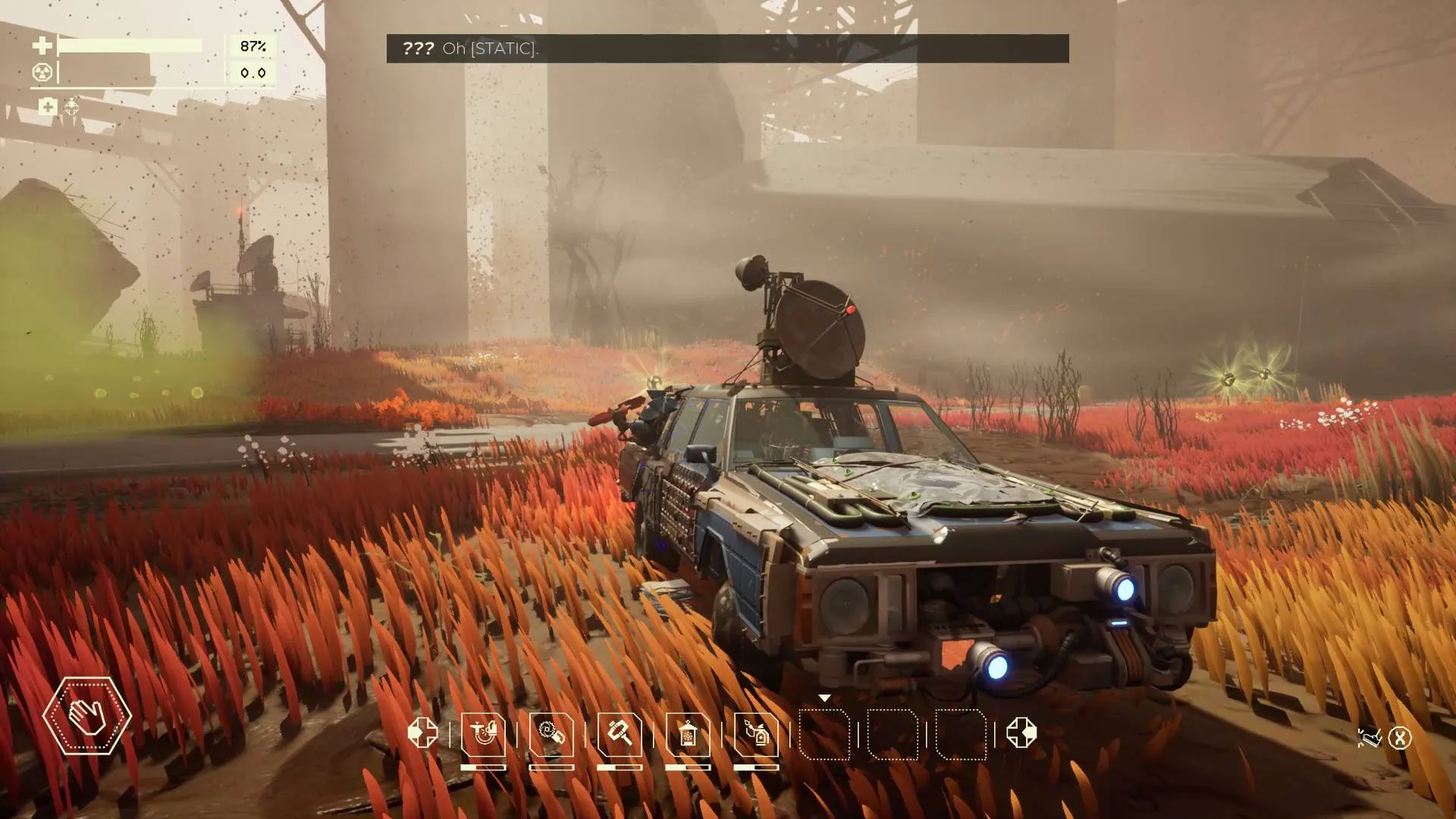
Pacific Drive – Redux

I bought Pacific Drive on release and put in about 12 hours before I had enough. Conceptually, it was really good. A great setting (sci-fi anomalies), solid art, exploration, rogue-like, and a good story. There were issues with the details. You couldn’t functionally save mid-run, and runs took upwards of 45 minutes. Death was a complete wipe of that time. Even a successful run had you spending nearly half your resources repairing and preparing for the next run. I put it on the shelf with a promise to return when it got the QoL patches I needed.

Well the good news is that the game got a ton of patches, most of them a while ago. There are now multiple difficulty multipliers, from effectively a tourist mode to iron man. You can toggle a ton of options along the way.

I opted for two changes, and that was for full repairs when returning to base and lower crafting requirements. It still required a lot of repairs in the field, and barely getting through a few runs. Saves happen between zones, meaning I only lost 10 minutes of progress, much more acceptable. The crafting material one seems simple, but you still need two dedicated runs to get the material needed for some items (coral is great example). All told, it still took about 25 hours to get through it all, so not like this was a full cake walk. Quite the opposite, plenty of times where I just simply died due to some random effect. Which reminds me…

In the base game, you could (and certainly would) acquire quirks through regular gameplay. A quirk is some random effect that can have a random cause. The simple stuff is like turning left and the wipers turn on. The bad stuff is more like you move forward and the car shuts down. Resolving a quirk was a guessing game, where you needed trial and error and a specific machine back in your garage to resolve. In my original playthrough, I tried this mini-game and didn’t find it enjoyable. The full repair setting means no more quirks (well, you’ll get them temporarily still), which means much cleaner runs.

I will say that having completed the game, and looking back, I realize that only 1 item is actually required to reach end game, and it’s an item given to you as part of the storyline. If you simply complete every task offered, you can pretty much speed run to the end. It will require some rather impressive driving skills and more in-mission repairs than I’d like, but 100% doable. For those looking for a rather ‘hard to kill me rig’ that doesn’t require end-zone farming:

  • 4 off-road tires (cheap to make, works on everything)
  • Armored doors, panels, bumper (dirt cheap and super effective)
  • Rear bumper will be the quest item above, which should be active 100% of the time (blocks nearly all environmental effects, but drains battery)
  • Roof rack + roof fuel tank (massive increase in overall fuel and integrated, so no need to fuel mid-mission)
  • 2x side rack wind turbine battery chargers (cheap to make, works while driving, easily offsets battery drain item from above)
  • Optional: roof rack resource scanner if you do plan on farming end-game materials. It is stupidly effective.

The end result is still an engrossing experience that is quite a bit different that what other games have on offer. With all those patches, you have even more flexibility as to what portions fit your specific gaming preferences as well. I think we were somewhat blessed in 2024 with smaller dev studios able to find space to showcase games like these. Well worth the pickup.