
This page was updated on Nov 18, 2026.
This specific post highlights the one part of Factorio that is not found in other games. Heck, it had next to no real purpose in the base game as you could just saturate belts. Space Age logistics can be a huge pain in the butt to set up, and if not managed can absolutely drain a planet’s productivity.
Logistics in the simplest sense is getting materials from where they are produced to where they are needed. In the complex sense, this is about minimizing buffers, where you have too much material waiting to either be delivered or produced. In the base game it was simple, an empty belt was a problem. In Space Age, you can’t create belts between planets.
Space Logistics can be automated, but it’s a multi-step activity. The easiest way to explain it is that Space Platforms are mobile storage chests. You want them to always request the maximum amount of material needed so that it can be drawn down where needed. From there, each Landing Pad should only request what they need, which is not obvious.
In a practical example, every ship will always ensure it has 1000 Rocket Fuel. That way, it can distribute whatever each planet requires. Early on at low volumes, having 2 ships do a cycle on the inner planets (Nauvis, Vulcanus, Fulgora, Gleba) is more than enough. Later on, you’ll likely want dedicated platforms for say, only Red Circuits. Aquilo needs a dedicated ship given the size of asteroids.
Landing Pad
The landing pad can accept 3 rockets at a time. Add cargo bays if you need to receive more bulk. Each landing pad should have inserters heading to active providers (purple chests) with 20 or so storage (yellow) chests nearby. This ensures that you landing pad is empty and that all the items are in your logistics network. You should only use steel chests if you want items inside them to be “hidden”.
Again, you MUST store items in colored chests for it to count to the logistics network. Items on your character, in wood/steel chests, or the actual landing pad do not count.
Supply vs Demand
I will use these terms a lot. Supply is what is available from a space platform. Demand is what you actually need in a landing pad. Demand is the difference between what you have on a planet, and what you should have. Ideal – actual = demand.
Fill the Supply
In the Space Platform interface, you can create groups. These should be logically broken down to items from each individual planet. If you have an item in multiple groups, know that they are additive. These groups will change as you progress throughout the game.
- Nauvis: Nauvis has 3 phases. The first time you leave you will offload a pile of stuff for a first landing eslewhere. The 2nd phase is keeping up delivery (e.g. circuits, electric poles, robots). The 3rd phase will be nuclear, biter eggs, and Mk3 Productivity modules
- Vulcanus: Foundries, Big Miners, Green Belts, Cliff Explosives, Calcite. (Eventually, 80% of your production will be here). Mk3 Speed modules are later.
- Fulgora: Recyclers, Electromagnetic Plant, Mk3 Quality modules. You’ll add holmium plates and superconductors later.
- Gleba: Plastic, Rocket Fuel are easily made here. Carbon Fiber, Rocket Turrets, Bulk Inserters, Spoilage and Bioflux are good to have (the last one spoils). Mk3 Efficiency modules later… though they have very niche use.
- Aquilo: Cryogenic Plants, Railguns, Foundations.
- Fusion Power: Fusion Generator, Fusion Reactor, Power Cells, Cold Fluoroketone (barrel)
- Rocket Parts: Low Density Structure, Blue Circuits, Rocket Fuel
The first landing on each planet has slightly different requirements, so make a group just for that and adjust as needed – like making sure you have a landing pad. Each Space Platform should move between planets and requests a full load of all the respective groups. You may need more (or higher quality) cargo bays on the platform to store it all.
Well, the exception here is science. I’d suggest 1 ship dedicated to collecting 2000 of each planet’s science output, and only science. Gleba should be the last planet you collect from, to maximize the time before spoilage.
Set The Demand
Two options, static and dynamic. Static is simple enough, you set the item demands in the landing pad interface. If you request 200 red belts, then you will receive up to 200 red belts. If you don’t want red belts, you need to change the demand. The landing pad becomes the logistics network and you must ensure everything is stored here and nowhere else.
Dynamic uses combinators and math. It’s a relatively easy set up to repeat and understanding it on a planet makes ship building much, much more effective.
Requesting Magic
The concept here is that you want a Landing Pad to only request the items it needs and not any more than that. The groups are the maximum amount you ever want on a planet. What you have in the logistics network is subtracted from that maximum. Your request is the difference.
A practical example. I want to have 200 Bulk Inserters on Vulcanus. My logistics storage has 68 in stock (found in 3 boxes and connected landing pad). I therefore need to ship 132 down to the planet.
How does that work with the tools in game? Some simple enough steps.
- A Constant Combinator that is set to include all the requests for a given planet. This is the maximum amount I will ever need. Constant because it will not change. (Using the above example, that would include 200 Bulk Inserters)
- An Arithmetic Combinator that will be connected to the Constant Combinator and the logistics network roboport. I will subtract the available amount from the demand. (Using the above example, it will be 200-68)
- Connect the Arithmetic Combinator to the Landing Pad, and set the Landing Pad to set requests automatically. The result is that the Landing Pad will only request the items I need from the available space platform.


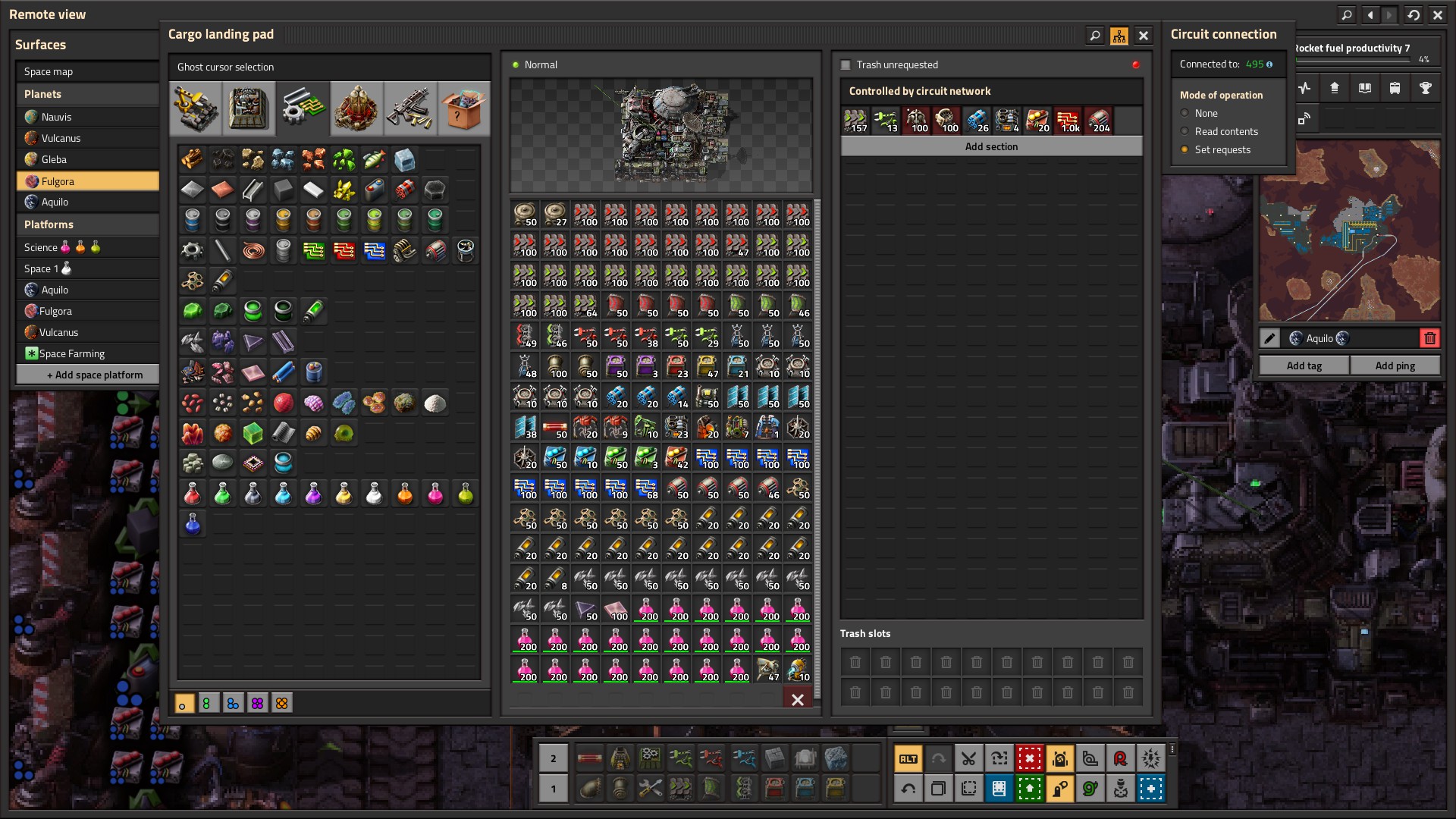
This helps for numerous reasons. Importantly, it ensures I always have the minimum required items on any given planet which dramatically reduces waste. Second, it ensures that if I produce an item on the planet that I don’t request it from a space platform. Third, it limits the amount of items shipped to a planet so that I only need to produce what’s needed across the entire space network, and allows a planet to focus on the more critical items. This is important in the mid-game when sending rockets to space is relatively expensive.
Finally, and most importantly, I never need to worry about it again. That means that once I leave a planet, it stays operating in the state I left it forever. I can focus on the next task, without having to worry about the prior one.
 Leo's Life
Finally, this is precisely what I was trying to do. I was not sure exactly how to do it as I have been trying to gain an understanding of how the whole circuit network items actually functioned. The Factorio wiki is a little weak in explaining just exactly how they work in my opinion. Then I realized it’s just math and that they basically brought in electric engineering to the game. Which is cool. But since I am not an engineer, I really wanted to understand how this stuff worked. I have created some rudimentary things by studying it. This, however, is exactly what I was really after and now I know it needed multiple combinator types and this helps me further understand how they all work. Thank you for posting this. The only thing out there I could find that was relevant to my needs.
LikeLike
Oh, and a big thank you 🙂
LikeLike
Glad to help!
LikeLike
I was trying all kinds of combinations of buffer chests (didn’t do what I wanted), Requestor Chests (also not doing what I wanted), and trying to figure out how to get a Supply Group (ideally, but I tried manually as well) to request only missing items that I didn’t already have here (closest I got was it’d just keep re-requesting the full Supply Group list, send it into the network, then say, “OMG I’m empty, send me more!” and eating up all my rocket fuel and many space platform trips 🙂 ).
This is exactly what I needed, thank you!
LikeLike
I honestly pulled my hair trying until this made sense. Can’t see how I could play without it now
LikeLike
I had a question on this concept (compared to just adding cargo bays and letting the Landing Pad and Logistic Network do the math for you).
I posted it to Steam Forums https://steamcommunity.com/app/427520/discussions/0/604152090018768027/.
Great series, Asmiroth!
LikeLike
Pingback: Factorio – Logistics Examples | Leo's Life