Techtonica – Different Spin

Clearly, I really like the automation genre. I like a lot of genres (Metroidvanias are near the top), but automation is where I get a kick. At its most basic, it’s visual algebra, a near perfect merger of architecture and engineering. The factory must grow!

I covered Factorio the other day, and there are pile of posts on Satisfactory and Dyson Sphere Program (DSP). They each bring a different thing to the genre, and therefore have their own identity. Techtonica hits 1.0 today and I wanted to take a bit to go over how it brings its own flavor to the table.

World Design

  • The maps are voxel based and designed by hand. This gives an inherent grid structure to everything, 3D construction, and a ton of exploration potential. There’s a substantial amount of lore and progress from the hand-crafted experience.
  • The world size has functional limits. You have a LOT of space, but nothing infinite. Since you’re spending time in caves, you need to mine to make bigger factories.
  • There’s a storyline, and a good one. Who’d of thunk it? Having goals outside of making numbers go up is important.
  • Prior to 1.0, you had to unlock various station hubs, which gave a sense of progress as things changed over time. 1.0 you’ll unlock more floors, which again is focused goals.
  • There’s no PvE. Hard to explain how much I dislike PvE in a game about numbers.
  • The sound/art design is unique in that it doesn’t look to reuse Unreal Engine assets and structures. Art is always personal, and I certainly enjoy it more here than others (except DSP, building an actual sphere around a sun never gets old).
  • There’s a jetpack. Jetpacks are life for 3D games.

Factory

  • Every Assembler rank increases the amount created by a factor of 2 as compared to manual creation. This dramatically reduces the amount of machines needed at scale. So let’s say it’s a 2 stage crafting process (raw, intermediate, final). Automating it makes it 4x more efficient (each step reduces by 2x). Mk2 Assemblers are 16x more efficient (each step is 4x). If it’s 4 stages, then it’s 32x better (2x2x2x2) at rank 1, and 256x !!! better at rank 2 (4x4x4x4).
  • All games have miners, smelters, assemblers, and then more complex variants. Techtonica has this, but by the mid-point pivots to a completely different method of collecting items through Blasting. Instead of more efficient numbers, you have to build new mining operations. 1.0 will pivot again, as you’ll need to pump sand and explore downwards.
  • 3D main bus construction is automatically straight and intuitive to use. DSP is the closest comparison.
  • Power generation is relatively simple (pre 1.0) with water wheels and transformers. Power distribution is through Power Floors, meaning no poles or wires getting in the way. I really dislike power poles.
  • Production Cycles are present where you re-use items as catalysts in order to produce other things. Planter / Thresher cycles is a great example, where you continually re-use seeds to generate plant material.
  • You can’t delete things, but you can blast them to oblivion. While I think the AwesomeSink in Satisfactory is both an easy out and end-game goal, I do like that production queues need to be thought out.
  • Monorails that are a 1:1 system for transporting mass amounts of material. I have a general dislike of trains due to their complex pathing requirements and rail radius limitations. Monorails are awesome!

Research

  • Creating intermediate research items to unlock new things is in all the games. Only Techtonica has those items as a permanent fixture on the map. Kinda like trophies. (They will take significantly less space in 1.0).
  • Research is well thought out, with queues, and no randomness. (This, without hesitation, is my largest remaining gripe with Satisfactory – Hard Drives are dumb). NO RANDOMNESS! It also doesn’t add more unique buildings to an already complex production chain (I feel DSP has crossed that line now).
  • Research is never wasted, as it provides an incremental benefit the more of it you have. Most games focus instead on logarithmic infinite research (e.g. +10% mining with increasing costs), here it’s a passive gain depending on the size of the trophy.

I am hopeful for Techtonica 1.0, in that it can continue to lean into it’s strengths so that comparisons are more obvious between games in the genre. I’ll be having regular posts on a new playthrough for the next little bit. Small devs can use the attention!
Factorio 2.0

Factorio is the granddaddy, if you will, if the factory automation genre. There were others before, but Factorio really set the bar for others to reach. It launched in early access in 2016 (before that word really meant anything), hit 1.0 in 2022, and just recently released it’s expansion Space Age. I’m not poking my head into Space Age as Techtonica is in like 3 days and that game requires more attention given the state of affairs.

A brief recap of what Factorio is:

  • 2 dimensional factory automation game. The lack of vertical space means that planning of layouts is essential as you won’t be able to run belts easily. Trains for massive transport needs.
  • Research is accomplished through tiers of constructed items. You don’t use ore, you use inserters, rails, capacitors…
  • Enemy AI that responds to pollution and grows in difficulty over time (you can turn this off).
  • Buildings are all pre-fab, meaning your inventory is clear about what you can place
  • Logistics networks that allow bots to construct buildings or move inventory around automatically.
  • Modules & beacons that increase productivity, crafting speed, or reduce power consumption.
  • In that network there are logic gates that can be used to start/stop items from being created.
  • The base game completes when you send a rocket into space.
  • An absolutely wild amount of mods.

You’ll likely recognize many of these items found in other games. In some cases Factorio does it better, in others it’s just added complexity.

I opted to head back into the game after a very long absence. I don’t think I had played after 1.0 (2022), so most of my memories were based on complex friction. 2.0 is now available, even if you don’t have Space Age, and with it comes a huge amount of Quality of Life boosts.

  • Every inserter has filters built in
  • Blueprints are baked in, no research needed. Also can rotate blueprints.
  • Improved “ghost” behavior (a placeholder before constructing)
  • Robots have much better logic
  • Trains have a slew of improvements, importantly in track design
  • Electric Poles have a larger range (YES!)
  • Maximum range indicators for below ground belts/pipes, and auto-placement when dragging. This feature alone will shave 10% off a playthrough.
  • Search/Pedia function that saves from alt-tabbing to the wiki.
  • Rockets are simpler to launch (well… sorta)

The prior run throughs were complicated, mostly because the controls really limited your options. I am absolutely convinced that all factory automation games today are 3D because of the painful memories of spaghetti belts in Factorio. So my 2.0 run through was a generally pleasant surprise when all the QoL items showed up throughout the run. I’d go so far to argue that the game is finally accessible!

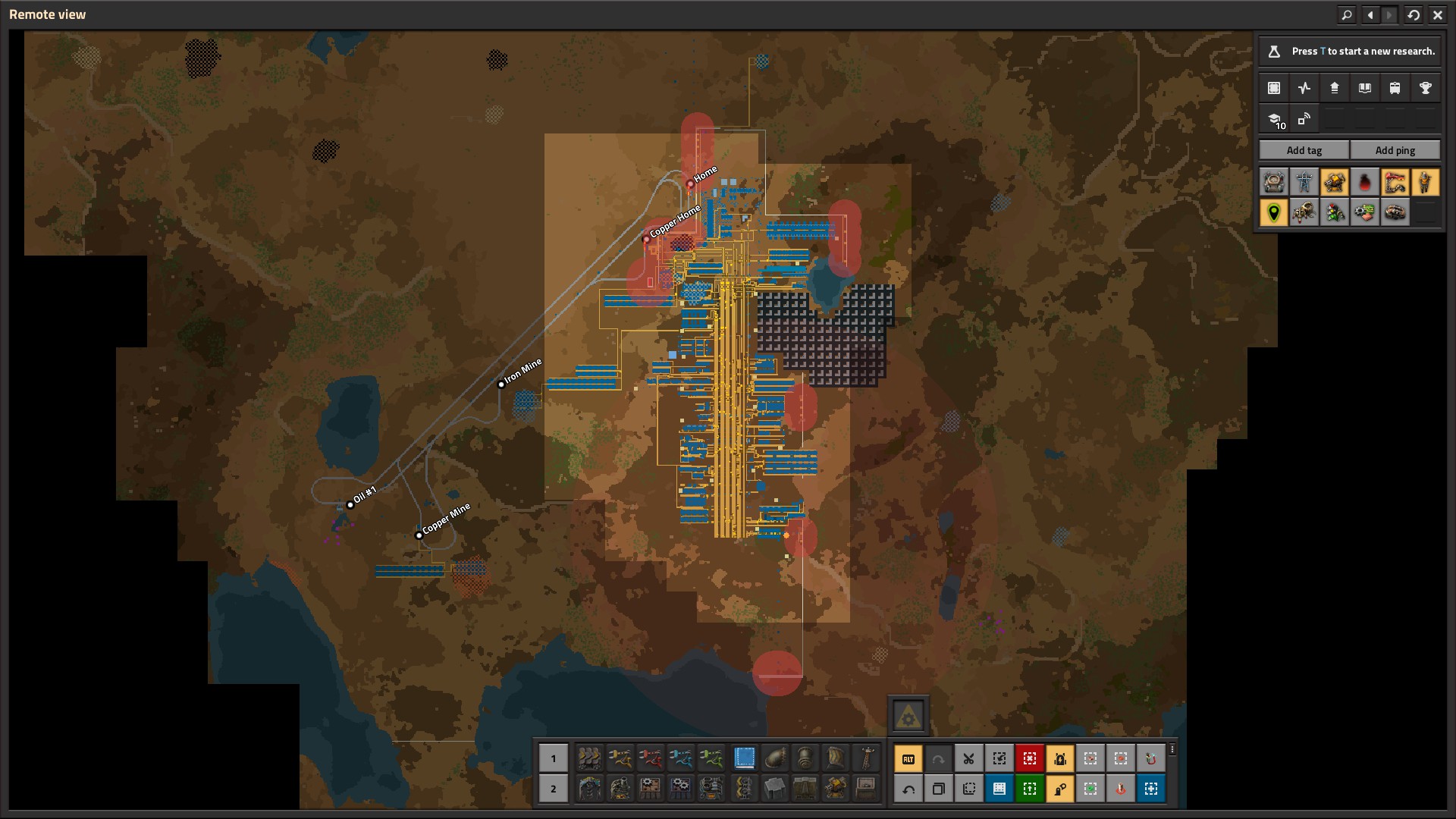
My final map
Max zoom out from the silo

After having completed the playthrough, there are still some interesting friction points here that are simply not present elsewhere.

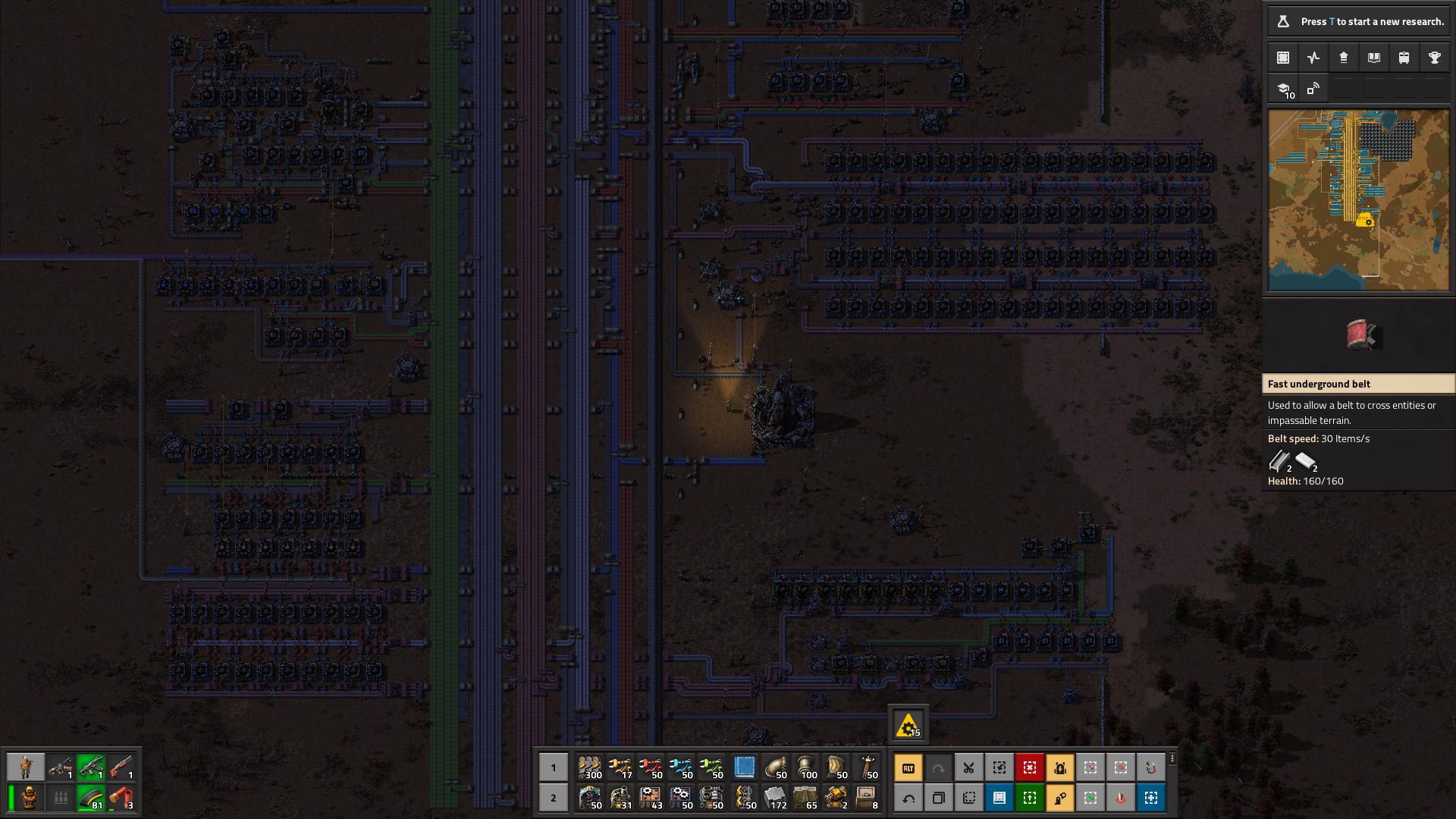
  • The main bus in the picture (the colored vertical lines) are a right ass pain to manage without sufficient planning. It takes a truckload of material to build all those belts, splitters and underground portions. Honestly, every other factory game I’ve played does it better (Foundry has throughput issues, but mechanically sound).
  • The main bus can only really accommodate a subset of material as a result of this PITA. Which enables a fair amount of creativity in mini-factory design.
  • Building prefab often adds un-needed complexity. Theoretically you can “belt” up to 8 different items making them accessible for crafting. You will need about 12 of those materials to pre-fab buildings. See point about the main bus about why this isn’t terribly pleasant, until you simply don’t care anymore.
  • The logistics network solves 99% of these issues, with the exception of mass crafting intermediate items. It takes a long time to get there.
  • Ratios are hard to figure out, making mini-factories a puzzle with either very good answers, or very bad answers. The wiki does wonders here.
  • I remember playing without blueprints and now with. I can’t fathom going back.

Factorio 2.0 is about as good as it can possibly get given the core design fundamentals present. Almost every single pain point comes down to the limitations of 2d design and therefore the requirement of very efficient logistic space design. It feels like every other part of the game is a candy coating and relatively smooth sailing.\

SIDE NOTE: 20% of players have launched a rocket, which is the game completion step. 65% have gotten to the oil step (which is effectively trains, or tier 3 of 6). Given the sheer amount of complexity, those are impressive retention numbers. Satisfactory players only appear to have 30% who have even started the game, 4% that have gotten to phase 4 of 5.

Every other game in the genre has avoided this issue by adding in vertical components, meaning that the fundamental design is different. Those games instead need to balance numbers (input / output / throughput) and world design (exploration / goals).

  • Satisfactory added Dimensional Depots as a parallel to logistic bots and absolutely blew the roof off the game as a result. The game can instead focus on building BIG, and does so amazingly well. Blueprints are needed for massive factories!
  • Dyson Sphere Program added logistics and blueprints to solve a lot of scaling issues. They are still trying to figure out the PvE portion with Dark Fog.
  • Foundry is still trying to figure it out. The starting experience still needs work, and there is no clear end goal.
  • Techtonica is hitting 1.0 in a few days. More as I start a new playthrough.

Long post conclusion… Factorio is a great example of creative design within interesting constraints. Nearly every feature we take for granted in the genre originated here, and pretty much as a result of game engine limitations. Even more interesting is how Factorio hasn’t stopped evolving! It’s not like going back to Morrowind where it’s in a time capsule – this game has continued to develop and steer a path forward (either the devs or mods) which others have not much choice but to follow. Wild when you think about it.