
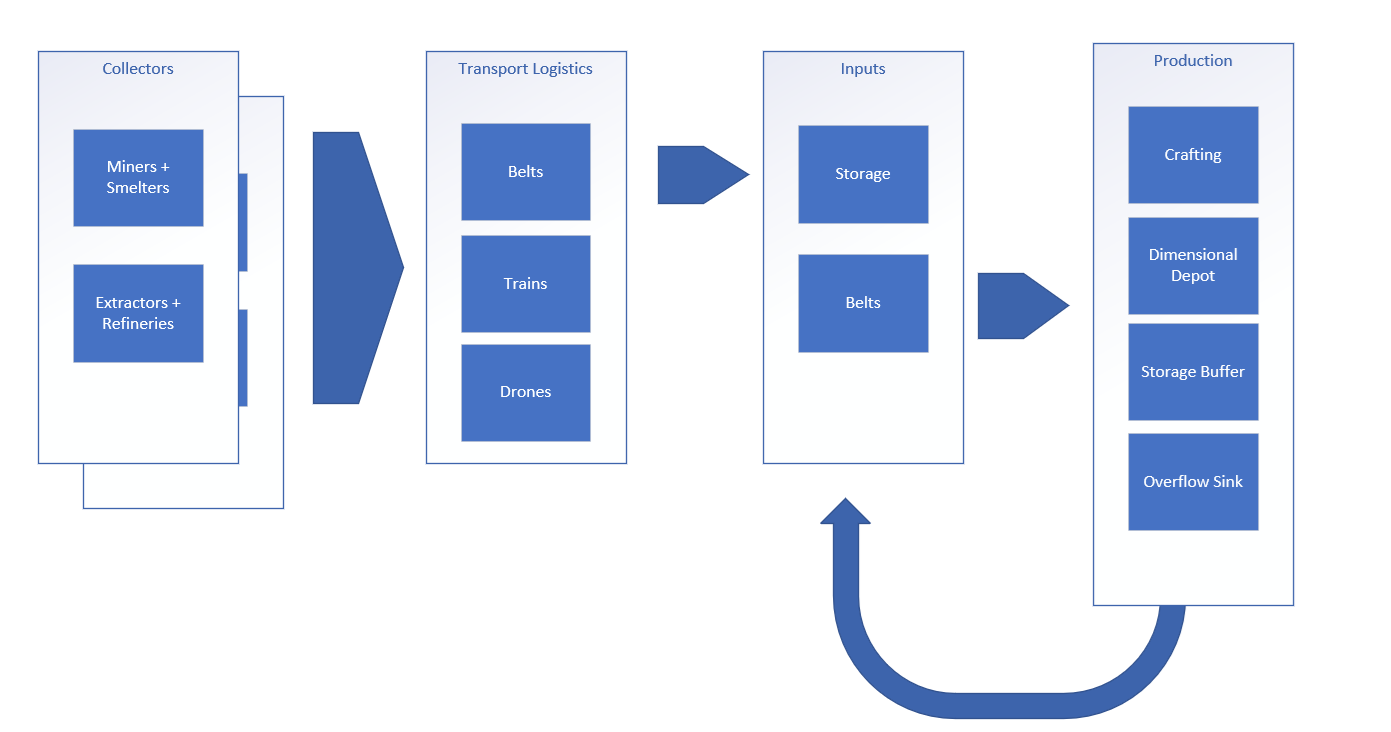
Factory games generally work better with a main bus to manage the distribution logistics. That is, the ability to move material around efficiently. Recall this visual from Satisfactory
Techtonica does it different, as it doesn’t have a large map (or at least it’s broke into instances) and doesn’t have liquids. It does have complex production chains though.
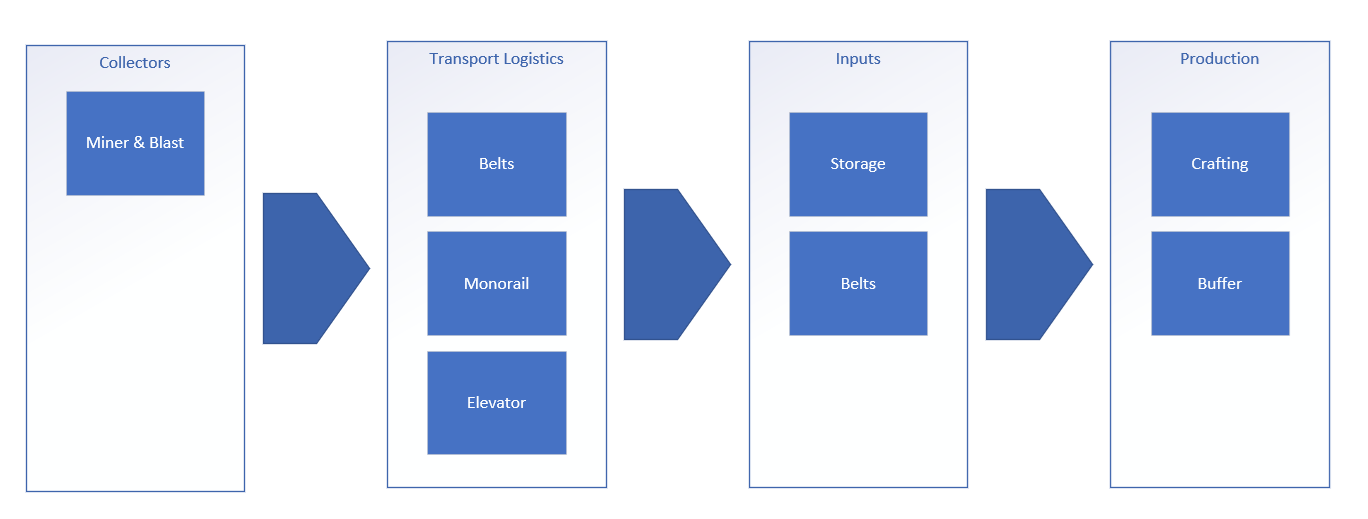
In some games, you’ll have a main bus, then dedicated arms to craft a given thing, which takes up a lot of room. Space restrictions in Techtonica mean you need to build compact and plan WELL ahead of schedule. The good news is that the vertical space is rather large. As a general rule, you can dig around 5 spots higher than the highest point of the ceiling until you clip out.
Now in terms of planning, you need:
- Power. Lots of it. Power in Techtonica is dependent on water. Floor 2, 7 and 11 are the only places with enough room for this. And Accumulators (batteries)
- You need an open space. Almost every floor has this, though floor 4 may be the best option.
- You need Iron, Copper and Limestone available. Only floors 2 & 11 have this. You can ship the other material through the elevator.
- You need a LOT of logistics items. Meaning Belts, Floors, and Inserters. I strongly recommend having a dedicated station to build this that isn’t part of the factory at the start. You also want to research vertical belts quickly.
- There are 3 types of production (Assemblers, Crushers, Threshers). You need dedicated space for each.
- Research cores need space for a core composer. They are big and should be put far away.
- The elevator can transmit power through the floor, items through the ports.
For my playthrough, I have a ground floor for mining & power generation, the next floor covers the entire zone. The first floor will be split into 4 sections.
- The absolute farthest part will be for Core Composers (research cores).
- Close to that area, I’ll have Accumulators (though for practical purposes, you can easily place them on any other floor.) You will use floors above this location for Crushers later in the game.
- Third, is a large area that supports 16 Planters and 4 Threshers. You’ll need 3 floors eventually
- 3 floors of 16x planters
- First floor to thresh plan materials into intermediates
- Second and Third floor dedicated to processing intermediates.
- Finally the factory proper.
- For most of the game, you’ll need ~12 lanes in the bus. Each lane should have a space between to (belt + empty + belt) to aid with pulling things off the belt cleanly
- Iron Ingot
- Copper Ingot
- Iron Frame
- Copper Frame
- Iron Component
- Copper Wire
- Mechanical Component
- Copper Component
- Plantmatter Frame
- Processor Unit
- Relay Circuit
- Pulled items should head to a storage buffer, then an Assembler. Because space is at a premium, build the Assemblers just far enough apart to have dedicated input lanes. If a product has 2 inputs, then you need : belt, belt, inserter, assembler (2 spaces), inserter, belt. That’s 7 spaces.
- When you hit the end of the floor, build stairs going up that are 6 high, and then attach a floor to them. This will transfer power to the next floor and give enough space to run belts on the ceiling if need be.
- Generally, you only need to store 1 stack of any given item that is NOT going onto the belt (e.g. crank wheels). Any item that is going on the stack, you want to store overflow (have the same quality inserter putting things in, and putting things out).
- Some items should not be put on the belt as they are only used in 1 other step. Either belt them through the back, or build the assemblers next to each other.
- For most of the game, you’ll need ~12 lanes in the bus. Each lane should have a space between to (belt + empty + belt) to aid with pulling things off the belt cleanly
My first floor of of the factory was dedicated to intermediate materials to fill up the belt. My second floor was logistics buildings, since Inserters have cross-dependencies. Third floor was more advanced items where Relay Circuits are finally added.
You will have some weird spaghetti for item upgrades, as you need the base item. Belts, Assemblers, Miners, Smelters, Threshers will need the base materials added from the back. When you get Mk2 Assemblers in a limited quantity, prioritize the production chain to make Mk2 Assemblers, then work from the bottom up as quadrupling the base item has compound benefits at the end.

Mining Bits + Research
This needs special consideration, as you likely only want to have 1 Assembler per mining bit tier, as you only consume half the output for the next rank. Mk1 bits produce at 10/min. Mk2 only needs 4/min input. You likely won’t create Mk4 bits until much later in the game, and then chain them into Mk5, 6, and 7. Mk7 bits generate at 1/minute and dig 2500m. As long as this is going 100% of the time, you will unlock each floor without thinking about it.
Research can be a pain. Red creates 30, Blue uses 30 to create 10, Green uses 9 (?) to create 3. This is a pain because the requirements of research are inversely proportionate. You may only need 15 red to unlock something but you need 300 green to unlock another. I’d strongly recommend having 2 Assemblers per research core. More than that will not be sustainable. Once you unlock Crushers, you can make a dedicated area for research, it’s too complicated until you can use gold.
Final Note
When you unlock Blast Miners and slabs, you’ll want to use those instead to create raw materials as it’s quite a bit more effective. The factory itself can remain as is. Late game with Crushers, you’ll find different ways to make things with slabs, at that point it may be worth rebuilding the entire factory proper to be more efficient.
 Leo's Life