
Pre-amble. When I was a kid, I wanted to be an architect. Or rather, of the career options presented to me, that was the one I was most interested and aligned to. I liked to take complex problems, re-use as many solutions as possible, and invent along the way to finding a solution. At the time, architecture was generally limited to buildings. They build larger plans, an engineer validated that the design respected all codes, and the GC organized the work. If all of them were great at their roles, crazy things came out as a result.
Unfortunately, I did not enjoy traditional architecture and it took me a while to figure how to make that dream a reality. The good news is that architecture has evolved since those days, and there’s a parallel function called Enterprise Architecture. Similar concepts, but different applications. Thankfully I’ve been able to lean heavily into this passion and make a great career from it. In that regard, my superpower is to take complex problems, and find practical and elegant solutions. Moreso, that those solutions can be re-used and scaled.
Factory Automation
On the surface, factory automation is just an ever growing mathematical problem. You want to create a certain amount of item Z. To get there, you need to create a certain number of items X and Y. And so on, and so forth, all the way back to item A. That is the end goal.
The initial conditions however are only about exposing you to item A, and over time you develop the ability to create ever more complex items. This increases the number of item A you need over time. The ability to do so is restricted by the base material available (if not infinite), the processing capacity (e.g. how fast and how much a machine can make), the power available (e.g. how many machines can you run at once), and finally the logistical capacity (e.g. move things from where they are to where they need to be, in time). This is both simple in concept, and complex in implementation. A lot like my favorite university algebra classes (sad horn noises perhaps on that one).
Logistics Planning
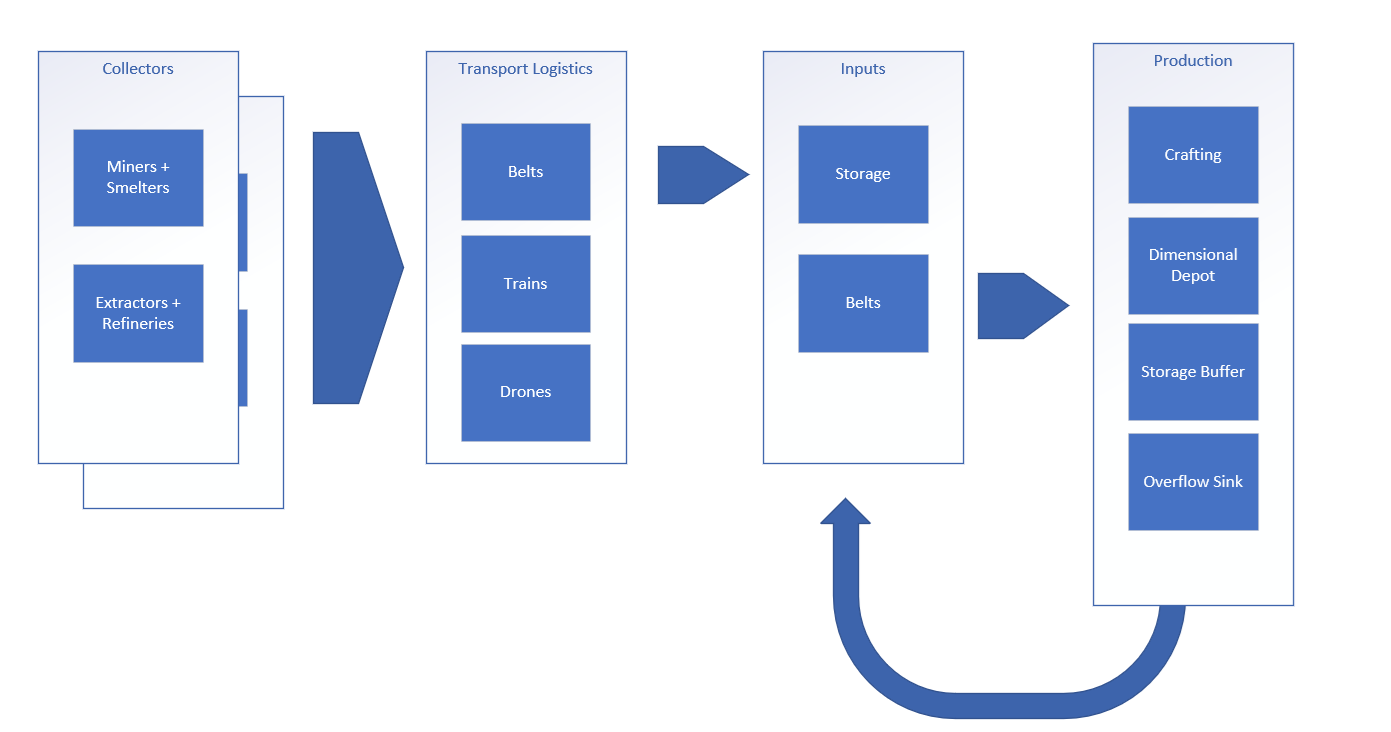
The image above is both generic in the types of steps, and specific to Satisfactory as the blue boxes within. Dimensional Depots only exist here after all.
- Collectors are where you get base materials out in the world and perform the basic conversions. These are the simplest of items. In Satisfactory, this would be things like Iron, Copper, Steel, Caterium, Aluminum ingots. Liquids are here too, depending on transport needs. Unique to this game, Plastic and Rubber are also here.
- Transport Logistics are how you get items from the Collectors to the next location. Early on, this is just more belts. Later on, when you need mass transport, trains are ideal. For low-volume items, Drones can be used.
- An Input line is core to the next step, which acts as a sort of logistics hub. You bring things to it, they are sorted, and put into containers for future use. Getting them from the containers to the production line is done through belts/pipes.
- The Production line is where you do all the crafting, and is designed to be modular and scalable. When an item is produced, it is sent to the Input location for future use. Satisfactory adds fun here, where you can have multiple crafting buildings, a storage buffer (here, or in the Input line), a Dimensional Depot (for personal use), and finally an optional sink for excess items. Personally, I don’t use sinks unless it’s unwanted byproduct, but it is an option.
The concepts here are applicable to every factory automation game, and frankly the differences between games depend on only a few details that generally add constraints (speed, size, complexity).
- Factorio is 2D, so getting belts and hubs to work cleanly is borderline art.
- Dyson Sphere Program has this exact model used for every construction, but has some nuance in the difference between base items (such as planets dedicated to Iron Plates), and buildings (a polar hub).
- Foundry is a simpler version of Satisfactory, by a large degree. Transport Logistics are the main issue.
- Techtonica (hitting 1.0 in early Nov) has more complex crafting cycles, speed issues with inserters, and significant space limitations. It will be interesting to see how this works with the elevator and a new location (new factory or complementary?)
The hardest part in all this is two-fold. First, the planning of the size required to make this run. I continually underestimate this. Second, the material to build floors/belts are absolutely massive. Getting started is hard, but once it’s running it is glorious to see. Techtonica is next up when it hits 1.0. This will be the plan!
 Leo's Life