Techtonica Pt4

Final post for a bit on this topic. I’ve talked about the mechanics and the math so far, and to a degree the limits of an early access product. The game is only in v0.3, which is two content releases from the basic portions. And in a game that is about production optimization, it is missing some key components to “make things clean”.

There are two core examples of this challenge.

First relates to constructing bases, meaning floors/walls and whatnot – not required at all but are about visual customization. There are about 30 items you can create to build a base, each of which uses a different set of material to construct. In practical terms, this means that you cannot practically automate construction of building forms and create each piece individually as you need it. This issue means that you need to haul around a lot of materials in your bag, and that if you need to experiment, you’ll end up with a bunch of crafted pieces in your bag that eventually need to be sorted out. There are two possible solutions here… building materials are split into 3 base items (concrete, steel, biomatter) and that you can “transform variants” of established pieces OR you can disassemble a piece into it’s base material to avoid inventory bloat.

Second is crafting tiers. Research tiers are a different thing, I specifically mean the two crafting tiers – Miners and Blasters. From the start, you have miners who give you basic ores, which can be refined in various stages to create every single item in the game. Eventually you unlock Blast Miners and Blast Smelters, which allow you to operate at scale – instead of 100 ores you need 1 slab, making it incredibly more space efficient. Most, but not all items allow crafting with tier 2 materials. Sadly, 3 things do not: Electric Motors, Steel Slabs, and Cooling Fans. Effectively that means that you cannot optimize those items without causing breaks in Blasting lines. The solution here is rather simple, there are missing 3 recipes and I could cut out a whole pile of spaghetti. I’m rather confident that v0.4 will have these, as v0.3 added others. I won’t rehash the Mining Charge math.. that has efficiency (and supply) issues.

This reminds me a lot of Satisfactory as the game added more content over time. Each patch had three types of changes : Quality of Life, Production Optimization, and Content. That game’s world is substantially larger, with way more than 4 node types. Satisfactory is finally going to reach v1.0, which has been a very long time coming. I still have some significant gripes with the game – that the engine is way too finicky (this is Unreal related and I honestly don’t think fixable), inventory sizes are too small (the mod is all but mandatory), transport across the world takes too long (this is dumb, put in a personal transporter), and that there are no tools to build at scale (I can’t fathom anyone playing past oil without this mod).
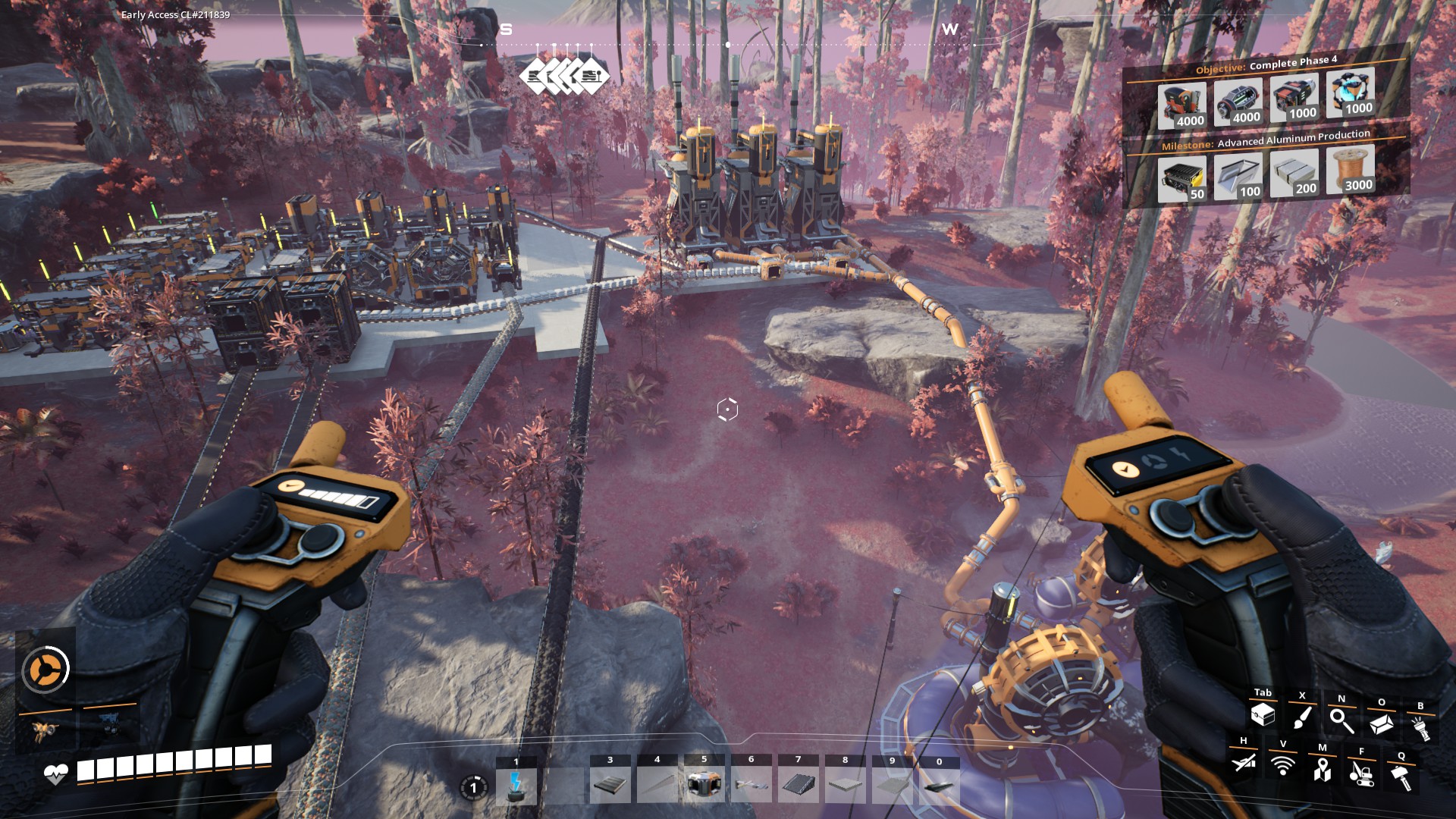
Satisfactory – Plastic factory, with weird angles everywhere.
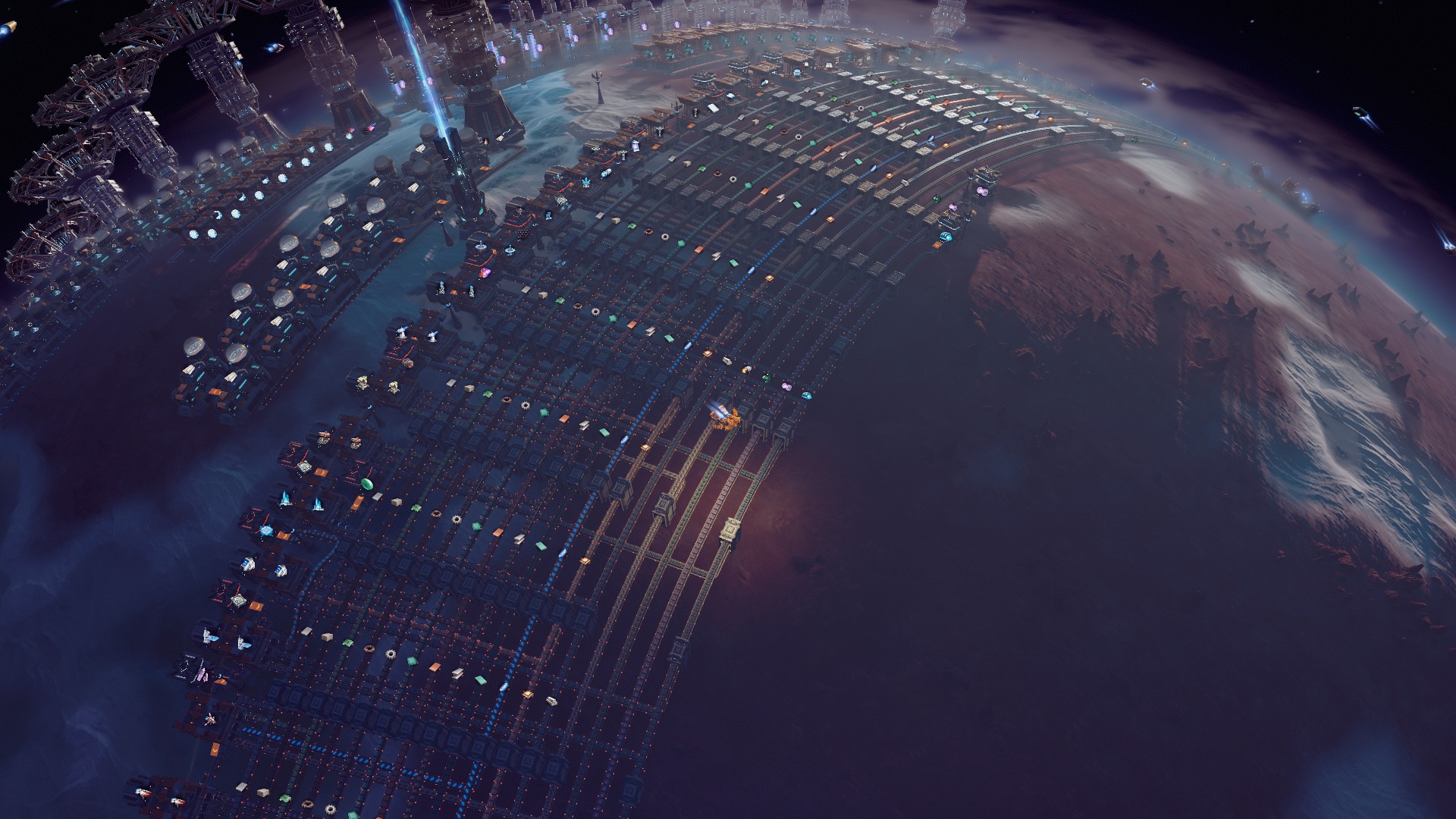
DSP – a main bus with extremely clean lines.

Techtonica is different because it’s voxel-based, meaning that the world is naturally smaller, that spaces cannot overlap, and that tools to build at scale are less important currently as the end-tier material doesn’t need 100+ miners to build 1 item. Helping Techtonica’s case is that you can automate the construction of every single object – material and stations. Dyson Sphere Program is a closer comparison in terms of tooling/structure, though that game has a significantly larger scale that Satisfactory (and infinitely better tools as a result).

Similar to DSP, I can see myself spending 10+ hours per content patch in Techtonica to rebuild the world with the new tools at hand. If I had to guess, there are at least 3 content patches to go from here.

Techtonica pt.3

Let’s start with 2D crafting first and the grandfather – Factorio. Crafting stations produce X items if you feed it Y material. You want to ensure you are feeding it the most to get the most production. Factorio uses inserters to transfer items to crafting stations. These have different speeds, depending on type, and different ranges. At scale you will have multiple stations running from a single belt, but won’t be optimal without a lot of work.

Dyson Sphere Program uses inserters and they marginally slow down at range. However you can research stacking options, so that you get max reach and max speed. Crafting at scale here is extremely easy to achieve.

Satisfactory doesn’t use inserters at all and only relies on belt speeds. This is good for many reasons, mostly to offset weird alignment issues (and boy are there lots of those!) This essentially means that any crafting station will simply take in (and give out) everything up to its stated max, and allows for “buffering” of items on the belts. The challenge with this particular model is that you’ll need to work belt magic if ever you need to split items between multiple crafting stations if you are unable to produce MORE items than the belts can buffer. For example, if you create 100 iron ingots per minute and have 2 stations requiring 30 each, you’re fine. If you have 2 stations requiring 60 each, then you need to split the belts rather than buffer so that both stations work.

Techtonica uses inserters like Factorio but is 3D. The progression of the game has various inserter types:

  • Regular – these move items 1 distance at a rate of 20 per minute
  • Long – these move items 2 distance at a rate of 15 per minute
  • Filter – these move items 1 distance at a rate of 15 per minute, but allow you to select the type of item moved (which is about half of all crafted materials)
  • Fast – these move items 1 distance at a rate of 40 per minute. In most cases you are better off using 2x regular, if you have space
  • Stacked – these move a stack of items (3/6/9/12) 1 distance at a time at a rate of 60 per minute. Caps at 720/minute.
  • Stack Filter – these move a stack of items (3/6/9/12) 1 distance at a time at a rate of 50 per minute, but allow you to select the type of item moved (which is about half of all crafted materials). Caps at 600/minute.

(Note: as with other factory games, create an automated supply chain of inserters, storing 250 at a time. Basic Assemblers make 45/min, more than enough speed.)

When to use these is the key piece is the math part. One recipe requires 904.9 items/minute, meaning that you need 2 Stacked filters to even have a chance to meet the requirement. Nothing too complicated so far.

This is inefficient, as the inserters only support 30/min, but the output is actually 90/min. Stacked Filters are the ONLY option here, which don’t exist until the final upgrades. Meh.

When looking at having a main bus, things start off simple enough as long inserters typically have enough speed (if you put 2) to run 30/minute. At later points, especially with advanced assemblers, you need 100+ items inserted per minute. Creative needs call for creative solutions.

A larger space option that is 2D
This multi-stack option with vertical belts allows for very tight bus work.

I do like this creative aspect of the game, which is much more similar to the belt ninjistu of Satisfactory. The larger challenge is not so much building these things, but the lack of blueprint tools to repat them – an item only solved through mods in Satisfactory and yet to be available here.

Now, one caveat to all this, and it relates to Blast Miners. Through upgrades, you can get 5x the material with 15x the explosives, and at max level that means 60 explosives per minute, per miner. In fact, it goes 3x, 5x, 10x, 15x in terms of requirements for benefits.

  • Base: 5/ minute
  • 3x: 15/minute – a long inserter can do this well enough. The worst ratio and the best option.
  • 5x: 25/minute – this is horrendous belt ninjistsu
  • 10x: 50/minute – as bad as 25/minute
  • 15x: 60/minute – 1 fast + 1 regular inserter sending to a stack inserter, or you need belt magic. Let alone the fact that you can only realistically create 75/minute until you invest heavily in end-game automation.

For the 5x/10x variants: Option 1 = ignore the 25 per minute and only do 20, save the hassle. Option 2 = belt magic with a ton of splitters to break down materials across multiple belts.

The white numbers show how to get 25/minute on a single belt.
A much more compact version of above. 40 in, split to 25 + 15. Put in 80 and you get 50 + 30. Modern art and takes 5 minutes to build.

I am chalking this mostly up to Early Access foibles here. First, that the “end game” scaling has some really weird magic math, and second, this Blast Miner balancing act is trying to be fancier than it need be. I enjoy mathing stuff out. This one though, right on the edge of madness! Which I think is what keeps me coming back.

Techtonica pt.2

Wanting to add more here, some thoughts on how production games manage progression.

Many of these games operate on a construct of volume, scale, and then complexity. You harvest a set of basic material, automate construction of basic elements, use those elements to create more complex things, which allows you to scale the initial harvesting.

As you get further in the creation chains, you would normally unlock alternative chains of production that either provide shortcuts by skipping steps or, using different materials, gives different paths to create items. These alternative paths require new approaches to crafting chains. The challenge then becomes about balancing complex crafting chains to create enough volume to create final items. Items that require hundreds if not thousands of the basic harvested items no less.

The math required to balance all this is substantial, some complex algebra in fact. Changing a ratio at tier 2 can have huge ripple effects 5 steps later. Techtonica has had a few stages (other EA games too) where the math effectively created an exploit for infinite material. It is not easy, and small dev teams need a lot of testers to validate.

Where Techtonica differs from other games is two fold. First, basic resources are practically infinite, more akin to Sastisfactory, but can yield different material at different stages. Second, a significant portion of the game resides with plant material, which is 100% dependent on a finite amount of seeds. You never lose seeds, but this caps your production rates. This doesn’t seem like an issue at first, but at some point you’ll realize that Mining Charges are the key to everything, and production of that specific item requires tons of seeds.

A basic plant farm.

Which brings me to exploration. Techtonica had multiple cave systems that are only accessed through digging. Sometimes 10 minutes of digging. I think this time padding is good, it allows a factory to produce while you explore. Finding all these locations though… that’s the tough bit. Not the best map, then again I still think it’s better than Satisfactory. Some parts of the research tree require exploration to hidden areas, which the functional impacts only really matter end game. Not too sure how I feel about that just now. I know I really don’t like Satisfactory’s RNG take on this.

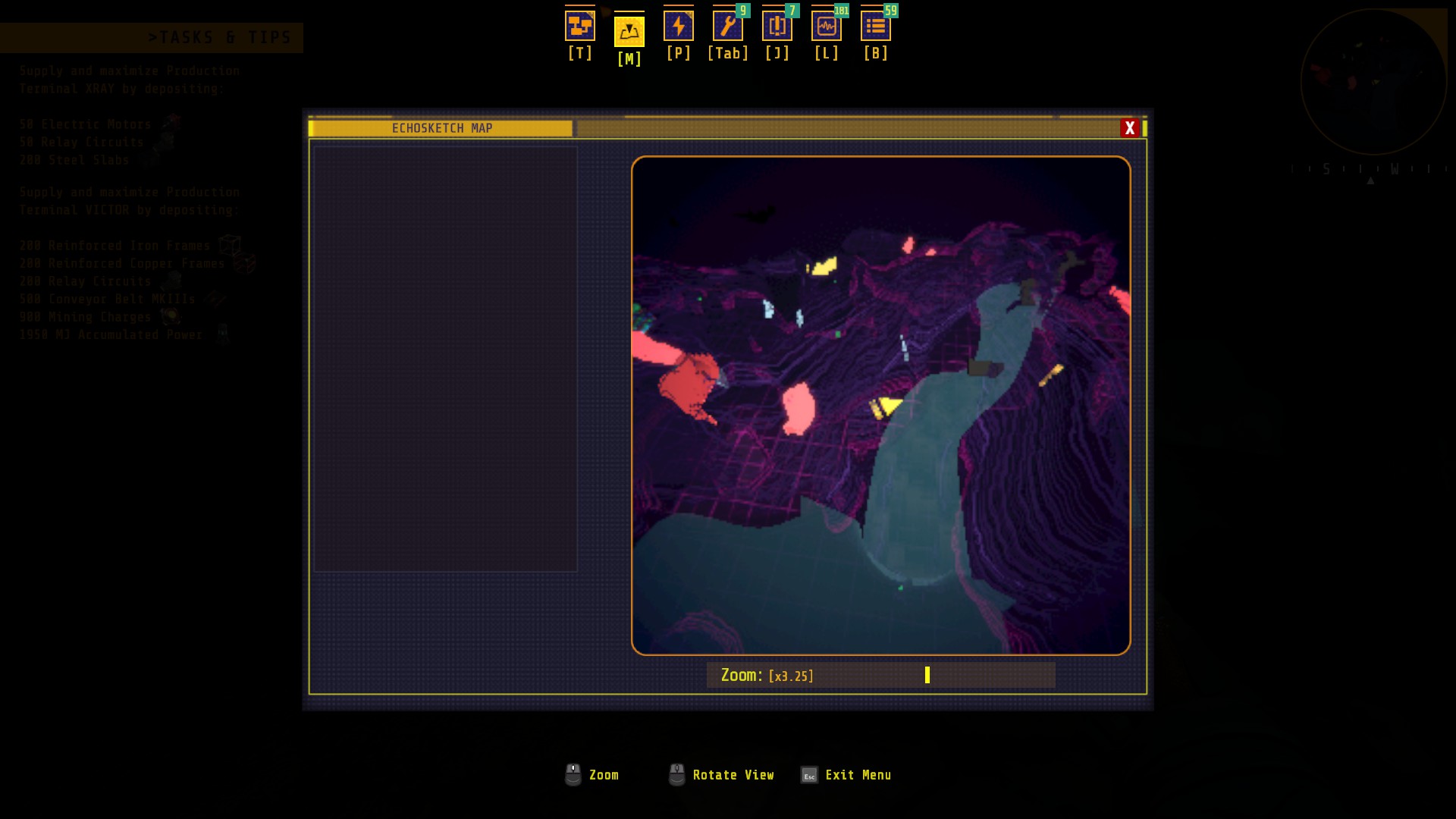
This 3D map shows open areas. Green dots are chests buried in the walls.

I’ve got one more post relating to the mechanics of crafting and rate limits. Techtonica is still finding its footing here.

AAAA Prices for B-level Games

Cue derision for Ubisoft CEO Yves Guillemot justifying Skull & Bones price point as being worthy of a AAAA game. For a game that is mechanically less than the game that spawned the idea 10+ years ago (Assassin’s Creed 4). I mean, fine, there are bound to be games out there that are such high quality and value that the top-tier price tag makes it arguably (and I will argue this) worth it, but that demographic is clearly suffering from some mental delusion applying such justification to Skull & Bones.

Preamble complete.

It is no mystery that the cost of everything is up, game development included. That trend was clear well before the pandemic, and isn’t helped when waiting 2-3 weeks after a release gets you a game for 20-50% off (35% off in the case of Skull & Bones!) The proliferation of Unity and other game engines, as well as hundreds of tutorials has democratized game development – anyone and their grandmother can give it a shot. Steam launched 14,451 games last year. What the actual hell?! Actually finding a good game in that pile is all but impossible, meaning lots of budgets on marketing (Dave the Diver!) or simply hoping that word of mouth is enough (Valheim!) Games should not cost $200m to make, they should not take 10 years to reach market.

Different that any other form of media, games in nearly all cases have improved content due to patches. What you’re paying for is effectively the privilege to test the content, and to a degree avoid FOMO. Even when looking at Game of the Year candidates – waiting a few days pays off. Alan Wake 2 is an absolute banger and still it had some rough spots that needed a few patches to iron out. But for every Alan Wake, you’re going to have to parse through piles of Suicide Squad.

In today’s hyper-connected world, it takes very little for the target audience to get a good sniff of a game prior to launch. A high price tag and zero reviews before launch, or extremely limited media attention are massive red flags. No news, in this case, is often bad news.

Next up is Capcom taking a mighty risk pricing Dragon Dogma 2 at top tier. Previews have been quite glowing, the character creator was launched early, and there is some relative positive track record here. That said, you’d be crazy to pre-order this game or any other. You’re not missing out on anything by not buying it early, and it most certainly will require some patches to be truly playable. Plus, you’ll save some dough along the way.

Markets only change when the consumers demand it. Time to start making small choices that will have major impacts.

Techtonica v0.3

I picked Techtonica up in the Steam Winter Sale, though it launched in EA back in July. I’ve got something for production optimization games, obviously. It recently hit v0.3, which is all about efficiency, my kind of patch!

For starters, Techtonica is what Satisfactory (mod-free) would be on a smaller map and much, much less finicky controls. Factorio-3D to a large degree. This reduced scale improves accessibility, because you don’t need to build a 72-step factory in the early game that takes up all your screen space. Techtonica instead focuses on exploration and gradual automation. Progress is gated behind milestones, each bound to a specific station. You start with Lima, which acts as a tutorial. Victor is next, and the game effectively opens nearly every aspect here, and gives you the space to build a multi-floor factory. Xray is next, and that is about large scale automation with monorails. The milestones aren’t incredibly burdensome, you’ll need 200 of a given item and most production rates are enough that you can get buy with a half dozen harvesters. Compare this to Satisfactory where you needed dozens upon dozens of harvesters/foundries to get even the most basic elements running.

An extremely large quality of life feature is that the game is more or less voxel based, meaning there’s no real possibility of being mis-aligned or not clearly understanding how space is managed. You can’t clip objects, which re-enforces the mathematical optimization. Vertical belts (rather than super spaghetti) allow for cleaner and more optimized multi-story factories. The ability to quickly copy objects is the first step for blueprints (which really only matter in large scale things), and the replacer tool almost acts as an upgrade mechanic.

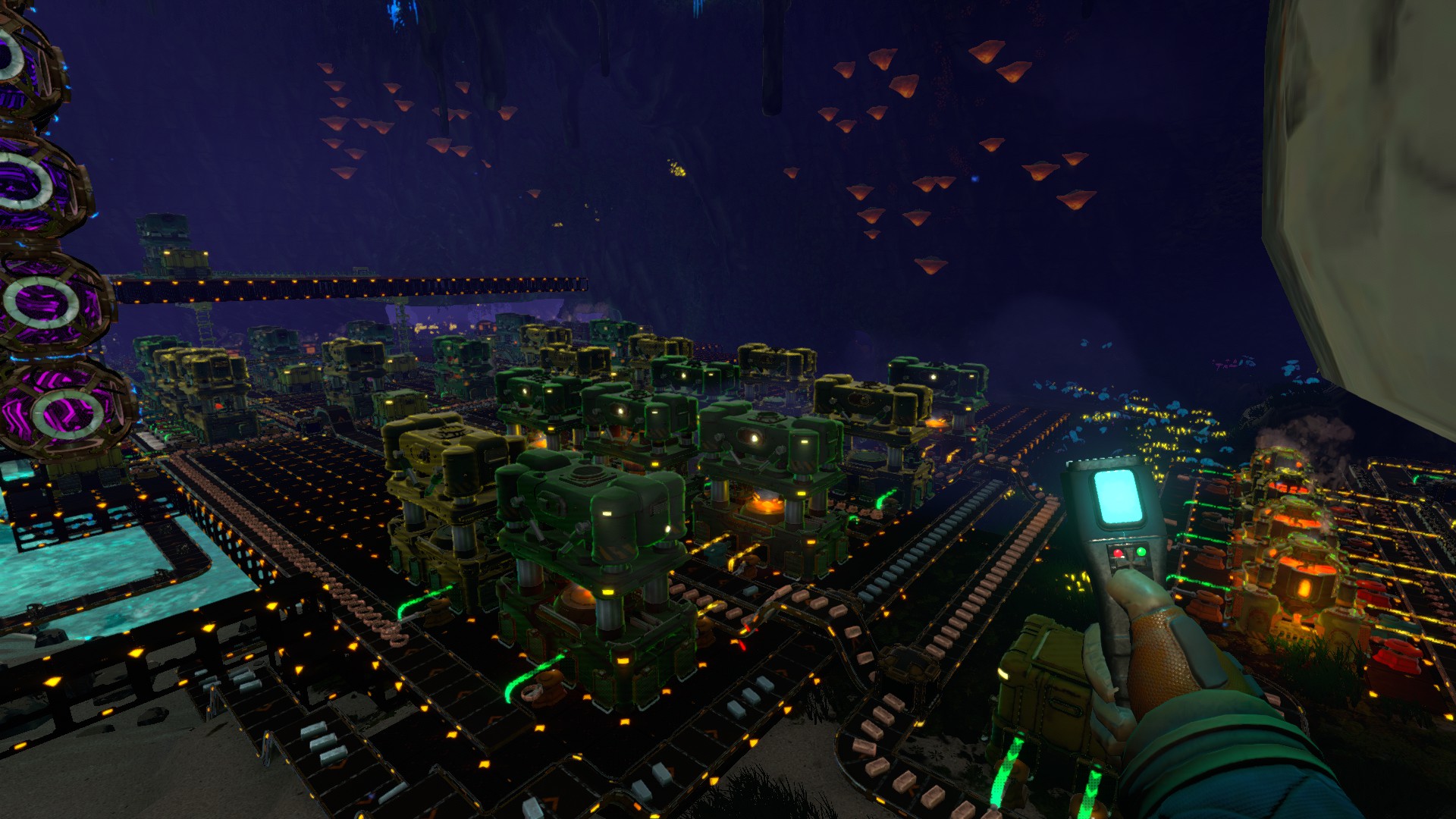
The main production floors. I really like the aesthetic.

Now, Dyson Sphere Program (if you turn off Dark Fog) is still the gold standard here, and Techtonica has some rather large QoL bits to figure out. Some items require tremendous amounts of material and the results can stack to crazy amounts (you’ll know when you make monorail bits), which makes it hard to manage crafting chains. Research is done through cores, which must be physically placed in the world, taking up huge chunks of room. Assemblers have rate inputs that simply cannot be met by inserter tools, certainly the long variants, which adds unnecessary puzzle mechanics and overly complicate production chains (you’ll need many storage containers to manage overflow).

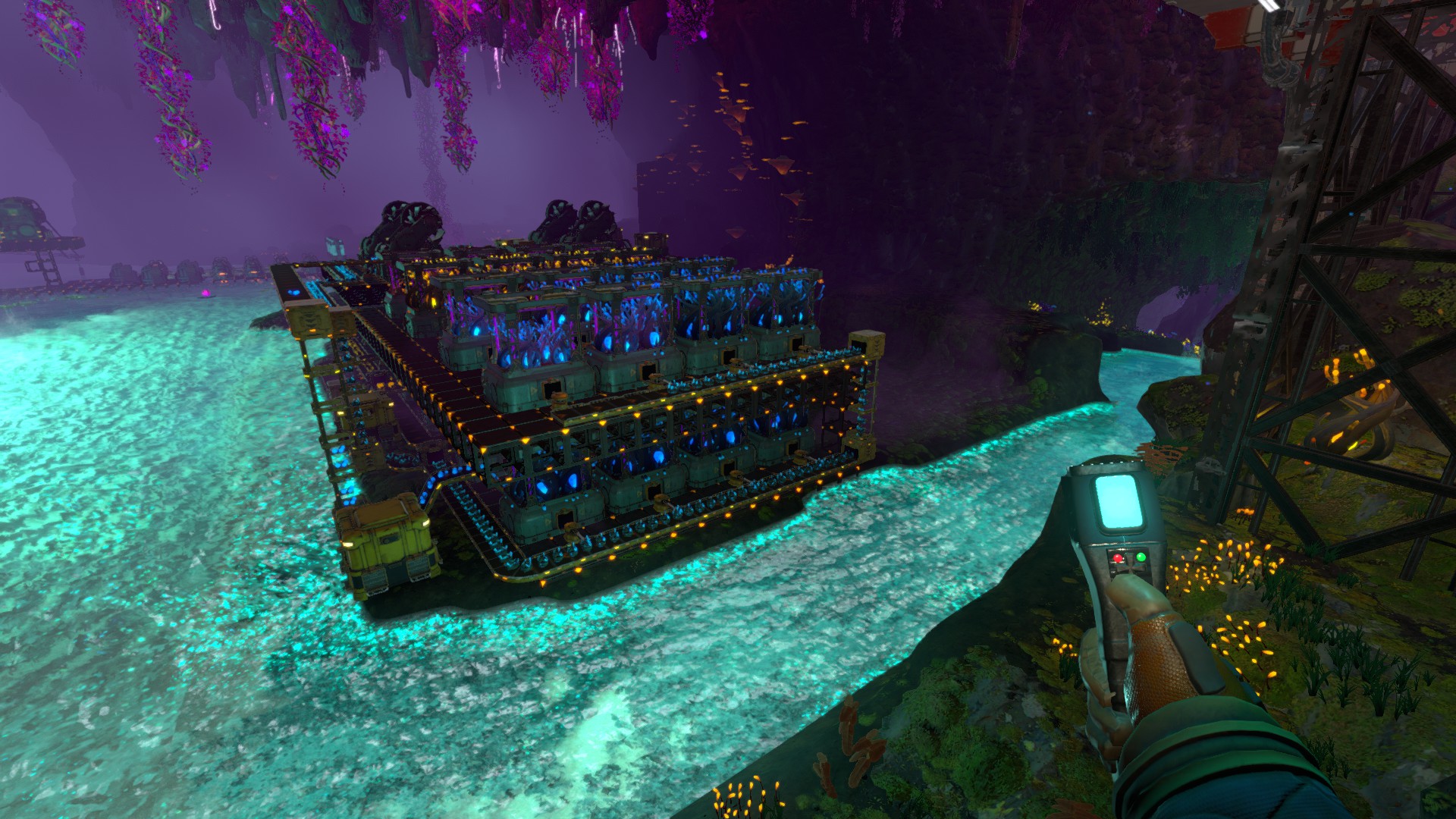
Research cores in the back, plant products in the middle, power in the front. It looks damn cool when it’s moving.

One piece that annoys me to a great degree in these games is the concept of intermediary steps, especially those that are single material ones. The only purpose they hold is to create artificial time gates – or allow scaling when belts/inserters cannot provide. For example, Iron Mechanisms. They need 100x Iron Components. Those require 2 Iron Ingots, which come from 2 Iron Ores. Do the math, and each Mechanism takes 400 Iron Ores. Related, when you encounter one of these steps, your prior balanced production rates of say, 10x/minute now require 100x/minute, which means more scaling is required.

Now that is an issue with the genre as a whole, and if the tooling is there to manage the scale issues, then no real biggie. Again, Dyson Sphere Program completely knocks it out of the park when it comes to scaling tools, which Satisfactory is the lead-chip-eating-cousin. It remains to be seen how Techtonica addresses scaling as more content is added… because it’s not like you have infinite space to build with.

As for a roadmap, with “Desert MIRAGE” as a content point, I am assuming that open space may be on the horizon. Given prior history, it’s likely 6 months away. At this point, I’d recommend a watchlist rather than giving it a shot. It’s good, but unless you really love the genre and willing to have the odd bug muck-up an optimized belt maze, well… your library is likely chock full of options.

Pacific Drive

I do like games with finality to them, what with a credit screen or some sort of last big hurrah. A line in the sand that someone else put that says “it’s ok, move on”. I’ve noticed of late that I’ve been drawn more to games with a seemingly infinite tail, but an unstructured one. I played Return to Moria much longer than I needed to, Enshrouded certainly fits that bill. Valheim I’ll get back to when the next continent launches. Survival games in general have this longer tail, as there’s a need for an optimized cycle that seems to scratch my itch. Probably why rogue-lites work well with me, it’s about incremental progress and juggling multiple variables.

Pacific Drive is a survival rogue-lite that is really quite a bit different than anything out there. Perhaps that’s unfair, Pacific Drive is a mix of multiple known ingredients in a different meal, and a damn fine meal too!

It’s a story driven survival game, with pieces of horror. High level, you get sucked into a contaminated area that is always trying to find new ways to kill you. You get to drive a station wagon around this zone, collecting materials, and then returning to base to upgrade both the base and the station wagon. There’s a pile of story in here, both as to why the zone exists and who brought it to be.

The rogue-lite portion is more about you dying on these voyages, and losing whatever you accumulated on that run. The larger challenge here is that each run is friggin’ long. The first few runs are fine, you have a single zone with some things to avoid and a bunch of stuff to collect. The risk factor is rather low, and the pace of collection follows. You then get multiple hops along the path, needing to select “safer” routes. There are actual stable zones, meaning there’s nothing trying to kill you – so optimal to collect stuff. Normal zones escalate in difficulty, and you have generally around 15 minutes before it goes all out to kill you. And then there are deadly zones, which are to be avoided at nearly all costs.

Red = you gonna die man.

The challenges of any roguelite relate to the risk/reward formula. Progress is gated behind materials (some of which are only found in later zones) and energy (which has 3 tiers, and again per zone). I hit a point where progress was gated behind a set of mid-point resources and I got absolutely wrecked through zone obstacles. I lost an hour of progress, shut the game, and left it alone for a few days.

When I returned, I went into the options and disabled item loss on death, which dramatically changed the approach to a run. Material collection was the sole priority, and as long as I collected enough materials to “rebuild” the car, everything else was a bonus. Rebuild in this case was the bare minimum, as survival wasn’t even a thought anymore. Risk dropped to next to nothing and it felt more like a farming game. This was not better.

The only answer I can provide to this model is a mod that allows you to instantly teleport to a previous discovered zone. You’re only in the “easy” zones to get to the hard ones, and this would save the 5 minute drive per, and avoid what feels like extremely bad RNG damage. It’s a weird spot. It can also be that I simply value time in a different metric than the target audience.

I like Pacific Drive, or at least I think I do. The concepts are cool, the storyline is quite interesting (all NPCs are through the radio), and you have meaningful progress to track. The art is really well done, the ambiance is constant, and you always feel the need to push just a little further. My personal challenge here is that there are tons of other games in my backlog that fit my time constraints.

Paul Atreides is a Villain

With Dune Part 2 releasing, this nearly 60 year old novel has some new light shone upon it. There are two aspects of the novel (and ensuing series) that are important to understand. First, it was published in 1965 (serialized in 1963) and the character context is from that period. Namely, that women empowerment had not been accepted, that widespread experimental drug use was common, and that religion was still core to most world powers. Second, the novels are a clear critique of following a messiah who’s entire construct is manufactured by a shadow party.

Paul Atreides is a very interesting character. He is officially groomed to be the Duke of his noble house, one that has relatively “good” values, or perhaps more relatable ones. He is unofficially designed to be a pawn in a galactic power struggle. It is clear that the Arrakis culture has been structure with religion and promises of a future messiah, a hope that today’s pain will be rewarded with future miracles. (Sound familiar?)

The difference here is that while Paul is thrust into the role, one he doesn’t want to start, he simply keeps walking forward as a matter of survival / revenge. Once he drinks the spiced water and gains prescience (the ability to see the future), he quickly pivots to fully embrace the messianic role. It takes time in the novels to explore what that future portrays (the Golden Path), but across them each of the protagonists knows that their are taking actions where the ends justify the means. This is the philosophical dilemma that Dune truly presents to the reader.

In today’s world context (or woke-ness), people may think that Paul is a white savior, or that people lack empathy, or a dozen other aspects that ignore the actual purpose of the story. Paul knows that his actions are evil, that each step forward has a tremendous cost to people he loves, but he takes it anyway, convinced that the results are worth it. It may not be “mustache twirling” evil here, but there was a multi-billion dollar film franchise where the villain thought killing half the universe’s population was a good idea – clearly, math was not Thanos’ strong suit. Paul is evil because he knows his actions are wrong and takes them anyway, effectively becoming a pawn along the Golden Path. This is a different approach, and bleaker, than say Foundation, where Harry Seldon uses math to dramatically reduce overall human suffering.

This is not a complaint about Dune, quite the opposite. The book is FULL of evil people in charge, and Paul is the LEAST evil of the bunch. The entire concept behind the series it that a population’s stated desire for peace is in direct opposition for its need of conflict. Humanity cannot grow while in Eden – and you cannot truly appreciate something until you no longer have it. In that context, Paul (and much more his son Leto) embrace the villain’s garb in order to force humanity to evolve past its limits. And more specifically, that humanity learn to be self-sufficient and not put all their trust into any oracle.

Which, if I look at the news today, seems like we still have lessons to learn.