Blasphemous 2 – More and Less

I played the first Blasphemous a good dozen times from start to end, and each of the DLCs included. It’s a souls-like metroidvania, though more the former than the latter. The game focused a lot on hard combat and obscure lore, while the exploration portion came up a distant third. It was all but impossible to hit the “true” ending without some sort of guide, or blind luck, as you needed to take a specific step at the midpoint to unlock it.

Blasphemous 2 takes every barb thrown it’s way and pivots to something different.

First the setting. You’re in Cvstodia, a land that’s run by a religion that worships The Miracle, an event/host/god that both demands worship and randomly punishes its adherents. It’s a world of gruesome and constant suffering, where everything is attributed to the will of The Miracle. If the worst nightmares of the Spanish Inquisition + Old Testament + Void of 40k all merged into one. It’s an absolutely fascinating setting. More please!

Combat now has 3 weapons that focus on damage, speed, and balance. They each come with a unique method of exploring (the core of the Metroidvania aspect), and their own skill tree. The ball & chain is slow and powerful, the largest range, with some unlocks that triple the damage output. It cannot block, but you can cancel out of attacks. The sword & dagger hits quickly, but you need to be in their armpits to get there. It can potentially deal crazy damage, and block attacks. Multiple enemies make it very hard to use, and the range is an issue with bosses. The balanced sword offers a nice middle ground of decent damage and the ability to block. However, its “special mode” prevents blocking (which makes me think this will be patched) , and provides only marginal damage improvements. It’s a tremendous defensive weapon.

Enemy variety is better than the first game, though the latter portion of this game has quite a few reskins. You’ll be attacked from multiple angles, with delays, making some battles incredibly hectic. At multiple points you’ll be locked in a room, forced to attack waves of enemies. This is arguably the most fun part of the game, depending on what tool you have in the belt. At no point did I ever feel that victory was out of my grasp.

Bosses are a mixed bag. The highs are in the art department and move variety, though most of them are much too “human like” and lack the vertical or size of a true boss fight. Many of them can feel cheesy (the dual fight in particular), until you get very accustomed to the dodge / i-frame mechanic. The difficulty is un-even, with some acting as walls, others I took out on first try with barely a scratch. The penultimate boss packs a hell of a punch.

Movement is smoother all across the board, with multiple traversal options unlocked throughout. The first game felt a bit like molasses, but here there’s a good flow around the fights, and most of the time with multiple enemies to deal with. This part is important, as the map is much less linear than expected, and has a metric ton of backtracking when you unlock more abilities. You’ll unlock shortcuts after difficult stretches, and eventually unlock the ability to fast travel. Map markers become your best friends. Exploration feels much less random here that the first.

Customization is simplified, and this is a good thing. You still have a rosary with beads you can swap for passive bonuses (e.g. more resistance, more money, etc..). Spell variety is “less” though unlocked earlier, meaning you’ll actually use them here on a consistent basis. Fervour Statues are a new piece, with slightly more powerful bonuses than beads, but come with a pairing feature for resonance. Pairing a statue that increases damage for the ball + chain, and one that does fire damage, gives you major fire attacks as a result. I will state plainly that it’s dumb that you need to experiment to find them and there is no record to tell you which you’ve found. I expect this to be addressed in a QoL patch.

Quests bear mention. There’s still no quest tracker and the hints can still be obtuse. Finding the “floor of screams and purple petals” isn’t much to go on. However, most quests are straightforward enough and the lore of an item gives you an idea of who needs what. You will be traversing the map multiple times to complete them, and the tail end quests give some tremendously useful rewards. The quests are more straightforward in general, but that’s a bar to trip over, not high praise.

Which gets me to the lore portion. The text/voice work is much better than the first game, and has much more clarity. Reading the lore of every item adds flavor rather than clear direction, with few exceptions. It’s still full of catholic imagery, and a “god” that punishes as often as it aids. The grotesque nature of everything permeates the world and makes it interesting. The first game expanded tremendously on the lore with each DLC, I’d expect as much here.

Blasphemous 2 pivots from almost pure combat to a more dense metroidvania, and I think it comes together quite well as a result. Nearly all the friction from the first game is addressed, which is frankly astounding for a sequel these days. The first game was quite rough around the edges, and the (free!) DLC helped flesh it all out. Blasphemous 2 doesn’t have those edges to start, and it’s ridiculously easy to get engrossed in the fluidity of it all. Well worth it.

Production Bus

A bus is a service that transports lots of things efficiently. For most, we think of public transport in a city. Engineers see this in designs. You can also consider a sea port where ships deliver products as a bus (though more like a logistics hub). Production games “succeed” on the concept of buses, as no logistical chain can scale without a bus.

The basics of a production chain are production –> distribution –> production. If you want iron bars, you need iron ore. If you’re going directly to the supplier, you are limited by their own production rate. If you need 500 ore per minute, and each miner creates 100 ore per minute, you need 5x distribution lanes. Everytime you increase production rates, then you need to create the entire distribution chain again. That doesn’t work at scale. What you’ll find instead are distribution centers that change it to production –> distribution –> storage –> distribution –> production, effectively turning the multiple branches into a sort of hourglass figure.

A production bus focuses on simplifying the distribution –> production portion, so that the same materials can be used in multiple production steps without adding more distribution. DSP has 9 items that can be crafted from stone, iron bars, iron cogs, circuit boards, and magnetic coils. I could run 45 (9×5) connections to build these items, or I could simply run 5 lanes and collect the material for 9 production stations. Clearly the latter is the better option. Add 3 more base items and you can produce another 15 or so items, making a slightly more complex bus of 8 items. This main bus allows you to produce almost every basic item (except motors) and get to the mid-game rather easily. My first playthrough I did not use a bus. It was pure spaghetti, with belts and machines running everywhere.

It bears note that production ratios matter at the initial stages of the game. 2 miners per node cluster, 6 smelters per line, and then the various bits and bobs (cogs, circuit boards, magnetic coils) to get the basic production bus going. Ratios do not matter at all past the mid-game, as you have ample storage options and tools to measure consumption.

Early to mid-game has a drone system that allows you to move items between locations without belts. This allows for quick injections of materials for unique production chains, like titanium alloy. Planetary logistics allow you to quickly ship across the planet in larger volumes, effectively allowing for “harvesting hubs”.

The mid-game moves from planetary construction, to solar system construction in that you need to distribute things between planets. The only way to do so is with planetary logistic centers, which are massive towers that take a ton of power to operate (and cargo ships). You’ll still need the production hub for basic materials, but scale starts to be a problem. When you need 3000 iron bars per minute, well, you’re going to need a production hub dedicated to that sole purpose. One planetary logistics takes in ore, sends it out to 50 smelters, who send the bars back to the tower. You can add more smelters and scale up as need be. You’ll eventually have a single planet crafting everything from dozens of towers, and hundreds of drones shipping things between them. It will look like a beehive, which is simply fascinating to just watch.

Towers EVERYWHERE

The late-game focuses on the actual Dyson Sphere, which requires a massive amount of material/power to produce. This creates multiple production chain roadblocks and scaling issues, and you end up with power issues. A single carrier rocket takes ~700 raw material to create, and you need thousands of them. Isolating bottlenecks, and then expanding production to get back onto the bus is the name of the game.

An end-game production bus planet, with dual layer Dyson Sphere behind. Over 100 towers, and 3000 smelters & assemblers. Not shown, the 8 feeder solar systems.

The end-game focuses on interstellar production, where entire planets are dedicated to single production chains. Entirely reasonable to have a planet with a few hundred smelters just making iron bars, which in turn will require a planet as a distribution hub collecting from the galaxy. The goal is to produce as much white science blocks as possible, which is required to unlock the infinite upgrades. Hitting even 100 white science per minute is a solid achievement, and aiming for 1000 is at another level.

It is entirely possible to get to the end game (4000 white science created) without leaving your starting planet, and running massive spaghetti monster belts. That was certainly my first playthrough. If you’re aiming for a “complete” Dyson Sphere, you can also stay on the starting planet, but you’ll end up terraforming a ton of it to get there. In both cases, a production bus is the only way you’ll get to that point. Putting it on a different planet, same system, has more to do with a blank canvas than anything else. If you want to run end-game, well, you’re in for a galactic level bus, with at least a dozen planets required to get the complete scale in order. I’ve only dipped my toe into that…wildly crazy space to be in.

My recent playthrough is just a tad over 60 hours, and that’s shy under 400 white science per hour. To get to 1000, I’d need to move towards dedicated planetary hubs (the current production planet is simply full), and that would need about double my current harvesting power, and a much different energy relay system. The good news is that blueprints allow MASSIVE time savings. If I did it the original way, that’s close to 10 hours of work to lay it out. With blueprints, which can be planet-sized, it would be closer to 2. Recall that setting up a nuclear power plant in Satisfactory was 20+ hours of effort and it still wasn’t working.

At some point I’ll get to true end game, but there’s Baldur’s Gate 3 calling me, as well as Blasphemous 2.

Dyson Sphere Program Redux

After spending nearly 20 hours finangling with a nuclear power plant setup and then missing a critical step that would require hours of re-work, I’ve put Satisfactory on the backburner. It boils down to three simple facts:

  1. The inability to-prefabricate buildings combined with stupidly small stack sizes means continuous back and forth for material when trying to build anything larger than a shoebox.
  2. The transport logistics for belts are the only thing that makes a lick of sense, given the above mentioned stack size issues.
  3. The z axis is core to the experience, and built to be a hurdle to surmount.

Dyson Sphere Program (DPS) addresses both of these points, and more

  1. You can pre-fabricate everything. Belts, smelters, drones, space stations, rockets, everything. And those items stack, so I can have 50 smelters, 200 inserters, and 600 belts to connect it all take up 4 (!) inventory slots.
  2. Transport logistics have multiple options. Belts are drag-and-drop and go for as long as you have inventory. Small-range drones show up early and cover what you can see. Planetary drones are mid-game. Interplanetary drones are end-game. All drones require infrastructure at start and end points, nothing in between.
  3. The z axis (vertical) is an option, and not a requirement. You use the z axis to get around roadblocks on the x/y plane, and then return to said plane.

I would chalk this up to quality of life bits, but this is actually the foundational part of any logistical puzzle. The speed of building something has little to do with your factory machines, but more to do with the ability to get material in and out of said factory. I am super cool with the concept of ‘mathing the crap out of something’, and that requires experimentation and the ability to modify things as you learn.

The z axis point in particular is important. Super Mario was 2D, most people played that. Super Mario 64 added a z axis, and exponentially added complexity to the game. Subnautica has a Z axis, but the entire game is predicated on simple movement. No Man’s Sky also has a Z axis, but there are no significant logistical hurdles… it’s primarily base building/architecture which is ‘snap based’, which makes it mostly decorative. Voxel games (think Minecraft) do a lot of work on the Z axis, but the pieces are snap & not finicky. The simplicity of the logistics (only minecarts) is amazing. Factorio, the grandfather and gold-standard, has a virtual z axis by applying tunnel and bridges.

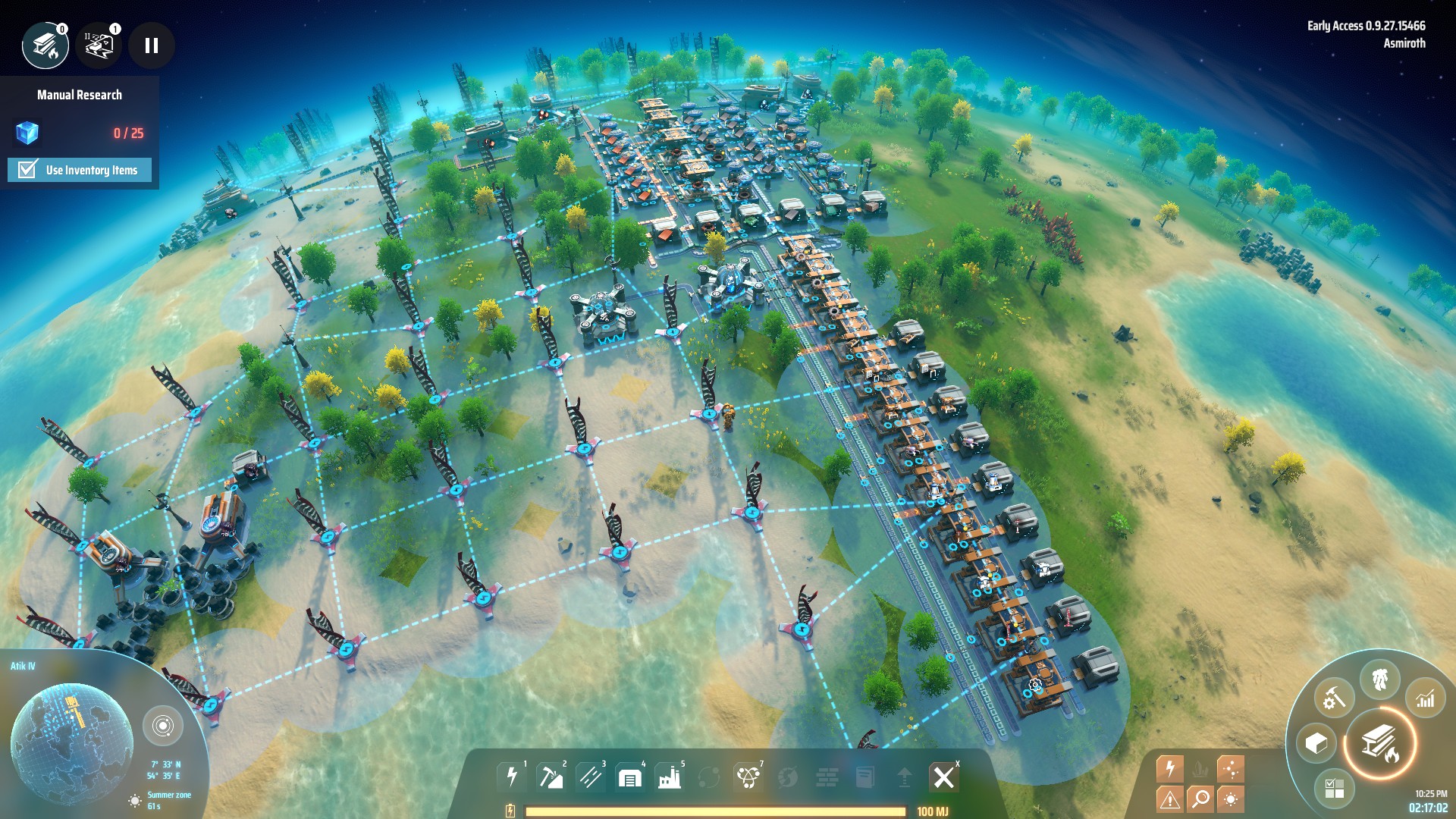
I’ll share a picture from DSP.

While there is belt ‘magic’, I didn’t really do anything special here aside from click the start location and the end location. The larger concept here is that there is a “bus” of production, which itself is a really interesting concept I’ll get to in another post. The long and short of it is that DSP has a broad material chain (more options), rather than a deep material chain (more crafting steps). The net effect is a different type of toolbelt.

I’ll only briefly touch on the research tree, where you have a tree of growth, clearly defined from your first 30 seconds in the game. Alternate recipes are automatically unlocked, and should be exploited when you can find the extra material – they are always more efficient. You unlock crafting options, and you unlock character perks that improve performance (e.g. mine more efficiently, move faster, stack more things). The latter upgrades often have “infinite” upgrade options for those that want to expand their production chains across multiple star systems.

More Thoughts…

I’ve tweaked a few more bits in Satisfactory of late and used the Smart! mod to try and help in some parts. I’ve further moved forward and unlocked every milestone in tiers 7 & 8, which effectively means all the core bits are unlocked. I’ll get to that point in a bit.

At last point, I had automated everything but sulfur and uranium, that case remains. I did add Nitrogen gas to the mix, and ran a very long pipe to my main hub as a result. This was required to get some extra milestone bits done through Blenders (hard material + liquid/gas). I’ve reached a point where time and scale are the main issues. A Manufacturer may only create 1 item per minute and that takes a damn long time to build enough to do much of anything. I’ve resorted to just letting the game run for a couple hours while I do something meaningful IRL. That builds stock levels, which allows for more construction.

Which itself is a problem because every end state item requires hundreds of items prior and dozens of sub-steps. Even the “simple stuff” is hard. More rubber? Need an oil extractor, a half dozen refineries, water, and transport. A late game item is crazy, just look at Cooling Sytems.

The recipes above are base items. Across the world are Hard Drives, which are used on a 10minute timer to unlock alternate recipes, that use different materials to create an item. For example, you can smelt 1 iron ore to make 1 iron ingot. Or, you can use 7 iron ore, 4 water to make 13 ingots – which is 2x as efficient for ore, but 9x more expensive in terms of power. Almost every recipe has 1 or more alternate options, and your choices on usage will depend on the materials you have at hand. “Best” alternates are therefore relative, though I would say that anything that simplifies Aluminum production, removes screws, or copper is going to be a good idea, if only due to the simplicity offered.

These Hard Drives are placed in containers which are 90% of the time in some sort of deadly place – poison, toxic, or on a sheer cliff. Plus they require some material and/or power to open. There are a dozen or so “simple” ones, while the rest require late-game materials and major power requirements. The next effect is that these recipes are unlocked very late AND you are placing power poles everywhere, in case you need 300MW of power to open a container. I get the idea here, rewarding exploration. The randomness of the alternate recipe just plain sucks. There are 85 alternate recipes, and many of them you won’t care about. For the math folks out there, that’s ~15hrs of RNG research timegating. Or, savescum at the start of the 10 minute counter and reset if you don’t get what you want. YMMV.

In the fun space of this, is that I needed to build a new mini-factory to output 20 Reinforced Iron Plates. I had an optimization issue in the middle of my production line and needed to supplement. To get there, I needed 240 iron ore and 15 machines. It was a good test of the Smart! mod, which aided with the foundation + the layout of the machines with a couple keystrokes. Took me about 10 minutes to figure out all the ins/outs of the mod, but the larger construction effort was cut in half. “Simple” belt management was a breeze. Stacked belts (dual+ inputs) don’t work, think I’ll need blueprints for that.

Plan A

The next milestone is building nuclear plants to generate sufficient power. I am currently consuming about 60% of my power, so if I want to build a new factory that scales, I need much more power. That breaks into steps:

  1. Collect and transport the uranium. It is incredibly toxic, and I need to ship a fair amount (~200/min) to a brand new plant.
  2. I need to build said plant. That’s over 60 buildings, which is substantial.
  3. Collect and transport the base material needed. Limestone, Iron Ore, Coal, Copper Ore, Sulfur, Water, Caterium Ore. At least there’s no aluminum required!
  4. Process the waste into Plutonium Fuel Rods so I don’t have a nuclear wasteland. That’s a dozen more buildings.

That will build 5 nuclear plants at a sustainable level of production. Yet, also build it in a way that allows for future growth. 5 plants = 12,500MW of power. The final space elevator requires 4000 Nuclear Pasta. Generating ~10 of that per minute (so ~7hrs to fill) is about 80,000MW of power needed. So yeah. Scaling.

Plan B

To start Plan A, I need material. TONS of material. Fine enough, that will take time to generate. While that is happening, I want to do 3 more things:

  1. Collect as many hard drives as possible
  2. Collect Slugs / Power Shards for overclocking
  3. Lay out power cables across the map.

Thankfully, all 3 of those are done in the same pass. There are 97 crash sites to explore, and I really only need 85. More than half have power requirements, so the power lines will be needed (and for the hover pack). Slugs are often near the crash sites, so that’s point 2 in the loop as well.

I’ve actually completed this step, which also means that for practical purposes the map is FULL of power lines. Hover Pack + Power Lines = easy vertical. All-told, this was about 4 hours of work to get through, with an external map to guide, and 3 runs for extra materials. Radar Towers tell you how many crash sites, but don’t tell you where. Now to continually research all these hard drives…

Plan C

Blueprints. I need many of them. They are small, but I can work with that. I cannot delete them, which is less fun (will work in Update 8 I hear). But to save the layout headaches I need:

  • Refinery options (there are 4)
  • Assembler
  • Foundry
  • Blender (3 input variants, 3 output variants – 9 total)
  • Smelter
  • Constructor
  • Factory floor (to run belts below)
  • Raised belt poles w/ power

These will be mostly lego blocks, and I’ll have to find a way to connect them together long term. I’ve got most created, but I need to actually test them to validate I can connect them.

The outlier is the Machinery, which has 4 belt inputs and I can only fit 1 per blueprint. I may just avoid blueprints here, but then again, I may create a below-ground belt fed one, and and an above ground version. Hmm.