
Turtles all the way down!
Ok. Not even close. But The Wandering Village(Early Access and on sale) is clearly inspired by the concepts of the world being on the back of a giant turtle, an item explored in fantasy settings for quite a while.
In this game, you travel on the back of Onbu, a large creature whose back is flat enough to live upon. The size is standard, but there’s randomness to all the components left on the back. Trees and rocks grow, berry bushes, there’s grass and dirt, and finally 1-time structures that allow harvesting material but cost “trust” from Onbu. Aside from that limited space, this is straightforward city simulator where you need people to do things, to build things, to find more people and so on. Progress therefore is limited to a) the number of people you have and b) the list of things you can build, which gets me to…
Onbu is always moving, and you have some influence on the direction at given intersections. Each path takes you through a different biome, which affects the heat/humidity/poison of the air, requiring you to pivot to different manufacturing modes. Don’t enter a desert if you can’t grow cactus to create water, for example. Onbu gets hungry, tired, and sick… and your job is to manage that aspect through either the directing him to safe places, or feeding/curing him. Also, in each biome, you can see objects of interest that provide you basic resources, special resources (iron/sand), more people, or possibly research points. You need all of this, meaning you are always incentivized to take challenges.
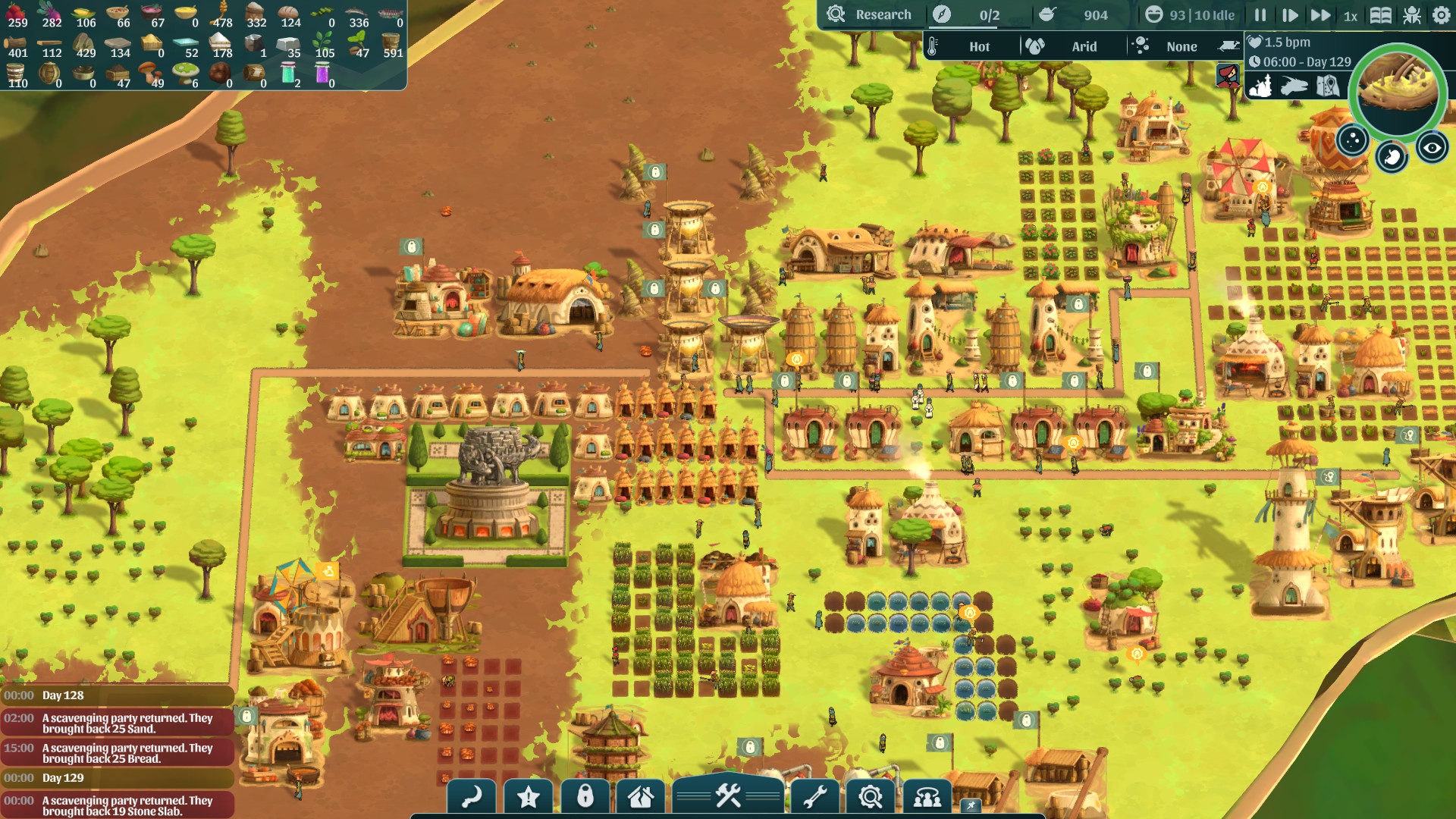
The game adds complexity through layers of difficulty. More people increases their types of needs to keep them happy. More biomes means more types of food and water generation. Poison means lot of doctors and eradicators to prevent massive outbreaks. Aside from basic items, most research requires research points, which are extremely limited. Generally, the pace of increased difficulty is well balanced. Is is possible to make a choice that kills you?
Sadly the answer is yes, and it’s entirely predicated on research. There are items you NEED and items you WANT. You simply cannot survive a water biome is you don’t have the ability to collect and clean sea water, which itself required the ability to make glass from sand, which comes from a desert biome. The Glassblower is deep in the research tree and it really isn’t clear why you need it until it’s clear you do. No water = no crops, so you try fishing to make food… well it so happens that also requires research points. And that’s not discussing the items that are double gated – such as a wheat windmill and bakery, where you can entirely unlock one and be a couple hours from unlocking the next, making it useless. This can be addressed through a re-balancing of research to be biome specific and tiered. Instead of paying 3 +5 +5 points to unlock 3 different things, you pay 13 total to unlock access to all of them (still requiring time to research them).
The only other gripe I have is towards population needs for housing + decorations. There are 3 types of housing, with different population benefits (#): tents (2), huts(6), and cottages(4). The resource requirements for cottages are VERY high and non-renewable, making them a poor decision in every respect. It is cheaper, and provides more benefits in all respects, to build 2 huts than to build 1 cottage. Which ok, is easily fixed by swapping the population benefits. The decorations part though, it takes 15 research points to unlock the “good” ones. These points are extra rare and worth much more for survival. The net effect is that you will never place decorations, guess it’s a system to be developed further down the road.
Total time for a given playthrough is about 8 hours, which I think is quite reasonable, and I never found that I was “waiting” for something to happen, which is a very tough balance to achieve. Replayability is primarily through additional difficulty modifiers, or I guess trying for an optimized run where you are able to better plan from the start (e.g. people never need to walk home, but walk all the time for food). The ideas here are impressive, and it’s pretty clear that there are only 2 major patches left to go, which should mean “official launch” in late fall 2023. If you don’t get it now, it certainly will be worth it then.
 Leo's Life