F.I.S.T.

I like Metroidvanias. I enjoy their puzzle like construction, the incremental power, the build variety, and the rewards for precision. Hollow Knight is right at the top of my list, just an all around amazing game from end to end. Bloodstained, Ori, and Blasphemous are up there too. Metroid Dread is good. Even the indie versions, like Gatto are a decent play as they focus on a specific aspect and go from there.

F.I.S.T. is a game from a smaller gaming developer, using Unreal Engine to try and capture the Metroidvania spirit. You play an anthropomorphic rabbit with a large metal hand attached to your back, on a McGuffin quest. I say smaller because while the game does look good (Unreal will do that) there are some polish pieces missing. I picked this up for free from EGS during the holiday event.
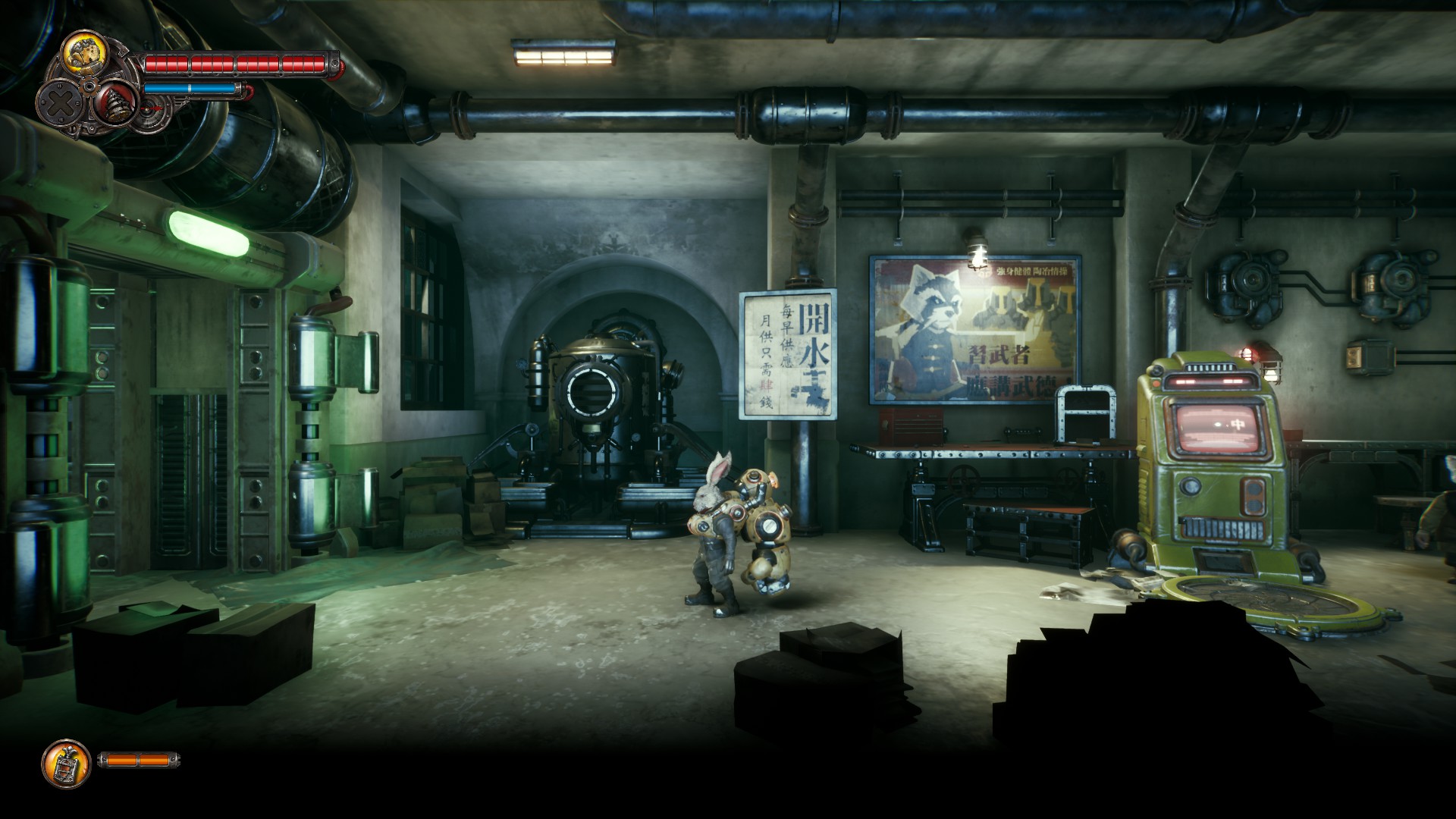
There is a substantial amount of detail in every screen

I’ll go over the items I think are essential to the genre:

Puzzles: There are secrets here, lots of backtracking based on new skills/abilities, and new movement abilities. Backtracking / shortcut doors are quite common. I’ve yet to unlock any type of fast travel, but given the size of the map I have to assume it’s there. On that, the map is very large and windy. While you unlock a dash very early, traversal feels laborious.

Incremental Power: You have a skill tree that improves your weapon combos. You don’t actually hit harder exactly, you just unlock new button press combos for say an extra swing or such. This does mean that even the starting enemies still take the same amount of hits later on. For shorter games, I don’t mind. The weapons themselves you unlock have different aspects… one is pure melee, another AE, another for mid-distance attacks.

Build variety: This is a tougher one, because I enjoy multiple playstyles. Metroid Dread doesn’t have this and it’s a major annoyance to me. F.I.S.T. ‘s variety is based on the 3 weapon types and your preference. The skill combo unlocks are only based on damage. It sort of works here.

Precision gameplay: After you play through the White Tower in Hollow Knight, you will understand why this is important… and this is where F.I.S.T. generally disappoints. The world in general feels “floaty”, where gravity doesn’t really exist unless it needs to. Hitboxes are oddly designed and not related to what you see on screen. All attacks have an AE component and your lack of mid-air controls makes its very hard to be precise. Staggering appears to be random, and there are no i-frames or cancel-out abilities. You press a button and you have committed to that movement occurring – the enemy too, meaning that either you hit first and they die, or you take damage. For normal enemies this is an annoyance… for bosses, this means death. You can certainly complete most bosses with zero damage, the mechanics are simple enough. But there are no rewards for playing accurately, which is quite fascinating to me.

F.I.S.T. is an interesting game, with some interesting choices. The map in particular is simply too large with too much filler. The precision puzzles lack the controls to feel rewarding rather than simply lucking out. Combat feels slow and random, with the same enemy types throughout. If you can get this for like $5-10, it’s an interesting distraction. It will also remind you that there are much better Metroidvanias out there, for the same price.
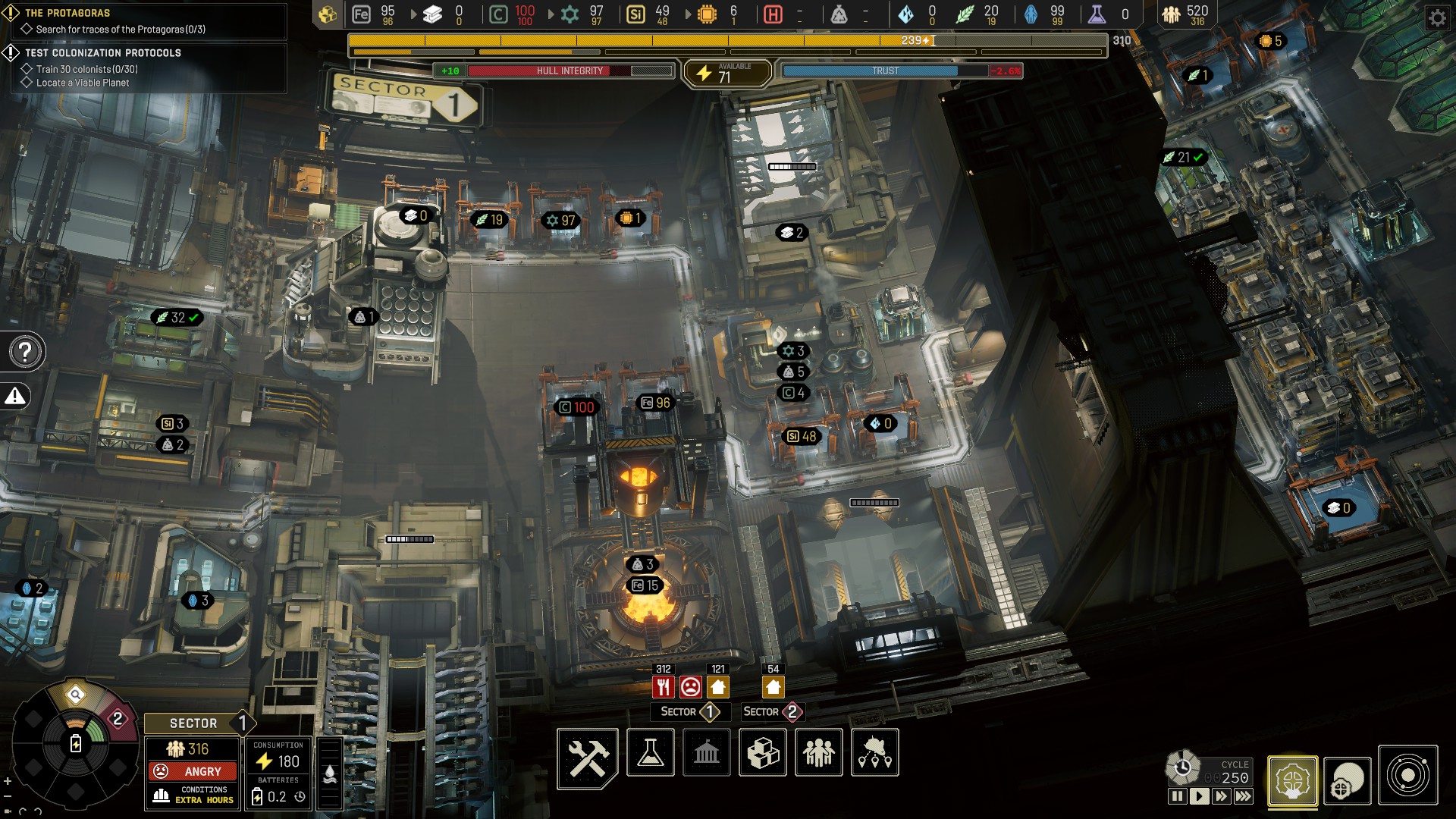
Cascade Failures

I’ve been pushing a tad more in IXION, and I keep hitting walls – literally in some cases. When you truly start the game, it boldly announces that you have a 6% chance of survival. Quite true.

This is a game where you’re consistently managing failures, but the tools to manage them are scarce. Resources are limited, but the goals of the game require a rather substantial amount of balance to keep the ship going forward.

For example, in order to complete the first act (not the tutorial), you need to collect 500 cryo pods. These are containers with frozen people in them. You don’t need to thaw them, just hold them. You start this act with around 100 people on board, and in a broad sense, the resources to feed/house twice as many. These people also have continual request from you, such as constructing a new building, or repairing an item. These tasks rarely have any strategic benefit… building a 3rd of a building will keep you off balance.

Completing this task in time gives trust, failing to do so lowers it. As long as you are balancing resources (not tasks), you should be gaining positive trust. If you fail to balance, you lower trust. 0 trust, game over. Ignoring the task has zero consequences – so you learn very quickly to ignore tasks. The reward for the task (a temporary boost) does not at all compensate for the loss of overall economy balance. In the case where you actually need to gain a boost of trust, your population is probably half on strike, you’re low on resources, and it’s nearly impossible to complete the task at all, making it a double negative. It’s unfortunate because this could be an interesting part of the game, but as it stands, the risks exponentially outweigh the gains.

Back to the cryo pods. Now, if you have too many people and not enough work (the only item you can overproduce is food, everything else is restricted), trust goes down. It’s simply not possible to have enough work for everyone. For every person you have, you need to house them. The basic building houses 15… so the math isn’t in your favor here to house 500. Not enough housing, trust goes down. If you have more cryo pods than you have people, trust goes down.

I should add that the space limitations are managed through opening new zones. Each zone you do open though, increases the stress on the hull, increasing your need for resources to repair it. You can open 1 extra zone in the first act and get through. Open a 2nd and you will be on very thin ice, with limited tools to balance the next failure.

Access to better buildings and housing is behind research. The housing requires level 2, which can only be acquired after you have collected the 500 pods due to an in-game event. What this effectively means is that you are forced into a failure state, and given a very limited set of options to proceed. A set of options that you are not aware of until the failure occurs.

You can construct specific buildings (which take space and resources) to boost trust. You don’t need these buildings if things are going well, and space/resources are scarce enough that it’s frankly seen as wasteful. Like buying a snow shovel in a city that has snow once a year… you can get through that day.

You will likely reach the point in act 1 where collecting these cryo pods works, and things are balanced. You will also reach a phase where there are too many cryo pods and you lose trust. Then a point where you have too many people and not enough food/housing. Then not enough resources to build new housing, or the necessary research unlocked to build the thing that fixes the problem. Then trust will dip. Then they will go on strike and stop producing the things you need (like food, which *blows mind* is so dumb). In 10 minutes you’ll go from a super content and balanced population to a cascade failure that you just aren’t equipped to get out of.

And then you’ll get a task requesting thawing more people.

I am super into games where there is an optimal way to play… I am less into games where there is only one way to play. IXION without doubt has an optimal way to play, but it also has a very narrow window of successful options. I am sure I can get into the right mindset to crack this nut, bu holy macaroni is it not today.

The Carry

A tale as old as time, and one that can be hilarious or frustrating. All multiplayer games have this, even board games. There are those that have a passion for the meta and those that are checked out. When success is determined by the whole, then this can lead to friction.

In challenging content, the group enters with an understanding that each member needs to bring something to the table. Top-end raiders need the best gear, potions and strategies. Many games avoid any random group generation for this, as the skill levels are next to impossible to figure out… or if they do, then MMR is the way to do so (with accompanied gripes.)

In non-challenging content, the group rarely has any understanding and there are opportunities to simply check out. Especially if the content is repetitive and seen as “filler”. Maw runs from WoW/Legion were a good example. FF14 MSQ (pre 6.1) was the same, where cutscenes were 3x as long as the actual content. The interesting bit is when randomness is applied to the challenge.

FF14 has a random group finder for raids. Raids that are scaled down to a given level. Some raids are extremely under-tuned so that you really don’t have to pay attention to anything. Others have 1 shot mechanics that require group coordination. Access to these events is gated through the main quest, so it is entirely possible to have a first time player surrounded by veterans.

While not a challenge to spot the AFK players, it can be hard to tell the difference between a new player or a troll. The sprout icon (indicating less than 168 hours, or not having completed Stormblood) is sometimes an indicator, but unreliable. Hell, there are times where you simply forget the mechanics because there’s just so much frigging content to begin with! There are 13 Alliance Raids, and over 30 Leveling dungeons…that’s a very absurd amount of content to remember.

FF14 doesn’t support mods like other MMOs do, and it doesn’t have meters either, giving a much more cooperative approach to content. Mythic+ runs simply do not exist, which is a glorious thing for the social glue of the game. In the 10 years I’ve played, I’ve seen less than 10 vote kicks total. Lucky if I saw less than 10 in a week while playing WoW.

Now, that’s not to say that I didn’t need to adjust my own expectations here. Moving from the go-go-go mindset into a more relaxed approach was jarring. I had to re-evaluate why I was playing, so that the journey was as valuable as the goal. That a 5 minute delay (if that) doesn’t matter. That if the tank did go LD/AFK, that the group honestly could still progress rather than fully stall. This mindset doesn’t apply so much to the end game crowd exactly, as the purpose of the game when all your classes are 90 is way different, but for the core game it slows it down just the right amount. Enough so that people generally have ample patience with “slower” players, where info is shared and bad puns.

And when the stress levels drop and you have more opportunities to chat with players, it tends to make for a much more pleasant environment. I’ve got enough stress in my day to day life, no reason for gaming to be one of them.

IXION

Frostpunk may be my all-time favorite city builder. It provides you with a limited set of tools, a near constant set of cascade failures, really tough choices to make, and the tiniest spark of hope throughout. That balance between the edge of control and the edge of failure is what makes the game superb. And it’s success certainly pushed for imitators.

IXION is such a game. The story is simple enough, the future of humanity is focused on an ark of sorts, that is on a space journey. The challenges are also cascading, with balance a constant battle. The tools are your disposal take a while to uncover, and some decisions can massively hamper your progress… to the point where save scumming is a running thought.

The start of phase 3

Space to construct is limited, and each building has a specific set of location needs. Build enough of a type of building and the sector (of 6) becomes specialized, providing a bonus. As with most games of this genre, small percentages have large impacts, so you are likely going to want to specialize.

Resources are scarce. You can find more people in frozen capsules – which feels really weird when you population quadruples somehow. These people need food, shelter, work… and if they don’t, then you start to lose trust, which causes a mutiny and game over.

The ship you are in is in continual decay, and each mission makes the damage greater and harder to repair. This means a constant drain on resources, and intelligent use of time as there are periods where you have to stop repairs to improve power generation, or move the ship. Oh, and each sector you unlock also adds to decay.

Research is both hidden in layers, and difficult to progress. Each “zone” has a limited amount of research points to collect, effectively giving you a soft-wall of progress and forcing you to move, and therefore increase difficulty.

Combined, as is the genre, you can be going along smoothly, only to encounter a massive cascade of failures because one small piece stopped working. Like collecting iron… which repairs the ship and helps construction, which generates housing, which causes trust and decay to increase, and that’s the end of that run.

I do enjoy the logistical challenge of keeping resources balanced between sectors, and overseeing the various needs of the population. That said, I also think there are some balance passes required in how they interact and how they are set at default. Logically, the system should default to complete balance between the storage in each sector… but it doesn’t. Food created in one sector won’t move to another unless you set up that swap… which caught me off guard and caused a rather negative event.

I also enjoy the compounding complexity of various decision points, where you can have a general idea of how something will help you in the future. Some of those decisions are very obtuse… like research for items you won’t be able to use for a very long time. Given the scarcity of some resources, it makes it so that there’s an order of priority that simply is not evident on your first playthrough, and little grace for those types of mistakes. I will point that each chapter requires a very long process to complete, which not only feels like padding, but is likely to generate additional challenges. Like how collecting 500 cryo pods creates discontent as its faster to collect than thaw… Discontent that increases accidents and deaths, making it spiral.

I’ll also point that the pace of the game is rather odd, with random acts of sabotage that you can do absolutely nothing to prevent, and that can hobble you substantially if you’re in a balancing act. They act as time padding, preventing progress for the sake of making the game longer. The rate of accidents increases substantially as happiness decreases, which happens when there are accidents.

I will point out that some decisions you will make can have dramatic consequences down the road, to the point where you won’t realize it until it’s too late. Some mission options have catastrophic consequences, so that you’re better to save scum that hobble through. Some sector construction layouts (in particular around things requiring external walls) can be disastrous… to the point where it’s better to revert to a save an hour+ ago than to rebuild. In a “normal” city builder, you are not continually facing failure, just delays. In here, to a stronger degree than I was expecting, a single bad decision can be enough for a game over.

These are quality gripes, and I can only see them because I’ve been fortunate enough to play Frostpunk. If you’re coming from something like Surviving Mars, then you may not notice these smaller bits. The pace and impact of decisions, in particular hitting massive milestones that alter the gameplay, are key to these types of games. If it’s just continual fire fighting, then that loses appeal quickly as you run into the next fire before the last is put out. IXION straddles that line, and doesn’t always have that work out. For a game that’s been out a month or so, this is super normal and balance passes are part of the deal. I’d still recommend the game in its current state, but can only imagine how amazing this game will be with a few small tweaks. All the pieces are here.