Let’s Talk Hades

There are a handful of game companies where I buy all their products, they are simply that consistent. Supergiant Games is one and Hades is no exception to the trend.

Incrementals/Roguelikes are all the rage. That does make sense, since developers make smaller packages and re-use it for dozens of hours of content. Assassin’s Creed recycles a ton of content, but it still adds small tweaks to the layout. Clearing that last fort on the map isn’t much different from the first one, it just happens to be on a hill rather than a bay.

A pure roguelike doesn’t allow for increments between plays, it expects the player to learn how to get better over time. Pure incrementals allow for the player to choose when to reset, and then provides some boost to the next attempt. You can find hundreds of these in mobile apps.

The merger between both is a challenge in terms of balance. You want there to be a cap to the increment in player power, but not so much that the game over screen never is a possibility after a few attempts. Conversely, you want the increments to be valuable so that people can “beat” the game. Tricky math, and as a general rule, players are much smarter than developers in that regard. Slay the Spire and Dead Cells are two recent examples of games that hit that just right.

Hades has more in common with Dead Cells, but focuses less on exploration and more on intense combat. The best Dead Cell runs simply blow through looking for specific drops. Hades forces you to clear everything in a room before giving you options as to the rewards in the next room. It’s hectic action with a period of respite afterwards.

Mechanically, the game has multiple levers to increment both the power of the player as well as the difficulty. It took me 17 tries to beat the final boss, and that first win had much less to do with the power increments than it did with my knowledge of the game.

The real beauty in Hades is the setting. Every character you talk to exposes more of the story, but only 1 conversation at a time, and often only after you die. And they are solidly written and drawn. Each one has their own motivations, slowing lifting the fog of the game as you progress. The friendly competitions with Thanatos, or great cooking of Eurydice are high points in the mess of tons of enemies. Even the bosses have dialogue that they expand upon after previous victories/defeats.

It’s easy to lose a couple hours to runs, a whole bunch of “one more turn” of old. Dying never feels like punishment, cause you’re always getting something from a run. And you never really feel cheated along the way, because you have more control over the room rewards than the high randomness of something like Slay the Spire. And once you beat the final boss, a whole new aspect of difficulty opens up, with a level of granularity that isn’t common in games.

And with any game of this nature, speedrunners are going at it. See video below, which took about as long for the whole game as it did for me to clear the last boss on my first attempt.

That’s fast.

An amazing game. Well worth the pick up. I’ll have a future post on some strategies I’ve found over many failures.
The Gacha Connumdrum

Free to Play is a lie. It really means “pay what you want”. It’s a more effective business model because 1 whale can compensate for hundreds of freeloaders, and in 99% of cases, the games are predicated on sheep for the wolves.

As a guy, there’s this interesting thing about being buff or having a suped up car. When you’re younger, you think these things will impress potential mates. As you grow older, you realize that the only other people who care are other males. The intended audience is in fact not the true audience.

F2P games are not made for me, they are made for whales. The largest incentive for whales is showing off how much of a whale they are, yet they need an audience for it. For PvE games, you would think this is cosmetics (it can be sometimes), but it fact it’s ladders. A smart developer will include the ability to view a character from the ladder… then you see cosmetics take a whole other meaning. PvP games are somewhat similar, but now we’re really talking sheep vs. wolves. I am not dismissing the talent that top level players have, but they need targets to practice. And those targets needs targets, and so on.

In both cases, there’s a feedback loop where the bottom of the pole sees the top and has some incentive to say “hey, they did this with X, I should buy X too!”. The monetization model is simple on the surface, but can get extremely complex as more and more systems are developed. The kicker here is that eastern developers have figured this out a while ago, and they have practically perfected it. Puzzles and Dragons is probably one of the most popular ones, and it’s 8 years old.

Which leads me to Genshin Impact. The bait of the game is amazing, I only hear positives. There’s a lot of good content until AR30. The money aspect up until then is mostly around wishes – loot boxes for characters and gear. It appears optional since progress is so quick. The switch that occurs past that point is that the fun things people were doing are now time gated (bypassed by money or waiting a day for resin to recharge). There are hundreds if not thousands of other games that use this exact same business model of energy / loot boxes (who hasn’t seen Raid ads on mobile?). Genshin Impact is different in that it looks amazing, is multi-platform and does an ok job on multiplayer. It’s lipstick on a pig. Nothing wrong if you like pork, but there’s no sane argument that it’s not pork.

All of this and I didn’t even get into the moral aspects of supporting a Chinese company. I’ll leave that to smarter folk.

I will end on saying I’m happy folks are enjoying it for the time being. Dollars to donuts it crashes before end of calendar in the west. As much because it’s a gacha game, compounded by our infinitely small attention spans.

Quality Time

I have a saying in that there’s no such thing as quality time, there’s just time. Coffee mug no less. Often gets quizzical faces. The concept is that if you only think about quality time, you’re missing out on all the rest. And the rest is often the best part.

The best conversations I have with my wife aren’t set up at a pre-ordained time, they are off the cuff. Getting my kids to open up isn’t based on perfect conditions, it’s just all of a sudden the verbal diarrhea comes out and you need to stop what you’re doing.

That said, it’s not about sitting on the couch and expecting these moments to just happen. Serendipity happens when you’re doing something else after all. With a whole bunch of time on my plate with work on hold for the past few weeks, I opted to pick up some new activities. I wrote earlier about Ghost of Tsushima (get it!), but there’s a lot of hours in a day. (Side note, one of the symptoms I have is severe exhaustion.)

In March, my wife picked up a pile of paint by numbers to tide the ways. We didn’t really pick it up then, but I certainly did in September. I have some good memories of it as a child, but it’s certainly more complex today, what with better paint, brushes, and technical knowledge. We have a few different brands, and I have to say that Reeves is by far the best one. Paint is solid, the brushes are quality, and the art itself is nice. I’ll have a shot up once I’m done my panda. I’d say I have about 20 hours or so in it now. It’s good to just sit, have a coffee, and have a chat with people around the table.

Spurred by a friend who dropped off a care package, we finally purchased an ice cream attachment to our KitchenAid stand mixer. I really love baking, and ice cream making is pretty close to it. It took a few tries, but I found a recipe that provides a consistent base to build from. Gave a shot at some chocolate peppermint, and some vanilla butterscotch batches, and I am more than impressed. The challenge is in making the stuff last. It puts a smile on the face of everyone who eats it, so it’s certainly worth the time.

Exercise is also a key fact of life for me. With the inability to play/coach hockey, I still need to move. This summer was incredibly hectic with cottage repairs and way too much office work. I started up again (and dropped alcohol for September) to kick start the metabolism. I have a good program that I follow, swap a few things here and there. Less than an hour and I’m done the set. Doing this while my kids are around has them doing some too. Wife has gotten back on it as well. Nothing to do with getting big, but all to do about feeling good. Being able to shoot some hoops with the kids, pick them up, dance a bit. I love games, but there’s a time and place for them too.

So the month of September was all about taking time to do things I enjoy, and sharing that with others. And conversely, taking time to do things others enjoy. For all the negatives that September has brought, it’s also brought a whole lot of good. Thankful for that.

Ghost of Tsushima

At the end of August, my MSI laptop had 5 dead keys on the keyboard. No idea how, or why, just dead. 6 weeks in the shop to get it both replaced and working – finding the part was hard enough, and the ribbon was wrong, then thermal pad issues. I decided to pick up Ghost of Tsushim on PS4 given the rather high marks. I was not disappointed.

First the less than good news, it’s an icon-filled map of activities. Some more traditional (clear a camp, find a thing), others less so (write a haiku, cut bamboo). The good news in this is that you can (and should) play the game without concern for any of it. It has some cosmetic purpose, and whatever power increments you do get, are exponentially scaled. So you get like 75% of the benefits 30% of the way in. By just playing the game you’ll come across all you need (and there’s a golden bird that pops up to bring you to some too). Ubisoft this is not.

The better news is the combat mechanics. The start of the game focuses a lot on stealth and archery – for good reason. They are efficient from start until end, and a 3 person chain assassination never gets old. Sadly, the enemy AI is not able to figure out rooftops. And standoffs sound and look cool (super cool), but the risk/reward factor is out of whack. As you improve both your passive skills and your awareness of the game (and enemies become more numerous), it becomes better to wade into the thick of things. The end of act 2 in particular has a massive battle that feels like an martial arts movie in choreography. The choice of parry or dodge impacts your counter-attack. Your stance impacts your effectiveness against opponents, think a rock-paper-scissors type of thing. There’s a hidden complexity behind it all that allows for masterpieces of combat to show up. My eldest daughter was able to pick up the “dance” after a few tries, impressive to watch.

The other game mechanics are simple enough. Climbing is straight out of Uncharted, including rope throws. Horse riding just works. Friendly NPCs always move at your speed – why is this not the case everywhere nowdays? Gear upgrades are based on materials found across the game, though in sparse quantities you’ll unlikely max everything until near the very end.

Continuing on the good news is the quest mechanic – or Tales. There are 4 kinds – the main quest, the supporting characters, the legendary ones, adn minor quests. Even the minor ones are voice acted and have some interesting bits. The legendary ones are essentially chasing skills and armor of legend, told through a really neat story mechanic. The mountain one in particular is really well executed. There are a half dozen supporting characters, each with their own arcs. About a dozen quests each and they explore each person’s failures and redemption. They are amazing. The main quest is solid in it’s own right, but doesn’t hit it’s stride until after the 2nd act. The main bad guy is a decent villain – ruthless and intelligent. The final mission…jeeeeeebus is that solid. Feels like the game was pitched with that 1 quest in mind.

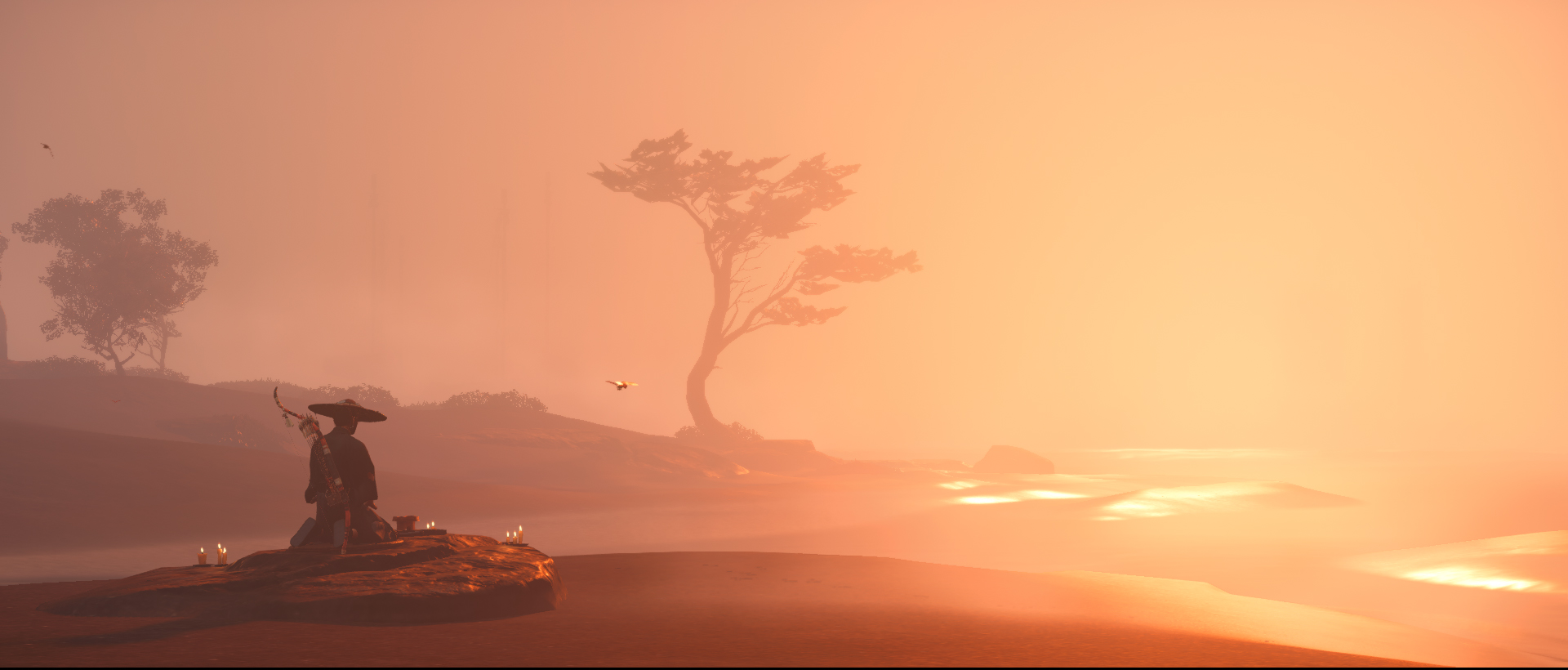
Now for the best part, the presentation. The game looks and sounds like a dream.

Words really cannot do this game justice. PS4 has done an absolute stellar job at world building this generation and this is without question my favorite one of the many great examples. You can even turn on Kurosawa mode, which changes the display to a grainy black & white view for a crazy feeling of the old movies. I found myself stopping for more than a few times just to enjoy the visual feast. Also a great reason to complete the haikus, which force you to stop and smell the roses.

My daughter and I completed the game, all map icons, most cosmetic collectibles (not flowers, records, artifacts, or banners) in about 50 hours of play. A solid 10 of those were just exploring the map. I played with Japanese voice over and English subtitles. An absolutely amazing game from start to end.