
As per the prior post, I don’t tend to pick up ‘premium’ games at launch. In many cases I end up waiting for a promised DLC to launch, as that often comes with a major balance patch. Think about Diablo3 pre- and post-RoS. Completely different games. Rogue Trader fits this model.
It’s a CRPG, which more or less means it’s like Baldur’s Gate. You control a party of characters who go on a very long set of quests, see stats go up, and make character defining decisions, almost always in an isometric-type view. BG3 pretty much perfected this model and everyone has been trying to find a niche along that path.
Now, Warhammer40K comes with baggage. It’s a world of constant war, where everyone is a shade of evil. If you look at the D&D alignment model, there is no good, there is no neutral. The Imperium (where you reside) is lawful evil. Anyone who says otherwise doesn’t understand satire. You play the titular Rogue Trader, a sort of vanguard to the imperium, conquering newly discovered planets, and building a financial empire. If you see it, it’s yours. Thankfully, no spreadsheets to manage here. Along the way you’ll collect a slew of party NPCs that fit various classes and backgrounds. Deluded space wizards, gun toting priests, deranged blood worshipers, and so on. You start off inheriting a part of the galaxy and need to stabilize it. Along the way, ‘bad stuff happens’. You can be dogmatic (be lawful evil), heretical (chaotic evil with space madness), or an iconoclast (which is frankly more pragmatic than good). Now, CRPGs in general prefer an iconoclast approach and first time players are going to see more here. Heretical is hard mode. Dogmatic makes sense about 20% of the time (e.g. purging a planet that’s converted to madness), and dumb the rest of the time (e.g. an ally offers you their services for free and you shoot them instead). The writing is thematically aligned to 40K, very lengthy and full of complicated terms. It works.
Quickly, the companions here are well done and thematically resonant. They have very little interaction between them, but their individual perspectives and side quests are all quite interesting. Who you bring along on the journey is personal choice, unless you’re on the hardest difficulty.
Mechanically, the combat is a bit of XCOM (with action points + cover) and BG with various skills. It’s often your team of 6 against a dozen or more enemies. AE attacks and multiple single target attacks per turn are key. Generally, this works well. More in a bit, but there reaches a point where compounding levels and skills make you effectively run in god-mode with some crazy OP builds. It can get a bit much and overly complicated, but it works.
Inventory is weird. Still trying to make sense of any of it. Your bag will be filled with generic items that have a 2-5% stat difference… but they have a very big integration with skills. Heavy Bolters may deal less damage on paper, but with the proper build they are infinite bullet machines. Keeping track of all of this is complicated, not to mention actually finding items that fit a build. YMMV.
The stats and builds though, that is a friggin’ mess. Every level you’re given a set of options, often 30 or so, that you can select from in a list. A list! You can’t easily see dependencies or syngergies, and each one of them practically requires you to scroll to read the definitions. On the one hand, congratulations on having so many skill options! On the other, you can see how this is practically impossible to balance. I keep thinking of Path of Exile’s skill tree and build options, it’s just so much. Min-maxers will love this, but it is absolutely a challenge in terms of broader appeal.
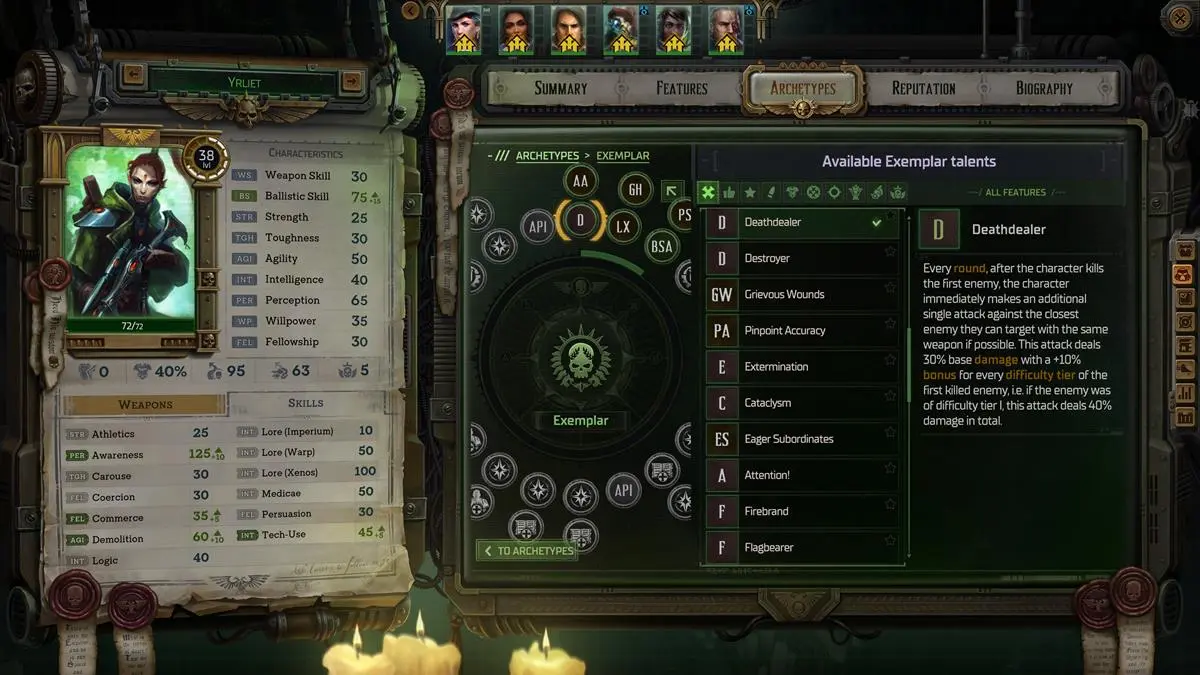
Side note, you remember the D&D issue with quadratic growth for mages? In that a warrior hit very hard and was sturdy for a few levels while a mage was a wet tissue, and then they acquired a few tier 4 spells and turned on god mode. That model is here too. Melee is dramatically limited in damage and movement by the mid-point. Ranged AE attackers can clear an entire field with multiple tools and turns. I mean, I still love the bladedancer cause they can decimate 5+ weaker enemies in a single turn and it looks damn cool. I can also shoot an arc rifle at the same group and AE them all for triple the damage, then get another free shot for the next group on the other half of the map.
There are a multitude of other systems in here that work at various levels. Space combat is meh. Space exploration has overly complicated (but absolutely nails the thematic pieces). Merchants are amazing, where if you have reputation with them and a given ‘profit factor’ that measures overall wealth, you simply by the thing. I really like this model.
Is this game better than BG3? No, and it’s not trying to be which is actually refreshing. It can easily take you 100 hours to get through a single playthrough, and very few games ever offer that these days. Replay value is iffy, as it’s less about build diversity than story choices. Well, I guess that particular statement is a matter of perspective with so many skills to choose from. Still, the question boils down to…
Is it any good, and is there value? An absolutely emphatic yes to the first part, the game is quite good. It has quirks and leans heavily into the theme, and frankly may be the ‘truest’ 40K game out there as a result. Value is subjective, but consider this – it’s 100hrs of content, with voice acting and quality writing throughout, it has meaty DLC, and is on a banger sale. I think there’s a lot of value, and I am rather picky on these sort of things.
 Leo's Life